
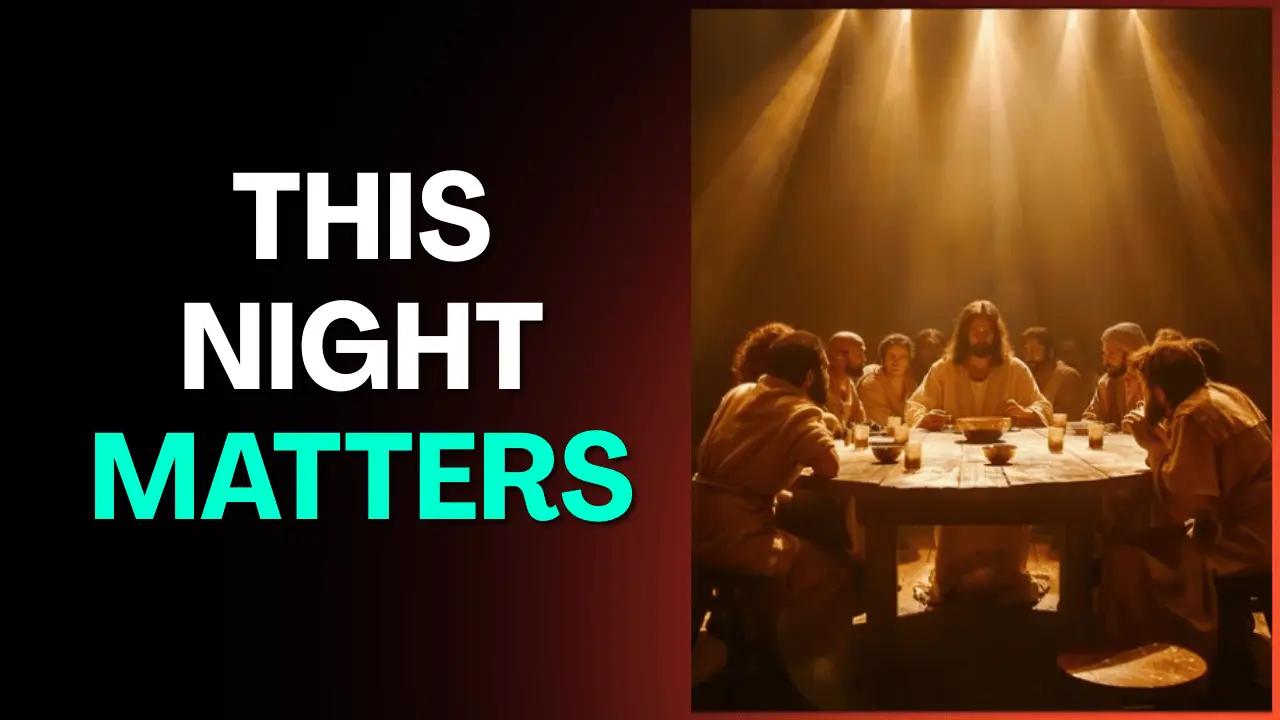

The Last Supper was a Passover meal according to the clearest reading of Matthew, Mark and Luke. The disciples prepared the Passover, Jesus described the meal as “this Passover,” and the gathering took place during the appointed Passover period.
John’s Gospel, however, uses several expressions that appear to place the Jewish Passover meal after Jesus had eaten with His disciples. This creates a genuine chronology question, but it does not automatically prove that the Gospel accounts contradict one another.
Several explanations can account for the different wording. “Passover” could refer to the wider festival rather than only one evening meal, John could be using “Preparation” as the normal name for Friday, or different Jewish groups may have followed different calendars.
The exact solution remains debated. What remains clear is that the Last Supper took place within the Passover setting and that Jesus deliberately connected His approaching death with Israel’s great celebration of deliverance.
Was the Last Supper Really a Passover Meal?
Matthew, Mark and Luke strongly present the Last Supper as a Passover meal.
Matthew 26:17 records the disciples asking Jesus where they should prepare the Passover. Jesus then instructed them to go into the city and prepare the meal. When evening came, He reclined at the table with the Twelve.
Mark gives almost the same sequence. Mark 14:12 identifies the day when the Passover lamb was sacrificed, and the disciples asked where Jesus wanted them to prepare the Passover meal. They followed His instructions and prepared it.
Luke provides the most direct wording. Luke 22:7 says the day came when the Passover lamb had to be sacrificed. Jesus sent Peter and John to prepare the Passover, and He later told the disciples:
“With desire I have desired to eat this passover with you before I suffer.”
These statements make it difficult to treat the meal as an ordinary dinner unrelated to Passover. The Synoptic Gospels intentionally use Passover language throughout the preparation and the meal itself.
The most natural conclusion from Matthew, Mark and Luke is that Jesus and His disciples understood the gathering as their Passover meal.
Evidence From Matthew, Mark and Luke
The Synoptic Gospels provide several details that support the Passover identification.
First, the disciples did not merely prepare a room or arrange an evening meal. They specifically asked where they should prepare the Passover. The repeated wording establishes the purpose of their preparations.
Second, the timing appears connected with the sacrifice of the Passover lamb. Mark and Luke both mention the day when the lamb was sacrificed, placing the meal within the expected festival sequence.
Third, the gathering began after evening arrived. Jewish days were counted from evening, so the meal could take place after sunset while belonging to the next calendar day in Jewish reckoning.
Fourth, Jesus explicitly called the meal “this Passover” in Luke. That statement provides the strongest direct evidence because it comes from Jesus’ own words within the narrative.
The meal also included details consistent with a Jewish festival gathering, including reclining at the table, shared bread and cups, a dipped portion of food and a hymn sung before the group departed.
None of those details alone proves that the meal followed every later Passover tradition. Together with the direct Passover language, however, they reinforce the Synoptic presentation.
Why John’s Gospel Appears to Give a Different Timeline
The difficulty comes mainly from several statements in John.
John 13:1 introduces the upper-room events with the words “before the feast of the passover.” A straightforward reading can sound as though the meal occurred before Passover began.
John 18:28 creates an even greater question. When the Jewish leaders brought Jesus to Pilate, they refused to enter the governor’s residence because they wanted to avoid ceremonial defilement and remain able to “eat the passover.”
If the leaders had not yet eaten the Passover, some readers conclude that Jesus’ earlier meal with the disciples could not have been the official Passover meal.
John 19:14 then describes the day of Jesus’ sentencing as “the preparation of the passover.” John also emphasizes that the day following the crucifixion was a special Sabbath.
Taken together, these statements can make John’s timeline appear one day different from the timeline presented in Matthew, Mark and Luke.
The Synoptic Gospels seem to place the Passover meal before the crucifixion. John can appear to place the Passover meal after Jesus’ arrest, with Jesus dying as preparations for Passover continued.
That apparent difference has produced several major interpretations.
Does John Contradict the Other Gospels?
John does not necessarily contradict Matthew, Mark and Luke. The different expressions permit more than one interpretation, and each proposed solution must account for the language used in all four Gospels.
The tension should not be hidden or dismissed. John 18:28 genuinely sounds as though the Jewish leaders still expected to eat something connected with Passover. At the same time, Matthew, Mark and Luke unmistakably call Jesus’ meal a Passover.
A contradiction would exist only if the Gospel writers used every Passover expression in exactly the same narrow sense while assigning the same event to incompatible dates.
The word “Passover,” however, could describe more than the main meal. It could refer to the Passover sacrifice, the opening night, additional festival offerings or the larger celebration that continued through the Feast of Unleavened Bread.
The question therefore becomes whether John refers to the main Passover meal or to another observance within the wider festival.
Explanation One: Passover Can Mean the Entire Festival
One common explanation argues that John uses “Passover” for the broader festival period rather than only the meal eaten at the beginning.
The Passover celebration and the Feast of Unleavened Bread were closely connected. Biblical writers could speak about them together as one festival period lasting several days.
Under this interpretation, the Jewish leaders in John 18:28 may already have eaten the main Passover meal but still wanted to remain ceremonially clean for another festival meal or offering.
Their desire to “eat the passover” would therefore not prove that the opening Passover meal remained in the future.
This reading allows the Last Supper to remain the Passover meal described by Matthew, Mark and Luke while understanding John’s words as a reference to continuing festival observances.
It provides a reasonable harmonization, although the verse does not explicitly identify which later meal the leaders intended to eat.
Explanation Two: “Preparation” May Mean Friday
Another explanation focuses on the expression “the preparation of the passover” in John 19:14.
The word translated “Preparation” became a common way of referring to Friday, the day when people prepared for the Sabbath. John 19:31 also connects the preparation day directly with the approaching Sabbath.
Under this reading, “the preparation of the passover” can mean the Friday that occurred during Passover week, not necessarily the day before the Passover meal.
The phrase would therefore identify the weekday and festival season: it was Friday during Passover.
This interpretation also fits the traditional sequence in which Jesus shared the Last Supper on Thursday evening, faced arrest and trial during the night and died on Friday before the Sabbath began.
It does not remove every question surrounding John’s wording, but it shows that the word “Preparation” does not automatically require a pre-Passover date.
Explanation Three: Different Jewish Calendars
Some interpreters suggest that Jesus and the Jerusalem authorities may have followed different calendars.
Various Jewish communities did not always agree about how dates should be calculated. If Jesus and His disciples observed Passover according to one calendar while the temple authorities followed another, both timelines could describe events accurately.
Jesus could have eaten a genuine Passover meal with His disciples before the authorities observed their own appointed Passover date.
This theory offers a direct explanation for the apparent difference, but the Gospels do not explicitly say that Jesus used a separate calendar. It therefore remains possible rather than certain.
The proposal should not be presented as a proven fact. It represents one attempt to reconcile the Gospel timelines while taking both sets of passages seriously.
Explanation Four: The Meal Occurred Before the Official Passover
Another interpretation accepts John’s chronology as the clearest historical sequence and concludes that the Last Supper occurred before the official Passover meal.
According to this view, Jesus held a farewell meal shaped by Passover themes but did not eat the formal temple-calendar Passover at the usual time. John then places the crucifixion during the period when Passover lambs were being prepared or sacrificed.
This interpretation highlights Jesus as the true Passover Lamb and explains why John repeatedly connects the crucifixion with Passover imagery.
The main difficulty is the explicit wording in Matthew, Mark and Luke. They do not merely describe a meal with Passover symbolism. They state that the disciples prepared the Passover and record Jesus calling it “this Passover.”
For that reason, readers who accept this interpretation must explain why the Synoptic writers used such direct Passover language for a meal held before the official observance.
Which Explanation Fits the Biblical Evidence Best?
The strongest starting point is the direct testimony of Matthew, Mark and Luke. All three identify the meal as Passover, and Luke records Jesus personally describing it that way.
A reasonable harmonized reading therefore treats the Last Supper as a genuine Passover meal and understands John’s references to “eating the Passover” and “the Preparation” within the broader festival setting.
This solution does not answer every chronological detail with complete certainty. Scripture does not explain exactly which festival meal the leaders intended to eat in John 18:28, and it does not pause to define every use of the word “Passover.”
The alternative views should therefore receive fair acknowledgment. Some readers understand John as placing the official Passover meal after the Last Supper, while others believe different calendars explain the timeline.
The disagreement concerns the precise calendar sequence, not whether the final meal and crucifixion belonged to the Passover setting. Every Gospel deliberately surrounds Jesus’ death with Passover language.
Was the Last Supper the Same as a Modern Passover Seder?
The Last Supper should not be described as identical to a modern Jewish Seder.
Jesus and His disciples gathered for a first-century Jewish Passover meal. Modern Seder practices developed through a long history, especially through rabbinic traditions recorded and organized after the New Testament period.
Some features of modern Passover observance may preserve earlier customs, but readers should not assume that every later prayer, cup, food, question or ritual appeared at Jesus’ table in its present form.
The Gospels identify only certain details. The disciples prepared the meal, Jesus and the Twelve reclined together, food was shared, bread and cups appeared, a morsel was dipped and the gathering ended with a hymn.
The biblical account should control the description. Later traditions can provide historical context, but they should not be inserted into the scene as though the Gospels explicitly mention them.
Readers interested in the wider events of that evening can explore The Last Supper and Communion Explained. That article covers the meal’s broader events, while the present article remains focused on its Passover identity and chronology.
Why the Passover Setting Matters
The Passover setting places Jesus’ final meal within Israel’s story of deliverance.
The original Passover remembered God rescuing Israel from slavery in Egypt. It involved judgment, protection, sacrifice, freedom and the formation of a covenant people.
Jesus chose this setting as He prepared to suffer and die. His death did not occur as an isolated tragedy without biblical context. It unfolded during the festival that remembered God’s saving action.
The Last Supper therefore looked backward to the Exodus while the crucifixion moved the story toward a greater act of redemption.
The separate article on the bread and wine at the Last Supper explains the meaning Jesus gave those elements without expanding the present chronology discussion.
The meal also ended with praise. The article on the hymn Jesus and His disciples sang examines why the Passover setting points toward the Hallel Psalms.
What Can Be Said With Confidence
Several conclusions remain secure even when readers disagree about the exact calendar.
Jesus shared a final meal with His disciples before His arrest. Matthew, Mark and Luke identify that meal as Passover. John places the entire passion narrative within a strong Passover framework.
The Gospel writers agree that Jesus knowingly moved toward His death and used His final evening to prepare His disciples for what would happen.
They also agree that His crucifixion occurred during the Passover season, giving His death a setting filled with themes of sacrifice, deliverance and covenant.
The precise relationship between the Synoptic chronology and John’s wording remains debated. A careful reading should acknowledge that difficulty without claiming that the accounts must contradict one another.
The clearest conclusion is that the Last Supper was a Passover meal according to the Synoptic Gospels and that John’s terminology can reasonably be understood within the wider Passover festival. Even where the exact timeline remains uncertain, the Passover meaning of Jesus’ final meal and death remains unmistakable.
Frequently Asked Questions
What is the Last Supper?
The Last Supper was the final meal Jesus shared with His disciples before His crucifixion, traditionally understood as a Passover meal.
Why is the Last Supper important?
It introduced the practice of Communion and symbolized the new covenant established through Jesus’ sacrifice.
Was the Last Supper a Passover meal?
Yes, it took place during Passover and reinterpreted its symbols in light of the coming crucifixion.
Why did Jesus announce betrayal during the meal?
It revealed the reality of human weakness while emphasizing grace and purpose.
How does the Last Supper relate to Communion today?
Communion re-enacts the symbolism of that evening, serving as remembrance and spiritual reflection.

1 thought on “Was the Last Supper a Passover Meal? What the Gospels Say”