
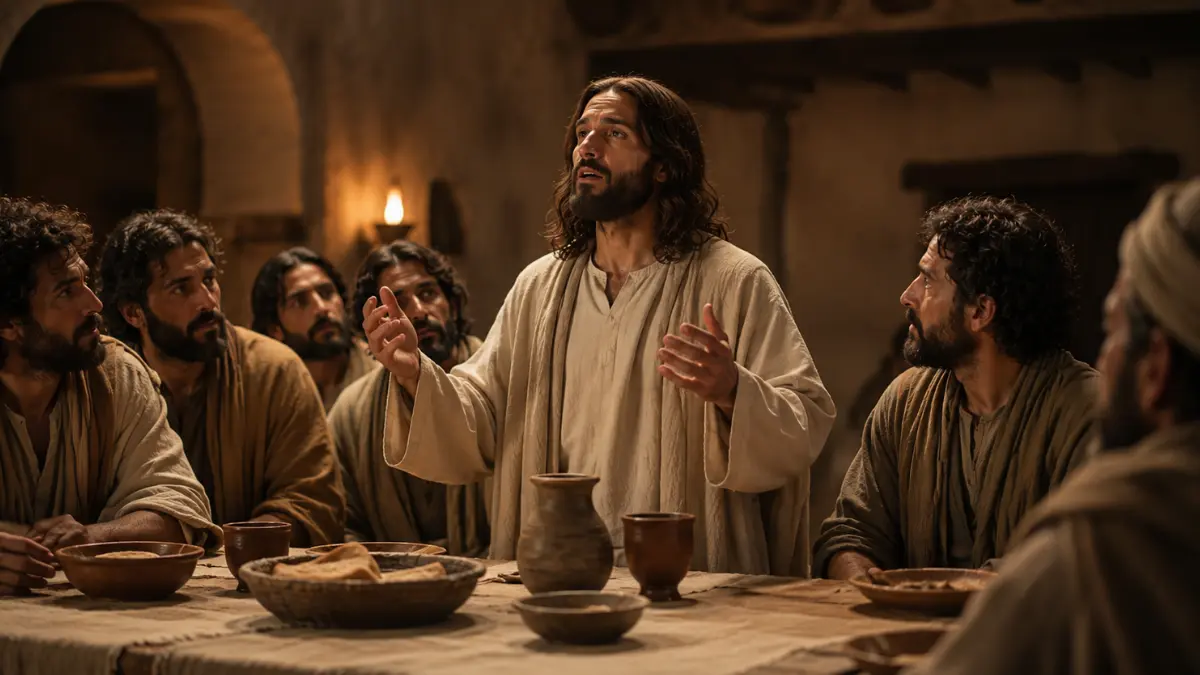

The Bible does not name the exact hymn Jesus and His disciples sang after the Last Supper. Matthew 26:30 and Mark 14:26 simply record that they sang a hymn before leaving for the Mount of Olives.
Because the meal took place within a Passover setting, many Bible scholars connect the hymn with the Hallel Psalms, a group of songs of praise found in Psalms 113–118. Jesus and the disciples may have sung several of these psalms, with Psalms 115–118 likely forming the concluding portion of the meal. Psalm 118 receives particular attention because it closes this group and contains words about rejection, deliverance, sacrifice and thanksgiving.
However, Scripture never says, “Jesus sang Psalm 118.” Christians can view the Hallel Psalms as the most likely answer while acknowledging that the exact selection remains uncertain.
Where Does the Bible Mention the Hymn?
Matthew and Mark record the hymn in almost identical language.
Matthew 26:30 says that after Jesus and the disciples had sung a hymn, they went out to the Mount of Olives. Mark 14:26 records the same movement from the meal to the Mount of Olives.
Neither writer gives the title, opening words or number of the hymn. Luke describes the meal and Jesus’ teaching but does not mention the singing. John records extensive teaching from the same evening but also leaves out the hymn.
The brief statement appears after Jesus speaks about the bread and cup. He then leaves with the disciples and travels toward the place where He will pray before His arrest.
Readers who need the wider setting of the meal can first read The Last Supper and Communion Explained. That broader account explains the Passover setting, the bread and cup, Jesus’ teaching and the events that led toward Gethsemane. This article focuses only on the song that closed the gathering.
Why the Passover Setting Matters
The hymn becomes easier to understand when readers place it within the Jewish Passover celebration.
Passover remembered God’s deliverance of Israel from slavery in Egypt. Families gathered to recall how God rescued His people, judged their oppressors and brought them toward covenant life with Him.
Prayer, Scripture, food and praise all helped worshippers remember that deliverance. Psalms associated with God’s saving power naturally belonged within this setting.
The Last Supper occurred during the Passover season, and the Gospel accounts connect the meal closely with Passover. Jesus sent disciples to prepare the meal, gathered with the Twelve and used the evening to explain His approaching suffering.
The hymn therefore probably did not function as an unrelated song selected at random. It likely belonged to the worship surrounding the Passover meal and reflected themes of rescue, covenant faithfulness and praise.
This context leads many interpreters to the Hallel Psalms.
What Are the Hallel Psalms?
The word “Hallel” comes from a Hebrew word connected with praise. The familiar word “hallelujah” carries the sense of praising the Lord.
The Hallel consists of Psalms 113–118. These six psalms celebrate God’s greatness, mercy, faithfulness and power to save. They also remember the Exodus, when God brought Israel out of Egypt.
Each psalm contributes something to the larger movement of praise:
- Psalm 113 praises the Lord who reigns above the nations and lifts the needy.
- Psalm 114 remembers Israel’s departure from Egypt and God’s power over creation.
- Psalm 115 contrasts the living God with powerless idols.
- Psalm 116 thanks God for hearing prayer and delivering from death.
- Psalm 117 calls every nation to praise the Lord for His enduring faithfulness.
- Psalm 118 celebrates God’s steadfast love, deliverance and victory.
These themes fit naturally within Passover. Israel praised the God who had heard suffering, defeated oppression and brought His people into freedom.
The Gospel writers’ reference to “a hymn” may describe the disciples singing part or all of this collection. It does not necessarily mean that they sang one short composition in the modern sense of a church hymn.
Did Jesus Sing All of Psalms 113–118?
No biblical passage confirms exactly how much Jesus and His disciples sang.
Later Passover tradition divided the Hallel around different parts of the meal. Worshippers commonly used Psalms 113–114 earlier and Psalms 115–118 closer to the conclusion.
If a similar pattern shaped the meal Jesus shared with His disciples, the hymn mentioned after the bread and cup may have included the latter portion of the Hallel. This would make Psalms 115–118 strong possibilities.
However, readers must use historical tradition carefully. The Gospel writers do not describe every stage of the meal, and later written Passover customs do not prove that every first-century Jewish household followed precisely the same order.
The evidence supports a likely conclusion, not an absolute one. Jesus probably sang from the Hallel Psalms, but Scripture does not tell us whether He sang every psalm, one section or another Passover song.
Was Psalm 118 the Hymn Jesus Sang?
Psalm 118 often receives the most attention because it closes the Hallel collection and would fit naturally near the end of a Passover meal.
The psalm begins and ends with thanksgiving for God’s enduring love. It describes distress, opposition, deliverance and confidence in God. It also includes several lines that the New Testament connects with Jesus.
Psalm 118 speaks about the stone that the builders rejected becoming the cornerstone. Jesus applied this image during His ministry when speaking about rejection and God’s purpose.
The psalm also contains the words, “Blessed is he who comes in the name of the Lord.” Crowds used this language when Jesus entered Jerusalem.
It refers to a festal procession and sacrifice, themes that carry unusual weight when placed beside the events approaching Jesus. He would soon face rejection, arrest and death, yet God’s saving purpose would not fail.
For these reasons, many Christians imagine Jesus singing Psalm 118 before walking toward Gethsemane. The connection carries deep meaning, but the Bible still does not identify Psalm 118 as the exact hymn.
The responsible conclusion says that Psalm 118 probably formed part of the Hallel associated with the closing of the meal. It should not claim certainty that Scripture does not provide.
What Would the Hallel Psalms Have Meant That Night?
The Hallel Psalms would have placed the final hours of Jesus within the larger biblical story of deliverance.
God Hears Those Who Call to Him
Psalm 116 describes someone who calls upon the Lord from a place of danger and sorrow. The psalmist trusts God because He listens and responds.
Soon after the meal, Jesus would pray in deep anguish at Gethsemane. The language of prayer, distress and trust would fit the emotional weight of the night.
God Remains Faithful During Opposition
Psalm 118 describes enemies surrounding the worshipper while confidence remains fixed on the Lord.
Jesus knew that religious leaders planned His arrest. He also knew that Judas would lead the arresting group to Him. Opposition had gathered around Him, yet He continued forward in obedience.
The Gospel accounts create some uncertainty about when Judas left in relation to the bread and cup. That separate chronology question appears in Did Judas Take Communion at the Last Supper?. By the time Jesus moved toward Gethsemane, however, Judas had committed himself to the betrayal.
Rejection Would Not Defeat God’s Purpose
The rejected-stone image in Psalm 118 closely matches the rejection Jesus faced.
Human authorities could reject Him, but their judgment could not cancel God’s plan. What appeared to be defeat would become central to the work God accomplished through Him.
Praise Could Continue Before Suffering
Jesus did not sing after the danger had passed. He sang while knowing that arrest and suffering stood immediately ahead.
The hymn did not deny the seriousness of the coming hours. It expressed trust in God within them. Jesus faced suffering with prayer, obedience and worship rather than confusion about His mission.
Did Jesus Lead the Singing?
The Gospel accounts say that Jesus and the disciples sang together, but they do not describe how they performed the hymn.
In traditional forms of Jewish worship, a leader could recite lines while others responded with a repeated expression of praise. The group might also sing or chant together.
Jesus may have led the disciples as the head of the gathered meal, but Scripture does not describe the exact musical arrangement. It gives no information about the melody, rhythm or individual voices.
The important biblical detail involves their shared act of worship. Jesus did not sing alone. The disciples joined Him before they left the upper room and walked toward the Mount of Olives.
Why Do Matthew and Mark Mention the Hymn So Briefly?
Matthew and Mark each use only a short sentence to describe the singing, but its position gives it importance.
The hymn closes one part of the narrative. Jesus has shared the meal, spoken about His body and blood and warned the disciples about what will happen. The group then sings and leaves for the Mount of Olives.
The sentence creates a calm transition between the table and the approaching crisis. Jesus moves from fellowship and worship toward prayer, betrayal and arrest.
The Gospel writers do not pause to explain the hymn because their first readers may have understood the Passover practice more readily than many modern readers do. The phrase could have immediately suggested familiar songs of praise associated with deliverance.
Matthew and Mark also keep their focus on the events leading to the cross. They mention the hymn because it formed part of that movement, but they do not turn the passage into a detailed account of Jewish music.
What the Hymn Reveals About Jesus
The hymn reveals that Jesus entered His suffering with full awareness and deliberate trust.
He had already told the disciples that one of them would betray Him. He had warned Peter about denial. He had explained the bread and cup in relation to His approaching death.
Jesus therefore did not sing because He misunderstood what awaited Him. He sang while knowing the cost of the path ahead.
This moment shows several aspects of His response:
- He remained committed to the Father’s will.
- He joined His disciples in worship.
- He placed His approaching suffering within Scripture’s story of redemption.
- He praised God before circumstances appeared victorious.
- He moved toward Gethsemane without abandoning His mission.
The hymn does not make the coming suffering less painful. In Gethsemane, Jesus would express genuine anguish. Worship and sorrow could exist together because trust in God did not require emotional denial.
Can Christians Call Psalm 118 Jesus’ Last Hymn?
Christians may describe Psalm 118 as the likely final psalm Jesus sang before His arrest, provided they communicate the uncertainty.
The New Testament never directly calls Psalm 118 His last hymn. The conclusion comes from combining the Gospel setting with Passover tradition and the usual order of the Hallel Psalms.
A careful statement would say:
“Jesus and His disciples most likely sang from the Hallel Psalms, possibly concluding with Psalm 118.”
An overly certain statement would say:
“The Bible confirms that Jesus sang Psalm 118.”
The first statement respects the evidence. The second claims more than the biblical text reveals.
Jesus may also have sung other prayers or psalms at later moments that the Gospel writers did not record. Matthew 26:30 and Mark 14:26 give us the final recorded instance of Jesus singing, not necessarily a complete record of every song He ever sang.
What Hymn Did Jesus Sing After the Last Supper?
The exact hymn remains unnamed. Matthew and Mark only tell us that Jesus and His disciples sang before leaving for the Mount of Olives.
The Passover setting makes the Hallel Psalms—Psalms 113–118—the strongest possibility. The final portion, Psalms 115–118, may have concluded the meal, and Psalm 118 may have served as the closing song.
These psalms praised God for deliverance, steadfast love and victory over death and opposition. Their words would have carried profound meaning as Jesus prepared to face betrayal, Gethsemane and the cross.
Christians can reasonably connect the Last Supper hymn with the Hallel while preserving the distinction between what Scripture states and what historical evidence suggests. The Bible confirms that Jesus sang with His disciples. It leaves the exact psalm unstated.
Frequently Asked Questions
What hymn did Jesus sing after the Last Supper?
The Bible does not name the exact hymn. Matthew 26:30 and Mark 14:26 only state that Jesus and His disciples sang before leaving for the Mount of Olives. Many scholars connect the hymn with the Hallel Psalms, Psalms 113–118.
Did Jesus sing Psalm 118 at the Last Supper?
Jesus may have sung Psalm 118, but Scripture does not confirm it directly. Psalm 118 concludes the Hallel Psalms and likely formed part of the praise sung near the end of a Passover meal.
Why do scholars connect the Last Supper hymn with Psalms 113–118?
The Last Supper took place in a Passover setting, and Jewish Passover worship commonly included the Hallel Psalms. Their themes of deliverance and praise also fit the biblical meaning of Passover.
Was Psalm 118 the final song of the Passover meal?
Later Passover tradition places Psalm 118 near the conclusion of the Hallel. This makes it a strong possibility for the hymn mentioned in the Gospels, but the biblical text does not confirm the precise order.

2 thoughts on “What Hymn Did Jesus and His Disciples Sing?”