
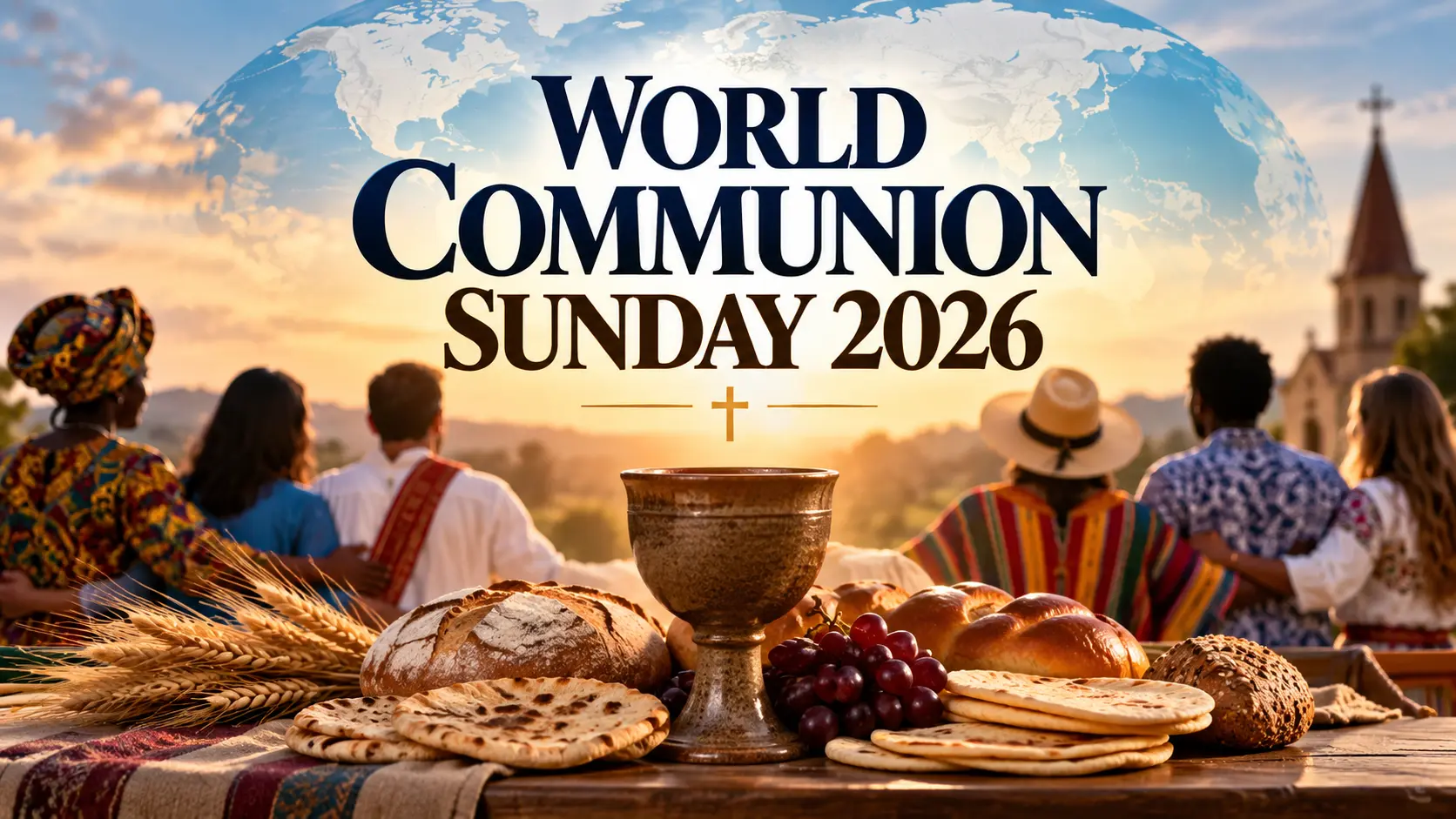

World Communion Sunday 2026 will be observed on Sunday, October 4, 2026, the first Sunday of October. On this day, Christian congregations in many parts of the world celebrate the Lord’s Supper with a special emphasis on the unity of believers across nations, cultures and church traditions.
The observance does not introduce a new sacrament or replace a church’s usual understanding of Communion. Instead, it calls Christians to remember that a local congregation belongs to a much wider body of believers worshiping Christ around the world.
World Communion Sunday 2026
| Quick Fact | Details |
|---|---|
| 2026 Date | Sunday, October 4, 2026 |
| When It Occurs | Traditionally the first Sunday of October |
| First Celebration | 1933 at Shadyside Presbyterian Church in Pittsburgh, Pennsylvania |
| Associated Founder | Rev. Dr. Hugh Thomson Kerr |
| Central Theme | Christian unity around Christ and His table |
| Key Scripture | 1 Corinthians 10:17 |
| Common Practices | Communion, global prayers, international worship elements and mission-focused giving |
The first-Sunday-of-October rule makes the date straightforward: in 2026, the first Sunday falls on October 4. United Methodist resources likewise list October 4 as the 2026 observance.
This is useful to know because generic holiday calendars may occasionally show conflicting dates. For church planning, denominational calendars and official church resources are the better reference.
What Is World Communion Sunday?
World Communion Sunday is an ecumenical Christian observance encouraging churches to remember the worldwide body of Christ while celebrating Communion.
Christians may gather in a rural chapel, a city congregation or a house church. They may worship in English, Spanish, Arabic, Korean, Swahili or hundreds of other languages. Their liturgies and theology may differ but World Communion Sunday invites believers to look beyond their immediate congregation and remember Christians in other cultures and nations.
It is important not to suggest that every Christian tradition understands Communion in exactly the same way. Churches differ over Christ’s presence in the Eucharist, who may receive it, how frequently it should be celebrated and how the sacrament or ordinance should be understood.
World Communion Sunday is therefore best understood as an ecumenical emphasis on Christian unity, particularly within Protestant traditions, rather than a new universal sacramental practice.
For the wider biblical background, see what the Bible says about sacraments, including why Communion holds such an important place in Christian worship.
Communion, Eucharist and the Lord’s Supper
| Term | Main Emphasis |
|---|---|
| Holy Communion | Fellowship and participation in Christ and His people |
| Eucharist | Thanksgiving; from the Greek eucharistia |
| The Lord’s Supper | Christ’s meal with His disciples and His command to remember Him |
The terms overlap, although Christian traditions often prefer one expression.
“Communion” naturally emphasizes participation and fellowship. “Eucharist” emphasizes thanksgiving and is especially common in liturgical traditions. “The Lord’s Supper” points directly to the meal Jesus shared with His disciples before the crucifixion.
That biblical setting is explored further in the Last Supper and Communion explained.
History of World Communion Sunday
World Communion Sunday did not begin as an ancient feast of the early Church. It developed from a Presbyterian initiative in Pittsburgh.
The idea is associated with Rev. Dr. Hugh Thomson Kerr, pastor of Shadyside Presbyterian Church. Presbyterian historical records explain that Kerr conceived the idea during his year as moderator of the Presbyterian General Assembly in 1930. The first celebration at Shadyside followed in 1933.
The goal was to help Christians recognize the interconnected nature of the Church at a time when economic hardship and international tension were deeply affecting society.
Historical Progression
1930 — The idea develops.
Hugh Thomson Kerr begins developing the concept of a shared Communion observance emphasizing Christian unity.
1933 — First celebration.
Shadyside Presbyterian Church in Pittsburgh holds the first World Wide Communion Sunday celebration.
1936 — Presbyterian adoption.
The observance is adopted as a denominational practice in the Presbyterian Church in the United States.
1940 — Wider ecumenical expansion.
The Department of Evangelism of the Federal Council of Churches, a predecessor of today’s National Council of Churches, promotes the observance more broadly.
Modern era — Global resources and participation.
Presbyterian, Methodist, United Church of Christ, Disciples of Christ and other ecumenically engaged communities now provide prayers, worship materials and mission resources connected with the day.
The official Presbyterian history of World Communion Sunday preserves this 1933–1936–1940 progression.
Biblical Meaning: “One Bread, One Body”
Scripture Spotlight — 1 Corinthians 10:17 (ESV)
“Because there is one bread, we who are many are one body, for we all partake of the one bread.”
Few passages express the theme of World Communion Sunday as clearly as 1 Corinthians 10:17.
Paul connects shared participation in the bread with the shared identity of believers as one body. This does not mean Christians lose their cultural differences. Rather, their common relationship to Christ creates a deeper spiritual belonging.
Meaning of the One Bread
Bread is ordinary and shared, but within Communion it points beyond an ordinary meal. Christians remember Christ’s self-giving sacrifice while also recognizing that faith is not merely individual.
Paul makes this communal dimension particularly clear in 1 Corinthians 11, where he rebukes practices at Corinth that humiliated poorer believers and contradicted the very unity the Lord’s Supper was meant to express.
That background is examined more fully in the meaning of unworthy Communion in 1 Corinthians 11.
“Do This in Remembrance of Me”
In 1 Corinthians 11:23–26, Paul recalls Jesus taking bread and the cup and commanding His followers to continue the meal in remembrance of Him.
That keeps Christ at the centre of World Communion Sunday. The observance should not become only a celebration of multiculturalism or international friendship. Its Christian significance comes from Jesus, His sacrifice and the covenant remembered at the table.
One Body Without Cultural Sameness
Ephesians 4:4–6 speaks of one body, one Spirit, one hope, one Lord, one faith and one God and Father. Galatians 3:28 shows how belonging to Christ challenges social and ethnic barriers.
Psalm 133 offers a related biblical picture of unity. Its imagery is explored in the meaning of the dew of Hermon in Psalm 133.
Christian unity therefore does not require cultural sameness. It means people with different backgrounds can share a deeper identity in Christ.
How Churches Observe World Communion Sunday Today
There is no single worldwide liturgy every congregation must follow. Churches adapt the observance according to their own worship traditions and Communion practices.
Current World Communion Sunday resources from Global Ministries include prayers from international Christian partners, worship music and bread-related materials designed to help congregations recognize the global character of the Church.
Multicultural Breads and Global Liturgies
Some congregations incorporate breads, recipes or visual displays associated with different cultures.
Depending on the church’s sacramental rules, these may include various loaves or flatbreads, while other churches retain their customary Communion elements and use international breads only as visual symbols.
The underlying idea is simple: Christianity exists across many cultures, yet believers gather around the same Christ.
Global Ministries’ 2026 materials include World Communion Sunday worship resources and bread recipes.
Languages, Hymns, Prayers and Offerings
Some congregations include Scripture readings, prayers or music from Christian communities in other countries. Members may pray portions of a service in their first languages, giving the congregation an audible reminder that Christianity extends far beyond one culture.
Other churches connect the day with mission or education.
For United Methodists, World Communion Sunday is one of the denomination’s Special Sundays. Offerings support educational opportunities, scholarships and leadership development. The denomination lists October 4, 2026 as that year’s date in its World Communion Sunday resources.
These elements support the observance, but they are not the heart of Communion itself. The table remains centered on Christ.
Denominational Participation and Theological Nuance
World Communion Sunday emphasizes unity, but Christian traditions continue to hold meaningful theological differences concerning the Eucharist.
| Tradition / Group | Observance Perspective and Eucharistic Nuance |
|---|---|
| Presbyterian | Historically central to the development of World Communion Sunday, with strong emphasis on Christian unity. |
| United Methodist | Formally recognizes World Communion Sunday as a Special Sunday, normally observed on the first Sunday of October. |
| UCC / Disciples of Christ | Strong ecumenical and global-mission emphasis, including worship resources through Global Ministries. |
| Lutheran and other Protestant churches | Participation and Communion practices vary by denomination and congregation. |
| Roman Catholic | Strongly emphasizes Eucharistic unity, while normally linking Eucharistic sharing with full ecclesial communion, subject to limited exceptions. |
| Eastern Orthodox | Understands Holy Communion as an expression of existing ecclesial unity and ordinarily admits properly prepared Orthodox Christians. |
| Evangelical / Non-denominational | Some congregations may emphasize worldwide Christian unity on this Sunday without formally using the World Communion Sunday title. |
The Catholic Church, for example, teaches that Eucharistic communion and ecclesial communion are closely connected, which is why intercommunion is normally restricted even while ecumenical unity is encouraged.
Eastern Orthodox Christianity likewise understands the Eucharist as central to the life of the Church and normally reserves reception for members of the Orthodox Church who are properly prepared.
World Communion Sunday therefore expresses a desire for Christian unity without pretending that all churches already share identical Eucharistic theology or practice.
Why World Communion Sunday Matters for Christians Today
1. Looking Beyond the Local Church
It is easy to think of Christianity mainly through the experience of one congregation or culture.
World Communion Sunday widens that perspective. It reminds believers that Christians worship under very different social, cultural and economic conditions throughout the world.
That awareness can encourage prayer, generosity, humility and a stronger sense of belonging to the worldwide Church.
2. Healing Divisions at the Table
Communion raises a challenging question: how can Christians receive signs of Christ’s grace while treating other believers with contempt?
The New Testament connects spiritual maturity with love, patience, kindness, gentleness and self-control. Those qualities are explored more fully in the Fruit of the Spirit in Galatians 5:22–23.
World Communion Sunday does not require Christians to ignore genuine disagreements. Instead, it reminds them that disagreement should not automatically become hostility, pride or indifference.
3. A Foretaste of the Heavenly Gathering
Revelation 7:9 pictures a great multitude from every nation, tribe, people and language standing before God.
World Communion Sunday can offer a small earthly picture of that biblical hope. A congregation remains local but its imagination becomes global.
Different languages and cultures become reminders of the breadth of the people Scripture pictures worshiping before God.
Conclusion: One Family Under Christ
On Sunday, October 4, 2026, Christians observing World Communion Sunday will gather around the Lord’s table while intentionally remembering believers far beyond their own communities.
What began at a Presbyterian church in Pittsburgh has become a recurring reminder that Christianity cannot be reduced to one nation, culture or congregation. Communion directs believers back to Christ while calling them to recognize the wider body to which they belong.
World Communion Sunday 2026 — Takeaway
- Date: Sunday, October 4, 2026
- Biblical theme: Many believers, yet one body in Christ
- Central invitation: Remember Christ faithfully, value His worldwide Church and practice the unity Communion represents
