
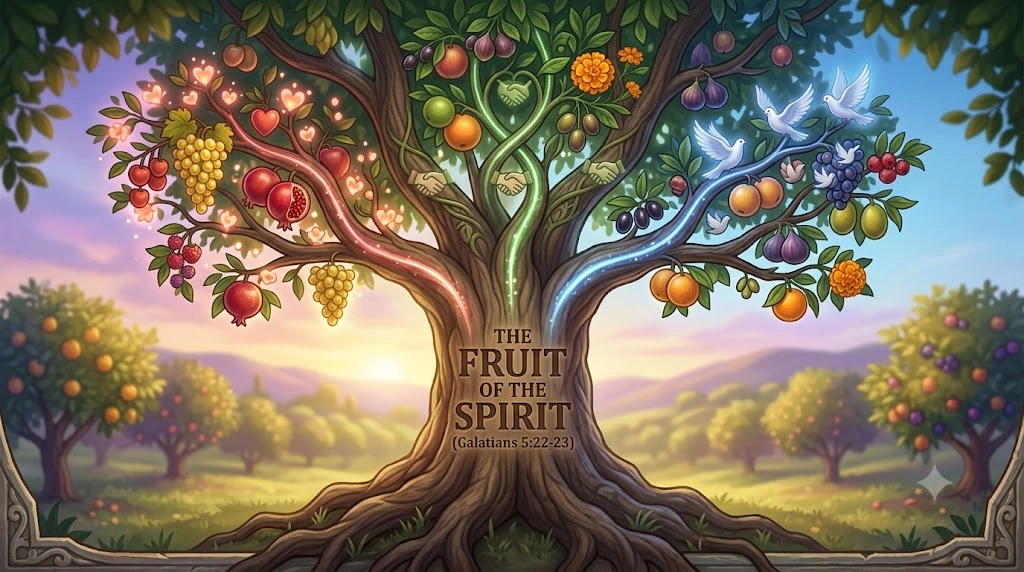

The Fruit of the Spirit is one of the most practical and frequently quoted passages in the New Testament. Written by the Apostle Paul to the churches in Galatia around 48–55 AD, this passage outlines the visible evidence of a life transformed by the Holy Spirit.
To fully grasp what Paul is teaching, we need to look beyond a simple list of virtues and understand the culture, theology and Greek language behind the text.
Galatians 5:22–23 (NIV)
“But the fruit of the Spirit is love, joy, peace, forbearance, kindness, goodness, faithfulness, gentleness and self-control. Against such things there is no law.”
1. Works vs. Fruit
In Galatians 5, Paul sets up a sharp contrast between two ways of living: “the works of the flesh” (Galatians 5:19–21) and “the fruit of the Spirit” (Galatians 5:22–23).
- “Works” (Erga): Refers to human effort, labor, and self-striving. Works are what human nature produces on its own, often characterized by legalism, pride, and self-indulgence.
- “Fruit” (Karpos): Refers to a natural product of living growth. Fruit is not manufactured by human effort; it is grown organically when a branch remains connected to a living tree or vine (John 15:5).
The contrast becomes even clearer when we examine the surrounding passage. Paul does not simply tell Christians to behave better. He describes two competing patterns of life. The “works of the flesh” are behaviors that arise from the fallen human inclination, while the “fruit of the Spirit” describes the character produced as a person lives under the direction of the Holy Spirit.
This is important because Christianity is not presented here merely as external moral improvement. Paul is describing transformation at the level of character and desire.
Earlier in Galatians, Paul had already argued that believers receive the Spirit through faith rather than by relying on works of the law (Galatians 3:2–5). Therefore, Galatians 5 continues the same argument: Christian freedom is not freedom to satisfy every desire. It is freedom to live according to the Spirit.
Paul summarizes this principle in Galatians 5:13:
“Serve one another humbly in love.”
Christian liberty therefore has a purpose. Freedom from slavery to sin and legalism becomes freedom for loving service.
Why “Fruit” is Singular, Not Plural
In the original Greek, Paul deliberately uses the singular noun karpos (fruit), rather than the plural karpoi (fruits).
This distinction carries profound theological meaning:
- Unitive Growth: The nine attributes are not separate “fruits” where you can choose to have patience but lack love. They represent a single, unified character trait—the character of Jesus Christ.
- Harmonious Manifestation: As the Holy Spirit matures a believer, all nine qualities develop together, even if some grow more noticeably at different seasons.
The singular does not necessarily mean that every believer will display every quality at exactly the same level at all times. Rather, Paul presents these qualities collectively as the Spirit’s fruit—the recognizable character that accompanies life directed by the Spirit.
This also prevents the passage from becoming a personality test. Paul is not asking Christians to determine whether they are naturally gentle, naturally outgoing, naturally patient, or naturally disciplined. He is describing a form of character that should increasingly shape the whole Christian life.
Fruit Is Evidence, Not a Method of Earning Salvation
Another important distinction is that Paul does not present spiritual fruit as a way of earning God’s acceptance.
The order matters:
Grace → Faith → Spirit → Transformation → Fruit
The fruit does not purchase salvation. Instead, it demonstrates the transforming work associated with life in the Spirit.
This fits Paul’s wider teaching in Galatians. The Christian life begins by faith and is not completed by returning to dependence on human effort (Galatians 3:3).
2. In-Depth Breakdown of the 9 Virtues
Paul structures these nine virtues into a harmonious whole that impacts a believer’s inner life, outward relationships and upward walk with God.
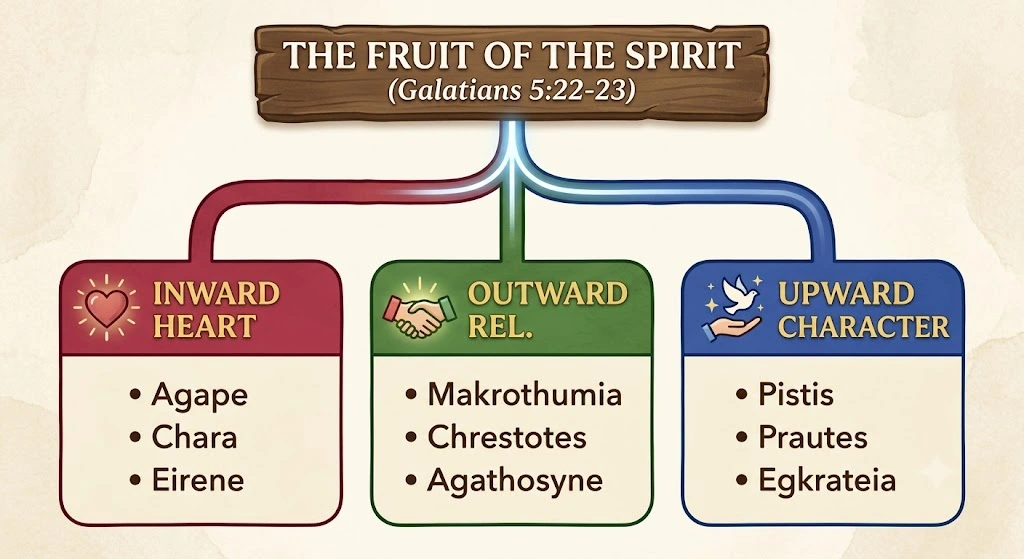
Group 1: Inward Heart Disposition (Love, Joy, Peace)
Love (Agape)
Agape describes deliberate, self-giving love. It is not merely an emotional feeling or attraction. In the New Testament, the word can describe a love that seeks another person’s good.
Unlike eros (romantic love) or philia (friendship or affection), agape emphasizes purposeful love and goodwill.
Paul places love first for a reason. Love is deeply connected with the entire argument of Galatians. Just a few verses earlier he writes:
“For the entire law is fulfilled in keeping this one command: ‘Love your neighbour as yourself.'” — Galatians 5:14
This means love is not simply one virtue among many. It provides an important framework for understanding the others.
Patience without love can become cold endurance.
Kindness without love can become superficial politeness.
Self-control without love can become rigid discipline.
Love gives the other qualities their proper direction.
In everyday life, agape can look like:
- forgiving someone without seeking revenge;
- helping another person without demanding recognition;
- speaking truth without intentionally humiliating someone;
- choosing another person’s good even when doing so is inconvenient.
Joy (Chara)
Chara refers to joy, gladness, or delight.
Biblical joy is deeper than temporary happiness. Happiness can rise and fall with circumstances, while Christian joy is connected to one’s relationship with God and confidence in His promises.
That does not mean a Christian is expected to feel cheerful every moment. Scripture contains numerous examples of faithful people experiencing grief, fear, sorrow, and distress.
Christian joy therefore should not be confused with pretending that suffering does not exist.
Paul himself wrote about hardship while continuing to speak about joy. This makes chara particularly significant: joy can coexist with difficulty.
James 1:2–3 similarly connects joy with trials, not because suffering itself is pleasant, but because perseverance can produce spiritual maturity.
Practical expression of joy:
A person displaying spiritual joy can experience disappointment without allowing disappointment to completely define their relationship with God.
Peace (Eirene)
Eirene is commonly translated as “peace.” Its meaning can include tranquility, harmony, and a condition of well-being.
The concept also connects naturally with the Old Testament idea of shalom, which carries a broader sense of wholeness and well-being.
The New Testament presents peace in several dimensions:
- Peace with God through reconciliation;
- peace within oneself as anxiety and turmoil are brought to God;
- peace with others through reconciliation and forgiveness.
Romans 5:1 speaks of believers having peace with God through faith, while Philippians 4:7 describes the peace of God guarding believers’ hearts and minds.
Spiritual peace therefore is not simply having a quiet life. A believer can experience peace while circumstances remain difficult.
Group 2: Outward Relational Character
Forbearance / Patience (Makrothumia)
Makrothumia literally combines ideas associated with “long” and “anger” or “temper.” The traditional concept of “long-suffering” captures the idea of having a long fuse.
It describes restraint in the face of provocation, difficulty, or the failures of other people.
Patience is therefore more than waiting in a queue without complaining.
It can mean:
- not immediately retaliating when insulted;
- continuing to treat difficult people with dignity;
- allowing someone time to change;
- resisting the urge to respond in anger;
- remaining faithful when progress is slow.
This is particularly important because relationships provide countless opportunities for this quality to become visible.
Kindness (Chrestotes)
Chrestotes describes kindness, goodness, generosity, or benevolent disposition.
Biblical kindness is not merely being pleasant.
It becomes visible through action.
A kind person notices needs and responds appropriately. Kindness can involve encouragement, hospitality, forgiveness, generosity, listening, practical assistance, or simply treating someone with dignity.
Paul also uses related language when describing God’s kindness toward humanity (Romans 2:4; Ephesians 2:7).
This makes Christian kindness more than social courtesy. It reflects something about God’s own character.
Goodness (Agathosyne)
Agathosyne refers to goodness or moral excellence expressed in action.
There is an important distinction between kindness and goodness.
Kindness often emphasizes benevolent treatment of others.
Goodness can include moral courage—the willingness to do what is right rather than merely what is comfortable.
Therefore, goodness does not always look soft.
- Sometimes goodness means helping someone.
- Sometimes it means telling the truth.
- Sometimes it means confronting wrongdoing.
Sometimes it means refusing to participate in something harmful.
Jesus’ cleansing of the temple is sometimes discussed as an example of righteous action rather than passive niceness, although the precise theological application should be made carefully.
The central point is that Spirit-produced goodness seeks what is genuinely right and beneficial rather than merely what appears pleasant.
Group 3: Upward Spiritual Maturity
Faithfulness (Pistis)
Pistis can mean faith, faithfulness, trust, or reliability depending on context.
In Galatians 5:22, many English translations render it faithfulness, emphasizing a character of dependability and loyalty.
A faithful person is not merely enthusiastic when circumstances are favourable. Faithfulness becomes visible through consistency.
It can involve:
- keeping one’s word;
- remaining loyal;
- fulfilling responsibilities;
- maintaining devotion to God;
- being dependable when nobody is watching.
This is especially important because spiritual maturity is not measured only by dramatic moments.
It is also revealed through ordinary consistency over years.
Gentleness (Prautes)
Prautes is commonly translated as “gentleness” or “meekness.”
It should not be confused with weakness.
Gentleness describes controlled strength—a person who possesses the ability to respond forcefully but chooses an appropriate response rather than acting destructively.
The popular illustration that prautes means a “warhorse trained under control” is often used in Christian teaching. However, that specific illustration should not be treated as a literal definition of the Greek word. The broader biblical picture is better understood through passages such as Matthew 11:29 and Galatians 6:1, where gentleness is associated with humility, restoration, and controlled conduct.
Gentleness can therefore look like:
- correcting someone without humiliating them;
- disagreeing without insulting;
- using authority without abusing it;
- responding calmly when provoked;
- helping someone who has fallen rather than destroying them.
Gentleness is strength governed by wisdom and love.
Self-Control (Egkrateia)
Egkrateia refers to self-control, mastery over one’s desires, and disciplined restraint.
It is especially relevant because the preceding qualities are not merely emotional states.
Love requires choices.
Patience requires restraint.
Faithfulness requires consistency.
Gentleness requires controlled strength.
Self-control therefore has a particularly practical role in spiritual maturity.
It can involve controlling:
- anger;
- sexual temptation;
- speech;
- spending;
- appetite;
- impulsive decisions;
- addictive patterns;
- the desire for revenge;
- the urge to respond immediately when emotionally overwhelmed.
Self-control does not mean suppressing every emotion. Instead, it means emotions and desires are brought under wise governance rather than automatically becoming commands.
3. “Against Such Things There Is No Law”
Paul concludes Galatians 5:23 with a subtle touch of irony: “Against such things there is no law.”
He highlights two critical points here:
- No Limit or Condemnation: No legal system or religious law can condemn someone for displaying love, peace, or self-control. There is no law that restricts how much kindness or faithfulness you can demonstrate.
- Fulfillment of the Law: The Old Testament law was designed to restrain bad behavior. However, when the Holy Spirit produces these nine virtues within a person, they naturally fulfill the moral purpose of the law without needing external compulsion (Romans 13:10).
There is also an important connection with the immediately preceding verses.
Paul has spent much of Galatians arguing against using circumcision and observance of the law as the basis for justification. Yet he does not conclude that Christian freedom means moral indifference.
Instead, he presents a different kind of obedience.
Rather than asking:
“What is the minimum I must do to remain acceptable?”
the Spirit-led Christian increasingly asks:
“How can I love God and serve others faithfully?”
This is why Galatians 5:13–14 is so important for understanding verses 22–23. Christian freedom is directed toward love rather than self-centeredness.
4. How the Fruit Is Cultivated
Spiritual transformation is neither pure passive waiting nor pure self-effort. It is a cooperative process often described as abiding and yielding.
The Principle of Abiding (John 15)
Fruit is a natural byproduct of connection. In John 15:4, Jesus states, “No branch can bear fruit by itself; it must remain in the vine.” Cultivating spiritual fruit begins with consistent spiritual disciplines:
- Scripture Intake: Feeds the mind with God’s truth to renew thinking (Romans 12:2).
- Prayer: Maintains continuous alignment with God’s Spirit.
- Community: Surrounding yourself with other believers provides the relational soil where patience, kindness, and forgiveness are practiced.
The Role of Obedience
The Spirit’s work does not eliminate personal responsibility.
Galatians 5:16 says:
“Walk by the Spirit, and you will not gratify the desires of the flesh.”
Paul then says:
“Since we live by the Spirit, let us keep in step with the Spirit.” — Galatians 5:25
The imagery suggests an ongoing pattern rather than a single spiritual experience.
Spiritual maturity develops through repeated choices.
- A person becomes more patient by repeatedly choosing patience.
- A person develops greater self-control by repeatedly refusing to surrender to destructive impulses.
- A person grows in kindness by repeatedly choosing to act for another person’s good.
The ability to make these choices is not presented as independent human achievement. Rather, the believer is called to cooperate with the Spirit’s transforming work.
Walking by the Spirit
In Galatians 5:25, Paul writes, “Since we live by the Spirit, let us keep in step with the Spirit.”
- Pause Before Reacting: When faced with anger, impatience, or temptation, pause and yield the moment to the Spirit rather than yielding to immediate emotional impulses.
- Pruning: God often uses difficult circumstances, challenging people, and personal trials as “pruning tools” (John 15:2) to strip away pride and make room for greater spiritual maturity.
Difficult People Can Reveal Spiritual Growth
One of the clearest practical implications of Galatians 5 is that spiritual fruit becomes visible in relationships.
It is relatively easy to appear patient when nobody is testing your patience.
It is easy to appear gentle when nobody disagrees with you.
It is easy to demonstrate self-control when there is no temptation.
Difficult circumstances reveal what is actually developing inside us.
- A frustrating person can expose impatience.
- An insult can expose anger.
- A disagreement can expose pride.
- A temptation can expose a lack of self-control.
- A disappointment can expose whether joy is entirely dependent upon circumstances.
These situations should not be understood as proof that a Christian has failed simply because a wrong emotion appears. Instead, they can become opportunities to recognize where further spiritual growth is needed.
5. Fruit of the Spirit and the Character of Christ
The nine qualities can also be understood in light of Jesus’ character.
Jesus demonstrated sacrificial love, compassion, faithfulness, gentleness, obedience, and self-control throughout His ministry.
This does not mean Galatians 5:22–23 is simply a hidden list of nine names for Jesus’ personality. Rather, Christian transformation is ultimately oriented toward becoming increasingly conformed to Christ.
Paul describes this broader goal in Romans 8:29: believers are being conformed to the image of God’s Son.
Therefore, the Fruit of the Spirit is not simply about becoming a “nicer person.”
It is about becoming increasingly Christlike.
That distinction matters.
- A person might become more polite through social training.
- A person might become more disciplined through personal development.
- A person might become calmer through meditation or habit formation.
Those changes can be genuinely beneficial, but Paul’s argument concerns something deeper: a life increasingly shaped by the Spirit of God and oriented toward Christ.
6. Fruit Grows Gradually
Fruit does not normally appear immediately after a seed is planted.
The same principle helps explain spiritual maturity.
A believer may genuinely desire to become more patient while still struggling with impatience.
Someone may sincerely want to become more self-controlled while still experiencing repeated temptation.
Someone may genuinely desire to forgive while still processing deep hurt.
Spiritual growth therefore should not be measured only by perfection.
A more meaningful question is:
Is there evidence of growth over time?
Compare:
- How did I respond to criticism a year ago?
- How quickly do I become angry now?
- Am I becoming more willing to forgive?
- Am I more dependable than I once was?
- Do I exercise greater restraint over my words?
- Am I increasingly concerned about other people’s good?
- Do I return to God more quickly after failure?
Growth may be gradual and uneven, but genuine transformation can become increasingly visible.
7. Fruit Is Tested in Relationships
Galatians 5 is particularly relational.
Paul’s command to “serve one another humbly in love” comes immediately before his discussion of the flesh and Spirit.
This means spiritual fruit should not remain an internal concept.
- Love is tested by relationships.
- Patience is tested by difficult people.
- Kindness is tested by inconvenience.
- Goodness is tested when doing right becomes costly.
- Faithfulness is tested over time.
- Gentleness is tested during disagreement.
- Self-control is tested by temptation.
The fruit becomes visible when Christian beliefs encounter ordinary life.
8. The Fruit of the Spirit Is Not the Same as Spiritual Gifts
The New Testament makes an important distinction between spiritual gifts and spiritual fruit.
Spiritual gifts are abilities given for ministry and the strengthening of the church. Paul discusses gifts extensively in passages such as 1 Corinthians 12, Romans 12, and Ephesians 4.
Spiritual fruit, however, concerns character.
This distinction has an important implication:
A person may possess impressive abilities, knowledge, leadership capacity, or ministry gifts while still needing significant growth in patience, humility, love, or self-control.
Paul’s teaching in 1 Corinthians 13 reinforces this principle. Extraordinary spiritual abilities without love do not represent Christian maturity in the way God intends.
The question is therefore not simply:
“What can I do?”
It is also:
“What kind of person am I becoming?”
9. Common Misconceptions
| Misconception | Biblical Reality |
|---|---|
| “These are natural personality traits.” | Spiritual fruit is supernatural. While anyone can possess natural niceness or patience, the Fruit of the Spirit concerns character shaped by the Spirit and expressed even when circumstances challenge it. |
| “I can work hard to produce patience.” | Human effort and discipline matter, but Paul does not present spiritual transformation as willpower alone. The fruit is associated with walking by the Spirit. |
| “Spiritual gifts and spiritual fruit are the same.” | Spiritual gifts (1 Corinthians 12) are abilities given by God for ministry. Spiritual fruit is character developed in the believer’s life. |
| “If I struggle with one quality, I have no spiritual fruit.” | Spiritual maturity is progressive. A believer can experience genuine growth while still having areas that require significant transformation. |
| “Being gentle means being weak.” | Biblical gentleness involves controlled strength, humility and an appropriate response rather than helplessness. |
| “Christian joy means always feeling happy.” | Biblical joy can coexist with grief, suffering, disappointment and hardship. It is deeper than temporary positive emotion. |
| “Self-control means suppressing every emotion.” | Self-control is better understood as governing desires, impulses, words and actions wisely rather than being controlled by them. |
| “Fruit is produced only when life is easy.” | Trials and difficult relationships can expose areas that need growth and provide opportunities to practice Spirit-shaped character. |
| “The nine qualities are nine independent spiritual achievements.” | Paul presents them collectively as the singular “fruit” of the Spirit. They form a unified picture of Spirit-shaped Christian character. |
| “The Fruit of the Spirit earns salvation.” | The fruit is not a payment for salvation. In Paul’s theology, the Spirit is received through faith and transformed conduct follows from life in the Spirit. |
