
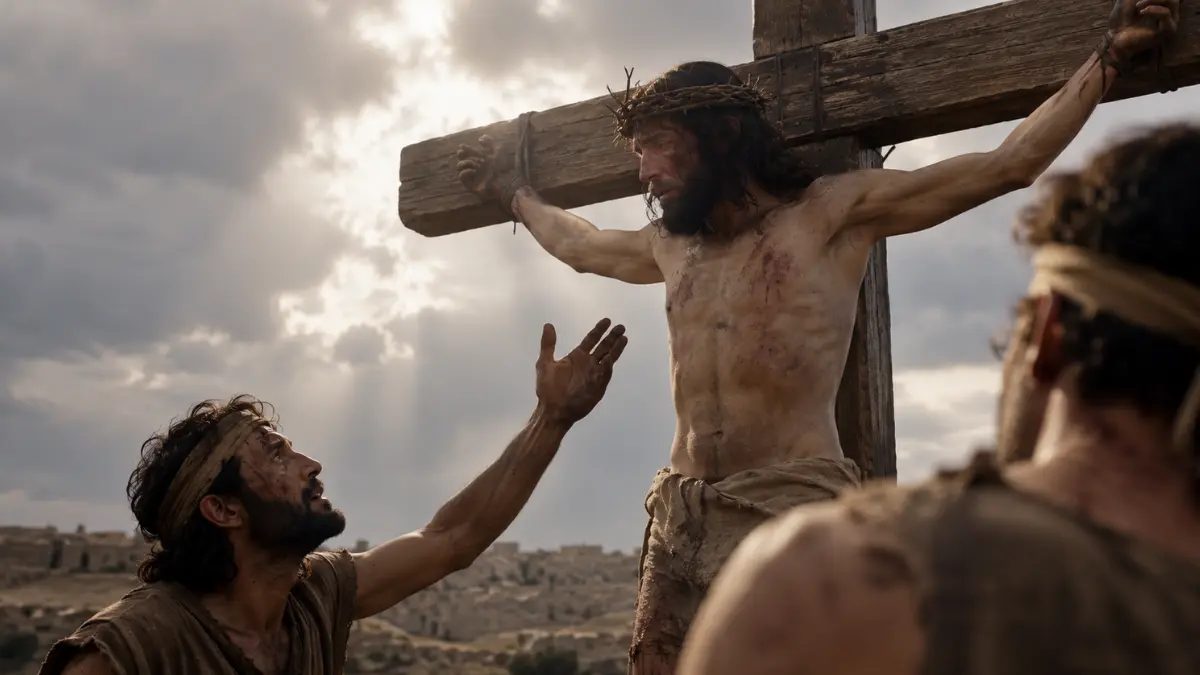

When Jesus said, “Today you will be with me in paradise,” He gave the repentant criminal beside Him a direct promise of hope. The man could not repair his past or leave the cross. He could only acknowledge his guilt, recognize Jesus’ innocence and appeal to Him as King.
Luke 23:43 raises questions about paradise, life after death, baptism and punctuation. Its central message remains clear: Jesus promised that the criminal’s future would be with Him.
What Happened in Luke 23:39–43?
Jesus was crucified between two criminals. One joined the surrounding mockery and challenged Jesus to save Himself and the men beside Him. He wanted escape from suffering but Luke does not show him admitting guilt or trusting Jesus.
The other criminal responded differently. He rebuked the first man, acknowledged that their punishment was deserved and declared that Jesus had done nothing wrong. He then said, “Jesus, remember me when you come into your kingdom.”
His request revealed more than fear. He admitted his guilt, defended Jesus’ innocence and believed that Jesus still possessed a kingdom even while hanging on a cross. When others saw defeat, this man trusted that Jesus would still reign.
Jesus answered, “Truly I tell you, today you will be with me in paradise.” The criminal asked to be remembered in the future but Jesus gave him an immediate and personal assurance that death would not separate him from Christ.
What Does “Today You Will Be With Me” Mean?
The word “today” gives the promise urgency. Jesus did not offer a vague hope that the criminal might receive mercy at some distant point. In the traditional reading of the verse, He assured the man that death would not separate him from Christ.
The most important words may be “with me.” Jesus did not describe paradise only as a destination. He described the man’s future through fellowship with Himself.
Jesus promised that the criminal would be with Him, making personal fellowship with Christ the center of the assurance. Although He appeared powerless to the crowd, He spoke as the King who could welcome someone into His kingdom.
What Does Paradise Mean in Luke 23:43?
The word translated “paradise” originally referred to a garden or beautiful enclosed place. In the New Testament, it became associated with God’s presence, blessing and restored life.
Jesus used “paradise” for the blessed future He promised the criminal in His presence. The verse makes fellowship with Christ certain while leaving some details about the intermediate state unexplained.
The word also appears in 2 Corinthians 12:4 and Revelation 2:7, where it is connected with heavenly blessing and the life God gives. Luke 23:43 does not provide a complete map of heaven, resurrection or the intermediate state.
Paradise therefore describes blessed fellowship with Christ. The criminal’s hope rested on the promise of Jesus rather than a detailed understanding of the afterlife.
Why Did Jesus Promise Paradise to This Criminal?
Jesus’ promise followed the criminal’s acknowledgment of guilt, recognition of Jesus’ innocence and appeal to His kingship. Christians commonly understand these words as evidence of repentance and faith.
The man did not defend his past or demand release from the cross. He accepted the justice of his sentence and turned toward Jesus for mercy, seeing kingship where others saw humiliation.
Jesus responded with more than the man requested. The criminal asked to be remembered, but Jesus promised personal fellowship. His words show that no sinful past places a genuinely repentant person beyond the reach of Christ.
Did the Criminal Truly Repent?
Luke does not use the word “repent” directly in this scene, but the criminal’s words show a changed response. Matthew and Mark describe the criminals joining the mockery, while Luke records one of them later defending Jesus.
Many Christians understand the accounts to mean that this man changed his response during the crucifixion. However, Luke does not describe exactly when or why that change occurred.
His words display the main features commonly associated with repentance. He acknowledged his guilt, accepted that his punishment was deserved, recognized Jesus’ innocence and entrusted his future to Christ.
The narrative does not present a formal formula for salvation. It presents a guilty man who humbled himself, spoke truthfully about Jesus and received a promise from Him.
What Does the Criminal’s Case Mean for Baptism?
Luke does not tell readers whether the criminal had previously received any form of baptism. What the passage does show is that he had no opportunity to leave the cross and be baptized after turning to Jesus.
Christians agree that Jesus’ promise rested on His authority and mercy, although traditions differ on what the criminal’s case means for baptism. Many view his situation as evidence that God is not prevented from saving someone who cannot receive baptism. Others emphasize that the event occurred before the church’s post-resurrection baptismal mission was fully established.
Luke 23:43 should therefore not be used to dismiss why baptism matters in Christian faith or to claim that an outward ceremony earns paradise. The clearest distinction in this account is between inability and deliberate refusal.
The criminal could not come down from the cross to obey a command physically. His situation does not give healthy believers a reason to ignore baptism when they have the opportunity to follow Christ.
Does Luke 23:43 Support Conscious Fellowship With Christ After Death?
Many Christians understand Jesus’ words as strong support for conscious fellowship with Christ after death. The traditional punctuation connects “today” with the promise of being in paradise, and this reading fits New Testament passages in which Paul speaks about departing to be with Christ and being away from the body but at home with the Lord.
Other Christians believe the dead remain unconscious until the resurrection. They read the sentence as, “Truly I tell you today, you will be with me in paradise,” making “today” describe when Jesus spoke rather than when the criminal would enter paradise.
Luke 23:43 alone does not settle every question about death, resurrection and the intermediate state. However, the traditional reading strongly supports the belief that the criminal would enter fellowship with Christ that same day.
Where Should the Comma Go in Luke 23:43?
Most Bible translations read:
“Truly I tell you, today you will be with me in paradise.”
A minority reading places the comma after “today”:
“Truly I tell you today, you will be with me in paradise.”
The earliest Greek manuscripts did not use modern punctuation, so translators must place the comma according to grammar, context and Jesus’ normal speaking pattern. The traditional punctuation is more natural for two main reasons.
First, Jesus repeatedly used the expression “Truly I tell you” without adding “today” to identify the day on which He was speaking. Adding “today” to the speaking formula would be possible, but unusual.
Second, the criminal asked Jesus to remember him when He came into His kingdom. Jesus answered with something more immediate, suggesting that “today” belongs with “you will be with me.” The minority reading remains grammatically possible, but the traditional placement fits the immediate context and Jesus’ normal wording more naturally.
Does This Passage Support Deathbed Repentance?
Luke 23:43 shows that a person can genuinely turn to Christ near the end of life. No one should assume that a sinful history or approaching death automatically places someone beyond mercy.
However, the passage does not encourage deliberate delay. The criminal did not plan a last-minute conversion or know that he would receive one final opportunity. He responded when he recognized the truth about Jesus.
Many people die suddenly or lose the ability to respond clearly. The criminal’s story offers hope to the dying, but it calls the living to respond now rather than treating repentance as something they can safely postpone.
What Luke 23:43 Teaches About Grace and Obedience
The passage shows that the authority of Jesus, not the criminal’s achievements, secured the promise. The man had no time to build a long record of service, yet his words revealed humility, truthfulness and trust.
This agrees with the wider biblical connection between grace, faith and repentance in salvation. Good works do not purchase forgiveness, but genuine faith normally produces a changed response when time and opportunity exist.
The criminal had little time remaining, yet his words already showed that change. He acknowledged guilt, defended Jesus and appealed to Him publicly. His actions support the biblical principle that faith produces visible action rather than remaining empty words.
During those same final hours, Jesus also said “I thirst” and later declared, “It is finished.” The promise to the criminal reveals the saving purpose behind those final moments: Jesus suffered while still offering hope to a guilty person who turned toward Him.
