
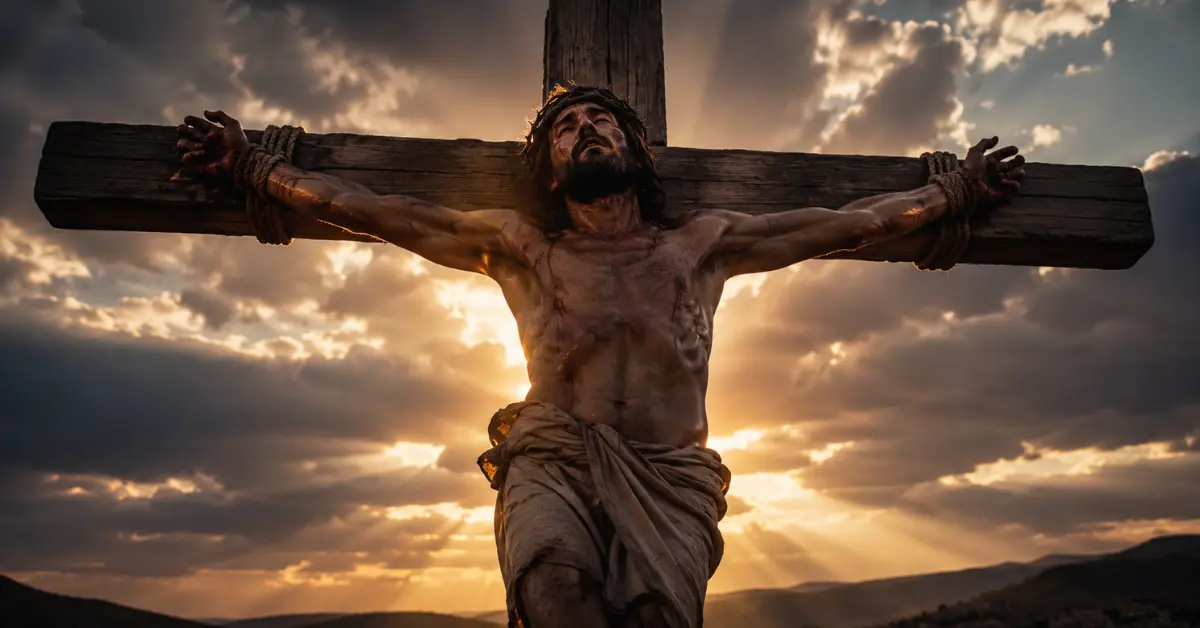

When Jesus said, “It is finished” in John 19:30, He announced that He haim to accomplish through His earthly ministry and sacrificial death. He had obeyed the Father, fulfilled the Scriptures leading to the cross and offered His life for sinners.
Jesus did not speak as someone admitting defeat. He spoke with the knowledge that He had carried His mission through to its appointed completion.
These words do not mean that every event in God’s plan had already happened. Jesus still had to rise from the dead, appear to His disciples and ascend to the Father. His declaration specifically marked the completion of the suffering and obedient work that led Him to the cross.
What Happened Immediately Before Jesus Said “It Is Finished”?
John places Jesus’ words within the final moments of the crucifixion:
“When Jesus had received the sour wine, He said, ‘It is finished.’ Then He bowed His head and gave up His spirit.”
— John 19:30
The surrounding verses explain the meaning of the moment.
Jesus knew that everything connected with His suffering had reached completion. He said, “I am thirsty,” and the soldiers lifted sour wine to His mouth. John connects this action with the fullfillment of Scripture.
After receiving the drink, Jesus declared, “It is finished.” He then bowed His head and gave up His spirit.
John does not describe Jesus as losing control of the situation. Throughout his Gospel, he presents Jesus as knowingly moving toward the purpose for which He came. Jesus understood what awaited Him and willingly continued toward the cross.
His final declaration therefore expressed completion rather than surprise, helplessness or despair.
Also Read: Sunday Encouragement Isaiah 41:10
What Does “Tetelestai” Mean?
The Greek word translated as “It is finished” is tetelestai. It comes from a verb that means to finish, complete, accomplish or bring something to its intended end.
The form of the word emphasizes that the work had reached completion. Jesus had not abandoned the task halfway through. He had brought it to the point the Father intended.
Some Christian teachings describe tetelestai as an ancient expression stamped on receipts to mean “paid in full.” That phrase can communicate a true Christian idea because the New Testament describes Christ as redeeming people and bearing the consequences of sin.
However, “paid in full” does not represent the most direct translation of tetelestai in John 19:30. The word itself means that something has finished or reached completion.
John’s Gospel provides the clearest explanation through Jesus’ earlier words.
Jesus said that His food involved doing the will of the One who sent Him and finishing His work. Later, He told the Father that He had glorified Him by completing the work entrusted to Him.
When Jesus reached the cross, He announced that this work had now reached its appointed end.
What Work Did Jesus Finish?
Jesus’ statement carries several closely connected meanings. The passage does not invite readers to choose only one.
Jesus finished the mission the Father gave Him
Jesus consistently described Himself as the One sent by the Father.
He came to reveal the Father, speak His words, perform His works, call people to faith and give His life for others. His ministry did not follow an accidental path that ended unexpectedly at the cross.
The cross formed part of the mission.
Jesus obeyed even when obedience brought rejection, suffering and death. When He said, “It is finished,” He announced that He had completed the work the Father required of Him through His earthly life and sacrifice.
Nothing had forced Him away from that purpose. Betrayal, false accusations, public humiliation and physical suffering had not caused Him to turn back.
He remained obedient to the end.
Jesus completed the suffering that led to His death
The hours of crucifixion had reached their conclusion.
Jesus had endured arrest, abandonment, questioning, mockery, scourging and the cross. He had experienced thirst and severe physical suffering. He had also carried the spiritual weight connected with offering Himself for sin.
“It is finished” meant that the suffering appointed for this moment had reached its end. Jesus did not say that suffering in the world had ended or that His followers would never suffer. He declared that His own sacrificial suffering on the cross had reached completion.
Christians therefore do not look for another sacrifice to replace or repeat what Jesus accomplished.
Jesus fulfilled the Scriptures connected with His death
John directly connects the final moments of Jesus’ life with the fulfillment of Scripture.
The Gospel describes the soldiers dividing His clothing, casting lots for His garment, offering Him sour wine and leaving His bones unbroken. John presents these details as part of the scriptural pattern reaching fulfillment in Jesus.
This does not mean that every biblical prophecy had already reached its ultimate fulfillment. Scripture still points toward Christ’s resurrection, the spread of the gospel, His return, final judgment and the renewal of creation.
Jesus completed the Scriptures connected with His earthly mission and death at that moment.
His words assured the reader that the cross fulfilled God’s purpose rather than interrupting it.
Jesus completed His sacrificial offering for sin
The New Testament explains Jesus’ death as a sacrifice offered once for all.
The sacrifices under the old covenant continued because they could not provide the final answer to human sin. Priests repeatedly offered sacrifices, but Jesus offered Himself.
His sacrifice did not require another victim to complete it. Christians do not add personal suffering, religious achievements or moral accomplishments to make Christ’s offering sufficient.
Jesus gave Himself fully.
“It is finished” therefore stands against the belief that people can earn reconciliation with God through their own goodness. Salvation rests on what Christ accomplished, not on a sinner’s ability to create a spotless record.
Did Jesus Mean “The Debt of Sin Is Paid in Full”?
Christians often use “paid in full” to summarize the saving meaning of the cross.
The New Testament uses the language of redemption, ransom, forgiveness and release. It teaches that Christ gave His life for sinners and freed them from a debt they could not resolve by themselves.
For that reason, “Jesus paid the debt of sin” can serve as a meaningful theological explanation.
However, readers should distinguish between the direct meaning of tetelestai and the wider Christian interpretation of the cross.
Jesus directly said, “It has been completed.” The broader New Testament helps Christians understand what His completed work accomplished, including redemption, forgiveness and reconciliation.
The theological truth does not depend on claiming that tetelestai functioned as a common receipt stamp.
Did “It Is Finished” Include the Resurrection?
Jesus spoke these words before His death and resurrection. Therefore, He did not mean that every stage of His saving mission had already taken place.
The resurrection remained essential.
Without it, the disciples would not receive confirmation that death had failed to hold Jesus. The resurrection publicly vindicated Him, demonstrated His victory over death and became central to the apostles’ preaching.
“It is finished” refers most directly to the obedient work and sacrificial suffering that reached completion at the cross.
The resurrection did not correct an incomplete sacrifice. It revealed the victory and significance of what Jesus had accomplished through His death.
The cross and resurrection belong together, but they do not describe the same event.
Did Jesus’ Words End the Old Covenant?
Jesus fulfilled the law and established the new covenant through His blood.
His death changed the way God’s people approached sacrifice, priesthood and covenant worship. Christians no longer depend on repeated animal sacrifices because Jesus offered the decisive sacrifice.
However, saying that Jesus fulfilled the law does not mean that the Old Testament became meaningless or that Christians received permission to ignore holiness.
Jesus brought the law and the promises toward their intended fulfillment. The Old Testament still reveals God’s character, humanity’s need, the history of His people and the promises that lead to Christ.
Christians obey God as a response to grace, not as an attempt to complete something Jesus failed to finish.
Did Jesus End the Power of Sin and Death?
Jesus decisively confronted sin through the cross, but believers still experience temptation, weakness and physical death.
The New Testament describes salvation through an already-and-not-yet pattern.
Christ has already secured victory. Sin no longer holds unquestioned authority over those who belong to Him. Death cannot make the separation from God permanent.
However, Christians still wait for the complete removal of sin, suffering and death when God brings His saving plan to its final fulfillment.
“It is finished” does not mean that believers will never struggle. It means their hope rests on Christ’s completed work rather than the uncertain outcome of their own efforts.
Why Did Jesus Bow His Head and Give Up His Spirit?
John says that Jesus bowed His head and gave up His spirit after making His declaration.
The order matters.
Jesus did not die and then leave others to decide whether His work had succeeded. He consciously announced completion and then surrendered His life.
Earlier in John’s Gospel, Jesus explained that no one ultimately took His life from Him. He laid it down willingly.
Human authorities remained responsible for condemning and crucifying Him, but they did not overturn God’s purpose. Jesus knowingly gave Himself.
John presents His death as a willing act of obedient love.
What “It Is Finished” Means for Christians Today
Jesus’ words speak directly to the way Christians understand salvation, guilt and obedience.
You cannot earn what Christ completed
People often try to make themselves acceptable to God through religious effort, moral improvement or comparison with others.
Christian obedience matters, but it does not replace the cross. Good works grow from faith; they do not complete Christ’s sacrifice.
A believer obeys because Christ has saved them, not because Christ completed only part of the work and left the rest for them to finish.
Repentance still matters
“It is finished” does not mean that sin has become unimportant.
The cross reveals both the seriousness of sin and the depth of God’s mercy. Grace does not encourage believers to protect destructive habits. It calls them to confess sin, receive forgiveness and turn toward a new way of life.
Christ completed the sacrifice for sin, but He did not approve a life that refuses repentance.
Guilt does not need to control a repentant believer
Some believers confess the same forgiven failure repeatedly because they believe continued shame proves sincerity.
The cross calls them to honest repentance, but it also calls them to trust Christ.
A repentant Christian can acknowledge the seriousness of sin without acting as though personal suffering adds something to Jesus’ completed work.
Conviction leads a person back to God. Condemning shame tells the person that Christ’s mercy can never become enough.
Christian service becomes a response to grace
Jesus’ finished work does not make Christian effort unnecessary.
Believers still pray, serve, forgive, pursue holiness and care for others. They do these things as a response to salvation rather than as a payment for it.
Grace produces faithful living when believers understand it correctly.
“It Is Finished” Was a Declaration of Completion
Jesus did not declare that He had failed, surrendered to His enemies or reached the end of His influence.
He declared that He had completed the work the Father gave Him through His obedient life and sacrificial death.
The Scriptures connected with His suffering had reached fulfillment. His offering had reached completion. He had remained faithful through the final moment.
The resurrection would soon reveal that the apparent defeat of the cross had become the place of victory.
For Christians, “It is finished” means that salvation begins with Christ’s accomplishment rather than human achievement. Believers still repent, obey and grow, but they do not perform those actions to repair an unfinished sacrifice.
They trust the One who carried His mission to completion.
Frequently Asked Questions
Does “It is finished” mean believers never need to repent?
No. Christ’s finished work provides the foundation for forgiveness. Believers still confess sin, turn away from it and continue growing in obedience.
Does “It is finished” mean Christians do not need good works?
No. Good works do not complete salvation, but they express living faith and gratitude. Christians obey because Christ has saved them, not to make His sacrifice sufficient.
Was “It is finished” Jesus’ final statement?
John records it immediately before Jesus gave up His spirit. Luke also records Jesus entrusting His spirit to the Father. The Gospel accounts preserve different words from the same final period of the crucifixion.
Did Jesus finish everything before the resurrection?
No. The resurrection, appearances and ascension still followed. Jesus specifically announced the completion of the work that led to and included His sacrificial death.
What exactly did Jesus finish on the cross?
He completed His obedient earthly mission, fulfilled the Scriptures connected with His suffering and offered His life as the decisive sacrifice for sin.

How did Jesus fulfill crushing Satan’s head as promised in Genesis 3:15.