
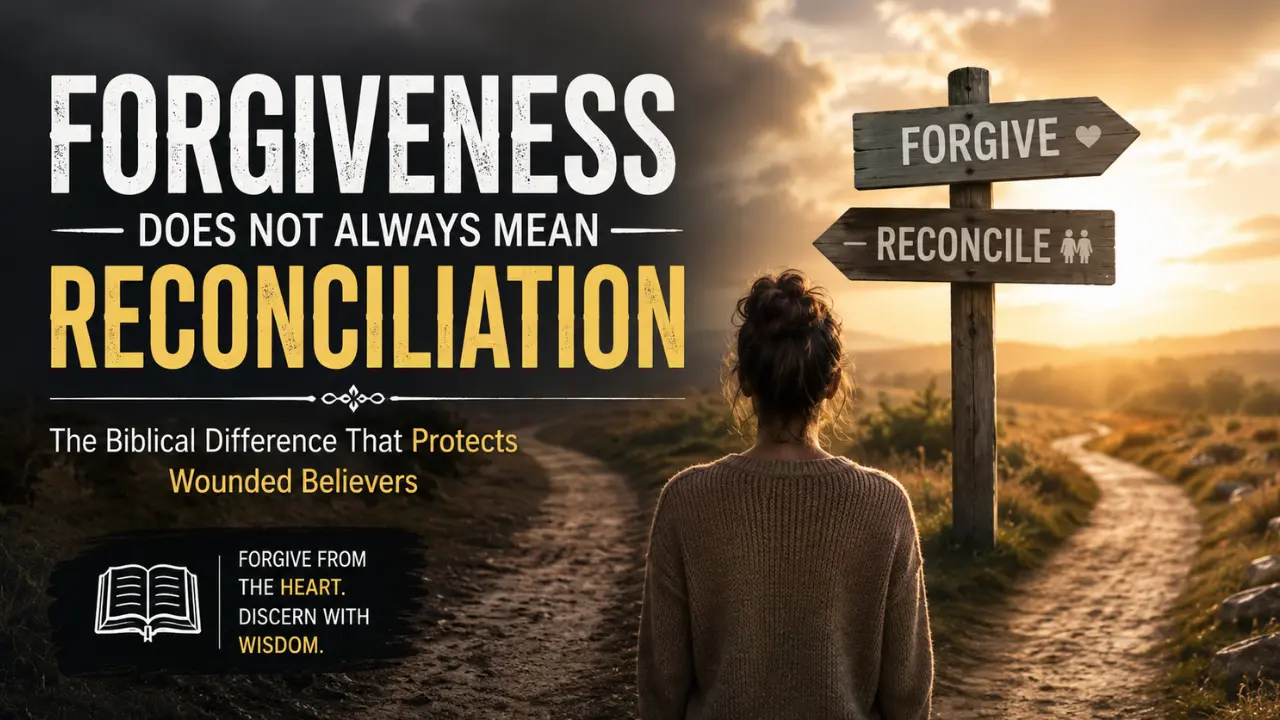

Forgiveness and reconciliation often get treated like the same command, but the Bible shows a deeper difference. A Christian can forgive someone from the heart while still refusing to rebuild trust with a person who shows no repentance, honesty, or change.
This truth matters because many wounded believers carry guilt for staying away from people who harmed them. They hear, “You need to forgive,” and they assume that means they must return to the same relationship, the same access, the same vulnerability, and the same pain.
Scripture never teaches that kind of spiritual confusion. God calls believers to forgive, but He also calls them to walk in wisdom, test fruit, guard the heart, and avoid destructive patterns.
Debate Many Christians Avoid
Some Christians believe forgiveness must always lead to full reconciliation. They say, “If you really forgave them, you would talk to them again.” Others believe forgiveness only means personal peace and never requires any relational effort.
Both views miss something important.
Forgiveness deals with the debt of the heart. Reconciliation deals with the repair of the relationship. Forgiveness can happen inside one person before the other person ever changes. Reconciliation needs truth, humility, repentance, safety, and a willingness from both sides to rebuild what sin damaged.
Jesus taught forgiveness clearly. He also told His followers to use discernment. He told them to love enemies, but He also warned them about wolves in sheep’s clothing. He sent them out as sheep among wolves, but He told them to remain wise as serpents and innocent as doves.
Biblical love never means blind access.
Forgiveness becomes harder when you keep holding the full emotional weight alone, which is why 5 Signs You Need to Cast Your Burden on the Lord can guide readers toward deeper surrender.
What Forgiveness Means in the Bible
Forgiveness means you release personal revenge and hand justice to God. It means you stop feeding bitterness, rehearsing hatred, and wishing destruction on the person who hurt you.
Forgiveness does not mean you deny the wound. It does not mean you pretend sin never happened. It does not mean you protect someone from the consequences of their choices.
When Jesus told His followers to forgive, He aimed at the heart. He knew resentment can turn pain into poison. A believer can suffer from someone else’s sin once, then suffer again for years through bitterness, anger, and endless mental arguments.
Forgiveness breaks that inner chain.
It says, “I will not become cruel because someone treated me cruelly. I will not play God. I will not carry revenge as my identity. I will trust the Lord with justice.”
That kind of forgiveness takes courage. It does not excuse evil. It refuses to let evil rule the heart.
What Reconciliation Requires
Reconciliation means two people move toward restored relationship. That process requires more than words. It requires truth.
A person who wants reconciliation must show humility. They must name the wrong honestly. They must stop shifting blame. They must accept responsibility without using spiritual language to escape accountability.
Many people want access without repentance. They want the relationship back without doing the hard work of repair. They say, “I already said sorry,” but they keep repeating the same harm. They demand forgiveness while ignoring the damage they caused.
The Bible does not call that reconciliation. It calls for discernment.
Forgiveness Can Be One-Sided
Forgiveness can happen in your heart before the other person ever apologizes. You can release revenge even when they never admit the truth.
Reconciliation cannot work that way. It needs participation from both sides.
| Biblical Issue | Forgiveness | Reconciliation |
|---|---|---|
| Main focus | Your heart before God | The relationship between people |
| Requirement | Obedience, mercy, release of revenge | Truth, repentance, safety, changed behaviour |
| Can one person do it alone? | Yes | No |
| Does it always restore access? | No | Only when trust can grow again |
| Does it ignore consequences? | No | No |
This difference protects believers from false guilt. You can forgive someone and still decide that close access would create spiritual, emotional, or practical harm.
Jesus Did Not Trust Everyone the Same Way
Jesus showed perfect mercy, but He never practiced foolish trust. John 2 says Jesus did not entrust Himself to everyone because He knew what lived in the human heart.
That detail matters.
Jesus loved people deeply. He ate with sinners. He forgave. He healed. He restored. Yet He also recognized hidden motives, hypocrisy, manipulation, and false repentance.
Christian love does not require emotional naivety. The Holy Spirit produces love, but He also gives wisdom. A forgiving heart does not need to become an unguarded heart.
When someone keeps lying, manipulating, abusing, mocking repentance, or using Scripture to pressure you, you do not honor God by pretending everything has changed. You honor God by walking in truth.
When someone wants to forgive but still feels emotionally broken, 8 Reasons Psalm 34:18 Comforts a Broken Heart gives a gentle biblical reminder of God’s presence.
Bible Connects Peace With Wisdom
Romans 12:18 gives one of the clearest principles for difficult relationships: “If possible, so far as it depends on you, live peaceably with all.”
That phrase carries two important limits.
First, “if possible” means peace does not always depend on one person. Some people refuse peace unless you surrender truth. Some people want control, not restoration. Some people only behave well when they get access again.
Second, “so far as it depends on you” means God holds you responsible for your obedience, not someone else’s rebellion. You can speak gently, repent where needed, forgive from the heart, and still face a person who refuses honesty.
Peace requires wisdom because fake peace often protects sin. Biblical peace does not bury truth under silence. It brings truth under the authority of God.
Forgiveness Does Not Remove All Consequences
Many believers confuse forgiveness with consequence removal. They think, “If I forgave them, I cannot set any boundary.” But Scripture never teaches that.
God forgave David after his sin, yet David still faced serious consequences. Jesus forgave the thief on the cross, yet the thief still remained on the cross. Forgiveness restores the heart before God, but consequences may still continue in life.
This principle matters in families, friendships, churches, and marriages. A person may need forgiveness and counseling. A person may need forgiveness and distance. A person may need forgiveness and legal accountability. A person may need forgiveness and time to rebuild trust.
Consequences do not always prove unforgiveness. Sometimes they prove that truth matters.
When Reconciliation Becomes Unwise
Reconciliation becomes unwise when the other person wants closeness without repentance. A relationship cannot heal while someone keeps protecting the same sin that broke it.
Look for patterns, not just emotional words.
A person may say “sorry” because they fear losing access. A person may cry because they dislike consequences. A person may quote Scripture because they want control. None of that automatically shows repentance.
Repentance carries fruit.
A repentant person tells the truth. They stop minimizing the wound. They listen without turning themselves into the victim. They give space for trust to grow slowly. They accept that forgiveness does not instantly restore the relationship to its former place.
Signs Reconciliation May Need More Time
Reconciliation may need more time when:
- The person keeps repeating the same behavior.
- They blame you for reacting to their sin.
- They demand immediate access.
- They use Christian language to pressure you.
- They refuse counsel, correction, or accountability.
- They treat boundaries as punishment instead of wisdom.
- They apologize quickly but change nothing slowly.
These signs do not mean you should hate the person. They mean you should slow down and seek wisdom.
Forgiveness Should Not Become a Tool for Manipulation
Some people use forgiveness language in a spiritually harmful way. They say, “A real Christian would forgive me,” but they really mean, “A real Christian would let me continue.”
That sentence twists the gospel.
The gospel never gives sinners permission to keep harming others. Grace does not protect pride. Mercy does not erase truth. Forgiveness does not give someone a spiritual right to repeat damage.
Jesus confronted sin because love tells the truth. He forgave sinners, but He also told people to leave sin. He gave mercy without pretending rebellion had no danger.
A believer should never use forgiveness as a weapon against another wounded believer.
You Can Forgive and Still Grieve
Forgiveness does not instantly remove sadness. A person can forgive and still cry over what happened. They can release revenge and still miss what the relationship once seemed to be. They can pray for someone and still feel pain when memories return.
This does not mean forgiveness failed.
Grief often follows betrayal because betrayal kills trust, innocence, safety, and expectations. Forgiveness deals with hatred, but grief deals with loss. God cares about both.
The Psalms show this clearly. David often brought pain, anger, fear, confusion, and sorrow before God. He did not pretend pain made him less faithful. He took pain into prayer instead of letting it rule him.
A forgiving Christian can still need healing.
What About Jesus Telling Us to Forgive Seventy-Seven Times?
Jesus taught repeated forgiveness because the human heart easily keeps score. He did not want His followers to become revenge-driven people who measure mercy with a calculator.
But repeated forgiveness does not mean repeated foolishness.
You can forgive seventy-seven times and still stop giving the same person seventy-seven chances to harm you in the same way. Forgiveness deals with your refusal to seek revenge. Boundaries deal with your responsibility to walk wisely.
For example, you can forgive someone who keeps lying, but you do not need to keep trusting their words. You can forgive someone who keeps gossiping, but you do not need to keep sharing private details. You can forgive someone who keeps manipulating, but you do not need to keep giving them emotional control.
Mercy and wisdom belong together.
How to Forgive Without Rushing Reconciliation
Many believers need a practical path because the difference sounds clear in teaching but feels hard in real life.
Start with honesty before God. Do not pretend the wound felt small if it deeply hurt you. Tell the Lord what happened, how it affected you, and what you fear.
Then release revenge. Ask God to remove the desire to punish the person with your own hands. This does not mean you stop caring about justice. It means you trust God more than your anger.
Next, check your own heart. Forgiveness does not remove your need to repent where you sinned in response. Sometimes another person hurt you first, but bitterness later tempted you to speak, think, or act in ways that did not honor God.
After that, look for fruit. Do not rebuild trust on emotion alone. Watch patterns. Listen for humility. Notice whether the person welcomes accountability or rejects it.
Finally, move slowly. God does not require you to rebuild in one emotional moment what someone damaged over time.
A Biblical Way to Think About Trust
Trust grows through faithful behavior over time. It does not return automatically because someone said the right words.
This matters because many people want the benefits of trust without the discipline of trustworthiness. They want access, closeness, influence, and comfort, but they do not want patience, humility, confession, or change.
Biblical trust should rest on fruit. Jesus told His followers that fruit reveals the tree. A person’s pattern matters more than one emotional apology.
That does not mean you become suspicious of everyone. It means you refuse to confuse love with carelessness.
When You Should Pursue Reconciliation
You should pursue reconciliation when the relationship can move toward truth, safety, and godly repair. Some relationships deserve patient effort, especially when both people show humility.
Reconciliation may become wise when:
- The person admits the wrong without excuses.
- They respect your healing process.
- They accept accountability.
- They show changed behavior over time.
- They stop demanding instant closeness.
- They care more about truth than image.
- They want restoration, not control.
In those moments, grace can rebuild something beautiful. Some relationships heal deeply because both people humble themselves before God. Forgiveness opens the door, and repentance helps rebuild the road.
When Distance Can Honor God
Distance can honor God when closeness would keep feeding sin, fear, manipulation, or confusion. Some believers need to hear that clearly because they assume distance always means bitterness.
It does not.
Jesus sometimes withdrew from crowds. Paul sometimes separated from harmful people. Proverbs warns about close companionship with angry, foolish, or destructive people. Scripture never commands believers to hand their hearts to unsafe people without discernment.
Distance should not come from hatred. It should come from wisdom, prayer, and a desire to obey God with a clean heart.
You can keep distance without slander. You can set boundaries without cruelty. You can pray for someone without giving them the same place in your life.
The Hardest Part Is Letting God Judge Fairly
Forgiveness feels hard because the heart wants to make sure the wrong counts. We fear that if we forgive, the person “gets away with it.”
But God sees everything. He sees the action, the motive, the damage, the tears, the hidden manipulation, and the private grief. No human court of opinion sees as clearly as He does.
Forgiveness does not say, “The wrong did not matter.” Forgiveness says, “God can judge this better than I can.”
That trust frees the wounded believer from carrying a burden only God can carry.
A Simple Prayer for Forgiveness and Wisdom
Lord, help me forgive without pretending the wound did not matter. Remove bitterness from my heart, but also give me wisdom about trust. Teach me to release revenge without rushing unsafe reconciliation. Help me love people truthfully, walk in peace where possible, and honor You with both mercy and discernment. Amen.

3 thoughts on “Forgiveness vs Reconciliation in the Bible”