
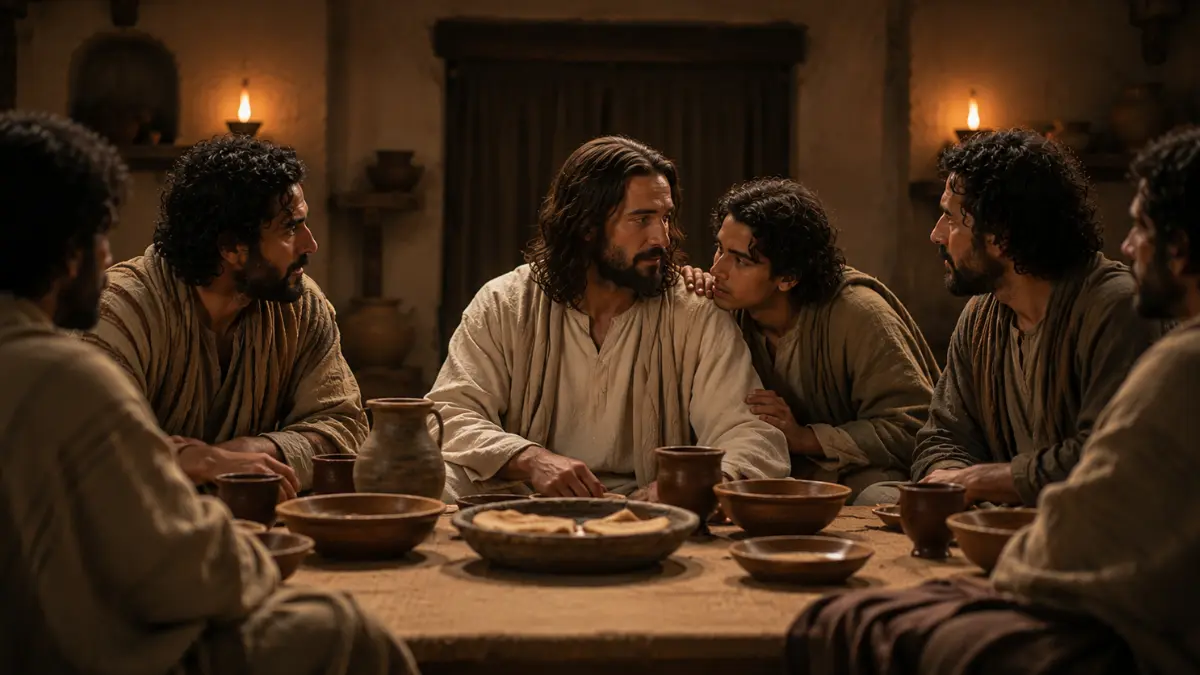

The Bible does not provide a complete seating chart for the Last Supper. However, John 13 gives enough detail to identify at least one disciple who reclined immediately beside Jesus and to make careful deductions about Judas and Peter.
The disciple whom Jesus loved occupied the clearest position next to Jesus. Christian tradition commonly identifies this disciple as John. Judas also appears to have remained close enough for Jesus to hand him a dipped piece of bread directly. Peter probably reclined farther away because he motioned to the beloved disciple and asked him to question Jesus privately.
These details allow readers to form a reasonable picture of the meal, but Scripture never identifies the exact position of every disciple. Any complete diagram must therefore include some interpretation rather than biblical certainty.
Readers who need the wider context of the meal, including the Passover setting, the bread and cup and Jesus’ final teachings, can read The Last Supper and Communion Explained. This article focuses specifically on where Jesus and the disciples likely reclined.
Disciples Reclined Rather Than Sitting on Chairs
Modern readers often imagine Jesus and the disciples sitting upright on chairs around a tall dining table. The Gospel accounts present a different picture.
Luke 22:14 says that Jesus and the apostles reclined when the hour for the meal arrived. John also describes the beloved disciple reclining beside Jesus and leaning back toward Him. These descriptions match the dining posture common during formal meals in the ancient Mediterranean world. Diners reclined on their sides near a low table, with their heads toward the food and their feet extending away from it.
A person normally supported the upper body with the left arm and used the right hand to take food. This position helps explain John’s description of one disciple leaning back toward Jesus. The passage does not describe two men sitting shoulder to shoulder in modern chairs. It describes diners reclining close together around a shared meal.
The arrangement also explains why the Gospel writers could say that one disciple reclined near Jesus’ chest or leaned back against Him. The disciple occupied the place immediately in front of Jesus within the reclining order and could move backward to ask Him a quiet question.
Beloved Disciple Reclined Closest to Jesus
John 13 provides the strongest evidence about the seating arrangement.
After Jesus announced that one of the disciples would betray Him, the group looked at one another in confusion. Peter wanted to know whom Jesus meant, so he motioned to the disciple whom Jesus loved and encouraged him to ask.
That disciple then leaned back toward Jesus and asked, “Lord, who is it?” Jesus answered that the betrayer was the person to whom He would give a dipped piece of bread. He then gave the bread to Judas.
The beloved disciple could speak quietly with Jesus because he reclined directly beside Him. The physical arrangement made private communication possible even though the larger group remained present.
Therefore, the safest biblical conclusion says:
- The beloved disciple reclined immediately next to Jesus.
- He occupied a position close enough to lean back toward Jesus.
- Peter could see him and signal to him.
- Jesus could answer without every disciple fully understanding the exchange.
This disciple represents the only person whom the Gospel explicitly places beside Jesus in such clear language.
Was the Beloved Disciple John?
The Gospel of John never names the beloved disciple in the Last Supper passage. It calls him “the disciple whom Jesus loved.”
Christian tradition has usually identified him as John, the son of Zebedee and one of the Twelve. This identification also explains why many Last Supper diagrams place John immediately beside Jesus.
However, readers should distinguish tradition from the wording of the passage. John 13 does not say, “John sat next to Jesus.” It says that the disciple whom Jesus loved reclined there.
Several passages near the end of the Gospel connect this disciple with the testimony behind the book. This connection has strengthened the traditional identification with John. Even so, the article should not present the name as though John 13 states it directly.
A precise explanation would say that the beloved disciple, traditionally understood as John, reclined next to Jesus.
Did Judas Sit on the Other Side of Jesus?
Judas may also have reclined directly beside Jesus, but the Bible does not state his position as clearly as it states the beloved disciple’s position.
Jesus dipped a piece of bread into the dish and handed it to Judas. This action suggests that Judas remained within easy reach. Ancient diners shared food from common dishes, so Jesus would not necessarily have needed Judas in the immediately adjacent position. However, the direct and apparently discreet exchange makes a nearby position likely.
Many reconstructed seating plans place Judas on one side of Jesus and the beloved disciple on the other. This arrangement would explain several details:
- Jesus could hand the dipped bread directly to Judas.
- Judas could speak with Jesus during the betrayal announcement.
- Most of the other disciples did not understand what Jesus meant when He told Judas to act quickly.
- The beloved disciple could lean toward Jesus from the opposite side.
The position would also carry a painful irony. Judas may have received a place of closeness while he had already committed himself to betrayal. Jesus knew what Judas planned, yet He continued to address him directly during the meal.
Still, readers should describe this placement as probable rather than certain. John confirms the exchange of bread but does not say, “Judas reclined immediately beside Jesus.”
The separate question of whether Judas remained when Jesus instituted the Lord’s Supper requires a comparison of all four Gospel accounts. That issue appears in Did Judas Take Communion at the Last Supper?.
Where Did Peter Sit at the Last Supper?
Peter probably did not recline immediately beside Jesus.
John says that Peter motioned to the beloved disciple and asked him to find out whom Jesus meant. If Peter had occupied the place directly next to Jesus, he could have asked the question himself. His decision to communicate through another disciple suggests some distance between him and Jesus.
The passage does not reveal how far away Peter reclined. He may have occupied another place around the same low table while remaining visible to the beloved disciple. A hand signal, facial expression, or quiet instruction could have communicated his request.
Some traditional diagrams place Peter opposite the beloved disciple or several positions away. Others assign him a place near the end of a U-shaped arrangement. Scripture cannot confirm either reconstruction.
Peter’s location also reminds readers that prominence within the group did not necessarily determine seating beside Jesus. Peter often spoke for the disciples and played a leading role, but another disciple occupied the place close enough for private conversation during this moment.
Can We Identify the Seats of the Other Disciples?
The Gospels do not reveal where Andrew, James, Thomas, Philip, Bartholomew, Matthew, Simon the Zealot, James son of Alphaeus, Thaddaeus, or the other disciples reclined.
Artists and Bible teachers sometimes create complete diagrams that assign a specific location to all twelve disciples. These diagrams may help readers visualize the scene, but most of their placements depend on assumptions.
The Gospel accounts provide only a few relational clues:
- The beloved disciple reclined next to Jesus.
- Peter remained close enough to signal to him but probably not close enough to question Jesus privately.
- Judas remained close enough for Jesus to give him dipped bread.
- Jesus and the apostles reclined together around the meal.
- The disciples could speak with one another during the betrayal announcement and their later disagreement about greatness.
These details create a general picture rather than a numbered seating plan.
An article should not identify the remaining seats unless it clearly labels them as imaginative or historical reconstruction. Scripture gives no basis for claiming that Thomas occupied the fourth place, Matthew sat across from Jesus, or Andrew reclined at a particular end of the table.
Was the Table U-Shaped?
Many modern reconstructions place the Last Supper around three sides of a low U-shaped dining arrangement, often called a triclinium.
Roman dining customs influenced formal meals throughout the Mediterranean world. A three-sided arrangement allowed servants to approach the open center or side while guests reclined around the other sections.
This setting provides one plausible way to understand the Gospel descriptions. It allows diners to recline, share common dishes, speak across the table, and occupy places of differing social honor.
However, recent archaeological discussion has questioned whether Christians should automatically assume an elite Roman triclinium for the Last Supper. The Gospels establish reclining, but they do not describe the table’s exact shape, size, furniture, or decoration.
The meal may have used cushions, mats, couches, one low table, or several surfaces arranged for the group. A U-shaped table offers a helpful model, but it does not carry the authority of the biblical text.
Why Leonardo da Vinci’s Arrangement Is Not a Seating Record
Leonardo da Vinci’s famous painting has shaped the way millions of people imagine the Last Supper. It presents Jesus at the centre of a long rectangular table, with all twelve disciples facing the viewer from the same side.
Leonardo created the mural between 1495 and 1498 for the refectory of the Dominican monastery of Santa Maria delle Grazie in Milan. He designed a Renaissance work of art more than fourteen centuries after the biblical event.
The painting communicates emotion, movement, betrayal, and the centrality of Jesus with remarkable artistic power. However, it does not attempt to provide an archaeological reconstruction of a first-century Jewish meal.
Leonardo needed viewers in the monastery dining hall to see every face. Placing the disciples along one side of the table served the visual composition. A historically reconstructed reclining arrangement would have hidden some figures behind others or turned their backs toward the viewer.
Christians can value the painting without treating it as evidence about where the disciples sat. John 13, Luke 22, and the other Gospel accounts provide the primary information.
What Is the Most Likely Seating Arrangement?
A cautious reconstruction would place Jesus among reclining disciples near a low dining surface.
The beloved disciple, traditionally identified as John, occupied the position immediately beside Jesus. Judas probably reclined close to Jesus, possibly on the other side, because Jesus handed him the dipped bread. Peter likely occupied a place farther away but within sight of the beloved disciple.
Beyond those three disciples, the evidence becomes too limited to assign individual seats.
The most responsible summary looks like this:
| Person | Likely position | Level of certainty |
|---|---|---|
| Jesus | Host within the reclining group | Certain |
| Beloved disciple | Immediately beside Jesus | Strong biblical evidence |
| John | Traditionally identified as the beloved disciple | Strong tradition, not named in John 13 |
| Judas | Very near Jesus, possibly immediately beside Him | Probable |
| Peter | Farther from Jesus but within sight of the beloved disciple | Reasonable deduction |
| Other disciples | Around the shared meal | Exact positions unknown |
This reconstruction explains the conversation without claiming that the Bible gives more detail than it actually provides.
Why Does the Seating Arrangement Matter?
The seating arrangement helps readers understand the physical actions described in John 13.
The beloved disciple did not cross a room to question Jesus. He leaned back from a nearby reclining position. Peter did not speak directly because another disciple occupied the closer place. Jesus handed Judas bread within the normal movement of a shared meal.
The likely arrangement also adds emotional depth to the betrayal. Judas did not operate from the edge of the gathering as an obvious outsider. He shared the table and may have occupied a place very close to Jesus.
At the same time, the seating order should not become a basis for judging which disciple Jesus valued most. Jesus had already washed the disciples’ feet and taught them to reject competition for status. Physical proximity during one meal does not provide a complete ranking of spiritual importance.
The Gospels direct attention toward Jesus’ knowledge, service, teaching, and approaching sacrifice rather than toward a permanent hierarchy of seats.
Who Was Sitting Next to Jesus at the Last Supper?
The disciple whom Jesus loved sat—or more accurately, reclined—next to Jesus at the Last Supper. Christian tradition generally identifies this disciple as John.
Judas probably remained very near Jesus and may have occupied the place on His other side because Jesus handed him the dipped bread. Peter appears to have reclined farther away because he signalled to the beloved disciple to ask Jesus about the betrayer.
The Bible does not identify the remaining positions or provide a complete seating chart. U-shaped diagrams can help readers visualize the scene, but they remain reconstructions.
After the meal, Jesus and the disciples sang before leaving for the Mount of Olives. The Gospels do not name that song, but the Passover context provides important clues in What Hymn Did Jesus Sing After the Last Supper?.
Scripture gives enough detail to understand the conversation and the physical closeness of the principal figures. It does not give enough information to assign every disciple a numbered seat.
Frequently Asked Questions
Did John sit beside Jesus at the Last Supper?
The Gospel describes the disciple whom Jesus loved reclining beside Jesus. Most Christian tradition identifies him as John, but readers should distinguish that traditional identification from the exact wording of John 13.
Did Judas sit next to Jesus at the Last Supper?
Judas probably reclined very close to Jesus because Jesus handed him a dipped piece of bread. However, the Bible does not explicitly say that Judas occupied the seat immediately beside Him.
Was Judas on the other side of Jesus from John?
Many reconstructed seating plans place the beloved disciple on one side of Jesus and Judas on the other. This arrangement fits several Gospel details, but Scripture does not confirm it directly.
Did the disciples sit on chairs at the Last Supper?
They most likely reclined around a low dining surface rather than sitting upright on modern chairs. Luke and John use language that describes reclining during the meal.

1 thought on “Who Sat Next to Jesus at the Last Supper? Explained”