
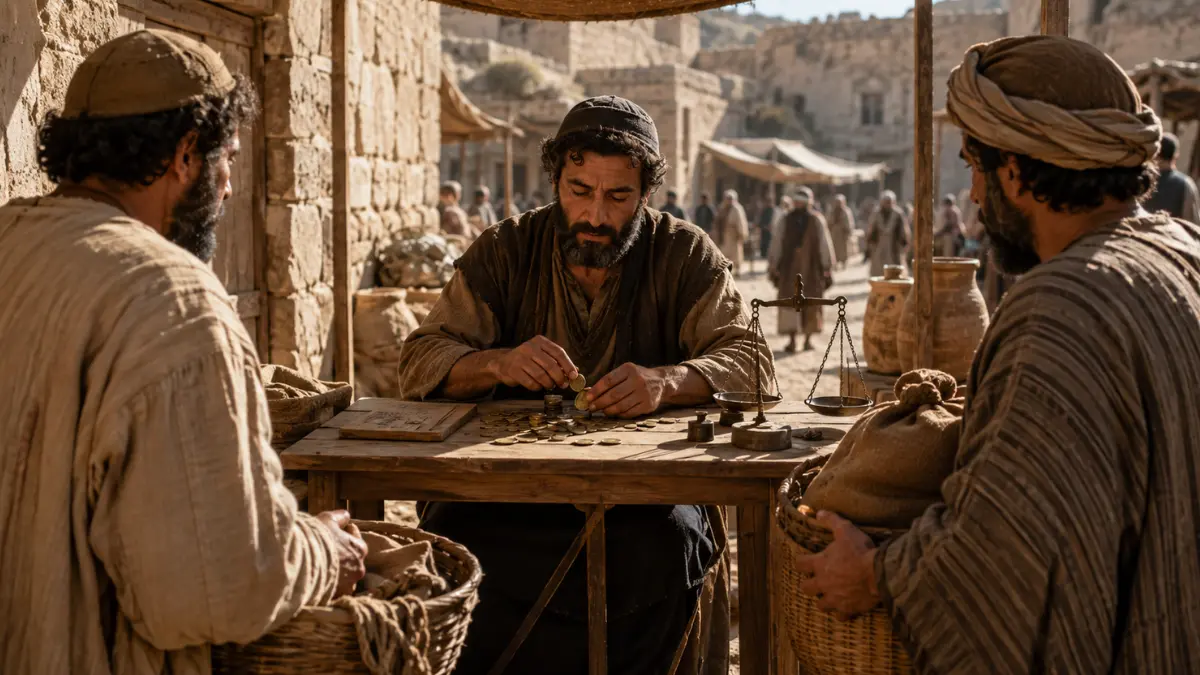

Why were tax collectors hated in the Bible? They collected money for Roman or Roman-supported rulers, worked within systems that made overcharging possible, and often appeared to profit from the hardship of their own communities.
Tax collectors were hated because people associated them with foreign control, financial exploitation, personal greed and betrayal. The Gospels reflect this reputation when they repeatedly group tax collectors with “sinners.” However, the historical picture requires an important distinction: not every tax collector worked directly for Rome and the Bible does not say that every individual collector was dishonest.
What Did a Tax Collector Do in Jesus’ Time?
The Gospels use the Greek word telōnēs for a tax collector. Older English Bibles, particularly the King James Version, commonly translate this word as “publican.”
That translation can cause confusion. The Latin publicani were often wealthy contractors who obtained government revenue contracts. The tax collectors encountered by ordinary people could occupy lower positions, collecting tolls, customs duties or other payments on behalf of those contractors and local authorities.
This means “tax collector” did not always describe one identical job. Some collectors dealt with taxes assessed on land, property or agricultural production, while others collected duties on goods moving through towns, ports, roads and territorial boundaries.
Matthew appears to have belonged to the second group. Matthew 9:9 describes him sitting at a telōnion, meaning a toll booth or customs station. The parallel accounts in Mark 2:14 and Luke 5:27 call the man Levi.
The Gospel setting places this booth near Capernaum, an important location for fishing and regional trade. Matthew may therefore have collected duties on commercial goods moving through the area rather than personally assessing every kind of Roman tax.
Why Did Tax Collection Feel Like Political Betrayal?
Taxation reminded people who held political power over them. In Judea, Roman authorities controlled taxation after the region came under direct Roman administration in AD 6. Galilee, where much of Jesus’ ministry took place, remained under Herod Antipas, a local ruler whose authority depended on Roman support.
For ordinary Jewish families, the distinction between a Roman tax and a Herodian toll did not necessarily remove the political resentment. Both systems supported rulers operating within the wider Roman order.
Collectors also worked among the people being taxed. They were not distant officials whom villagers never saw. They stood at local booths, inspected goods, demanded payments and represented the ruling system during everyday transactions. A Jewish collector could therefore appear to be helping powerful rulers extract money from his own neighbours.
The political tension surrounding taxation became especially clear during the census associated with Quirinius. According to Acts 5:37, Judas the Galilean led a revolt during the census. Josephus also connects this resistance with opposition to Roman taxation and rule. Not everyone joined such resistance, but the episode shows why taxes could carry political and religious significance beyond the amount of money involved.
Calling every tax collector a direct Roman employee would still be inaccurate. Matthew may have collected tolls under Herod Antipas, while Zacchaeus worked in Jericho within Roman-administered Judea. Their precise positions differed but both belonged to revenue systems that many people resented.
How Did the Collection System Encourage Abuse?
Ancient governments frequently depended on contracts, intermediaries and local agents to collect revenue. In some arrangements, an authority expected a fixed payment while contractors and collectors recovered that amount from the population. The structure created an opportunity to demand more than the official amount and keep part of the surplus.
Ordinary people could find it difficult to challenge an assessment. They might not know the exact legal rate, and the collector represented a government that possessed greater political and financial power than they did. This imbalance made extortion possible even if not every collector used it dishonestly.
John the Baptist’s instructions in Luke 3:12–13 reveal that overcollection was a genuine concern. When tax collectors asked what they should do, John told them to collect no more than the amount authorized. His response did not command them to abandon the occupation, but it directly addressed the abuse associated with it.
That distinction matters. Scripture condemns dishonest collection rather than declaring that receiving public revenue was automatically sinful. The moral problem arose when a collector used his authority to take more than he had a right to receive. This form of exploitation fits the Bible’s broader warnings about oppression and the misuse of power.
Were Matthew and Zacchaeus Doing the Same Job?
Matthew and Zacchaeus were both tax collectors, but the Gospels describe different positions.
Matthew sat at a toll booth near Capernaum. Historical reconstructions commonly associate the booth with duties on goods moving between the territories of Herod Antipas and his brother Philip. Because the Gospel does not identify Matthew’s exact employer or contract, this remains a reasonable historical inference rather than a stated biblical fact. Michael J. Kok’s study of Matthew’s toll-booth tradition also places the booth near Capernaum and connects it with movement between those territories.
Luke 19:2 calls Zacchaeus a “chief tax collector” and says that he was wealthy. The Greek title architelōnēs suggests a more senior position than that of a person sitting at an ordinary collection booth. He may have supervised other collectors, controlled revenue rights in the area or managed a larger collection operation.
Jericho made such a position potentially profitable. The city stood near important travel and commercial routes and was associated with valuable agricultural products. Craig Keener explains that Jericho offered substantial opportunities for customs collection, helping to explain both Zacchaeus’s wealth and his prominent title.
Matthew therefore represents a collector working at a toll station, while Zacchaeus appears to have held a higher managerial position. Neither example should be treated as a complete description of every tax collector in the first-century world.
Were All Tax Collectors Dishonest?
The Gospels present tax collectors as a socially despised group but they do not prove that every collector cheated people.
Luke 3:12–13 shows that tax collectors could respond to John the Baptist without leaving their occupation. His instruction assumes that they could perform their work honestly by taking only the authorized amount.
The story of Zacchaeus also requires careful language. Luke 19:8 records him saying that he gives half of his possessions to the poor and repays fourfold if he has defrauded anyone. Many readers understand this as a new promise of restitution following his encounter with Jesus.
However, the Greek verbs translated “I give” and “I restore” are in the present tense. Some interpreters understand Zacchaeus to be describing an existing practice in response to the crowd’s accusation, while others read the verbs as present-tense expressions of what he is now determined to do. The grammar permits both interpretations.
The passage therefore should not be used as simple proof that Zacchaeus had cheated every person he taxed. It shows that fraud was a credible accusation against a chief tax collector and that financial justice stood at the center of his response, whether he was announcing a new commitment or defending his established conduct.
Matthew’s story contains even less information about his previous behavior. The Gospel identifies his occupation and records Jesus calling him, but it does not describe a particular act of extortion committed by him. His profession carried a damaged reputation, yet the text does not provide enough evidence to reconstruct his personal financial record.
Was the Hatred Mainly About Ritual Impurity?
Tax collectors were primarily condemned because people associated their work with oppression, disloyalty and dishonest gain. Claims that every tax collector was automatically ritually unclean because he handled foreign coins or interacted with Gentiles go beyond what the Gospel accounts establish.
Later Jewish writings contain negative assessments of tax collectors, but those texts require careful use. The Mishnah and Talmud were compiled after the period of Jesus’ ministry and cannot automatically establish every first-century attitude or practice.
A peer-reviewed examination of whether tax collectors were considered ritually unclean argues that scholars have sometimes misread these later sources. Ritual impurity was not necessarily permanent or socially irreversible, and purification remained possible. The stronger reason for condemning tax collectors was their reputation for corrupt and oppressive behaviour.
This does not mean religious concerns played no role in social relationships. A collector’s occupation, companions and suspected conduct could damage his standing within the community. The available evidence, however, supports moral and political hostility more clearly than a blanket claim of permanent ritual exclusion.
Why Were Tax Collectors Grouped with “Sinners”?
The phrase “tax collectors and sinners” appears repeatedly in the Synoptic Gospels. It reflects the low moral and social standing attached to the occupation rather than providing a legal judgment about every person in it.
Tax collectors represented several widely distrusted qualities at once. They handled money for unpopular rulers, possessed the authority to demand payments and could profit from assessments ordinary people struggled to verify. Their work also brought them into regular contact with other collectors, officials, merchants and people outside respected religious circles.
This helps explain the reaction when Jesus ate with them. In the ancient world, sharing a meal expressed social acceptance and fellowship. When Jesus dined with tax collectors, his critics did not see an ordinary private meal. They saw a respected teacher welcoming people whom society treated as morally compromised.
Jesus did not defend extortion or greed. In Mark 2:17, he compared his mission to a physician caring for the sick and said that he came to call sinners. His table fellowship showed that a hated reputation did not place someone beyond repentance, mercy or restoration.
Calling Matthew intensified the scandal because Jesus did more than speak courteously to a collector. He invited someone from a distrusted profession to become a disciple. The account therefore depends on the audience understanding how negatively tax collectors were viewed.
Why Was Their Reputation So Powerful in the Gospels?
Tax collectors made particularly effective examples in Jesus’ teaching because his listeners already recognized their social reputation.
In Luke 18:9–14, Jesus contrasts a self-righteous Pharisee with a tax collector who asks God for mercy. The force of the parable comes from its reversal of expectations: the socially despised man approaches God with humility, while the publicly religious man trusts in his own virtue.
Matthew 21:31–32 creates a similar reversal when Jesus says that tax collectors and prostitutes were entering the kingdom of God ahead of religious leaders who refused to believe John. The statement does not celebrate exploitation. It exposes the danger of assuming that social respectability guarantees a faithful response to God.
Tax collectors were therefore hated for understandable historical reasons, including political collaboration, economic pressure and opportunities for abuse. The Gospels acknowledge that reputation but refuse to let it become an irreversible judgment on every individual who carried the title.
