
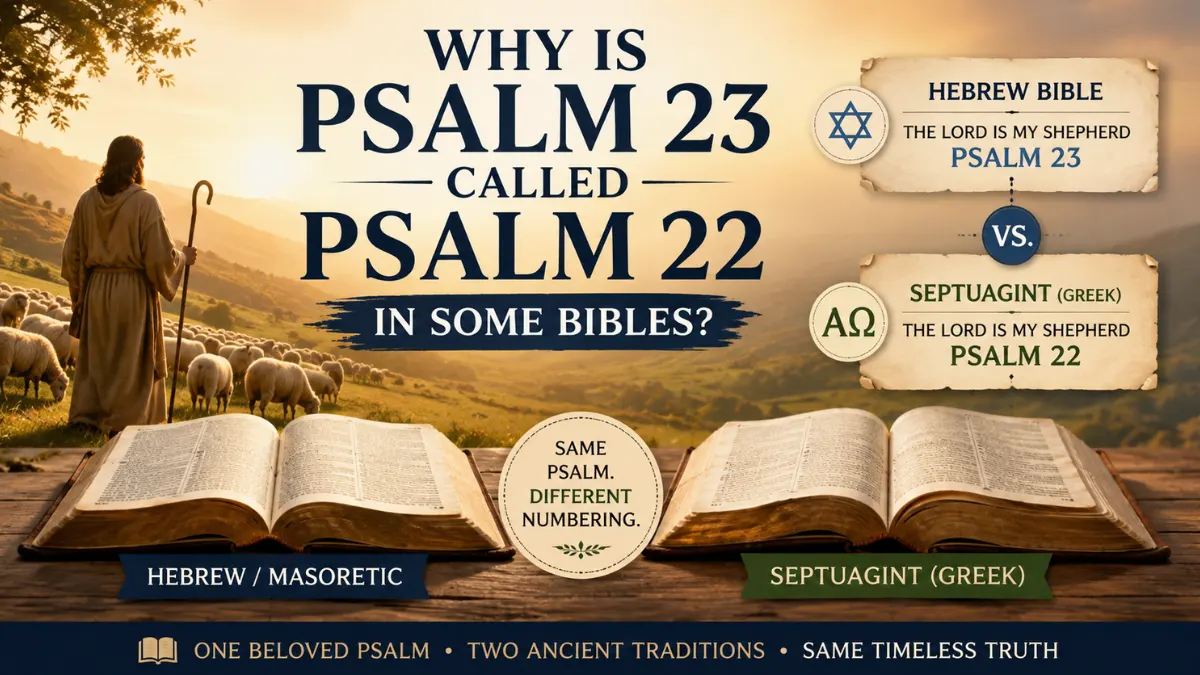

Psalm 23 is called Psalm 22 in some Bibles because the Hebrew and Greek traditions divide several psalms differently. The familiar “The Lord is my shepherd” psalm is the same composition in both systems: it is Psalm 23 in the Hebrew/Masoretic numbering and Psalm 22 in the Greek Septuagint numbering.
Nothing has been removed from the Shepherd Psalm, and the different number does not indicate a different version of its message. The difference comes from how earlier psalms are divided and counted.
Is Septuagint Psalm 22 the Same as Psalm 23?
Yes. Septuagint Psalm 22 corresponds to Psalm 23 in the numbering used by most modern English Bibles.
The two systems can therefore identify the same psalm with different numbers:
Hebrew/Masoretic: Psalm 23
Greek Septuagint: Psalm 22
This distinction matters when reading Orthodox Bibles, older Christian writings, traditional liturgical material, or commentaries that follow Septuagint-style numbering.
It can also create an unexpected problem with Psalm 22.
In most modern English Bibles, Psalm 22 is the psalm beginning with the anguished cry, “My God, my God, why have you forsaken me?” In Septuagint numbering, that composition is Psalm 21.
So when an older or Orthodox source refers to “Psalm 22,” the number alone may not tell a modern reader which psalm the author means.
For an explanation of the Shepherd Psalm itself rather than its numbering, see PsalmWisdom’s Psalm 23 meaning and message guide. Here, the issue is only why the same psalm can carry two numbers.
Where Does the Difference Between Psalm 22 and Psalm 23 Begin?
The numbering difference begins with Psalms 9 and 10.
In the Masoretic Hebrew numbering, the material is counted as two psalms:
- Psalm 9
- Psalm 10
In the Greek Septuagint, the corresponding material is numbered together as Psalm 9.
That creates the one-number difference that continues through the Shepherd Psalm.
| Hebrew/Masoretic numbering | Septuagint numbering |
|---|---|
| Psalm 8 | Psalm 8 |
| Psalms 9–10 | Psalm 9 |
| Psalm 11 | Psalm 10 |
| Psalm 22 | Psalm 21 |
| Psalm 23 | Psalm 22 |
| Psalm 24 | Psalm 23 |
This is the immediate reason a Septuagint-based Bible calls “The Lord is my shepherd” Psalm 22 rather than Psalm 23.
It is better to describe this as a difference in division and numbering rather than saying that one tradition simply removed or added a psalm.
Psalms 9 and 10 also have literary connections. Together they preserve portions of an alphabetic acrostic pattern, which helps explain why treating the material as a single literary unit is not arbitrary. However, the surviving textual traditions do not divide every psalm in exactly the same way.
How Do the Two Psalm Numbering Systems Become Aligned Again?
Psalm 23 is not the only place where the Hebrew and Septuagint numbers differ.
Later in the Psalter, other compositions are joined or divided differently. Because of those later differences, the two systems eventually return to the same numbering at Psalm 148.
The main correspondence is:
| Hebrew/Masoretic | Greek Septuagint |
|---|---|
| Psalms 1–8 | Psalms 1–8 |
| Psalms 9–10 | Psalm 9 |
| Psalms 11–113 | Psalms 10–112 |
| Psalms 114–115 | Psalm 113 |
| Psalm 116:1–9 | Psalm 114 |
| Psalm 116:10–19 | Psalm 115 |
| Psalms 117–146 | Psalms 116–145 |
| Psalm 147:1–11 | Psalm 146 |
| Psalm 147:12–20 | Psalm 147 |
| Psalms 148–150 | Psalms 148–150 |
The Orthodox Church in America’s comparison of Septuagint and Hebrew Psalm numbering provides the complete correspondence.
This table also shows why it is inaccurate to describe the Septuagint as simply being “one psalm behind” from beginning to end. The relationship changes at several points because the traditions place some psalm boundaries differently.
For Psalm 23, however, the conversion is straightforward:
Psalm 23 Hebrew = Psalm 22 Septuagint.
Why Do Orthodox and Some Older Bibles Call It Psalm 22?
Eastern Orthodox biblical and liturgical traditions commonly use the Septuagint as their Old Testament textual tradition. That is why the Shepherd Psalm frequently appears as Psalm 22 in Orthodox contexts.
The Greek numbering also influenced much of the historic Latin tradition.
The traditional Gallican Psalter, which became the dominant Psalter within the medieval Latin Vulgate tradition, follows Septuagint-style numbering. Older Latin-based Christian works and translations influenced by that tradition can therefore identify the Shepherd Psalm as Psalm 22.
This is why the Douay-Rheims Bible, for example, traditionally presents “The Lord ruleth me” under Psalm 22.
However, it would be too broad to say that every Catholic or Latin Bible uses Psalm 22 today.
Modern Catholic Bibles often use the Hebrew numbering familiar to contemporary English readers. The Nova Vulgata, the modern official Latin Bible of the Roman Catholic Church, likewise follows the Hebrew-style Psalm numbering rather than simply preserving the older Gallican numbering throughout.
The safest distinction is therefore not “Catholic versus Protestant.”
It is which Psalm-numbering tradition a particular Bible, Psalter, liturgy, or commentary follows.
What Does Psalm 23(22) Mean?
Sometimes a Bible or Christian publication gives both numbers.
A reference such as:
Psalm 23(22)
usually tells the reader that the composition is Psalm 23 according to Hebrew numbering and Psalm 22 according to Septuagint-style numbering.
A source whose primary numbering follows the Septuagint may reverse them:
Psalm 22(23)
The exact order depends on which numbering system the publication treats as primary.
The parenthetical number therefore does not identify another chapter or an alternate Shepherd Psalm. It helps readers using the other numbering tradition locate the same composition.
This convention becomes especially useful when reading liturgical texts, historical theology, older commentaries, or works that move between Hebrew, Greek, and Latin biblical traditions.
How Can You Tell Which Psalm a Source Means?
When the numbering creates uncertainty, check the opening words or subject of the psalm rather than relying on the number alone.
If a source calls Psalm 22 the psalm about the Lord as shepherd, green pastures, quiet waters, the dark valley, and the prepared table, it is using Septuagint-style numbering.
If its Psalm 22 begins with the cry “My God, my God, why have you forsaken me?”, it is using Hebrew/Masoretic-style numbering.
The apparent disagreement therefore has a simple explanation.
“The Lord is my shepherd” is Psalm 23 in Hebrew/Masoretic numbering and Psalm 22 in Septuagint numbering because the two textual traditions divide several psalms differently.
Once that numbering difference is recognized, references such as Psalm 22, Psalm 23, Psalm 22(23), and Psalm 23(22) all point readers to the correct text without suggesting that the Shepherd Psalm itself has changed.
