
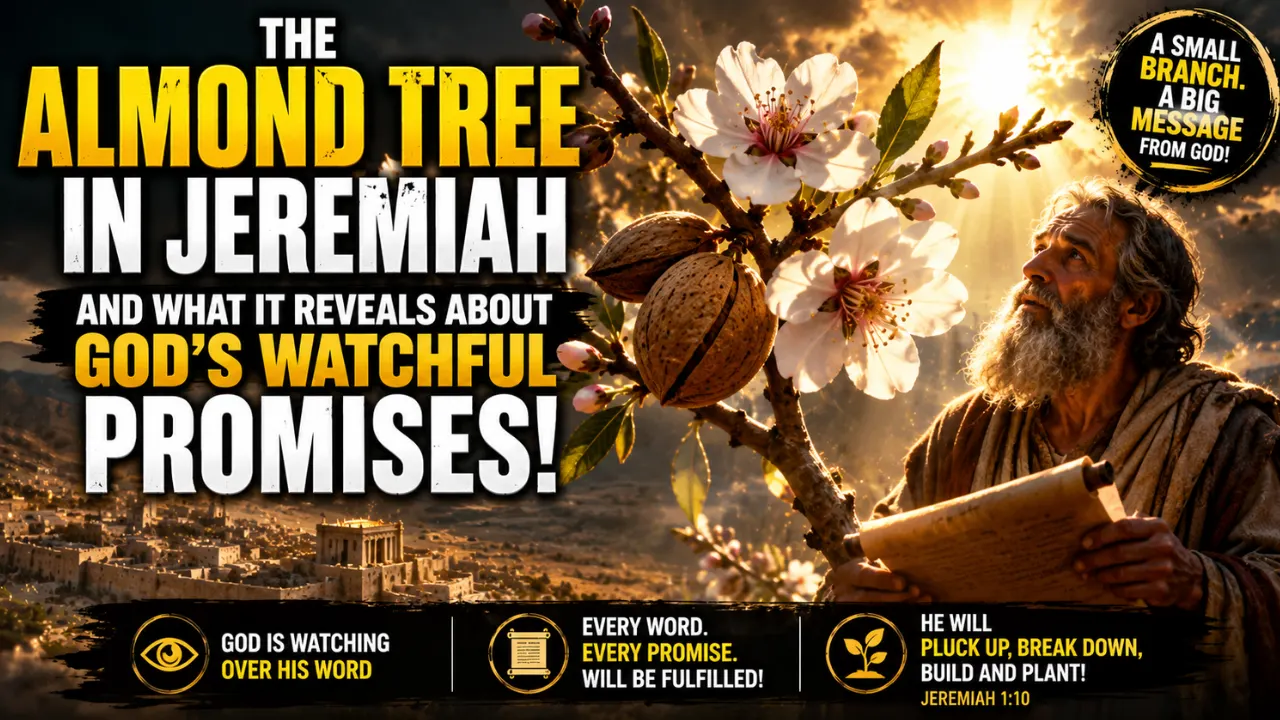

God did not begin Jeremiah’s ministry with a dramatic vision of armies, thrones or fire from heaven. He began with something simple enough to be missed: the branch of an almond tree. Yet in that quiet image, God placed one of the strongest revelations in the book of Jeremiah. The prophet was being sent into a nation that would resist him, reject him and accuse him but before the conflict began, God showed him a sign of divine certainty.
In Jeremiah 1:11–12, the Lord asks, “Jeremiah, what do you see?” Jeremiah answers, “I see the branch of an almond tree.” God replies, “You have seen well, for I am watching over My word to perform it.” The vision rests on a Hebrew wordplay. The word for almond, shaqed, closely resembles shoqed, meaning watching, wakeful or alert. Jeremiah sees the shaqed and God declares Himself shoqed over His word.
This is not a minor poetic detail. It is the foundation of Jeremiah’s prophetic ministry. God was teaching His prophet that divine speech does not drift into uncertainty. What God speaks, He guards. What He declares, He brings to pass. What He warns, promises, judges or restores remains under His sovereign attention until His purpose is fulfilled, reflecting [the certainty and faithfulness of God’s word — Why God’s Promises Never Fail].
Jeremiah’s Calling in a Nation Near Collapse
Jeremiah was called during a dark and unstable period in Judah’s history. The nation still had religious structures, temple language and covenant memories but its heart had turned toward idolatry, injustice, false confidence and spiritual rebellion. Outward religion remained, yet obedience had decayed. The people claimed connection to God while resisting His correction. This spiritual condition closely connects with [the danger of outward religion without true obedience — What the Bible Says About Empty Religion].
This made Jeremiah’s ministry painful from the beginning. He was not sent to flatter Judah or protect national illusions. He was appointed to speak God’s word in a generation that did not want to hear it. His calling would bring loneliness, mockery, threats, imprisonment and deep emotional anguish.
Jeremiah 1:10 gives the shape of his assignment: he was set “to pluck up and to break down, to destroy and to overthrow, to build and to plant.” This verse is essential because it shows that Jeremiah’s message would include both judgment and restoration. God would tear down what was corrupt but He would also plant what belonged to His redemptive purpose.
The almond branch vision comes within this calling. God was not merely encouraging Jeremiah personally. He was declaring that every aspect of the prophetic word, whether judgment or restoration, would be performed by divine authority.
Why the Almond Tree Matters
Almond Tree Awakened Early
The almond tree was one of the earliest trees to bloom after winter. While much of the land still looked barren, almond blossoms announced that a new season was near. This made the tree a natural symbol of wakefulness, readiness and alertness.
That background gives force to Jeremiah’s vision. The almond branch was not random. It carried the idea of something awake before others recognized the change. God was showing Jeremiah that He was already alert over His purposes, even while Judah remained spiritually dull. This symbolism closely connects with [the biblical theme of spiritual wakefulness and readiness — What It Means to Be Spiritually Awake].
Human beings often mistake delay for absence. Judah may have assumed that because judgment had not yet fallen, God’s warnings could be ignored. The almond branch declared the opposite. God was awake. His word was active. His timing was moving toward fullfillment.
Hebrew Wordplay Strengthens the Message
The connection between shaqed and shoqed gives the vision its sharp prophetic force. Jeremiah sees an almond branch and God says He is watching over His word. The image and the interpretation belong together.
This wordplay is not merely clever language. It reveals divine character. God is not careless with His speech. He does not forget what He has promised or delay because He is uncertain. His word remains before Him, guarded by His own faithfulness.
For Jeremiah, this meant his ministry did not depend on public approval. Whether people listened or resisted, God’s word would stand. The prophet’s courage had to rest not in visible success but in the certainty that the Lord Himself would perform what He had spoken.
God Watching Over His Word
God’s Word Is Never Empty Speech
When God says He is watching over His word to perform it, He reveals that His speech carries active authority. Divine words are not opinions, wishes or possibilities. They are expressions of God’s will, character and power.
This truth runs through all of Scripture. God speaks creation into existence. He speaks covenant promises to Abraham. He speaks through Moses, the prophets and ultimately through His Son. Isaiah 55 declares that God’s word will not return void but will accomplish the purpose for which He sent it. This theme closely connects with [the power and reliability of God’s word throughout Scripture — Why God’s Word Never Fails].
Jeremiah’s almond branch vision belongs to this same biblical pattern. God’s word creates reality, confronts sin, exposes falsehood, announces judgment, promises mercy and brings restoration. It cannot be reduced to religious language. It is living authority.
God Watches Over Warnings and Promises
The vision is both comforting and sobering. Many readers love the phrase “God watches over His word,” but in Jeremiah’s context, the word included warnings of judgment against Judah. God was watching over His warnings as surely as His promises.
This matters because Scripture cannot be received selectively. God’s promises of mercy are true but so are His calls to repentance. His words of comfort stand firm but so do His warnings against rebellion, pride, idolatry and false worship. This balance reflects [the relationship between God’s mercy and His holiness — God’s Justice and Mercy in the Bible].
Jeremiah’s ministry proves that divine faithfulness is not sentimental. God is faithful to all He has spoken. He fullfills promises of restoration but He also confronts sin with holy seriousness.
Almond Branch and Jeremiah 1:10
Plucking Up and Breaking Down
Jeremiah’s assignment began with hard verbs: pluck up, break down, destroy and overthrow. These words describe judgment against entrenched sin. Judah’s false security had to be exposed. Idolatry had to be confronted. Empty religion had to be stripped of its disguise.
The almond branch assures Jeremiah that these difficult words would not fail. A prophet may be ignored by people but he is not ignored by God. Jeremiah would speak into resistance but the Lord would watch over the message until it accomplished its purpose.
This gives the vision weight. It was not a gentle devotional symbol only. It was a sign that God’s holiness was awake over a nation that had grown spiritually asleep.
Building and Planting
Jeremiah 1:10 does not end with destruction. It also includes building and planting. This reveals the mercy within Jeremiah’s calling. God would judge what was corrupt, yet He would not abandon His redemptive plan. After uprooting, He would plant. After tearing down, He would build.
The almond branch therefore carries hope as well as warning. God watches over His promises of restoration with the same faithfulness that governs His judgments. Later in Jeremiah, this becomes clear through promises of return, renewal and the new covenant, reflecting [the promise of restoration and the new covenant in Jeremiah — The Meaning of the New Covenant in Jeremiah].
This pattern reveals God’s way with His people. He removes what destroys life so that He can establish what reflects His purpose. His word may wound false confidence but it also gives life where repentance and grace take root.
Almond Tree Elsewhere in Scripture
Aaron’s Rod That Budded
The almond appears again in Numbers 17, when Aaron’s rod miraculously buds, blossoms and produces almonds. This sign confirmed God’s chosen priesthood after rebellion in Israel. A dead staff became fruitful by divine power, proving that authority and life come from God, not human ambition. This event closely connects with [how God confirms His chosen authority in Scripture — The Meaning of Aaron’s Rod That Budded].
This connection adds depth to Jeremiah’s almond vision. The almond can symbolize divine confirmation, appointed authority and life emerging where human ability cannot produce it. In both passages, God acts visibly to confirm what He has spoken.
Aaron’s rod showed that God establishes His chosen order. Jeremiah’s branch showed that God performs His prophetic word. Both images declare that divine authority cannot be overturned by human resistance.
Almond Blossoms in the Tabernacle
Almond blossom designs also appeared on the golden lampstand in the tabernacle. The lampstand gave light in the holy place and its almond-shaped cups connected the imagery of watchfulness, sacred presence and illumination. This symbolism reflects [the spiritual meaning of the golden lampstand in the tabernacle — What the Lampstand Symbolized in the Tabernacle].
This does not mean every almond image carries the same exact meaning but the pattern is significant. In Scripture, almond imagery appears near themes of divine presence, priestly authority, light and God’s active oversight.
Jeremiah’s vision fits this larger biblical atmosphere. The Lord is not distant from His people or inattentive to His word. He is present, awake and faithful.
What the Almond Tree Teaches Believers Today
God Is Faithful During Delay
The almond branch speaks strongly to seasons when God seems slow. Many believers struggle when prayers appear unanswered, promises feel distant, or circumstances remain unchanged. Human impatience often interprets delay as neglect.
Jeremiah’s vision corrects that assumption. God can appear silent while remaining fully watchful. His purposes often unfold beneath the surface before they become visible. The almond tree blooms early, announcing change before the landscape fully reflects it.
Faith learns to trust God’s vigilance even when evidence feels incomplete. The Lord does not need visible momentum to be faithful. His word remains active because He Himself stands behind it.
God’s Word Must Be Taken Seriously
The almond branch also warns against casual treatment of Scripture. If God watches over His word to perform it, then His commands, promises, warnings and invitations must be received with reverence.
A generation may dismiss holiness, redefine obedience, excuse sin or mock judgment but God does not surrender His word to cultural preference. Jeremiah’s own generation had religious language without faithful obedience and the almond branch declared that God was not deceived by appearances.
Believers today need the same seriousness. Scripture is not material for inspiration only; it is the voice of God calling His people to trust, repent, obey, hope and endure.
Spiritual Wakefulness Matters
Because the almond tree carries the idea of wakefulness, the vision also calls God’s people to spiritual alertness. A watchful God should not have a sleeping people. Scripture repeatedly warns against dullness, complacency and careless living.
Jesus told His disciples to watch and pray. Paul urged believers to wake from spiritual sleep and walk wisely. The almond branch stands as a prophetic reminder that God’s word is moving toward fullfillment, whether people are attentive or not.
A faithful life is not passive. It listens carefully, obeys quickly, repents honestly and remains ready before God.
Almond Branch and the Certainty of Christ
Jeremiah’s vision ultimately belongs within the larger story of God fulfilling His redemptive word. Across centuries, God watched over His promises until Christ came in the fullness of time. The Messiah was not an abandoned promise or a forgotten prophecy. He was the fullfillment of God’s covenant faithfulness.
In Jesus Christ, the certainty of God’s word becomes visible. Promises of redemption, mercy, judgment, restoration and kingdom hope meet in Him. The cross did not cancel God’s word; it fulfilled it. The resurrection did not surprise heaven; it displayed the power of the God who performs what He speaks.
The almond branch teaches that God is never asleep over His purposes. He watches over words of warning, words of mercy, words of judgment and words of restoration. What He has spoken will not dissolve into uncertainty and what He has promised in Christ will stand until every purpose is fullfilled.
