
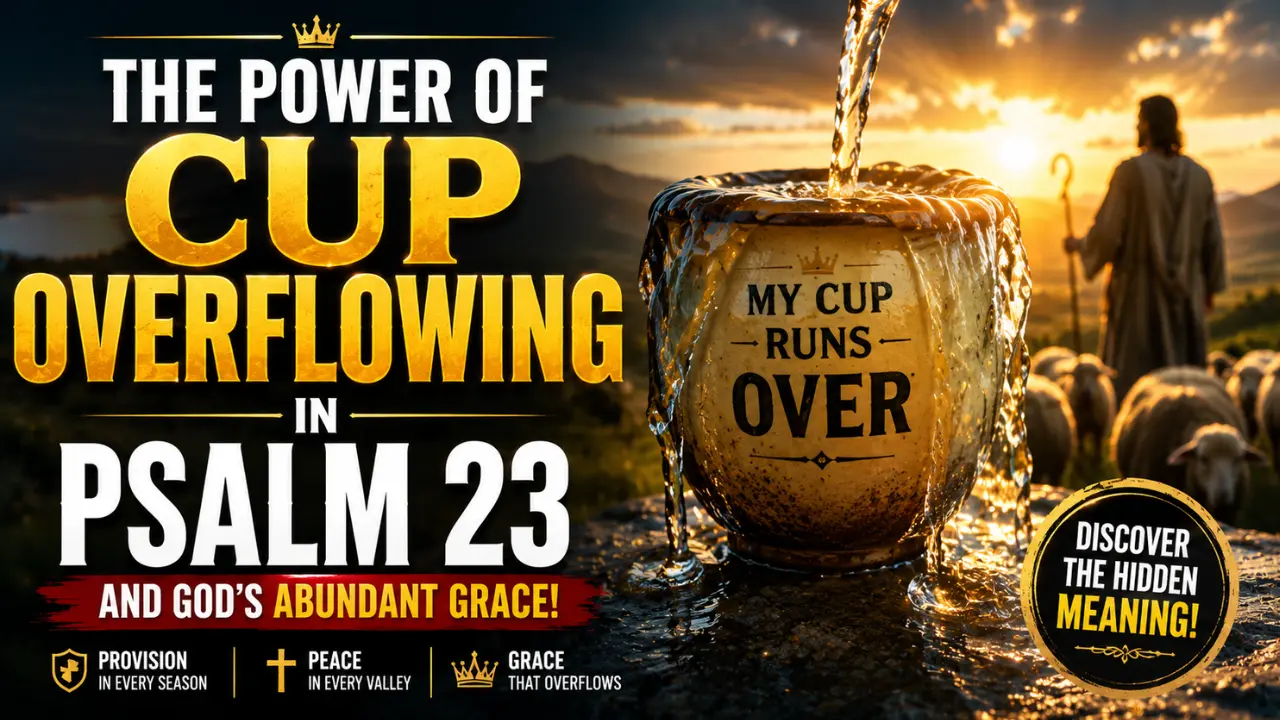

Among the most beloved lines in Scripture is David’s declaration in Psalm 23: “My cup runs over.” Some translations say, “My cup overflows.” The image is simple but its meaning reaches far beyond surface encouragement. David is not merely describing happiness, success or material prosperity. He is describing the generous care, protection, provision and grace of God in the life of someone who belongs to the Shepherd.
Psalm 23 was written by a man familiar with danger, betrayal, wilderness, war, loneliness and loss. This makes the line even stronger. “My cup runs over” was not spoken by someone untouched by suffering. It was spoken by someone who had walked through valleys, faced enemies and learned to depend completely on the Lord’s faithfulness.
The overflowing cup becomes a testimony of divine sufficiency in imperfect circumstances. It reveals that God does not merely keep His people alive spiritually. He restores, strengthens, honours, and sustains them with grace greater than their need, echoing [the biblical picture of God’s overflowing grace and provision — What It Means Spiritually When Your Cup Overflows].
Psalm 23 as a Shepherd Psalm
Psalm 23 presents the Lord as a shepherd who guides, protects, feeds, restores and remains present with His sheep. David moves through a series of powerful images: green pastures, still waters, paths of righteousness, the valley of the shadow of death, the rod and staff, the prepared table, the anointed head and the overflowing cup. Each image builds a portrait of complete divine care, much like the full spiritual meaning of Psalm 23 as the Shepherd Psalm reveals through its imagery.
The cup does not appear randomly. It follows the words, “You prepare a table before me in the presence of my enemies; You anoint my head with oil.” David shifts from the field to the table, from shepherd imagery to hospitality imagery. God is not only the Shepherd who guards him in danger; He is also the Host who welcomes, honours and provides for him in abundance.
This changes the emotional weight of the verse. David is not describing selfish excess. He is describing the lavish generosity of God toward His covenant servant. The Lord gives more than survival, more than protection and more than bare necessity. He gives fellowship, honour and sustaining grace.
What the Cup Symbolized in the Bible
Cup Represented One’s Portion
In Scripture, the cup often represents a person’s portion, experience, destiny or assigned condition in life. Sometimes it refers to blessing and joy. Other times it speaks of judgment and suffering. Psalm 16:5 says, “The Lord is the portion of my inheritance and my cup,” showing that the deepest satisfaction of the faithful is found in God Himself.
This background matters because David’s full cup points to a life held by divine favour. His portion is not emptiness, abandonment or despair. His life under the Shepherd is filled with mercy, presence and care that exceed his ability to measure.
The same symbol can carry sobering meaning elsewhere in Scripture, especially when prophets speak of the cup of wrath. This contrast makes Psalm 23 even more precious. David’s cup is not filled with judgment but with covenant goodness. His portion is the Shepherd’s faithful care.
Overflowing Means More Than Enough
An overflowing cup is not a vessel barely filled enough to survive. It is filled beyond its limit. The image communicates generosity, fullness and abundance from the hand of God.
This fits the broader biblical pattern. God gives manna in the wilderness, multiplies oil for a widow, fills nets with fish, turns water into abundant wine and feeds thousands with baskets left over. His mercy is not reluctant. His grace is not measured with fear of running out.
Psalm 23 presents this same truth in a quiet but powerful image. The Shepherd’s care is not thin, scarce or hesitant. It is full enough to sustain the soul and generous enough to overflow into gratitude, worship and confidence.
Oil and Cup Together: Honour of God’s Hospitality
“You Anoint My Head With Oil”
In the ancient world, anointing a guest with oil could express welcome, honour, refreshment and blessing. Oil soothed the body, carried fragrance and marked the guest as received with dignity. When David says, “You anoint my head with oil,” he presents God as a gracious Host who does not treat him as unwanted or forgotten, reflecting the biblical symbolism of anointing oil as honour and blessing.
This matters because the table is prepared “in the presence of my enemies.” David is not honoured only after all conflict disappears. God honours him while opposition remains. The enemies do not control the table, the oil or the cup. The Lord does.
The anointing shows personal care. The cup shows generous provision. Together, they reveal a God who welcomes His servant with visible favour even in a hostile world.
Full Cup Shows Acceptance and Abundance
A host who kept a guest’s cup filled showed welcome and generosity. A cup running over communicated more than enough provision. It meant the guest was not being tolerated at the edge of the table but received with honour.
David’s language is therefore deeply relational. Psalm 23 is not only about God meeting needs; it is about God drawing His servant into fellowship. The Shepherd becomes the Host, and the sheep becomes the honoured guest.
This is why the verse carries such comfort. God’s people are not merely rescued from danger and then left at a distance. They are welcomed, restored and seated under divine care.
Meaning of Abundant Grace
Grace Is More Than Forgiveness
Grace includes forgiveness, but it is larger than pardon alone. Biblical grace is God’s active favour working in weakness, sustaining believers through every season and supplying what human strength cannot produce.
David’s cup points to this sustaining gift. God gives strength when strength is exhausted, peace when circumstances remain unstable, wisdom during confusion and comfort during sorrow. Grace does not deny human weakness. It meets weakness with divine sufficiency, revealing [how God’s grace sustains believers in weakness and hardship — The Meaning of God’s Sustaining Grace].
This is why abundant grace is not shallow optimism. It is the assurance that God’s care is greater than the believer’s lack, fear, failure and need.
Abundance Does Not Mean a Trouble-Free Life
Psalm 23 places fullness beside danger. The same psalm that speaks of green pastures also speaks of the valley of the shadow of death. The same verse that celebrates a filled cup also speaks of enemies nearby.
This protects the meaning from shallow prosperity thinking. David’s cup does not overflow because life is easy. It overflows because God is present, faithful and sufficient in every season.
Abundant grace does not always remove hardship immediately. Often, it sustains the believer within hardship, strengthens faith under pressure and gives peace that circumstances cannot explain.
“You Prepare a Table Before Me”
God Provides in the Presence of Enemies
The prepared table is one of the boldest images in Psalm 23. David does not say God removes every enemy before feeding him. He says God prepares a table in their presence. This means divine provision is not dependent on peaceful surroundings.
The table represents fellowship, security, provision and confidence. To sit and eat while enemies watch is to declare that the Lord’s protection is greater than their threat. David is not sustained by the absence of conflict but by the presence of God.
The filled cup belongs to that table. It is a sign that fear does not have the final word. God’s hospitality stands stronger than hostility.
God’s Honour Is Greater Than Human Opposition
Enemies can accuse, threaten, misunderstand or resist, but they cannot cancel what God provides. Psalm 23 shows the Lord publicly caring for His servant in the very place where opposition seeks to intimidate him.
This does not make the believer proud. It makes the believer secure. David’s confidence rests not in his own greatness but in the Shepherd’s authority.
The overflowing cup therefore becomes a sign of God’s faithful care under pressure. It is abundance in the face of accusation, peace in the face of danger and honour given by God rather than borrowed from human approval.
Overflowing Cup and Spiritual Satisfaction
God Fills What the World Cannot
Psalm 23 speaks to the deep hunger of the human soul. People often chase fullness through success, relationships, wealth, status, entertainment or achievement, yet these gifts cannot satisfy permanently when separated from God.
David’s testimony points to a deeper source. The Shepherd gives rest to the soul, not merely comfort to the body. He restores what anxiety drains, steadies what fear shakes and fills what earthly gain cannot reach.
This theme reaches fuller expression in the words of Jesus, who offers living water to the thirsty. The fullness of Psalm 23 finds its deepest answer in Christ, who gives life that does not dry up and peace that the world cannot give.
Shepherd and the Source of Grace
Shepherd Knows the Needs of His Sheep
David’s confidence comes from the character of the Shepherd. Sheep are dependent creatures. They need guidance, protection, pasture, water, correction and rescue. Without a shepherd, they wander into danger and lack what they need to live.
Psalm 23 presents grace as personal care. God does not provide from a distance without attention. He leads, restores, comforts, protects, hosts, anoints and fills. Every movement in the psalm reveals attentiveness.
The cup runs over because the Shepherd knows exactly what His sheep need and gives according to His goodness.
Grace Flows From God’s Character
The abundance in Psalm 23 flows from who God is. He provides because He is good. He protects because He is faithful. He restores because He is merciful. His generosity is not random or unstable; it reflects His covenant love.
This becomes clear in the final promise: “Surely goodness and mercy shall follow me all the days of my life.” The overflowing cup is connected to the pursuing goodness of God. David does not trust in temporary emotion. He trusts in the character of the Lord.
Cup in the New Testament
Jesus Offers Living Water
The language of spiritual fullness becomes even clearer in Jesus Christ. In John 7, Jesus speaks of rivers of living water flowing from within those who believe in Him. This points to the Holy Spirit and the life God gives through Christ.
Jesus does not offer survival-level spirituality. He gives living water, eternal life and fellowship with God. The fullness David celebrates in Psalm 23 becomes clearer through the gospel.
The Shepherd of Psalm 23 is ultimately revealed in Christ, the Good Shepherd who lays down His life for the sheep.
Christ Drank the Cup of Suffering
The New Testament also deepens the cup imagery through the suffering of Jesus. In Gethsemane, Christ speaks of the cup He must drink. At the Last Supper, He speaks of the cup of the new covenant in His blood.
This creates a powerful gospel connection. Believers receive the cup of blessing because Christ accepted the cup of suffering. He bore judgment, carried sin and gave Himself so His people could receive mercy, fellowship and eternal life.
The overflowing cup of Psalm 23 is therefore not sentimental. It is grounded in redemption. Grace overflows because Christ gave Himself completely.
Why Psalm 23 Still Speaks Today
Weary Souls Still Need a Shepherd
Modern life often leaves people anxious, distracted, exhausted and spiritually thirsty. Many search for peace while carrying pressure, loneliness, fear and uncertainty. Psalm 23 continues to speak because it reveals a Shepherd whose care reaches the deepest places of human need.
David’s cup is not filled by comfort, status, or control. It is filled by the Lord. That is why the psalm still comforts those walking through valleys, facing enemies or waiting for restoration.
The promise is not that life will always be easy. The promise is that God’s presence will be enough, His care will not fail and His grace will remain sufficient.
Eternal Hope Behind the Overflowing Cup
Psalm 23 ends with a promise greater than earthly comfort: “I shall dwell in the house of the Lord forever.” This final line lifts the cup beyond temporary blessing. The Shepherd’s care does not end at death and His grace does not expire with earthly life.
David’s testimony becomes a declaration about the nature of God. The Lord is not a Shepherd who gives barely enough. He restores the soul, prepares the table, anoints the head, fills the cup, pursues His people with goodness and mercy and brings them into His presence forever.
The cup runs over because grace begins with God, is secured in Christ and carries His people toward eternal fellowship with Him.
