
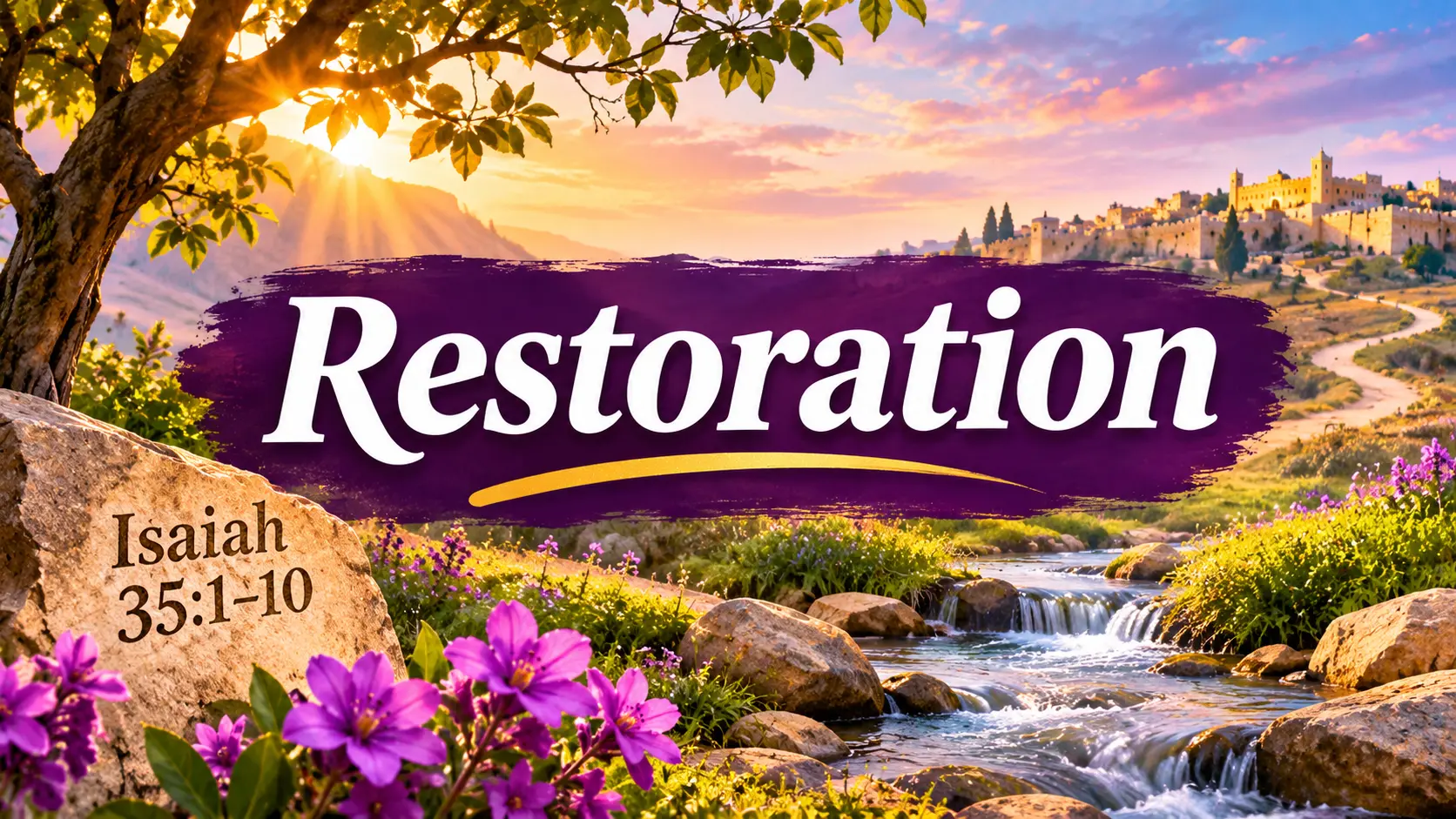

Isaiah 35:1–10 describes God’s promise to transform a desolate wilderness, strengthen discouraged people and bring His redeemed people home to Zion with everlasting joy. At the heart of the chapter is the declaration in verse 4 that God Himself will come to save them.
For Christians, this promise connects with Advent through the coming of Jesus Christ. The restoration described by Isaiah is reflected in Christ’s earthly ministry while also pointing toward the fullness of salvation that Christians anticipate through His return.
The chapter begins with a rejoicing wilderness and ends with a rejoicing people. Between these two scenes, Isaiah reveals how God’s saving presence transforms both the travellers and the land through which they journey.
Judgment and Restoration
Isaiah 35 stands in deliberate contrast to Isaiah 34, which describes divine judgment against the nations, particularly Edom. Where the preceding chapter pictures ruined settlements and desolate territory, Isaiah 35 describes flourishing land, flowing water and a protected journey home.
The connection extends beyond contrasting landscapes. Isaiah 34:8 speaks of divine vengeance and recompense concerning Zion, while Isaiah 35:4 uses the same language alongside the promise that God will come to save His people.
Judgment and restoration are therefore closely connected within these chapters. The divine intervention that brings judgment upon hostile powers also brings deliverance to those awaiting God’s salvation.
Biblical scholars frequently interpret Isaiah 35 in connection with the hope of returning from Babylonian exile. As Michael J. Chan explains in his commentary on Isaiah 35, the chapter speaks to a displaced people longing for restoration after losing their homeland and security.
Although the precise circumstances of the chapter’s composition remain debated, its destination is clear. God promises a restored community returning to Zion rather than simply offering reassurance to individuals experiencing temporary difficulties.
The Wilderness Blossoms
Isaiah 35:1–2 presents the wilderness as participating in the joy of God’s restoration. The King James Version describes the desert blossoming as the rose, although several modern translations identify the flower as a crocus.
The precise identification of the Hebrew plant remains uncertain. The prophetic image, however, is unmistakable: a landscape previously associated with dryness and hardship becomes abundant with life.
Verse 2 mentions Lebanon, Carmel and Sharon, regions associated with natural beauty and flourishing vegetation. Their splendor is extended to the wilderness, where the glory and excellence of the Lord become visible.
Isaiah does more than describe an improvement in environmental conditions. Through poetic imagery, the wilderness itself rejoices in response to God’s restorative work.
For Advent readers, this vision helps explain why Christian hope extends beyond personal spiritual comfort. Romans 8:19–23 similarly describes creation awaiting deliverance from corruption, connecting God’s saving purpose with the renewal of the wider created world.
God Will Come to Save
Isaiah 35:3–4 turns toward people whose experiences have left them physically weakened and emotionally discouraged. The prophet instructs his listeners to strengthen weak hands, support feeble knees and speak encouragement to those whose hearts are fearful.
These instructions place responsibility upon the wider community. Rather than expecting frightened people to overcome their difficulties independently, Isaiah calls others to strengthen them with the assurance of God’s coming.
The central promise appears in Isaiah 35:4 (KJV), where the prophet declares that God will come with vengeance and recompense before concluding, “he will come and save you.” Their courage rests upon what God promises to accomplish rather than their own ability to escape hardship.
The reference to vengeance concerns God’s judgment, not permission for personal retaliation. Read alongside Isaiah 34:8, it presents divine justice as part of the deliverance promised to God’s people.
Hebrews 12:12–13 later echoes Isaiah’s language about weakened hands and knees within a discussion of endurance and spiritual discipline. The New Testament applies this prophetic encouragement to believers who must persevere through difficult circumstances.
This message is particularly relevant during Advent, when Christians reflect upon waiting for the Lord. Our Psalm 130:5 Advent devotional explores how biblical waiting involves trusting God’s word even when circumstances have not yet changed.
Healing and New Life
Isaiah 35:5–6 describes blind eyes being opened, deaf ears receiving hearing, people unable to walk leaping and those unable to speak finding their voices. Bodily healing forms part of the restoration associated with God’s saving presence.
These descriptions should not be reduced entirely to metaphors for spiritual understanding. Their physical character becomes particularly important when the New Testament describes the healing ministry of Jesus.
The second half of verse 6 returns to the wilderness, where water breaks forth and streams flow through the desert. Verse 7 continues the transformation by describing dry ground becoming pools of water and formerly barren places supporting abundant vegetation.
Readers of the KJV may notice the unusual reference to the habitation of dragons in Isaiah 35:7. Many modern translations render the Hebrew term as jackals, animals associated in this context with desolate surroundings.
A similar expression appears in Isaiah 34:13, where these creatures inhabit territory devastated by judgment. In Isaiah 35, their former habitat becomes a place where grass, reeds and rushes flourish.
The wilderness is no longer portrayed as an obstacle preventing God’s people from reaching home. Its transformation provides the setting for the safe journey described in the following verses.
The Highway of Holiness
Isaiah 35:8 introduces a highway that the KJV calls “The way of holiness.” It represents the sacred passage through which God’s redeemed people travel toward Zion.
The road is distinguished by its holiness, with the passage declaring that the unclean will not travel upon it. This description concerns the character of the restored community rather than establishing a system through which individuals earn redemption by their own moral achievements.
The final portion of verse 8 contains a difficult Hebrew expression. The KJV presents even foolish travellers as being able to journey without losing their way, while the NIV understands wicked fools as being excluded from the road.
The NET Bible’s translation notes reflect the latter understanding, interpreting foolishness in terms of moral corruption rather than intellectual ability. This represents one approach to the difficult Hebrew wording, not a definitive resolution of every translation difference.
Verse 9 provides a clearer description of the road’s security by declaring that lions and dangerous beasts will not threaten those traveling upon it. The redeemed are given a protected passage through territory that would ordinarily expose travellers to danger.
The Highway of Holiness is therefore not simply an image of escape from captivity. God prepares a way through which His people can return to their promised destination.
The Return to Zion
Isaiah 35:10 brings the entire vision to its destination as the ransomed of the Lord return to Zion with singing and everlasting joy. Zion refers here to Jerusalem, the city closely associated with worship, God’s presence and the identity of His people.
The descriptions of the travellers as redeemed in verse 9 and ransomed in verse 10 emphasize that their deliverance comes from God. The passage does not specify a ransom payment or describe the process through which it is made; its emphasis rests upon the people being rescued and restored.
Isaiah 51:11 repeats almost the same promise, again describing the redeemed returning to Zion with singing while sorrow and mourning disappear. This parallel places Isaiah 35 within the wider prophetic expectation of restoration following displacement and suffering.
Holiness and divine protection also appear in other prophecies concerning Jerusalem. Our explanation of Isaiah 4 and the promise of a restored Zion examines how God’s cleansing and protective presence contribute to that vision.
The chapter’s final image completes the promise introduced in its opening verses. The wilderness rejoices because God transforms it, while the redeemed rejoice because His saving work has brought them home.
How Isaiah 35 Points to Jesus
In Matthew 11:2–6, John the Baptist sends his disciples from prison to ask whether Jesus is the expected Messiah. Jesus answers by directing their attention toward the works being accomplished through His ministry.
He describes blind people receiving sight, those unable to walk walking, deaf people hearing, the dead being raised and the poor receiving the gospel. These works echo several prophetic passages, particularly Isaiah 35:5–6 and Isaiah 61:1.
Reading Isaiah 35 alongside Matthew 11 helps explain why Jesus answers John’s question in this manner. Rather than quoting the entire prophecy, He points toward acts of restoration that correspond with Isaiah’s expectations of God’s saving intervention.
Yet John remains imprisoned despite these remarkable events. Matthew 14:1–12 later records his execution, showing that the arrival of Christ’s saving ministry did not immediately remove every instance of injustice and suffering.
This distinction is essential when interpreting Isaiah 35 through the Christian understanding of Advent. Jesus’ earthly ministry reveals signs of the promised restoration, while believers continue to await the fullness of His kingdom.
The prophecy should not be treated as an unconditional guarantee of immediate physical healing, financial prosperity or freedom from hardship. Nor does its healing imagery suggest that disability diminishes a person’s dignity or results from a lack of faith.
The Message for Advent
Isaiah 35:1–10 is appointed for the Third Sunday of Advent in Year A of the Revised Common Lectionary. The Advent lectionary published by Vanderbilt Divinity Library pairs it with Matthew 11:2–11 and James 5:7–10, bringing together prophetic restoration, Christ’s ministry and patient expectation.
James uses the example of a farmer waiting for the precious fruit of the earth to encourage believers to remain patient until the coming of the Lord. Read alongside Isaiah’s flourishing wilderness, this passage reminds Christians that the certainty of God’s promise does not eliminate the need to wait.
The Third Sunday of Advent is associated with rejoicing in many Western Christian traditions. Isaiah’s promise of everlasting joy offers a biblical expression of that rejoicing, even though the passage is not an appointed reading for this Sunday every year.
Its message also carries a practical responsibility. Just as Isaiah instructs his listeners to strengthen weak hands and encourage fearful hearts, Christians preparing for Advent can support those facing illness, loneliness, grief or uncertainty.
Revelation 21:4 provides a further Christian connection with Isaiah’s closing vision by describing a future in which death, sorrow and pain are removed. Both passages express a hope that reaches beyond temporary relief toward complete restoration in God’s presence.
The message of Isaiah 35 for Advent is not that believers must ignore present suffering to rejoice. Christians remember the restoration revealed through Christ’s first coming while patiently anticipating the day when sorrow and sighing will finally give way to everlasting joy.
