
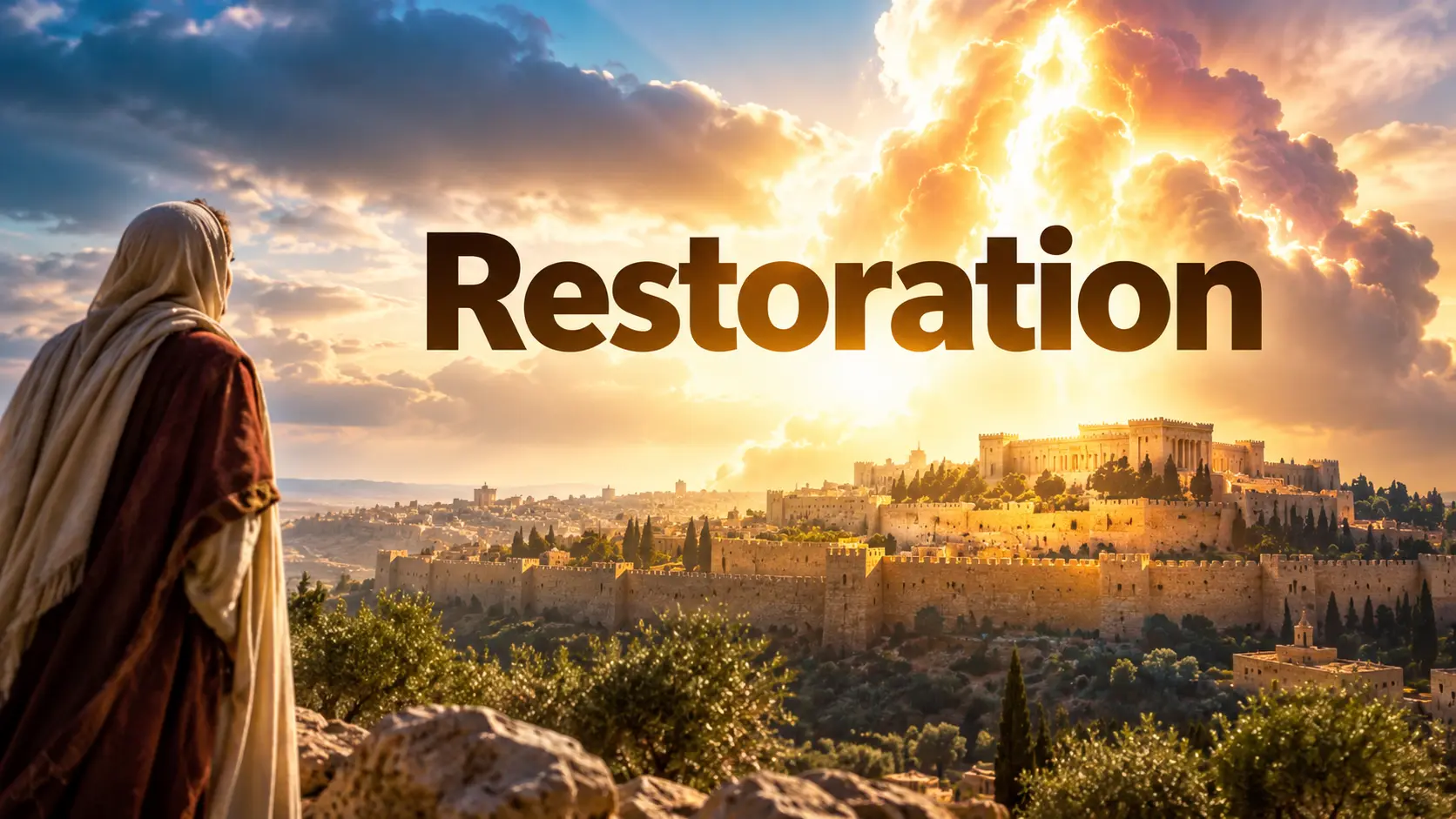

Isaiah 4 describes God’s promise to restore Zion after judgment, cleansing the people who remain and surrounding Jerusalem with His protective presence. The chapter moves from the devastation of a broken city to a vision of renewed beauty, holiness and security. Its central message is that Jerusalem’s future will not be defined by its destruction but by God’s work of restoration.
This promise unfolds through three connected images: the Branch of the LORD bringing renewed glory, the cleansing of those who survive and a cloud and fire covering Mount Zion. Each image reveals a different part of what restored Jerusalem will become, making Isaiah 4 a short but significant prophecy of judgment giving way to hope.
Why Isaiah 4 Begins With Jerusalem in Ruins
Isaiah 4:1 describes seven women approaching one man and asking to be called by his name, even offering to provide their own food and clothing. Although the scene appears unusual when read alone, it continues the warning in Isaiah 3:25–26 that Jerusalem’s men will fall in battle and the city will be left mourning.
The seven women represent the desperate social conditions following widespread destruction. With many men lost, marriage has become difficult to secure, and the women seek the recognition associated with a husband’s name. The number seven emphasizes the severity of the situation without necessarily predicting an exact number of women for every surviving man.
This opening matters because it establishes the condition from which Zion needs restoration. Jerusalem has lost the stability and security it once depended upon and its people are left facing the consequences of judgment.
The direction changes in Isaiah 4:2. Instead of continuing the description of humiliation, Isaiah announces that the Branch of the LORD will become beautiful and glorious for those who have escaped. The contrast is deliberate: the city that has been stripped of its former glory will receive a new kind of beauty through God’s intervention.
Branch of the LORD and the Return of Zion’s Glory
Isaiah 4:2 introduces the first positive picture of restoration. The Branch of the LORD will be beautiful and glorious, while the fruit of the land will become a source of honour for Israel’s survivors.
The imagery of a branch growing after devastation suggests renewed life where destruction appeared to have ended every possibility of recovery. However, the meaning of the Branch itself has been interpreted in more than one way.
Does the Branch of the LORD Refer to the Messiah?
Many Christian interpreters understand the Branch in Isaiah 4:2 as a reference to the promised Messiah. This interpretation connects the passage with Jeremiah 23:5, where God promises to raise a righteous Branch from David’s family who will reign with justice.
Zechariah 3:8 also uses the title Branch in connection with God’s promised servant. These passages explain why Christian commentators have traditionally associated Isaiah’s Branch imagery with Jesus Christ and the restoration connected with His kingdom.
Another interpretation understands the Branch of the LORD as the renewed growth of the land. This reading emphasizes the second half of Isaiah 4:2, where the fruit of the earth becomes beautiful and glorious for those who survive.
Because both images appear together, the verse can naturally describe the renewed fruitfulness that follows divine judgment. The Cambridge Bible commentary favours this agricultural reading, while other commentators understand the passage primarily in Messianic terms.
The two interpretations differ in what they identify as the immediate reference of the Branch. Yet both recognize that Isaiah is announcing a reversal of Jerusalem’s earlier devastation and a future marked by God’s favour.
For understanding the chapter as a whole, this is the essential connection: Zion’s restored glory comes from what God brings forth after judgment, not from the power or prosperity the city previously possessed.
Cleansing That Makes Restored Zion Holy
Isaiah 4:3 identifies those who will share in Jerusalem’s promised restoration. Everyone remaining in Zion and recorded among the living in Jerusalem will be called holy.
This introduces an important distinction between merely surviving destruction and belonging to a restored community. Isaiah does not picture Jerusalem simply returning to its former condition. The people who remain are described as holy, indicating that restoration involves a change in their standing before God.
The reference to those recorded among the living emphasizes the survivors who belong to this renewed Jerusalem. It fits Isaiah’s wider theme of a remnant preserved through judgment, although the verse itself does not explain every detail of when that restoration will occur.
Isaiah 4:4 then explains why the remaining people can be called holy. The Lord will wash away the impurity of Zion’s daughters and cleanse Jerusalem of its bloodshed through a spirit of judgment and burning.
The language recalls the moral failures condemned in the preceding chapters. Jerusalem’s leaders had been accused of injustice and oppression, while its society had become marked by pride and disregard for righteousness.
Consequently, restoring Zion requires more than rebuilding what was destroyed. The corruption associated with the city must also be removed, because returning to its former condition would not accomplish the holiness Isaiah describes.
The images of washing and burning express this necessary purification. Washing suggests the removal of defilement, while burning communicates the severity of the judgment through which corruption is eliminated.
The sequence is significant. Isaiah first describes the people as holy and then identifies God’s cleansing action as the reason this condition becomes possible.
Restored Zion is therefore not simply a surviving Jerusalem. It is a Jerusalem transformed by God’s judgment and cleansing. This explains why the chapter connects renewal with holiness rather than presenting restoration as the recovery of political strength or material prosperity alone.
Why God Covers Restored Zion With Cloud and Fire
The final picture of Isaiah 4 is also its most distinctive. In verses 5–6, the Lord creates a cloud and smoke by day and the brightness of flaming fire by night over Mount Zion and its assemblies.
These images recall God’s presence during Israel’s journey through the wilderness. Exodus 13:21–22 describes the Lord guiding His people through a pillar of cloud during the day and a pillar of fire at night, while Exodus 40:34–38 connects the cloud with His presence over the tabernacle.
Isaiah draws upon this familiar imagery to describe what life in restored Zion will be like. The God who accompanied Israel through the wilderness will make His presence known over the renewed community.
There is an important development in the picture. During the Exodus, the cloud and fire accompanied a people traveling toward their destination. In Isaiah 4, the imagery appears over Zion itself, suggesting a community established under God’s continuing protection.
The promise extends beyond the presence of cloud and fire. Isaiah 4:6 describes a shelter providing shade from the day’s heat and refuge from storms and rain.
These images explain the purpose of the covering. The restored city will no longer be pictured primarily through its vulnerability, humiliation or exposure to destruction. Instead, its defining security will come from the Lord who shelters it.
The language also resembles the biblical portrayal of God as refuge in the Psalms. Passages such as Psalm 91 describe the Lord as a place of shelter and protection, a theme explored in PsalmWisdom’s 7 Psalms for Protection and Safety in Times of Danger. Isaiah’s particular promise, however, concerns God’s protective presence over restored Zion rather than an individual guarantee of freedom from every hardship.
The closing vision completes the contrast introduced at the beginning of the chapter. Isaiah 4 opens with the people of Jerusalem desperately seeking security in the aftermath of destruction but it ends with God providing a covering over the restored community.
The prophecy does not identify a precise date for every aspect of this restoration and Christian interpretations differ over how its promises relate to the Messiah and the future of Jerusalem. What the passage consistently emphasizes is the character of the restored Zion: its surviving people are made holy, its former shame is replaced by beauty and its security rests beneath the presence of God.
That is the central promise of Isaiah 4. Jerusalem’s judgment is real but it does not cancel God’s purpose to restore Zion. The chapter looks beyond destruction to a renewed community whose glory, holiness and protection come from the Lord.
