
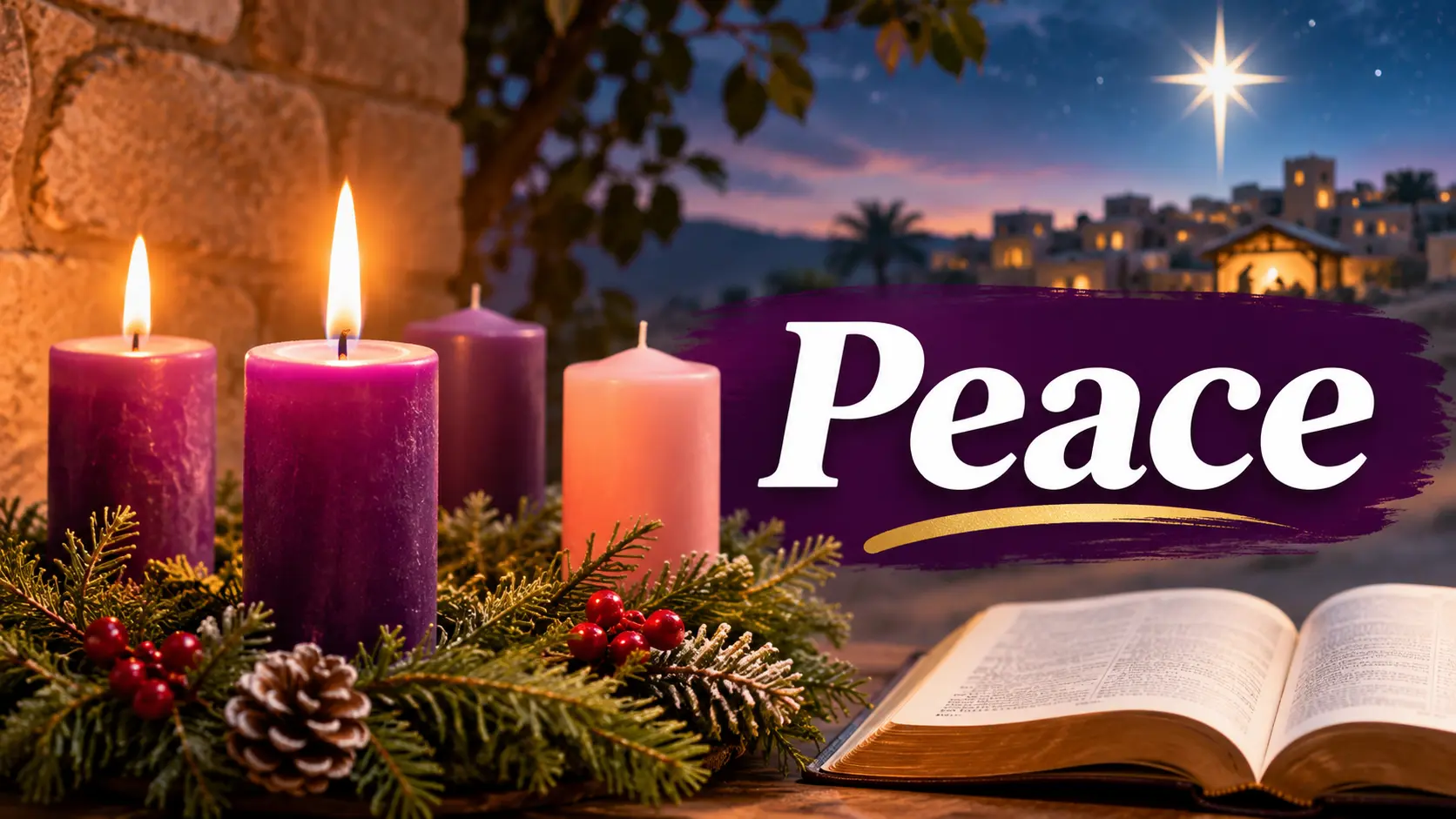

The second Advent candle represents peace in many Christian traditions, while others associate it with faith or the Old Testament prophets. Often called the Bethlehem Candle, it recalls the promised birth of Jesus Christ and the peace that He came to bring.
The candle is lit on the Second Sunday of Advent, which falls on December 6 in 2026. Its biblical meaning draws upon the prophecy concerning Bethlehem, the faith of Mary and Joseph and the announcement of peace following the birth of Jesus.
What the Second Candle Means
In Christian traditions that follow the themes of hope, peace, joy and love, the second Advent candle represents peace. It builds upon the hope remembered during the first week by directing attention toward Jesus Christ, through whom reconciliation with God becomes possible.
Other traditions understand the second candle as a symbol of faith, remembering those who trusted God’s promises before witnessing their fulfillment. Mary and Joseph provide particularly relevant examples of this trust through their obedience before the birth of Jesus.
These two meanings share a biblical foundation in Romans 5:1 (KJV), where Paul writes that believers who are justified by faith have “peace with God through our Lord Jesus Christ.” The verse connects faith with a restored relationship with God rather than simply describing peace as a feeling of emotional comfort.
Peace, Faith or Prophets?
Christians attending different churches during Advent may encounter different names for the second candle. These variations reflect distinct devotional traditions rather than conflicting biblical teachings about the coming of Jesus.
The Archdiocese of Brisbane identifies the second candle with peace and reconciliation. Its Advent arrangement encourages Christians to consider how the peace brought by Christ should influence their relationships with others.
The Archdiocese of Southwark associates the second candle with faith while recognizing its connection with Bethlehem and peace. This interpretation remembers Mary and Joseph’s journey and the arrival of the promised Savior.
An alternative arrangement appears in the Church of England’s Advent wreath guidance, which associates the first Sunday with the patriarchs and the second with the prophets. In this devotional scheme, the second candle commemorates those who foretold the coming of the Messiah.
The differences are not strictly divided along denominational lines, as even Catholic communities may follow different arrangements. The Bible provides the foundations for these themes, but it does not prescribe a particular sequence of Advent candle meanings.
Why Bethlehem Matters
Long before the birth of Jesus, Bethlehem held an important place in Israel’s history. It was the hometown of David, where Samuel anointed him as the future king of Israel according to 1 Samuel 16.
Centuries later, Micah identified Bethlehem as the place from which a future ruler would emerge. In Micah 5:2–6, the prophet connects this relatively small community of Judah with the promise of righteous leadership and deliverance.
Micah ministered during a period of Assyrian expansion, when Israel and Judah faced military threats and political instability. His prophecy speaks of a ruler who would shepherd God’s people in the strength of the Lord, offering hope amid those threatening circumstances.
Micah 5:5 (KJV) begins with the declaration, “And this man shall be the peace,” before addressing the possibility of Assyrian invasion. The passage continues into verse 6 with the expectation of deliverance from that threat.
Understanding these verses together reveals that Micah’s prophecy concerns more than the birthplace of a future king. It also expresses the expectation of security and restoration under the leadership of God’s promised ruler.
Matthew 2:4–6 connects the Bethlehem prophecy with Jesus when Herod asks the chief priests and scribes where Christ should be born. Within Christian interpretation, Jesus is identified with the promised ruler, connecting His birth with Bethlehem’s royal heritage and messianic expectations.
This biblical background explains why the second Advent candle is sometimes called the Bethlehem Candle. The town represents the meeting of prophetic expectation and fulfillment, while Micah’s description of the promised ruler connects Bethlehem directly with the theme of peace.
Biblical Connections
The Prince of Peace
Isaiah 9:6 (KJV) describes the promised child using several titles, including “The Prince of Peace.” The following verse connects His government with justice, righteousness and enduring peace.
Isaiah’s prophecy addresses circumstances marked by darkness and oppression. Rather than promising temporary relief from personal worries, it presents the expectation of a righteous ruler whose kingdom would bring lasting peace.
Christians understand this prophecy in connection with Jesus Christ and His kingdom. The Peace Candle commemorates His arrival while also pointing toward the fullness of the peace Christians anticipate under His reign.
Mary and Joseph’s Faith
The experiences of Mary and Joseph help explain why some Christians associate the second Advent candle with faith. Both received divine instruction that required obedience without complete knowledge of what would happen next.
When Gabriel announced that Mary would give birth to Jesus, she initially questioned how this would happen. Her response in Luke 1:38 (KJV), “be it unto me according to thy word,” demonstrates her willingness to accept God’s purpose.
Joseph faced different circumstances after discovering Mary’s pregnancy. Matthew 1:20–24 records how an angel appeared to him in a dream, explained the origin of her pregnancy and instructed him to take Mary as his wife.
Their later journey to Bethlehem resulted from a decree issued by Caesar Augustus, as recorded in Luke 2:1–7. Joseph traveled there because of his connection with David’s family lineage, rather than because an angel had specifically instructed them to fulfill Micah’s prophecy.
Their experiences illustrate how faith can involve obedience before the wider purpose of events becomes apparent. Mary and Joseph responded to what God had revealed to them without being given a complete explanation of everything that would follow.
Light and Peace
One of the clearest biblical connections between the flame of an Advent candle and the theme of peace appears in Zechariah’s prophecy in Luke 1:67–79. Speaking after the birth of John the Baptist, Zechariah describes God’s mercy and the approaching fulfillment of His promises.
Luke 1:78 introduces the image of the “dayspring from on high,” referring to the arrival of divine light. The following verse describes light reaching those in darkness and guiding their feet “into the way of peace.”
These verses connect light with salvation and peace within the same prophetic message. Although Zechariah was not describing an Advent wreath, his words offer a meaningful biblical connection with the symbolism Christians associate with lighting the second candle.
The announcement of peace continues in Luke 2:14, when the heavenly host praises God following Jesus’ birth. As explained in our study of what peace on earth means in Luke 2:14, this announcement does not mean that every earthly conflict immediately ended when Christ was born.
Colossians 1:20 connects reconciliation with the blood of Christ’s cross, revealing how the peace associated with His birth extends into His saving work. The second Advent candle therefore points beyond the manger toward the purpose for which Jesus came.
Why the Candle Is Purple
The second Advent candle is traditionally purple or violet in churches that use three purple candles and one rose candle. Purple reflects the prayerful preparation and repentance associated with the Advent season.
The United States Conference of Catholic Bishops explains that the purple candles represent spiritual preparation through prayer, penance and good works. The rose candle is traditionally lit on the Third Sunday of Advent, known as Gaudete Sunday, to express rejoicing as Christmas approaches.
Other Christian communities may use different candle colours, including blue or white. The colour of the second candle does not determine whether it represents faith, peace or the prophets, since these meanings depend on the devotional arrangement being followed.
Is the Tradition Biblical?
The Bible does not command Christians to light an Advent wreath or assign spiritual meanings to four candles before Christmas. The practice developed within Christian tradition as a way of remembering and reflecting upon biblical teachings.
The distinction lies between the symbol and the truth it represents. While the candle itself is not a biblical ordinance, the promises concerning Bethlehem, the coming of the Messiah and reconciliation through Jesus Christ are grounded in Scripture.
Christians may therefore observe the tradition without attributing spiritual power to the candle itself. Lighting an Advent candle is a devotional practice, not a requirement for salvation or a measure of a person’s faith.
Lighting the Second Candle
On the Second Sunday of Advent, Christians following the wreath tradition light the first and second candles together. As additional candles are lit throughout the season, the increasing light expresses anticipation of Christmas and reminds believers of the promised return of Christ.
Families continuing from a first week of Advent Bible reading plan can read Micah 5:2–6 or Luke 1:67–79 when lighting the second candle. These passages offer an opportunity to reflect on the promised ruler from Bethlehem and the relationship between light, salvation and peace.
The Peace Candle also encourages a practical response to the biblical message it represents. Romans 12:18 teaches believers to pursue peaceful relationships wherever possible, making reconciliation and responsible peacemaking appropriate subjects for reflection during the second week of Advent.
Whether the second candle commemorates peace, faith or the prophets, its central focus remains Jesus Christ. The prophecy of Micah, the obedience of Mary and Joseph and the words of Zechariah all help Christians understand the biblical significance of the Savior whose coming they remember during Advent.
Frequently Asked Questions
Why is the second Advent candle called the Bethlehem Candle?
It is called the Bethlehem Candle because Bethlehem was the prophesied birthplace of Jesus Christ. Micah 5:2–6 connects Bethlehem with a promised ruler, while Matthew 2:4–6 applies the prophecy to Christ.
Is the second Advent candle faith or peace?
Both interpretations exist within established Christian traditions. Some churches emphasize peace through Christ, while others remember the faith demonstrated by Mary and Joseph before Jesus was born.
Why is the second Advent candle purple?
Purple traditionally symbolizes prayer, repentance and spiritual preparation during Advent. The second candle’s purple colour reflects the character of the season rather than determining whether its individual meaning is faith or peace.
