
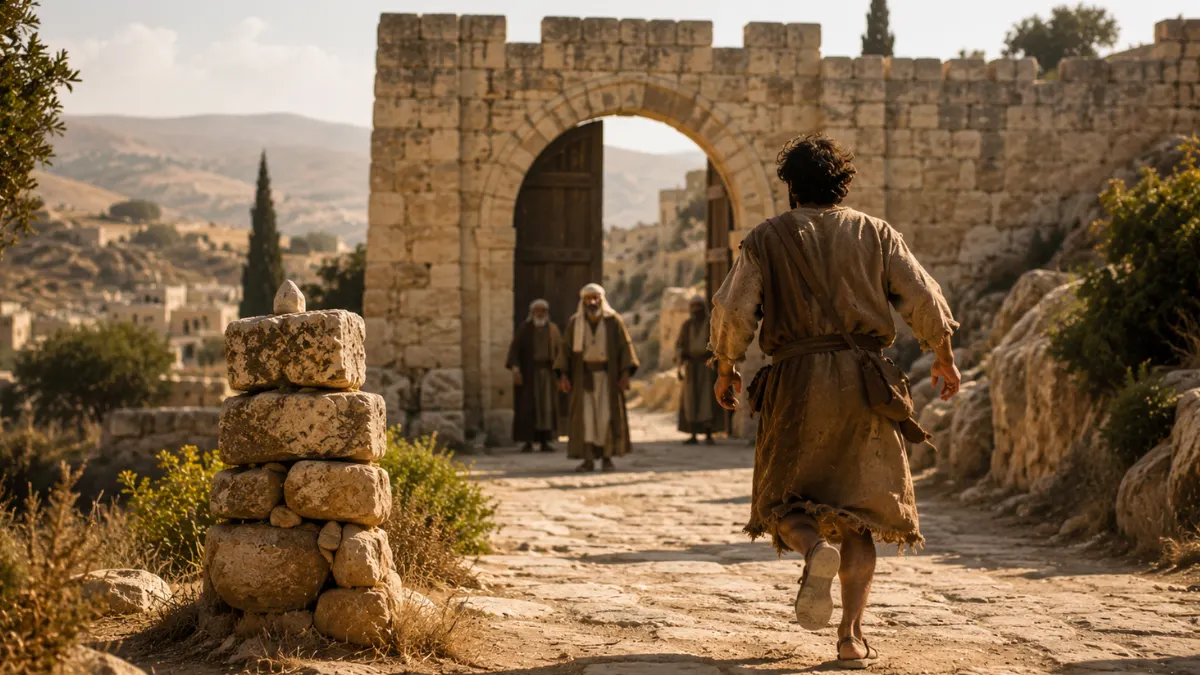

What was a city of refuge in the Old Testament? A city of refuge was one of six designated Levitical cities where someone who had caused a death and claimed the killing was unintentional could flee from the avenger of blood until the case was judged.
If the killing was judged accidental or without murderous intent, the person could remain protected in the refuge city. Intentional murder did not receive the same protection. The cities therefore were not places where murderers could simply hide from justice; they formed part of Israel’s legal response to homicide, family retaliation and the need to distinguish murder from unintended killing.
Numbers 35, Deuteronomy 19 and Joshua 20 provide the main biblical instructions for how this system worked.
What Was a City of Refuge in the Bible?
The cities of refuge were designated places of protection for someone involved in a death that may not have been intentional.
The biblical law recognized an important distinction between murder and a death caused without prior hatred or deliberate intent. At the same time, the victim’s family had a recognized representative who could act in response to the death.
Without a refuge system, a person responsible for an accidental death could potentially be killed before the circumstances were properly judged.
The refuge city interrupted that process.
A person could flee there rather than immediately falling into the hands of the blood-avenger. The case could then be examined to determine whether the death resulted from deliberate murder or from an unintended act.
The Bible Odyssey overview of biblical refuge describes the six cities as Levitical cities where someone responsible for an accidental death could seek asylum from the avenger until judgment was made.
The key point is that refuge came before final judgment. Reaching the city did not automatically prove the fugitive had done nothing wrong, nor did it make a deliberate murderer untouchable.
Why Did Israel Need Cities of Refuge?
Deuteronomy 19 gives one of the clearest examples of the problem the law was designed to address.
Two men go into a forest to cut wood. One swings an ax, the iron head flies from the handle, strikes the other man, and kills him.
The survivor caused the death, but he had not hated the victim or planned to kill him.
Nevertheless, a close family representative of the dead man might pursue the killer in the heat of anger.
The city of refuge created distance between the death and immediate retaliation so that the circumstances could be judged first.
This reveals the central purpose of the system. Israel’s homicide law did not treat every death caused by another person as identical.
Intent mattered.
Prior hostility mattered.
The circumstances of the killing mattered.
Numbers 35 considers factors such as the object used, whether the killer acted deliberately and whether hostility existed between the two people. Deuteronomy similarly distinguishes an accidental killing from a person who hated someone, ambushed that person and intentionally killed them.
The refuge cities therefore protected the process of determining what kind of killing had actually occurred.
Who Was the “Avenger of Blood”?
The person traditionally called the avenger of blood is described by the Hebrew expression go’el ha-dam.
The word go’el belongs to a wider family of Hebrew terms involving a close relative who acts on behalf of family interests. The responsibility changes according to the situation.
In Ruth, Boaz acts as a family redeemer in matters involving property and family continuity. PsalmWisdom’s study of the kinsman-redeemer in Ruth explains that different use of the same broader go’el concept.
In the refuge laws, however, the go’el ha-dam acts in connection with the death of a relative. English Bibles commonly translate the expression as “avenger of blood” or “blood-avenger.”
The role should not simply be imagined as an uncontrolled family feud.
The go’el ha-dam was a designated family representative operating within Israel’s homicide laws. The refuge system placed limits around when that representative could act and created a protected setting while the nature of the killing was determined.
This helps explain why the city itself mattered. The fugitive was not merely hiding from an angry person. The biblical law defined where protection applied and under what circumstances that protection could continue.
Who Could Flee to a City of Refuge?
Someone involved in a killing could flee to a refuge city when the death was claimed to have occurred unintentionally and without prior murderous intent.
Numbers 35 states that the refuge cities were available not only to Israelites but also to foreigners and resident aliens living among them in such cases.
Joshua 20 likewise describes the cities as places for someone who killed another person accidentally and without deliberate intent.
However, there is an important procedural distinction.
The person fleeing had not necessarily been finally judged the moment they reached the city.
Joshua describes the fugitive arriving at the city gate and explaining the circumstances to the elders. The person could receive initial admission and protection while the case proceeded.
That means a better description is not simply “only innocent people could enter.”
Rather, the refuge city protected someone claiming an unintentional killing until the legal process determined whether the claim was valid.
Intentional murder was treated differently once established.
What Happened After Someone Reached the City?
Joshua 20 describes the fugitive reaching the entrance of the refuge city and presenting the case before its elders.
The elders could admit the person and provide a place to live within the city. If the blood-avenger arrived, the fugitive was not simply handed over before the case had been judged.
Joshua then says the person would remain until standing trial before the assembly.
Numbers 35 similarly speaks of judgment between the killer and the blood-avenger before the assembly.
Deuteronomy 19 presents another part of the legal picture. If intentional murder was established, the elders of the killer’s own city were to send for the murderer and deliver him from the refuge city.
The three passages therefore do not describe every procedural detail identically.
Joshua emphasizes initial admission by the refuge city’s elders, Numbers speaks of judgment before the assembly, and Deuteronomy describes the elders of the killer’s home city acting when deliberate murder has been established.
What they share is more important for this article: the refuge system did not allow immediate retaliation to substitute for judgment.
A killing had to be distinguished from murder.
What Were the Six Cities of Refuge?
Joshua 20 names six refuge cities, divided across the two sides of the Jordan River.
West of the Jordan
- Kedesh in Galilee, in the hill country of Naphtali
- Shechem in the hill country of Ephraim
- Hebron, also called Kiriath Arba, in the hill country of Judah
East of the Jordan
- Bezer in the territory associated with Reuben
- Ramoth in Gilead in the territory associated with Gad
- Golan in Bashan in the territory associated with Manasseh
Numbers 35 says six cities were to function as cities of refuge, with three on one side of the Jordan and three in Canaan. They were included among the cities assigned to the Levites.
Their distribution gave designated places of refuge across Israel’s territory rather than concentrating the institution in one location.
Joshua names these cities for their practical role and location; the text does not assign a separate hidden symbolic meaning to each city’s name.
The six cities were therefore:
Kedesh, Shechem, Hebron, Bezer, Ramoth in Gilead and Golan in Bashan.
Could a Murderer Use a City of Refuge to Escape Punishment?
No. Reaching a city of refuge could prevent immediate retaliation before judgment, but the city was not permanent asylum for someone found guilty of intentional murder.
Numbers 35 draws several distinctions between deliberate and unintended killing.
It considers whether a deadly object was used, whether a person struck another intentionally, whether hostility existed, and whether the act happened suddenly without enmity.
Deuteronomy 19 presents the contrast even more directly.
If a man hated his neighbour, waited for him, attacked him, killed him and then fled to one of the refuge cities, the elders were commanded to have him brought back rather than allow the refuge city to shield him permanently.
This is why describing the six cities merely as “safe places for killers” badly misrepresents the law.
The institution did not erase accountability for intentional murder.
Its protection was directed toward someone not found guilty of deliberate murder, especially where an unintended death could otherwise trigger immediate blood vengeance.
Why Did the Manslayer Have to Stay Until the High Priest Died?
If the killing was judged unintentional, the manslayer still did not simply return home.
Numbers 35 says the assembly was to rescue the person from the blood-avenger and return the manslayer to the refuge city. The person then had to remain there until the death of the high priest serving at that time.
Joshua 20 repeats the same basic endpoint.
This meant refuge was both protection and restriction.
The manslayer was protected within the designated city, but normal residence at home was interrupted because a human life had still been lost.
Numbers 35 makes the geographical restriction especially serious. If the manslayer left the boundary of the refuge city before the permitted time and the blood-avenger encountered and killed that person outside it, the text says the blood-avenger incurred no bloodguilt for that act.
The manslayer therefore had to remain within the place where legal protection had been assigned.
The restriction could not simply be bought away.
Numbers 35 also forbids accepting a ransom that would allow a manslayer to return home before the high priest’s death. Likewise, ransom could not be accepted as a substitute for the prescribed punishment of someone guilty of murder.
Money could not cancel the rules governing either deliberate murder or protected residence.
Why Did the High Priest’s Death Change the Situation?
Numbers 35 clearly says that after the high priest died, the manslayer could return to the family land and former home.
What the passage does not do is give a detailed explanation for why the high priest’s death ended the required residence.
Later interpreters have suggested several possible meanings. Some connect the high priest with national atonement, while others understand his death as marking the end of a legal or social period.
Those interpretations should not be presented as though Numbers 35 explicitly states them.
The safest conclusion is:
The death of the serving high priest was the legal event that ended the manslayer’s required residence in the city of refuge and permitted a return home. Scripture states that rule clearly without fully explaining its rationale.
Did the Bible Require Roads to the Cities of Refuge?
Deuteronomy 19:3 tells Israel to prepare the way to the cities of refuge and arrange the territory so that a manslayer could flee there.
English translations express the instruction somewhat differently, but the basic biblical concern is practical access.
A city of refuge would have little protective value if someone eligible for refuge could not reasonably reach it.
Later Jewish tradition gives more detailed descriptions of how the routes were maintained. Rabbinic texts discuss prepared roads and signs directing fugitives toward refuge.
Those details are useful for understanding later Jewish interpretation of the institution, but they should not be read backward into Joshua 20.
The Bible itself commands preparation of the route and establishes the location and function of the refuge cities.
Details such as crossroads bearing signs marked “Refuge” belong to later rabbinic tradition, not to Joshua’s original list of the six cities.
Keeping the distinction clear prevents later commentary from being presented as though it were part of the biblical text.
