

What is a kinsman-redeemer in Ruth? A kinsman-redeemer was a close relative with the standing to protect or restore threatened family interests. In Ruth 3–4, that role becomes connected with Elimelech’s family property, Ruth’s future and preserving the deceased family line.
The Hebrew word is go’el, meaning a redeemer or family protector. Boaz qualifies as one of Naomi and Ruth’s potential redeemers, but he cannot act immediately because another relative stands closer and has priority. The story therefore involves much more than a man simply being required to marry a widow.
That distinction explains why Ruth approaches Boaz, why Boaz refuses to bypass the nearer relative, why the matter is settled publicly at Bethlehem’s gate, and why a sandal becomes part of the final transaction.
What Does Kinsman-Redeemer Mean in Ruth?
The expression kinsman-redeemer represents the Hebrew word גֹּאֵל — go’el, from a verb connected with redeeming, recovering or reclaiming.
In Ruth 2:20, Naomi realizes that Boaz is not merely a generous landowner who has treated Ruth kindly. He belongs to the family circle from which a redeemer could come.
The role of a go’el was broader than marriage. A close family member could act when important family interests were in danger of being permanently lost.
Leviticus 25 provides an important background. If an Israelite became poor and had to part with ancestral property, a close relative could redeem it. The purpose was tied to preserving family inheritance rather than allowing economic hardship to permanently separate land from the family.
That helps explain why some translations describe the go’el in Ruth as a guardian of family interests.
Ruth’s situation eventually involves property, inheritance, widowhood, and continuation of a deceased family line but those elements should not be turned into a universal definition saying that every go’el had exactly the same responsibilities in every situation.
Why Was Boaz Considered a Redeemer?
Naomi identifies Boaz as one of their potential redeemers after Ruth returns from gleaning in his field.
This changes the direction of the story. Naomi and Ruth had returned to Bethlehem after Elimelech, Mahlon and Chilion had died. Ruth was a widow, Naomi had lost her husband and sons, and the future of the family line had become uncertain.
Boaz was related closely enough to have a possible role in restoring what had been placed at risk.
That does not mean Naomi identifies him as the only possible redeemer. The story later reveals that another relative has a stronger claim.
Ruth’s request to Boaz in chapter 3 makes the issue explicit. She asks him to spread his garment, or “wing,” over her because he is a redeemer.
The Hebrew imagery is meaningful because Boaz had earlier praised Ruth for seeking refuge under the wings of the Lord. Ruth now uses related language when appealing to Boaz.
Her request is commonly understood as a request for marriage and protective family commitment and she explicitly grounds it in Boaz’s position as a go’el.
Boaz understands the seriousness of the request, but he immediately explains that another redeemer stands nearer than he does.
Why Was Another Relative Ahead of Boaz?
Ruth 3–4 assumes that the nearer eligible relative has priority. Because another man stands closer to the family than Boaz, Boaz first gives him the opportunity to redeem.
This is why Boaz does not simply promise Ruth that he will marry her and settle the matter privately.
He tells her that he will act if the nearer relative declines.
The following morning, Boaz goes to Bethlehem’s gate and waits for the man. He also gathers ten elders so that the matter can be handled publicly.
Ruth 4 makes the order clear: the unnamed relative has the first opportunity, while Boaz comes next.
The text does not give readers a complete chart explaining every level of kinship or every possible redeemer. It only tells us what matters for this case: the unnamed man has priority over Boaz and Boaz respects that priority.
What Was Happening With Elimelech’s Family Land?
Ruth 4 introduces property belonging to Elimelech’s family.
Boaz tells the nearer relative that Naomi is selling, or arranging the transfer of, property associated with Elimelech. The man is given the first opportunity to redeem it and initially agrees.
The exact legal nature of Naomi’s transaction is debated. The text should therefore not be forced into a modern real-estate model in which every detail of ownership, purchase, and title transfer works exactly as it would today.
What is clear is that family property connected with Elimelech is at stake and the nearer relative possesses the first redemption opportunity.
At first, he is prepared to take it.
Boaz then explains that the transaction also carries implications involving Ruth the Moabite and the preservation of the deceased man’s name in connection with his inheritance.
At that point, the man changes his decision.
The episode shows why family redemption in Ruth cannot be understood merely as purchasing a piece of land. Property is part of a wider concern involving inheritance and the continuation of a family whose male line had been devastated by death.
Was Boaz Legally Required to Marry Ruth?
This is where many explanations of the kinsman-redeemer become too simple.
Deuteronomy 25:5–10 describes what is commonly called levirate marriage. In the situation described there, a man dies without a son and his brother has a responsibility involving the widow and the continuation of his deceased brother’s name.
Boaz, however, is not presented as Mahlon’s brother.
For that reason, Ruth and Boaz do not represent a straightforward application of the exact situation described in Deuteronomy 25.
Leviticus 25 provides another important legal background because it deals with a close relative redeeming family property, but those property-redemption laws do not simply say that the redeemer must marry a widow.
The Bible Odyssey discussion of levirate marriage notes the difficulty and explains that scholars debate how closely Ruth 4 should be classified as levirate marriage.
Ruth appears to bring related family concerns together in a distinctive arrangement: family property is endangered, a deceased man’s line needs preservation, Ruth is a widow, and more than one qualifying relative is involved.
Therefore, the statement “Boaz had to marry Ruth because every kinsman-redeemer was legally required to marry a widow” is inaccurate.
Boaz’s marriage to Ruth becomes connected with redemption in this particular story, but marriage was not the simple definition of the go’el role.
Why Did the Nearer Redeemer Refuse?
When Boaz first presents the land matter, the nearer relative agrees to redeem.
After Boaz introduces the fuller implications involving Ruth and the deceased man’s inheritance, the relative refuses.
He explains that he cannot redeem because doing so could impair or endanger his own inheritance.
Ruth does not tell us exactly how he calculated that risk. The text gives no detailed financial explanation, so theories about precisely how much land, money or inheritance his household would lose should not be presented as established fact.
What matters is that the man considers the complete responsibility too costly or risky for his own inheritance and formally gives up his opportunity.
Boaz can then proceed.
This contrast is significant because Boaz accepts the responsibility that the nearer relative declines, but the narrative does not portray Boaz as ignoring legal order to obtain Ruth. He waits until the man with priority publicly relinquishes his right.
What Did the Sandal and City Gate Mean?
Ruth 4 places the transaction at Bethlehem’s city gate, a public setting where elders and witnesses could observe important community matters.
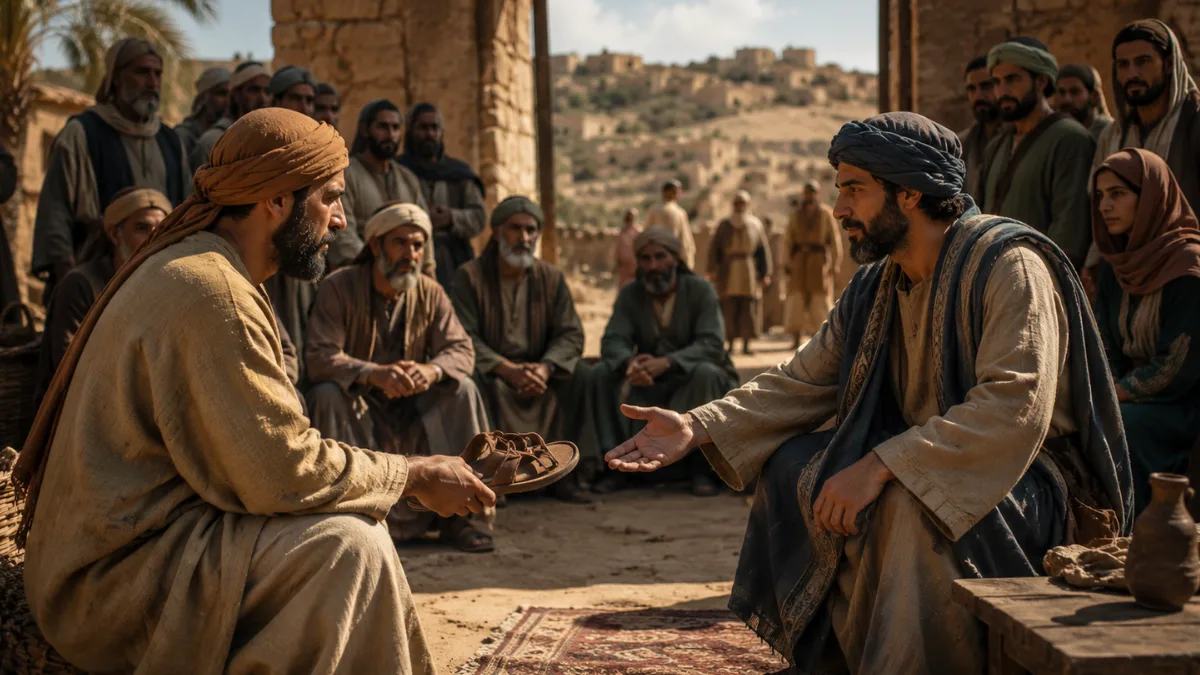
Boaz gathers ten elders and presents the case before them. When the nearer relative decides not to redeem, Ruth explains that a sandal was used in Israel to confirm transactions involving redemption and exchange.
The man removes his sandal, making the transfer visible before witnesses.
The sandal therefore functions as a public sign confirming that the redemption opportunity has passed from the nearer relative to Boaz.
There is a related sandal ceremony in Deuteronomy 25, but the two scenes should not automatically be treated as identical.
In Deuteronomy, the widow removes the sandal of a brother-in-law who refuses his responsibility, and the ceremony involves public disgrace. In Ruth 4, the nearer relative removes his own sandal as part of a transaction and Ruth does not shame or spit at him.
Both passages involve family continuity and sandal imagery, but Ruth itself explains its ceremony in terms of confirming redemption and exchange.
The public setting matters just as much as the sandal. Boaz settles everything before elders and witnesses rather than relying on a private promise made to Ruth at the threshing floor.
What Did Boaz Actually Restore?
Once the nearer relative relinquishes his right, Boaz publicly announces what he is taking responsibility for.
The transaction involves interests connected with Elimelech’s family property, Ruth as Mahlon’s widow, and the preservation of the deceased man’s name in connection with his inheritance.
Boaz specifically speaks about preventing the deceased man’s name from disappearing from among his relatives and from the community.
This is why the climax of Ruth cannot be reduced either to a romantic wedding or to a land transaction.
The story is about the restoration of a family situation that appeared almost hopeless at the beginning of the book.
Naomi had lost her husband and both sons. Ruth had lost her husband. The family line appeared threatened, and its property interests were vulnerable.
By the end, Ruth and Boaz have a son, Obed. Obed becomes the father of Jesse, and Jesse becomes the father of David.
The book therefore moves from family loss toward continuity, inheritance, and a future that extends far beyond what Naomi or Ruth could see when they first returned to Bethlehem.
What Does Kinsman-Redeemer Mean in Ruth in Simple Terms?
In Ruth, a kinsman-redeemer is a qualified close relative who can step in to protect threatened family interests. Boaz becomes the redeemer only after a nearer relative gives up his prior opportunity.
The case involves Elimelech’s family property, Ruth’s future as Mahlon’s widow, preservation of the deceased family name and continuation of the family line.
This is why “kinsman-redeemer” should not be defined simply as “a man required to marry his dead relative’s widow.” Ruth 3–4 draws on ideas related to family redemption and preservation of a deceased man’s line, but Boaz is not Mahlon’s brother, and the story does not fit Deuteronomy 25 in a completely straightforward way.
Boaz’s role is therefore best understood as one of family restoration. He respects the nearer relative’s priority, handles the matter publicly before witnesses, accepts the responsibility the other man declines, and becomes the person through whom the endangered family gains continuity.
Ruth’s story uses redemption in a concrete family and inheritance setting. The Bible later develops redemption much more broadly, and readers interested in that wider theme can explore PsalmWisdom’s study of the scarlet thread of redemption across Scripture.
Within the Book of Ruth itself, however, the meaning remains specific: Boaz acts as the family redeemer who helps restore what death, widowhood and threatened inheritance had placed at risk.
