
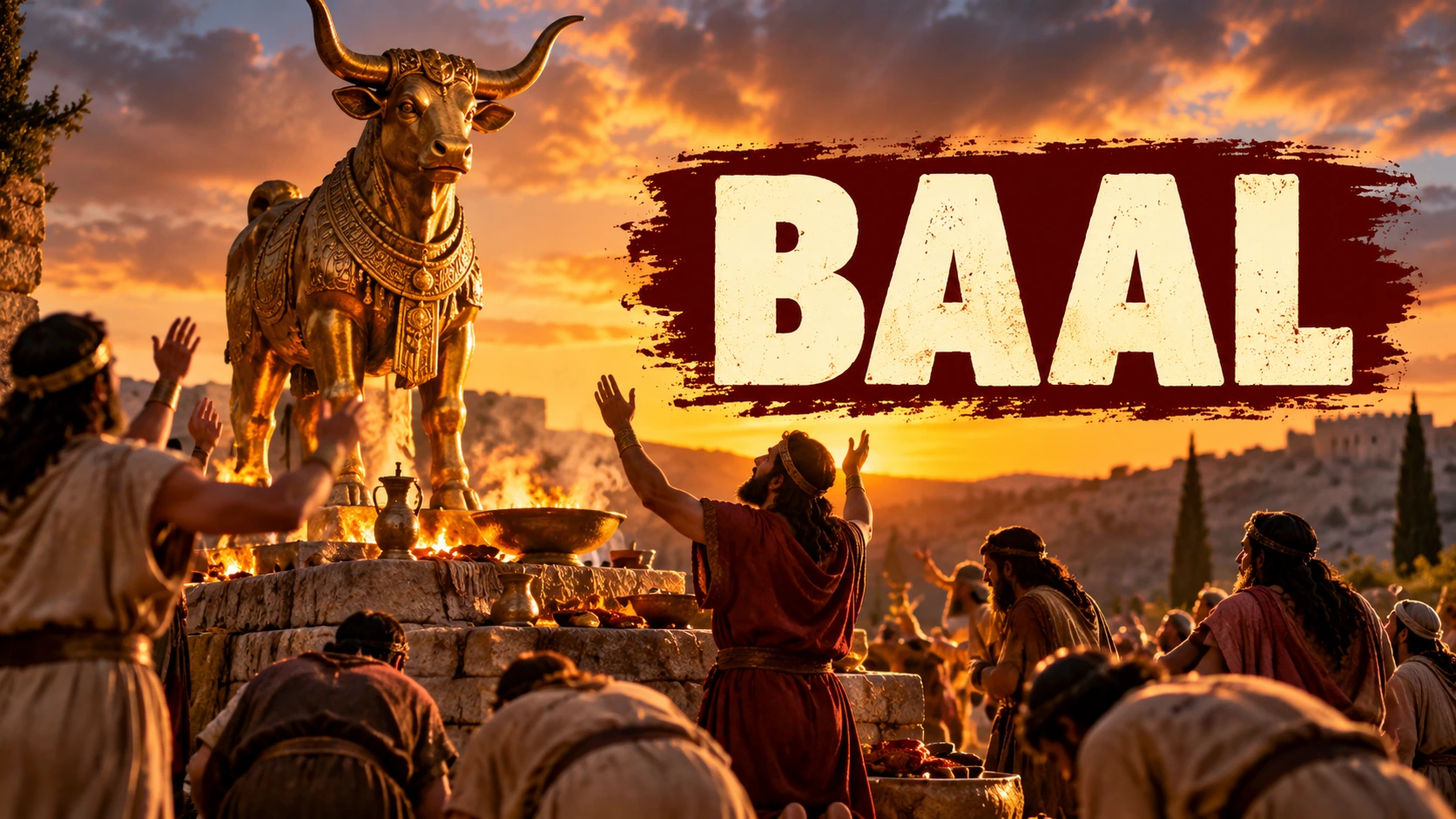

Baal was a prominent Canaanite god associated with storms, rainfall, and agricultural prosperity. In the Bible, his worship became one of Israel’s most persistent religious problems. From the period of the judges to the reign of King Ahab and the warnings of later prophets, the Israelites repeatedly turned toward Baal despite their covenant relationship with the Lord.
What makes this history particularly interesting is that Baal worship was connected with something essential to everyday survival. Ancient communities depended heavily on seasonal rainfall, and Baal was believed to have power over the storms that brought water to their fields. His worship offered the promise of agricultural prosperity in a land where failed harvests could threaten an entire community.
I examined the biblical accounts alongside historical evidence about Canaanite religion to understand why this worship remained attractive across generations. The strongest explanation emerges from three connected influences: dependence on rainfall, the acceptance of Canaanite religious practices within Israelite communities and political support for Baal worship under certain kings.
Baal and the Origins of His Worship
The name Baal comes from a Semitic word meaning “lord” or “master.” It could function as a title but it was also used for deities worshiped in different communities throughout the ancient Near East.
The Baal most prominently associated with Canaanite religion was a storm god commonly identified as Baal-Hadad. He was believed to possess authority over rain and thunder, making him especially significant in societies whose agriculture depended on seasonal weather.
Ancient texts discovered at Ugarit, a city on the Mediterranean coast of present-day Syria, provide valuable evidence about his religious importance. These writings portray Baal as a powerful deity associated with storms, warfare, and kingship.
The religious traditions preserved at Ugarit were not necessarily identical to every form of Baal worship practiced in Israel. Nevertheless, they help explain why a storm god could occupy such an important place in the wider religious environment of Canaan.
Connection Between Baal and Rainfall
Rainfall was central to agricultural life in ancient Canaan. Farmers relied on seasonal rains to support crops, sustain grazing land and maintain the resources needed by their communities.
A god believed to control those rains could therefore appear particularly valuable. Worshiping Baal was connected with hopes for successful harvests, productive land and continued prosperity.
This relationship helps explain why Baal worship appealed to people whose religious concerns were closely connected with their material needs. Seeking agricultural security was not an abstract theological question; it involved the food and resources required for daily life.
However, the historical evidence establishes what Baal’s worshipers believed about his powers, not that those powers actually existed.
The Bible repeatedly challenges those beliefs by presenting the Lord as the true source of rainfall and agricultural provision. This becomes especially important in the accounts of Elijah and Hosea, where Baal’s supposed authority over prosperity is directly disputed.
My assessment is that Baal’s association with agricultural survival was one of the strongest reasons his worship could remain attractive to Israel. People did not necessarily need to abandon every aspect of their existing religious identity to become interested in practices promising protection for their crops and livelihoods.
How Baal Worship Spread Among the Israelites
The Bible records Israel’s involvement with Baal long before the reign of King Ahab. Numbers 25 describes Israelites participating in worship associated with Baal of Peor, while Judges repeatedly portrays the people turning toward the religious practices of surrounding nations.
Judges 2:11–13 states that the Israelites served the Baals and Ashtoreths after abandoning the Lord. The passage describes a wider pattern in which the people adopted worship that conflicted with their covenant obligations.
These accounts suggest that Baal worship was not simply imposed upon Israel by foreign rulers. It also became established through contact with neighboring communities and the acceptance of local religious traditions.
One particularly revealing example appears in Judges 6, where Gideon is instructed to destroy an altar dedicated to Baal.
Baal Worship in Gideon’s Family
According to Judges 6:25, the altar Gideon was commanded to destroy belonged to his father. This detail places Baal worship within an Israelite household rather than describing it only as a practice followed by neighboring peoples.
When Gideon destroys the altar, the townspeople demand that he be punished. Their reaction indicates that the worship site had significance within the community and that some residents were prepared to defend it.
Gideon’s father, Joash, responds by questioning why people should defend Baal if Baal is genuinely a god capable of defending himself.
The episode reveals a significant difference between encountering a foreign religion and living in a community where that religion has become familiar.
By Gideon’s time, Baal worship could be associated with family property, local customs and communal expectations. Rejecting it could therefore involve challenging practices that relatives and neighbours had already accepted.
I find this particularly important when explaining why Israel repeatedly returned to Baal. Religious practices that become part of community life can persist beyond the circumstances that originally encouraged their adoption.
The problem was not always that Israelites were choosing between two completely unfamiliar religious systems. In some communities, Baal worship had already become part of the environment in which people lived.
This helps explain why the book of Judges describes repeated departures from the worship of the Lord rather than one isolated episode of idolatry.
Ahab and Jezebel’s Support for Baal Worship
Baal worship gained a different level of influence during the reign of King Ahab.
First Kings 16:31–33 records Ahab’s marriage to Jezebel, the daughter of Ethbaal, king of the Sidonians. The passage states that Ahab served Baal, worshiped him, and constructed a temple and altar for him in Samaria.
This represented more than the acceptance of a local religious custom. Ahab gave Baal worship a prominent place within the religious life of the northern kingdom.
The distinction becomes clearer when Ahab’s actions are compared with the earlier account of Gideon.
Gideon’s family possessed a local altar to Baal. Ahab, by contrast, established a temple in the kingdom’s capital, making the worship visible within the setting of royal authority.
First Kings 18:19 also describes prophets of Baal and Asherah associated with Jezebel’s household. The numbers given in the narrative indicate an organized religious presence supported by royal resources.
Why Royal Support Made Baal Worship Harder to Reject
Royal patronage could give a religious practice status, resources, and public legitimacy. A temple supported by a king occupied a different position from an isolated altar maintained by a family.
For ordinary Israelites, the presence of Baal worship within royal institutions may have made it appear more established and acceptable. This is a reasonable historical inference, although the Bible does not describe every individual’s motivation for participating.
The influence of Ahab and Jezebel also meant that opposition to Baal worship could involve confrontation with political authority.
This helps explain the dangerous circumstances surrounding Elijah’s ministry. He was challenging religious practices associated with the ruling household rather than merely disputing the beliefs of a few individuals.
When I compare the accounts in Judges and Kings, the development is striking. Baal worship appears first as part of Israel’s local religious environment and later receives direct support from powerful political leaders.
The attraction of Baal’s supposed agricultural benefits was reinforced by the social and political structures surrounding his worship. That combination helps explain why the practice became difficult to eliminate.
Elijah’s Challenge to Baal’s Power
The confrontation between Elijah and the prophets of Baal in 1 Kings 18 becomes more meaningful when viewed against Baal’s association with storms and rainfall.
First Kings 17:1 records Elijah announcing that there would be no dew or rain except according to his word. The resulting drought created a direct challenge to the supposed power of a deity believed to control the weather.
If Baal could provide the rainfall necessary for agricultural prosperity, a severe drought raised an obvious question about his ability to protect those who depended upon him.
The confrontation on Mount Carmel brought that question into the open.
In 1 Kings 18:21, Elijah challenges the people over their divided allegiance between the Lord and Baal. The subsequent contest involves two offerings and a test of which deity will answer.
The prophets of Baal repeatedly call upon their god, but the narrative emphasizes that they receive no response. Elijah then prays to the Lord, and fire consumes the offering.
The account continues beyond that dramatic moment. First Kings 18:41–45 describes the return of rain after Elijah’s prayer.
Why the Drought Matters as Much as the Fire
The relationship between the drought and the return of rain is essential to understanding what the narrative says about Baal.
The drought challenged the power attributed to him, while the return of rain associated the restoration of agricultural life with the Lord.
The fire on Mount Carmel demonstrated divine authority within the biblical account, but the surrounding weather crisis addressed one of the main reasons people worshiped Baal in the first place.
For readers interested in the miracle itself, PsalmWisdom’s article on the fire from heaven on Elijah’s altar at Mount Carmel examines that event and its significance in greater detail.
What stands out to me in the wider narrative is how closely the challenge matches Baal’s supposed responsibilities. The contest did not occur independently of Israel’s material concerns. It unfolded during a crisis involving the very rainfall that Baal’s worshipers believed he could provide.
The biblical message is that the Lord, rather than Baal, holds authority over the natural conditions sustaining Israel.
Yet the confrontation also raises another important question. If Baal’s prophets were publicly defeated, why did the Bible continue to describe Israel turning toward Baal in later generations?
The answer becomes clearer in the prophetic writings, particularly Hosea’s explanation of how the people understood the source of their prosperity.
Hosea’s Explanation of Israel’s Trust in Baal
Hosea 2 offers one of the most revealing explanations of Baal worship in the Bible.
Instead of describing a public contest between rival prophets, Hosea examines the beliefs that influenced Israel’s religious loyalty.
Hosea 2:5 uses the imagery of an unfaithful woman who believes her lovers provide the necessities of life, including food, water, clothing, and other resources.
The imagery represents Israel’s relationship with other objects of worship. The people had begun attributing their material well-being to sources other than the Lord.
Hosea 2:8 makes the accusation more specific. The Lord declares that Israel failed to recognize Him as the provider of grain, wine, oil, silver, and gold, and that resources He had provided were used in connection with Baal worship.
This passage explains something that the historical narratives alone do not fully reveal.
Israel Credited Baal for the Prosperity It Received
The items mentioned in Hosea are not random examples of wealth. Grain, wine, and oil were valuable agricultural products associated with the successful use of the land.
Their presence in the passage strengthens the connection between Baal worship and expectations of agricultural prosperity.
According to Hosea, the central mistake was that Israel attributed provision to Baal rather than recognizing the Lord as its source.
This is different from the question addressed at Mount Carmel.
Elijah’s confrontation challenged whether Baal possessed authority over rain. Hosea’s accusation concerned the way Israel interpreted the prosperity it already enjoyed.
I find this comparison especially useful because it reveals two sides of the same religious problem. During drought, people might appeal to a supposed rain god for relief. During prosperous seasons, they might credit that deity for the abundance they received.
The attraction could therefore persist in both difficult and favorable circumstances.
If harvests were poor, Baal worship might appear to offer hope for improvement. If harvests were successful, worshipers could interpret the outcome as confirmation that Baal had provided for them.
This is an interpretation of the religious incentives implied by the texts, not a claim that the Bible records every worshiper’s private reasoning.
Nevertheless, Hosea supplies strong evidence that the attribution of agricultural prosperity was central to the conflict.
My assessment is that Baal worship could remain persuasive because people connected it with both their need for provision and their experience of prosperity. Hosea’s criticism addresses precisely that confidence.
The problem was not merely the presence of another religious name. Israel had begun placing trust and gratitude in a deity the prophet rejected as the true source of its blessings.
Why Baal Worship Persisted in Israel
The Bible records efforts to eliminate Baal worship, but those efforts did not end every form of the practice throughout Israelite and Judahite history.
Second Kings 10 describes Jehu’s campaign against the worshipers of Baal in the northern kingdom. He destroys the temple of Baal, and verse 28 states that he removed Baal worship from Israel.
That statement describes the outcome of Jehu’s campaign, but it should not be interpreted as proof that every form of idolatry permanently disappeared.
The following verses distinguish his actions against Baal from his continued involvement with the religious practices associated with Jeroboam.
Later, 2 Kings 23 records King Josiah’s reforms in Judah, including the removal of objects and religious officials connected with Baal worship.
The fact that Baal-related practices appear in these different historical settings shows why one dramatic confrontation or one royal reform should not be treated as the end of the entire problem.
Why Destroying Baal’s Altars Was Not Enough
The different biblical accounts suggest that Baal worship was sustained by more than individual temples.
In Judges, it was established within families and communities. Under Ahab, it received royal support. In Hosea, it was connected with beliefs about the source of agricultural prosperity.
These influences could not necessarily be eliminated through a single act of religious reform.
Destroying an altar removed a place of worship, but it did not automatically change every belief or expectation that had made the worship attractive.
Likewise, the removal of royal support did not guarantee that all communities would immediately abandon their established traditions.
This distinction helps explain why the Bible repeatedly addresses Baal worship across different generations. The historical accounts describe changing circumstances, while the underlying religious conflict continues to appear.
PsalmWisdom’s broader explanation of idolatry in the Bible examines why giving worship and trust to other gods violated Israel’s covenant obligations. Baal worship provides a particularly revealing historical example because it combined religious devotion with expectations of material security.
The biblical evidence does not establish that every Israelite worshiped Baal or that all forms of Baal worship were identical. It does, however, demonstrate that the practice repeatedly became influential enough to draw condemnation from Israel’s religious leaders and prophets.
Why Israel Kept Turning to Baal
After comparing the biblical accounts, I find that Israel’s repeated attraction to Baal cannot be explained by one event or one ruler.
Baal was associated with rainfall and agricultural prosperity, giving his worship an immediate connection with economic survival. His religious traditions were already familiar in the surrounding Canaanite environment, making them accessible to Israelite communities.
The worship became established within households and local communities, as Gideon’s story demonstrates. Under Ahab, royal patronage gave Baal worship a more prominent institutional position.
Hosea reveals another important influence. Some Israelites attributed their food, agricultural abundance, and material blessings to Baal, showing how religious loyalty became connected with their understanding of prosperity.
These factors help explain why the practice repeatedly returned, even when prophets publicly challenged it or rulers attempted to remove it.
The strongest connection in my comparison is between Baal’s reputation as a provider of rain and Hosea’s accusation that Israel credited him with gifts the Lord had supplied. Elijah challenged Baal’s supposed power during a drought, while Hosea challenged the belief that Baal deserved gratitude during times of provision.
Together, those accounts reveal why the biblical conflict extended beyond the rejection of a foreign idol.
The central issue was Israel’s understanding of who sustained its life and deserved its worship. According to the biblical writers, turning toward Baal meant directing trust, loyalty, and gratitude away from the Lord.
Baal remained attractive because his worship was connected with needs people considered essential, while established customs and political influence helped sustain that worship across generations.
That is why Baal occupies such a prominent place in Israel’s biblical history. His worship represented a recurring alternative to trusting the Lord for the very things upon which the people depended.
