
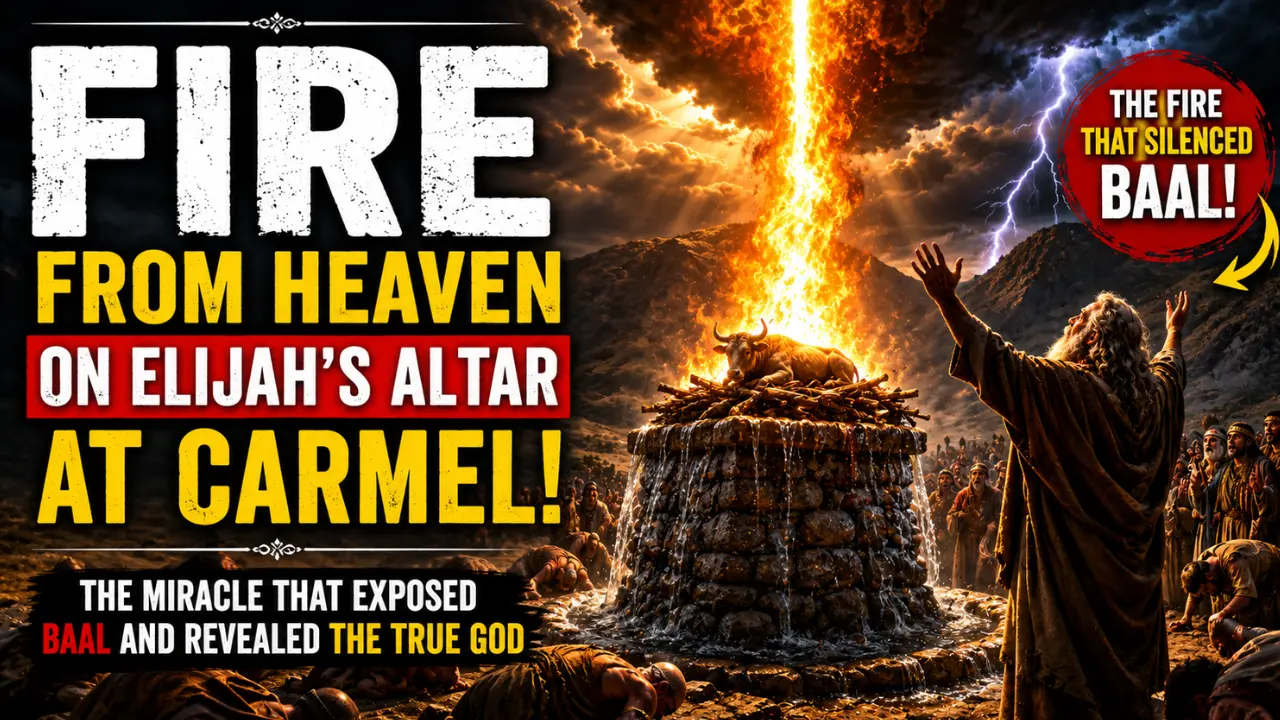

The fire from heaven on Elijah’s altar at Carmel is one of the clearest demonstrations of divine authority in the Old Testament. The event was not simply a supernatural display intended to impress Israel. It was a covenant confrontation in which God exposed idolatry, confirmed true worship, answered the prophetic ministry of Elijah, and called a divided nation back to exclusive loyalty to the Lord.
The setting matters because Israel was not merely ignorant of God. The nation had entered a dangerous state of religious mixture. Under Ahab and Jezebel, Baal worship had gained power, influence, and public legitimacy. The people were wavering between the Lord and Baal, attempting to maintain some connection to Israel’s covenant God while also embracing the practices and promises of a false god associated with fertility, storms, rain, and agricultural blessing. Mount Carmel became the place where this divided loyalty was publicly judged.
The fire from heaven therefore symbolized God’s answer to Israel’s spiritual crisis. It revealed that the Lord alone was God, that Baal’s claims were empty, that true worship required covenant faithfulness and that divine power could not be manipulated by ritual intensity or religious performance.
Why the Contest Happened on Mount Carmel
The confrontation on Mount Carmel took place during a severe drought. This detail is essential because Baal was commonly associated with rain, storms, fertility, and agricultural life. Elijah’s announcement of drought had already challenged Baal’s supposed domain. If Baal truly controlled rain and fertility, the drought exposed his powerlessness before the God of Israel.
Mount Carmel may have also been associated with fertility and lushness, which made the setting even more significant. The contest was not held in a neutral spiritual environment. It occurred in a context where Baal’s claims could be publicly tested before the people. The Lord did not merely defeat Baal in theory. He demonstrated His authority precisely in the area where Baal was believed to hold power.
This means the fire from heaven must be understood as part of a larger covenant dispute. The question was not whether one prophet could outperform another group of prophets. The question was whether Israel would recognize the Lord as the only true God and abandon the idolatrous system that had corrupted the nation’s worship.
Elijah’s Question Exposed Israel’s Divided Heart
Elijah’s challenge to the people was direct: “How long will you halt between two opinions?” This question identified the real issue at Carmel. Israel’s crisis was not only Baal worship itself, but divided allegiance. The people were attempting to stand between two claims, two forms of worship, two sources of security, and two visions of divine power.
The word picture suggests instability and hesitation. Israel was not walking firmly in covenant faithfulness. The nation was limping between the Lord and Baal, unable or unwilling to choose exclusive obedience. Elijah’s question made neutrality impossible because covenant faith cannot remain suspended between God and idols.
The fire from heaven answered this divided condition. It showed that the Lord does not stand as one option among many religious possibilities. He is the living God who alone has covenant claim over Israel. The miracle demanded recognition, repentance, and renewed loyalty.
Why Elijah Repaired the Broken Altar
Before Elijah prayed for fire, he repaired the altar of the Lord that had been broken down. This action was one of the most important symbolic movements in the whole account. The broken altar represented more than neglected religious furniture. It reflected Israel’s broken covenant life, damaged worship, and abandonment of faithful devotion to the Lord.
By repairing the altar, Elijah enacted restoration before the fire came. The altar had to be restored because the issue at Carmel was not spectacle but covenant renewal. The fire would not fall on an altar dedicated to Baal. It would fall upon the restored altar of the Lord, showing that God’s response was connected to true worship ordered according to covenant faithfulness.
Elijah used twelve stones according to the number of the tribes of Israel. This detail gave the altar national and covenant meaning. Even though the kingdom was divided historically, the altar testified to Israel’s identity before God as the covenant people descended from Jacob. Elijah was not simply challenging false prophets; he was calling the whole people back to the God who had named, chosen, and claimed them.
The Water on the Altar Removed Human Explanation
Elijah commanded that water be poured over the sacrifice, the wood, and the altar until the trench around it was filled. This was not unnecessary drama. It served a theological purpose. The water removed any suspicion that the fire could be explained by hidden embers, natural ignition, or human manipulation.
The prophets of Baal had spent hours trying to generate a response through shouting, ritual movement, and self-injury. Elijah’s preparation moved in the opposite direction. He made the miracle impossible by ordinary means and then prayed a simple covenantal prayer. The contrast showed that true divine response does not depend on human frenzy, ritual pressure, or emotional coercion.
The use of water during a drought also sharpened the confrontation with Baal. In a season when rain had been withheld and Baal’s supposed authority over fertility had failed, Elijah drenched the altar before praying to the Lord. The act emphasized that the God of Israel held authority over both fire and water, judgment and rain, drought and restoration.
The Silence of Baal Revealed the Emptiness of Idolatry
The prophets of Baal cried out for hours, but no answer came. The text emphasizes the silence repeatedly because that silence is theological. Baal did not merely delay. He did not respond because he had no living power to respond. The rituals of his prophets produced sound, movement, intensity, and blood, but no divine voice and no fire.
This contrast is central to the meaning of Carmel. False worship can create religious activity without divine reality. It can produce urgency, spectacle, and emotional force while remaining spiritually empty. The prophets of Baal demonstrated human desperation directed toward a powerless object of worship.
Elijah’s confrontation exposed idolatry not only as wrong but as empty. Idols promise control, blessing, fertility, security, and power, yet they cannot answer the deepest need of the people. Baal’s silence prepared the way for the Lord’s fire to reveal the difference between human-made religion and the living God.
Elijah’s Prayer Was Rooted in Covenant
Elijah’s prayer was brief, direct, and theologically rich. He addressed the Lord as the God of Abraham, Isaac, and Israel, grounding the moment in covenant history. He did not appeal to personal charisma or prophetic status as an independent source of power. He asked God to make known that He was God in Israel and that Elijah had acted according to His word.
This is crucial for understanding the fire. Elijah was not performing a miracle to prove himself. He was asking God to vindicate His own name, His covenant, His word, and His claim over Israel. The prophet’s authority depended entirely upon the Lord who sent him.
Elijah also prayed that God would turn the hearts of the people back again. That request reveals the purpose of the miracle. The fire was not given merely to defeat an argument. It was given to restore covenant recognition and call Israel back from spiritual adultery. The deepest issue was the heart of the nation before God.
The Fire Confirmed the Lord’s Authority
When the fire descended, it consumed the offering, the wood, the stones, the dust, and the water in the trench. The completeness of the consumption showed that the response came from overwhelming divine power. Ordinary fire would consume dry wood and sacrifice; this fire consumed even the saturated altar and surrounding elements.
The fire confirmed several truths at once. It showed that the Lord accepted the restored altar and sacrifice. It revealed that He alone ruled over the forces Baal was believed to control. It demonstrated that covenant worship was not empty ritual when directed to the living God. It also showed that divine holiness confronts idolatry with judgment.
The fire was therefore both mercy and judgment. It was mercy because God answered in a way that called Israel back. It was judgment because the answer exposed the emptiness of Baal and the seriousness of covenant rebellion.
Why the Fire Consumed the Stones and Water
The detail that the fire consumed the stones, dust, and water should not be overlooked. The miracle exceeded the ordinary burning of a sacrifice. The altar itself was affected, which emphasized that the event was not a private devotional sign but a public revelation of divine power over every element present.
The stones represented the rebuilt covenant altar. The water represented impossibility from a human standpoint. The dust emphasized totality. Nothing associated with the altar remained outside the reach of God’s fire. The Lord’s answer was not partial or ambiguous. It was complete enough that the people could not reasonably attribute it to technique, coincidence, or hidden human action.
This total consumption reinforced the message that the God of Israel was not dependent upon favorable conditions. He did not need dry wood, human assistance, ritual manipulation, or natural probability. His authority was absolute.
The People’s Response Revealed the Purpose of the Miracle
When the people saw the fire, they fell on their faces and confessed, “The Lord, He is God.” Their response shows that the miracle accomplished its intended purpose. The people were not simply amazed; they were brought to acknowledgment. The fire moved the nation from hesitation toward confession.
This confession directly answered Elijah’s opening challenge. The people had been wavering between two opinions. After the fire, they declared that the Lord alone was God. The event exposed divided worship and called for covenant decision.
The falling on their faces also shows reverence before divine holiness. The people recognized that the issue was not merely which prophet had succeeded. They had witnessed the living God answer from heaven before a nation that had tolerated idolatry.
Fire From Heaven as Divine Approval and Judgment
In the Old Testament, fire from God often appears at moments of divine approval, covenant confirmation, priestly inauguration, judgment, or holy presence. The fire at Carmel belongs within this larger biblical pattern. It confirmed Elijah’s altar and sacrifice while condemning the false worship surrounding Baal.
This dual meaning is important. The fire did not only say, “This sacrifice is accepted.” It also said, “This false worship is rejected.” Divine fire revealed God’s holiness by accepting what was rightly offered and exposing what was idolatrous.
The event therefore teaches that true worship is not defined by intensity, sincerity, or public religious energy alone. True worship is defined by covenant faithfulness to the living God. Baal’s prophets were intense, but intensity could not make an idol real. Elijah’s prayer was simple, but it was directed to the Lord who lives and answers.
The Fire and Covenant Restoration
The fire from heaven was not isolated from what followed. After the confrontation, the drought ended and rain returned. This sequence matters because it showed the Lord’s authority over the entire crisis. Baal had failed to give rain, failed to send fire, and failed to defend his prophets. The Lord answered by fire and then brought rain.
The fire restored recognition of the true God before the rain restored the land. This order is theologically significant. Israel’s deeper problem was not first agricultural drought but covenant unfaithfulness. The land’s barrenness reflected a spiritual crisis in the nation. The fire addressed the covenant disorder before the rain answered the physical drought.
Carmel therefore shows that restoration begins with the recognition of God’s rightful authority. The external blessing of rain followed the public exposure of idolatry and the renewed confession that the Lord alone is God.
The Meaning of Elijah’s Altar for True Worship
Elijah’s altar teaches that true worship must be ordered by God’s covenant truth rather than human preference. The prophets of Baal attempted to provoke divine response through ritual excess, but Elijah restored the altar of the Lord and prayed according to God’s covenant name and word.
This distinction is vital. Worship is not made true by emotional intensity alone. It is not made true by numbers, spectacle, tradition, or cultural power. True worship is faithful response to the living God who reveals Himself and calls His people to exclusive devotion.
The fire on Elijah’s altar confirmed that the Lord receives worship according to His truth. It also warned Israel that worship mixed with idolatry cannot remain spiritually neutral. Divided worship eventually becomes false worship because it refuses the exclusive claim of God.
Christ and the Deeper Fullfillment of Accepted Sacrifice
The fire at Carmel should be interpreted first within its Old Testament covenant setting, but it also fits within the broader biblical movement toward Christ. Elijah’s altar involved accepted sacrifice, divine confirmation, and the turning of hearts back to God. These themes find their deepest fulfillment in the work of Christ.
At Carmel, God accepted a sacrifice that publicly revealed His authority and called the people back from idolatry. In the Gospel, Christ becomes the final and perfect sacrifice through whom reconciliation with God is accomplished. Unlike Elijah’s altar, which addressed a national crisis in Israel, the cross addresses the deeper human crisis of sin, alienation, and rebellion.
The connection should not be forced as if every detail at Carmel directly predicts the cross. The stronger connection is theological: accepted sacrifice, divine vindication, judgment against false worship and the restoration of people to God all reach fuller meaning in Christ’s redemptive work.
What the Fire From Heaven Means
The fire from heaven on Elijah’s altar at Carmel means that the Lord publicly revealed Himself as the only true God before a divided nation. It confirmed Elijah’s restored altar, exposed Baal’s silence, judged idolatry, accepted covenant worship, and called Israel back to exclusive allegiance.
The event was not merely about supernatural power. It was about covenant truth. The Lord answered not to entertain the crowd, but to restore recognition of His name, His authority, and His claim over His people. The fire consumed the sacrifice because true worship had been restored on the altar of the Lord, and it consumed the surrounding elements because God’s authority could not be limited by human conditions.
Mount Carmel remains one of Scripture’s clearest demonstrations that the living God does not compete as one deity among many. He reveals, judges, restores, and calls His people away from divided worship into covenant faithfulness before Him.
