
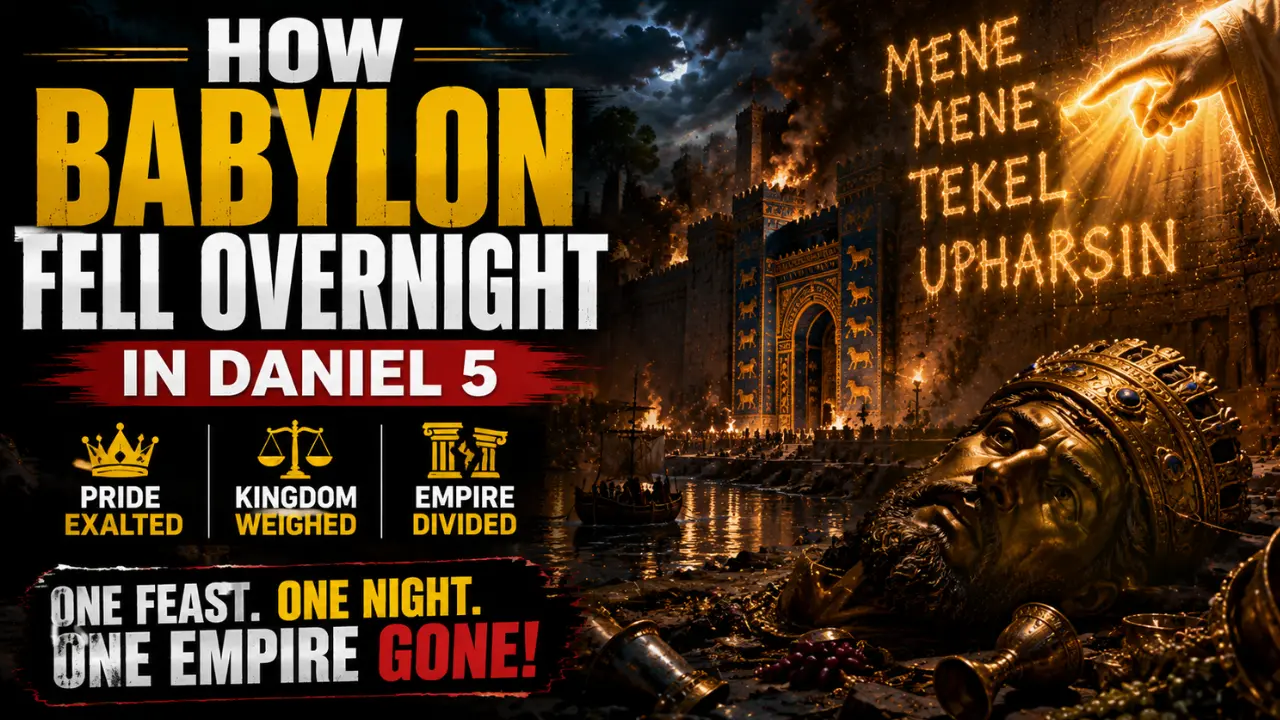

Daniel 5 presents the fall of Babylon as both a historical collapse and a divine judgment. The chapter does not focus mainly on military strategy, siege details or political transition. It explains why Babylon fell from the standpoint of God’s sovereignty. During Belshazzar’s royal feast, a supernatural hand wrote a verdict on the palace wall declaring that the kingdom had been numbered, weighed and divided. That same night, Babylon fell to the Medes and Persians.
The chapter’s central claim is that Babylon did not fall merely because another empire became stronger. Babylon fell because God had judged its pride, sacrilege, idolatry and refusal to humble itself before the Lord of heaven. The empire that had conquered Jerusalem, taken temple vessels and exalted its gods was itself brought under divine evaluation and removed from power, closely connected to [how Daniel reveals that earthly kingdoms remain accountable to God’s sovereign authority and judgment — Divine Judgment on Nations in the Book of Daniel].
Babylon’s Apparent Security Before Its Collapse
Babylon was not portrayed as weak or insignificant. It represented imperial power, wealth, military dominance and political achievement. The city had a reputation for strength and the empire had conquered nations, including Judah. From a human perspective, Babylon appeared secure.
Daniel 5 deliberately places Babylon’s outward confidence beside its hidden vulnerability before God. Belshazzar’s feast takes place while the kingdom stands near its end. The king celebrates as though imperial power guarantees safety but the narrative shows that Babylon’s future has already been determined by divine judgment.
This contrast is essential to the chapter. Babylon looks stable from inside the banquet hall but before God it has already been weighed and found lacking, closely connected to [how Scripture warns that human power and security can collapse suddenly under divine judgment — The Danger of False Security in the Bible].
Belshazzar’s Feast and Imperial Arrogance
Belshazzar’s feast is not simply background detail. It reveals the spiritual condition of Babylonian kingship. The banquet gathers nobles and royal figures in an atmosphere of luxury, confidence and public display. The empire is represented through feasting, wine, wealth and self-assurance.
This setting matters because Daniel 5 presents the feast as an act of false security. Belshazzar behaves as though Babylon’s status remains unquestioned. The king’s public celebration becomes a visible expression of imperial pride at the very moment when the empire is about to lose its dominion.
The feast therefore functions as more than a royal party. It is a narrative setting where Babylon’s arrogance becomes exposed before God.
Also Read: What The Handwriting On The Wall Meant In Daniel 5
The Temple Vessels and Sacred Desecration
The decisive act in Daniel 5 occurs when Belshazzar commands that the gold and silver vessels taken from the Jerusalem temple be brought into the banquet. These vessels had been consecrated for worship before the God of Israel. They were not ordinary treasures captured in war. They belonged to sacred service.
Belshazzar and his guests drink from these vessels while praising gods of gold, silver, bronze, iron, wood, and stone. This act turns the feast into covenant desecration. Babylon treats holy objects as imperial trophies and uses them in praise of idols.
This is the theological centre of the chapter. Babylon is not merely careless with religious artifacts. It is symbolically declaring victory over the God whose temple had been plundered. Daniel later identifies the offense clearly: Belshazzar has lifted himself up against the Lord of heaven, closely connected to [how Scripture treats the profaning of holy things as an act of pride and rebellion against God — The Biblical Meaning of Desecration and Holy Things].
Babylon Against the Lord of Heaven
Daniel’s accusation explains why the feast becomes the setting for judgment. Belshazzar did not merely dishonour Israel’s temple vessels. He exalted himself against the God to whom those vessels belonged.
The temple vessels represented covenant holiness. Their use in idolatrous praise shows contempt for what had been set apart for God. In Daniel’s interpretation, Babylon’s sin is not limited to drunkenness or extravagance. The empire profanes holy things, praises powerless idols and refuses to honour the God who holds human life and kingdoms in His hand.
This makes Daniel 5 an imperial judgment scene. Babylon’s kingship stands accused before the Lord of heaven.
The Handwriting on the Wall
At the height of the feast, fingers of a human hand appear and write on the plaster of the palace wall. The scene changes instantly. The banquet hall becomes the place where divine judgment is written publicly against the kingdom.
Belshazzar’s terror is significant. His face changes, his thoughts alarm him, his strength fails and his knees knock together. The king who treated holy vessels as objects of conquest cannot stand calmly before the message of God.
The handwriting functions as divine interruption. Babylon’s celebration is stopped by a verdict it cannot control, erase, or interpret through its own wisdom, closely connected to [how divine judgment in Scripture often interrupts human pride and false security unexpectedly — When God Interrupts Human Pride in the Bible].
Why Babylon’s Wise Men Failed
Belshazzar calls for the wise men of Babylon but they cannot read or interpret the writing. This failure continues a major theme throughout Daniel. Babylon possesses learning, court specialists, religious systems and political power, yet it repeatedly fails before the revelation of God.
The empire can conquer cities, command officials, and gather experts but it cannot understand the divine message written against itself. Daniel’s role contrasts sharply with Babylonian wisdom because he serves the God who reveals mysteries and rules over kingdoms.
This detail shows that Babylon’s collapse is not only political. Its wisdom system also fails at the moment of judgment.
Daniel’s Entrance and Prophetic Authority
Daniel is brought before Belshazzar because of his earlier reputation for interpretation. Yet Daniel does not enter as a court entertainer or royal adviser seeking reward. He rejects the king’s gifts and speaks as a prophet of the God who judges kings.
This matters for the authority of the chapter. Daniel’s interpretation is not a clever solution to a mystery. It is a prophetic explanation of divine judgment. Before he explains the words, he rebukes the king, showing that the writing is rooted in Belshazzar’s guilt.
Daniel’s authority comes from revelation, not from Babylonian office or royal approval.
Nebuchadnezzar as a Warning Belshazzar Ignored
Daniel reminds Belshazzar of Nebuchadnezzar, who had been given greatness, majesty and glory, yet was humbled when his heart became proud. Nebuchadnezzar was driven from human society until he learned that the Most High rules over the kingdom of men and gives it to whom He will.
This history is essential to Daniel 5. Belshazzar had access to the lesson of Nebuchadnezzar’s humiliation. He knew that Babylonian kingship was subject to the Most High, yet he did not humble his heart.
Daniel’s words, “though you knew all this,” make Belshazzar’s guilt more severe. He sinned against knowledge. He rejected a known testimony of divine sovereignty.
Accountable Knowledge and Divine Judgment
Daniel 5 teaches that knowledge of God’s works increases accountability. Belshazzar was not judged as someone with no witness to divine authority. He had inherited the memory of God’s dealings with Nebuchadnezzar and still chose pride.
This is why Daniel’s rebuke comes before the interpretation of the writing. The verdict is not arbitrary. It is grounded in Belshazzar’s refusal to humble himself before the God who had already revealed His authority over Babylon’s throne.
The fall of Babylon is therefore presented as judgment against willfull arrogance, not mere ignorance.
Mene: Babylon’s Days Were Numbered
The first word Daniel interprets is “Mene.” It means that God has numbered the days of Belshazzar’s kingdom and brought it to an end. The repetition of “Mene” strengthens the certainty of the decree. Babylon’s time has been counted, measured and completed before God.
This word undermines the illusion of imperial permanence. Babylon may appear secure to its rulers but its duration is not self-determined. The empire exists only within limits established by God.
“Mene” teaches that history is not ultimately governed by royal confidence or military strength. Kingdoms continue only as long as God permits them, closely connected to [how Scripture presents God as sovereign over the rise and fall of nations and rulers — God’s Control Over Human Kingdoms in the Bible].
Tekel: The King Was Weighed and Found Lacking
The second word is “Tekel.” Daniel explains that Belshazzar has been weighed in the balances and found lacking. This is judicial imagery. The king’s rule, character, response to revelation, treatment of holy things and posture before God have been evaluated.
Belshazzar is not measured by Babylon’s wealth, military influence, architectural greatness or royal status. He is weighed before God’s standard and found deficient.
This reverses the entire banquet scene. In the eyes of his court, Belshazzar appears powerful. Before the divine court, he lacks the humility, reverence and righteousness required before the Lord of heaven.
Peres: Babylon’s Kingdom Was Divided
The final word is connected to “Peres,” meaning that Babylon’s kingdom is divided and given to the Medes and Persians. This announces the transfer of dominion from one empire to another.
The meaning is not merely that Babylon will lose a battle. The kingdom itself is being reassigned under divine decree. Babylon’s authority is revoked. Its dominion passes to another power because God has judged it.
This completes the verdict. Babylon’s days are numbered, its king is weighed and its empire is divided.
Also Read: What “Mene Mene Tekel Upharsin” Means in the Bible
Babylon Fell That Same Night
Daniel 5 emphasizes the immediacy of the fullfillment. That very night Belshazzar is killed and the kingdom passes to another ruler. The speed of the collapse reinforces the authority of God’s written judgment.
The chapter does not present Babylon’s fall as a long decline from inside the narrative. It presents a sudden transition after divine judgment has been announced. The empire that appeared secure during the feast is removed before morning.
This overnight fall shows that Babylon’s walls, wealth, gods and royal power could not preserve it once God had declared its end, closely connected to [how Scripture repeatedly shows the sudden collapse of human power when divine judgment arrives — The Suddenness of Divine Judgment in the Bible].
Historical Background of Babylon’s Fall
Historically, Babylon fell to the Medo-Persian Empire in 539 BC. Ancient sources outside the Bible describe the city falling with surprising speed and limited resistance. Daniel 5 does not provide a detailed military account because its purpose is theological rather than tactical.
The biblical chapter is not primarily interested in how Persian forces entered the city. Its concern is why Babylon’s rule ended. Daniel interprets the event through divine sovereignty: Babylon fell because God had numbered its days, weighed its king, and divided its kingdom.
This does not deny historical military events. It gives them theological meaning.
Why Daniel Emphasizes Theology Over Military Detail
Daniel 5 is written as a court narrative of judgment, not a battlefield report. The chapter focuses on the feast, the vessels, the writing, Daniel’s rebuke and the interpretation because these elements reveal the spiritual reason for Babylon’s fall.
The omission of detailed military strategy is intentional. Daniel wants the reader to see that the decisive reality is not siege-craft or imperial rivalry but divine judgment. Babylon’s fall is interpreted from heaven’s perspective.
The chapter therefore teaches that history has theological meaning. Empires do not merely rise and fall through visible power struggles. They remain accountable before God.
Babylon as an Example of Imperial Pride
Babylon in Daniel represents more than one ancient city. It functions as a symbol of earthly power that exalts itself against God. The empire builds confidence in wealth, conquest, religious display and royal authority while remaining subject to the Lord who governs kingdoms.
Daniel 5 shows the weakness of such pride. Babylon can possess sacred vessels but it cannot control the God to whom they belong. It can praise idols but those idols cannot save the kingdom. It can gather wise men but they cannot interpret the divine verdict.
The empire’s confidence is exposed as false because it rests on power without humility before God.
The Fall of Babylon and God’s Sovereignty
One of Daniel’s central messages is that God rules over kingdoms. He gives authority, removes rulers, humbles the proud, reveals mysteries and determines the limits of empires.
Daniel 5 applies that theology to Babylon’s final night. The kingdom falls because God has judged it. The Medes and Persians receive dominion because Babylon’s authority has been removed.
The chapter therefore presents political transition as subordinate to divine rule. Earthly events unfold under the sovereignty of the Lord of heaven.
The Role of Idolatry in Babylon’s Judgment
Belshazzar’s feast is filled with praise to idols made from created materials. Daniel specifically contrasts these gods with the God who holds Belshazzar’s breath and all his ways.
This contrast is important. Idolatry is not merely mistaken worship. In Daniel 5, it is part of imperial rebellion. Babylon praises gods that cannot see, hear, know, reveal, judge or preserve. Meanwhile, the living God writes judgment on the wall and brings the empire to its end.
The fall of Babylon exposes the powerlessness of its idols before the God of Israel.
Meaning of Babylon’s Overnight Fall
Babylon fell overnight in Daniel 5 because the empire had come under divine judgment. Belshazzar profaned the temple vessels, praised idols, ignored the known lesson of Nebuchadnezzar’s humiliation and lifted himself up against the Lord of heaven.
The handwriting on the wall announced the verdict: Babylon was numbered, weighed and divided. The kingdom’s end was not merely a military event but a judgment enacted under God’s sovereignty.
Daniel 5 therefore presents Babylon’s fall as the collapse of imperial pride before divine authority. The empire feasted in confidence but it had already been measured in God’s court. By morning, Babylon’s power had passed away and the judgment written on the wall had become history.

2 thoughts on “How Babylon Fell Overnight in Daniel 5”