
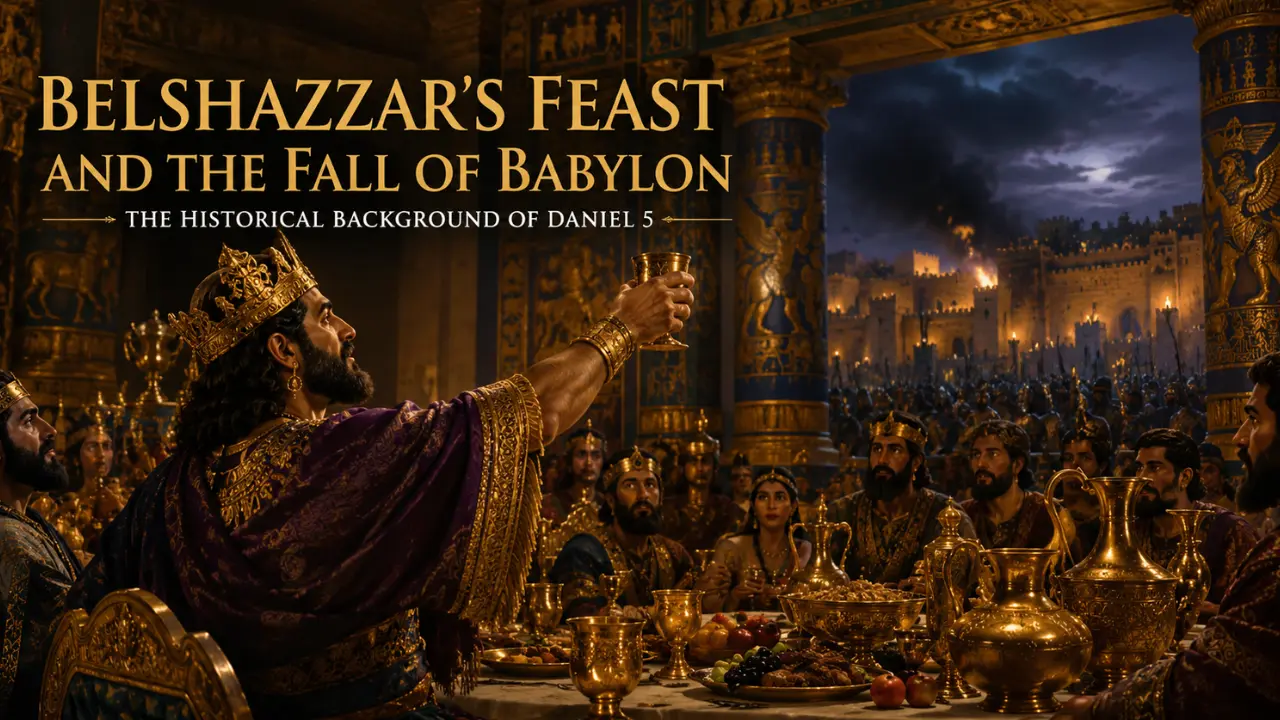

The historical background of Belshazzar’s Feast comes from the final period of the Neo-Babylonian Empire, when Babylon was still wealthy, powerful, and symbolically impressive, but politically weakened under the pressure of Persia. Daniel 5 places the feast in this tense setting: a royal banquet, sacred temple vessels, Belshazzar’s court, and the sudden announcement that Babylon’s kingdom would pass to the Medes and Persians.
This article explains the historical setting behind Daniel 5. It focuses on Babylon, Belshazzar, the royal feast, the empire’s decline, and the Medo-Persian takeover. It does not focus on devotional lessons or a detailed word-by-word explanation of the writing on the wall.
Daniel 5 Happens Near the End of Babylon’s Power
Daniel 5 is not set during Babylon’s strongest years under Nebuchadnezzar. It is set near the end of the empire, after Babylon had already passed through a period of political change, royal instability, and outside military pressure.
Babylon had once been the dominant power of the ancient Near East. Under Nebuchadnezzar II, it became famous for its military strength, royal building projects, wealth, and influence. Jerusalem had fallen to Babylon, and sacred vessels from the temple had been taken into Babylonian possession. That background explains why the temple vessels appear in Daniel 5.
By the time of Belshazzar’s feast, however, Babylon’s position was no longer secure. The Persian Empire under Cyrus had grown into a serious regional power. The older Babylonian confidence was still visible inside the palace, but the political reality outside the palace had already changed.
This makes Daniel 5 historically important. The chapter is not simply describing a royal celebration. It is placing a feast inside the final hours of an empire that was losing control of its future.
Also Read: What “Mene Mene Tekel Upharsin” Means in the Bible
Who Was Belshazzar in Babylonian History?
Belshazzar is presented in Daniel 5 as the ruler hosting the feast in Babylon. Historically, he is best understood as the royal son of Nabonidus, the last king of the Neo-Babylonian Empire. Nabonidus ruled from 556 to 539 BC, and ancient sources connect Belshazzar with royal authority during Nabonidus’s reign.
This matters because Daniel 5 calls Belshazzar “king,” while historical records identify Nabonidus as the final official king of Babylon. The difference is not as simple as a contradiction. In the ancient setting, Belshazzar appears to have held practical ruling authority while his father was absent or politically distant from Babylon.
Nabonidus is known for spending a long period away from Babylon, especially in connection with Tayma in Arabia. During that time, Belshazzar functioned as a major royal figure inside Babylon. Archaeology Magazine describes Nabonidus as leaving his son Belshazzar as regent when he left Babylon for years.
This explains why Belshazzar could host a major royal feast, command court officials, offer high rewards, and promise Daniel a high position in the kingdom. He may not have been the official king in the strictest dynastic sense, but he held enough authority inside Babylon for Daniel 5 to present him as the acting royal power in the city.
Why Daniel Was Offered the Third Highest Position
One historical detail in Daniel 5 is easy to miss. Belshazzar offers to make Daniel “the third highest ruler in the kingdom.”
That detail fits the historical situation well. If Nabonidus was the official king and Belshazzar was the next ruling authority, then the highest available honor beneath them would be the third position. Daniel 5 does not say Daniel would become second after Belshazzar. It says third.
This small detail supports the political setting behind the chapter. Belshazzar’s authority was real, but it existed within a kingdom where Nabonidus still stood above him in official royal status.
For readers, this helps make the chapter more historically understandable. Daniel 5 is not presenting a random palace scene. It is describing a court environment shaped by shared authority, royal absence, and an empire under pressure.
Also Read: How Babylon Fell Overnight in Daniel 5
Babylon Still Looked Strong From the Inside
Babylon’s fall can feel surprising because the city had a reputation for strength. Ancient Babylon was not a weak village waiting to collapse. It was a major imperial capital with walls, temples, wealth, administrative systems, and a long tradition of royal power.
Inside the palace, the feast showed confidence. Belshazzar gathered a thousand nobles, drank wine before them, and used the gold and silver vessels taken from the Jerusalem temple. Daniel 5 describes a setting of luxury, royal display, and religious arrogance. The feast was not a private meal. It was a public act of royal confidence.
This is one reason the chapter carries such historical weight. The empire looked powerful from the banquet hall, but its political foundation was already failing. The palace atmosphere and the military reality did not match.
The feast becomes historically striking because it shows Babylon’s ruling class acting as though the empire still possessed unquestioned security. Yet the Medes and Persians were already the rising power in the region.
Temple Vessels Connected Babylon’s Past Victories to Its Final Night
The gold and silver vessels in Daniel 5 were not ordinary drinking cups. They had been taken from the Jerusalem temple during Babylon’s earlier conquest. Their presence in the feast connects the chapter to Babylon’s older victories under Nebuchadnezzar.
Historically, this detail matters because imperial powers often displayed captured sacred objects as symbols of conquest. Taking temple vessels was not merely theft. It was a public sign that one kingdom had defeated another kingdom and that the gods of the defeated people had been humiliated in the eyes of the conquerors.
When Belshazzar used those vessels in the feast, he was reaching back into Babylon’s imperial memory. The objects reminded the court of Babylon’s earlier dominance over Judah. In that sense, the feast was not only political. It was also symbolic.
Daniel 5 presents this act as part of the final-night setting. Babylon’s rulers celebrated with objects taken from a conquered people, while their own empire was about to be taken by another power.
Also Read: Powerful Lessons From Daniel Chapter 5
Babylon’s Decline Was Already Underway
The fall of Babylon did not happen in a vacuum. The empire had already become vulnerable before the night described in Daniel 5.
Nabonidus’s reign appears to have created tension within Babylon. He is often associated with religious policies that elevated the moon god Sin, while Babylon’s traditional religious establishment centered strongly on Marduk. The Nabonidus Chronicle is one of the important ancient sources for this period, covering Nabonidus’s reign, the rise of Cyrus, and the fall of the Babylonian Empire.
This does not mean every detail of Babylon’s decline can be explained by religion alone. Empires usually weaken through several pressures at once. Babylon faced leadership instability, internal dissatisfaction, and the military expansion of Persia.
By the time Daniel 5 takes place, the Persian advance was not a distant rumor. Cyrus had already become a dominant force. Babylon was no longer simply defending its prestige. It was facing a serious transfer of imperial power.
Medes and Persians Were the Rising Power
Daniel 5 says the kingdom would be divided and given to the Medes and Persians. In historical terms, this points to the transition from Babylonian power to the Persian-led empire associated with Cyrus the Great.
The phrase “Medes and Persians” reflects the broader political world of the time. Cyrus came from Persia, but his empire had absorbed Median power and expanded into a much larger imperial force. By the time Babylon fell, Persia was not a small neighboring kingdom. It was an expanding empire capable of replacing Babylon as the leading power in the region.
The Cyrus Cylinder, now held by the British Museum, gives a Babylonian account of Cyrus’s conquest of Babylon in 539 BC and presents Cyrus as restoring order and returning divine statues to their temples.
This historical background helps explain why Daniel 5 treats Babylon’s fall as a major imperial turning point. The chapter is not merely about the death of one ruler. It marks the end of Babylonian dominance and the arrival of a new imperial age.
Fall of Babylon in 539 BC
Babylon fell to Cyrus in 539 BC. The Nabonidus Chronicle records the final period of Nabonidus’s reign, the Persian advance, and the capture of Babylon.
The exact military details are discussed differently across ancient traditions, but the broad historical result is clear: Babylon passed from Neo-Babylonian control into Persian control. Nabonidus was the last official king of Babylon, and Belshazzar’s role belongs to this final moment of the empire.
Daniel 5 places Belshazzar’s death on the same night as the judgment against Babylon. The chapter then says that Darius the Mede received the kingdom. This part of Daniel has been widely discussed because “Darius the Mede” is difficult to identify directly in external historical records. For a historical-background article, the important point is that Daniel 5 presents the fall as a transfer of power from Babylon to the Medo-Persian world.
The chapter’s historical force rests on that transfer. Babylon, the empire that had conquered Jerusalem, was itself conquered.
Why the Feast Matters Historically
Belshazzar’s feast matters because it gives the reader a palace-level view of Babylon’s final collapse. Instead of describing only armies, walls, and political negotiations, Daniel 5 shows the atmosphere inside the royal court.
- The feast reveals several things at once.
- Belshazzar still acted with royal confidence.
- Babylon’s elites were still gathered in luxury.
- The memory of earlier conquest was still being celebrated.
- Sacred objects from Jerusalem were still in Babylonian possession.
- Persian power was already close enough to bring the empire to an end.
This is why the historical setting is so important. Without the background, the feast may look like only a dramatic Bible scene. With the background, it becomes a chapter set at the edge of imperial collapse.
Belshazzar’s Feast Was a Final Imperial Scene
The feast in Daniel 5 should be read as a final imperial scene. Babylon had wealth, memory, religious pride, and royal ceremony, but it no longer controlled the direction of history.
Belshazzar stands at the center of that scene as a ruler with real authority but limited historical security. His father Nabonidus was the official king. Persia was rising. Babylon’s older glory could still be displayed in the palace, but it could not protect the empire from collapse.
That is what makes Daniel 5 historically powerful. The chapter does not need to give a long military report to show Babylon’s fall. It shows the empire from inside its own banquet hall, at the very moment when its future was being taken away.
Historical Summary
The historical background of Belshazzar’s Feast is the final stage of the Neo-Babylonian Empire. Babylon remained impressive, wealthy, and symbolically powerful, but its political strength had weakened. Belshazzar, the son of Nabonidus, appears to have held practical royal authority in Babylon while Nabonidus remained the official king.
Daniel 5 is set against this background of imperial decline. The royal feast, the temple vessels, the Babylonian court, and the announcement of Medo-Persian rule all belong to the same historical moment.
The fall of Babylon in 539 BC brought the Neo-Babylonian Empire to an end and opened the way for Persian rule under Cyrus. Belshazzar’s feast stands in Daniel 5 as the final palace scene before that transfer of power became complete.
Frequently Asked Questions
Was Belshazzar the last king of Babylon?
Nabonidus was the last official king of Babylon, but Belshazzar acted with royal authority in the city. This is why Daniel 5 can present Belshazzar as the ruler hosting the feast while historical records still identify Nabonidus as the final king.
Why did Belshazzar offer Daniel the third highest position?
Belshazzar’s offer makes sense historically because Nabonidus was first, Belshazzar was likely second in practical authority, and the next available rank would be third. This detail fits the political structure behind Daniel 5.
Why is Babylon’s fall important in Daniel 5?
Babylon’s fall is important because Daniel 5 shows the end of the empire that had once conquered Jerusalem. The chapter connects Babylon’s royal pride, temple vessels, and final feast with the sudden loss of imperial power.

1 thought on “9 Historical Details Behind Belshazzar’s Feast”