
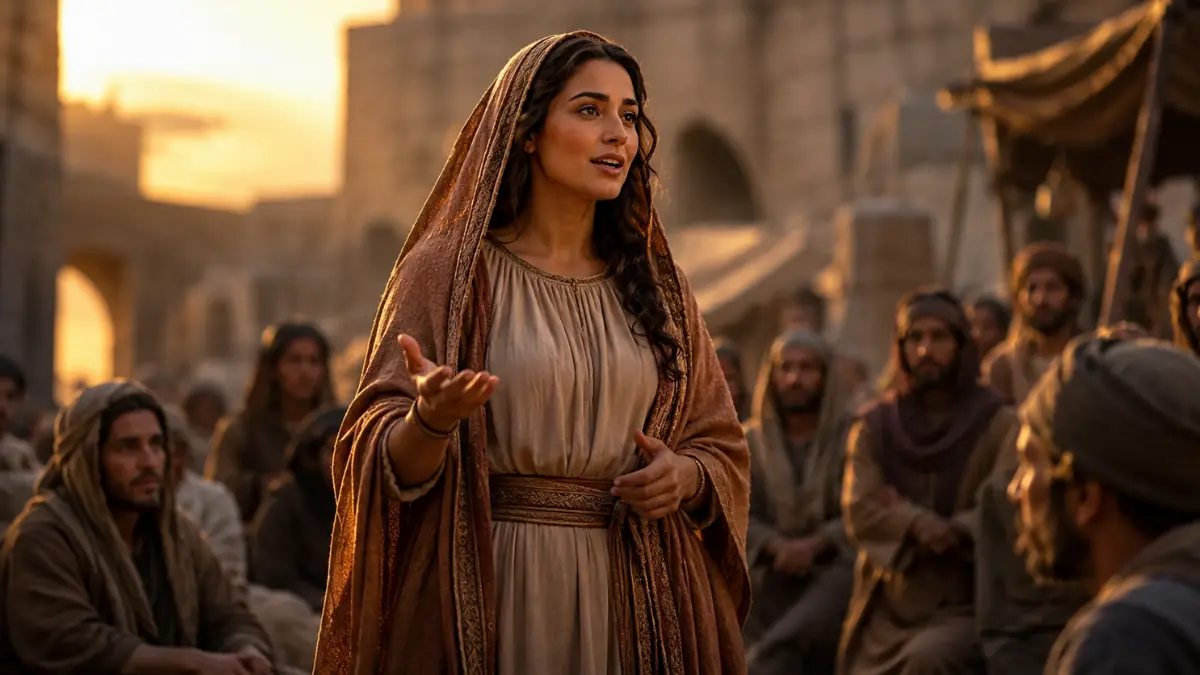

Proverbs portrays wisdom as a woman partly because the Hebrew noun for wisdom has feminine grammatical gender. The writers then develop that natural grammatical form into Lady Wisdom, a poetic character who teaches, warns, prepares a feast and invites people to choose a life shaped by truth and reverence for God.
The female image also serves the literary structure of Proverbs 1–9. A father instructs a young listener who encounters competing female voices. Lady Wisdom calls him toward discipline, faithfulness and understanding, while the adulterous woman and Lady Folly invite him toward secrecy, immediate pleasure and destructive choices.
Proverbs does not present Lady Wisdom as an ordinary historical woman or an independent goddess. The book uses personification to give a voice and character to the wisdom that comes from God and reflects His moral order.
Where Does Lady Wisdom Appear in Proverbs?
Proverbs develops the image of Lady Wisdom most clearly in chapters 1, 8 and 9.
In Proverbs 1, Wisdom calls aloud in streets, public squares and city gates. Ancient communities used these places for trade, leadership, legal decisions and public discussion. By placing Wisdom there, Proverbs shows that godly judgment belongs in ordinary life rather than only in private study or religious settings.
Wisdom speaks openly to inexperienced people and urges them to turn away from foolishness. Her message includes both invitation and warning. She offers instruction, but she also explains that people cannot continually reject correction without experiencing the consequences of their choices.
Proverbs 8 develops the figure further. Wisdom stands beside the road and calls to everyone who passes. She praises truth, prudence, justice, and sound judgment. The chapter also places personified Wisdom at the beginning of God’s creative ordering and uses poetic language to show that creation reflects divine wisdom.
Proverbs 9 presents Wisdom as a generous host. She builds a house, prepares a meal, sets a table, and sends servants to invite inexperienced people to enter. Her feast represents instruction, understanding, and participation in a wise way of life.
The same chapter presents Lady Folly as a competing host. She also calls to inexperienced people and offers food but she depends on secrecy, deception, and stolen pleasure. The parallel scenes turn wisdom and foolishness into rival invitations that lead toward opposite outcomes.
Also Read: Zacchaeus’ Fourfold Repayment in Luke 19 Explained
Why Does Proverbs Give Wisdom a Female Voice?
Hebrew grammar provides one reason, but the literary purpose reaches further. Proverbs gives Wisdom a female voice because personification makes an abstract quality easier to recognize and because the book wants readers to see wisdom as one of several competing relationships.
The Hebrew noun for wisdom is feminine
The Hebrew noun ḥokmah, usually translated as “wisdom,” has feminine grammatical gender.
Hebrew assigns grammatical gender to nouns, but grammatical gender does not always describe biological sex. A feminine noun does not automatically refer to a female person. However, when a writer personifies a feminine noun, feminine pronouns and imagery become a natural choice.
Grammar alone does not explain the full picture of Lady Wisdom. Proverbs does more than refer to wisdom with feminine language. The writers give her a public voice, a house, servants, a table, and the authority of a teacher.
The grammatical form creates a natural foundation, while the literary structure gives the figure her meaning.
Personification makes wisdom concrete
Wisdom can sound abstract when readers treat it only as intelligence, knowledge, or good judgment. Proverbs makes the idea concrete by presenting Wisdom as someone who speaks directly to people.
Lady Wisdom calls, corrects, teaches, warns, prepares, and invites. Readers can imagine hearing her voice and deciding whether to respond.
This personification shows that wisdom demands more than admiration. People must receive instruction, accept correction, and change their conduct. Wisdom affects speech, work, relationships, money, leadership, justice, and personal discipline.
Proverbs therefore presents wisdom as a lived relationship with truth rather than a collection of clever sayings.
The young listener faces competing female invitations
Proverbs 1–9 often frames its teaching as a father instructing his son.
Within that setting, the young listener encounters several female voices. The adulterous woman invites him toward secrecy and unfaithfulness. Lady Folly offers pleasure without responsibility. Lady Wisdom calls him toward discipline, understanding, and life.
This setting makes the female personification especially effective. The son does not merely compare correct and incorrect ideas. He must decide which invitation he will accept and which relationship will shape his future.
Lady Wisdom represents faithfulness, humility, and sound judgment. Lady Folly represents self-indulgence, resistance to correction, and disregard for consequences.
Although Proverbs frames much of this instruction around a son, the moral choice applies to every reader.
Also Read: Meet Zacchaeus: Short, Dishonest Tax Collector Who Found Christ
Lady Wisdom and Lady Folly Represent Opposite Paths
Proverbs 9 places Wisdom and Folly in carefully parallel scenes.
Both women call to inexperienced people, invite them into a house, and offer a meal. Their invitations may appear similar at first, but their character and outcomes differ completely.
Lady Wisdom prepares her house and meal with care. She sends servants to extend an open invitation and calls people to leave foolishness behind. Her home represents order, generosity, discipline, and stability.
Lady Folly appears loud and careless. She also invites passersby into her house, but she offers stolen water and secret bread. Her invitation appeals to people who want pleasure without integrity or accountability. She conceals the fact that her path leads toward death.
The contrast shows that foolishness often imitates wisdom. Both figures promise satisfaction, but only Wisdom tells the truth about the path ahead.
The two women also represent competing loyalties. Each asks the reader to enter her house, accept her teaching, and share her meal. Proverbs uses this imagery to show that people cannot remain neutral forever. Their choices gradually shape their character and direction.
The feast imagery strengthens the female-host portrayal. Wisdom offers nourishment through truth and instruction, while Folly offers temporary pleasure that hides its destructive cost.
Is Lady Wisdom a Literal or Divine Person?
Proverbs gives Lady Wisdom a powerful voice, but readers should not assume that the book describes an ordinary woman or a separate divine being.
Is Lady Wisdom a real person?
Proverbs presents Lady Wisdom as a poetic personification rather than a historical woman.
The book does not provide parents, a birthplace, a family history, or an ordinary place within Israelite society. Instead, it gives human speech and actions to an abstract quality.
Writers use similar language when they describe justice speaking, creation groaning, or death ruling. These images communicate truth without claiming that the ideas possess literal human bodies.
Lady Wisdom functions in the same way. She embodies the wisdom that comes from God, reflects His character, and guides people toward righteous living.
Calling the figure symbolic does not make her message unimportant. The personification carries moral and theological authority because Proverbs connects true wisdom with reverence for the Lord.
Is Lady Wisdom a goddess?
Proverbs does not present Lady Wisdom as an independent goddess.
The book consistently grounds wisdom in the Lord. God gives wisdom, establishes moral order, and defines what is righteous and just. Lady Wisdom never competes with Him for worship or authority.
She speaks with authority because she embodies wisdom that comes from God and agrees with His moral order.
Proverbs also teaches that the fear of the Lord forms the beginning of wisdom. That foundation keeps God at the center of the book and prevents readers from treating Lady Wisdom as a separate deity.
Does Lady Wisdom represent Jesus?
Christians have long noticed connections between Lady Wisdom and the New Testament description of Jesus.
The New Testament calls Christ the wisdom of God and teaches that creation came through Him. Proverbs 8 places personified Wisdom at the beginning of God’s creative ordering and presents creation as an expression of divine wisdom.
These connections allow Christians to see how Jesus perfectly reveals God’s wisdom. His teaching, character, death, and resurrection display a wisdom that often challenges human pride and worldly expectations.
However, Proverbs 8 first functions as wisdom poetry. It praises the place of divine wisdom in God’s ordered creation rather than giving a direct account of Jesus’ identity or eternal nature.
Christians may recognize a meaningful theological connection without treating every statement about Lady Wisdom as a direct biography of Christ.
Is Lady Wisdom the Holy Spirit?
Scripture often connects wisdom with the work of the Holy Spirit. The Spirit gives understanding, equips people for service, and guides believers into truth.
However, Proverbs never identifies Lady Wisdom as a personal name for the Holy Spirit.
The female figure primarily functions as poetic personification. Christians can affirm that the Holy Spirit gives wisdom without treating every statement spoken by Lady Wisdom as a direct description of Him.
Does the female image define God’s gender?
Proverbs does not use Lady Wisdom to define God as biologically male or female. It uses a female literary figure to communicate the character and invitation of divine wisdom.
Scripture uses many images to describe God’s actions and character. It calls Him a shepherd, king, rock, refuge, judge, and father. It also compares His compassion and care with qualities associated with motherhood.
These images reveal something true about God without making Him physically identical to every comparison.
Lady Wisdom therefore communicates the value, authority, and accessibility of divine wisdom without changing the wider biblical teaching about God.
Also Read: 7 Important Facts About the Amalekites in the Bible
What Does the Female Personification Teach Readers?
Lady Wisdom shows that wisdom requires a personal response.
Readers cannot become wise merely by learning definitions or admiring correct ideas. They must listen to instruction, accept correction, reject foolishness, and put truth into practice.
The female figure also teaches discernment. Proverbs presents several voices that promise satisfaction, freedom, or security. Readers must examine the character of each invitation and consider where it leads.
Lady Wisdom calls people toward honesty, faithfulness, justice, humility, self-control, and careful speech. Lady Folly appeals to immediate desire while hiding the long-term damage that follows.
The personification turns moral instruction into a relationship of trust and loyalty. Readers must decide which voice will guide their choices and which household will shape their lives.
Proverbs defines wisdom as practiced obedience rather than mere awareness of correct ideas. A person may know many facts and still act foolishly. The wise person receives correction, respects God’s authority, and allows sound instruction to influence everyday conduct.
The structure of Proverbs reinforces this point. The book begins with Wisdom portrayed as a woman who calls people toward life. Near its conclusion, Proverbs 31 presents a woman whose conduct demonstrates wisdom through work, generosity, responsible speech, and reverence for God. The text does not identify the Proverbs 31 woman as Lady Wisdom, but the thematic connection shows how wisdom becomes visible in ordinary life.
Why the Personification Matters
Proverbs gives wisdom a female voice because feminine Hebrew grammar makes the image natural, personification makes wisdom memorable, and the contrast with Lady Folly turns moral instruction into a choice between two ways of life.
Lady Wisdom does not function as an ordinary historical woman or an independent goddess. Proverbs also does not require readers to identify her directly with Jesus or the Holy Spirit. She embodies wisdom that comes from God and reflects His truth, justice, and moral order.
Through Lady Wisdom, Proverbs presents godly wisdom as instruction that readers must receive and practice. The female figure makes that invitation vivid while preserving the book’s central message that true wisdom begins with reverence for God and leads toward disciplined, righteous living.
Frequently Asked Questions
Is Lady Wisdom the Holy Spirit?
Proverbs does not identify Lady Wisdom as a personal name for the Holy Spirit. Scripture teaches that the Spirit gives wisdom and understanding, but Lady Wisdom primarily functions as a literary personification within Proverbs.
Does portraying wisdom as a woman mean God is female?
No. Proverbs uses a female literary figure to communicate the character and invitation of divine wisdom. The image does not assign biological sex to God or redefine the wider biblical teaching about Him.
Why does Proverbs contrast Lady Wisdom with Lady Folly?
The contrast presents wisdom and foolishness as rival invitations. Both women call inexperienced people and offer a meal, but Lady Wisdom leads toward understanding and life, while Lady Folly conceals the destructive outcome of her path.

1 thought on “Why Does Proverbs Refer to Wisdom as “She”?”