
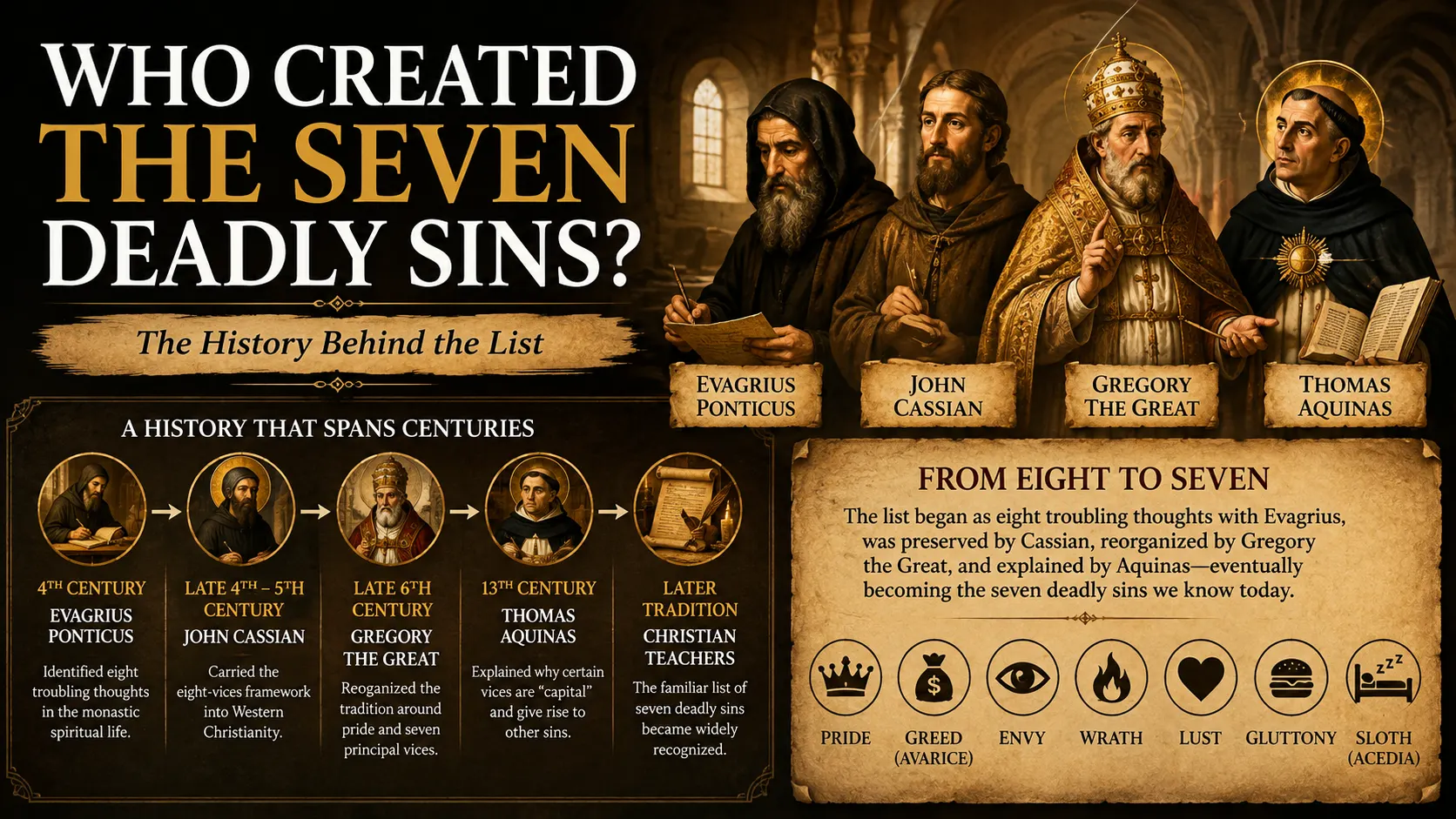

No single person simply sat down and created the seven deadly sins as Christians know them today. The familiar list developed gradually, beginning with an early Christian monk named Evagrius Ponticus, passing through John Cassian and Pope Gregory the Great and later being refined in medieval Christian theology.
That history matters because the seven deadly sins are sometimes mistaken for a list taken directly from one Bible passage. They are better understood as a Christian system for organizing recurring human vices that Scripture addresses in many different places.
The story also contains an interesting detail: the list originally had eight, not seven.
Who First Came Up With the Seven Deadly Sins?
The earliest major figure behind the tradition was Evagrius Ponticus, a fourth-century Christian monk and spiritual writer.
Evagrius lived during the 300s and spent part of his life among the desert monastic communities of Egypt. His concern was not to create a famous list for ordinary Christians. He was trying to understand the recurring thoughts and temptations that disturbed the spiritual lives of monks.
He identified eight troubling patterns of thought, often called the eight evil thoughts or eight logismoi. They were associated with:
- gluttony
- lust
- avarice
- sadness
- anger
- acedia
- vainglory
- pride
This is one of the most important distinctions in the history of the seven deadly sins: Evagrius did not actually give Christians the exact seven-item list commonly used today. His framework contained eight categories, and some of their names and relationships were different from the later tradition.
Evagrius was interested in what happened inside a person before outward wrongdoing appeared. A destructive action could begin with a thought that was entertained, repeated and eventually allowed to shape a person’s character.
That basic idea would remain important even as later Christian thinkers changed the list.
The Seven Deadly Sins Began as Eight “Evil Thoughts”
Calling Evagrius’s categories “sins” can actually hide part of what he was trying to describe.
His framework focused strongly on thoughts and inner movements. The concern was how recurring temptations could gain influence over the mind and interfere with prayer, discipline and spiritual growth.
This helps explain why the later deadly-sins tradition contains things such as envy, pride and sloth rather than simply listing obvious acts such as theft or murder.
The framework was attempting to identify deeper tendencies from which many different wrong actions could develop.
That idea survived into later Christian language about capital vices. Thomas Aquinas would explain that a capital vice is called “capital” from caput, meaning “head,” because such a vice can function as a source or governing motive from which other sins arise.
This is also why the history of the seven deadly sins cannot be reduced to the question, “Who chose the seven worst things a person can do?” That was not what the original framework was designed to accomplish.
What Did John Cassian Have to Do With the List?
The next major figure was John Cassian, a monk and Christian writer who lived around the late fourth and early fifth centuries.
Cassian became important because he helped transmit the Eastern monastic teaching represented by Evagrius into the Latin-speaking Christian West.
Rather than inventing an entirely new system, Cassian took the discussion of the eight principal vices and presented it to a different Christian setting. Through his writings on monastic life and spiritual struggle, these ideas became much more influential in Western Christianity.
So the history can already be seen as a chain rather than a single moment of invention:
Evagrius identified an eight-part framework → Cassian helped carry that framework into Western Christianity.
The number was still eight. The move toward the familiar seven came later.
How Did Eight Sins Become Seven?
A major turning point came with Gregory the Great, who became pope at the end of the sixth century.
Gregory reorganized the earlier vice tradition while discussing the roots and consequences of sinful behavior. His treatment did not simply reproduce Evagrius’s eight categories.
Some categories were combined or repositioned, while others were treated differently. Envy became part of Gregory’s arrangement, and pride occupied an especially important place in his understanding of vice. Historical accounts of the tradition describe Gregory as treating pride as a ruling or foundational vice rather than simply another item standing alongside the others.
This helps explain why historical versions of the list can look confusing when placed next to the familiar modern one.
A reader may encounter:
- sadness in an early list but not the modern seven;
- both vainglory and pride in older discussions;
- acedia rather than the everyday English word “sloth”;
- envy appearing differently in later arrangements.
These differences are not necessarily evidence that someone copied the list incorrectly. They reflect the fact that the seven deadly sins developed over centuries rather than appearing all at once in a fixed form.
The categories were being used to describe relationships among human desires, habits and spiritual failures. As Christian thinkers reconsidered those relationships, the organization of the list changed as well.
Did Pope Gregory Invent the Seven Deadly Sins?
It is therefore only partly accurate to say that Pope Gregory the Great invented the seven deadly sins.
Gregory was enormously important in shaping the Western seven-vices tradition, but he did not begin with an empty page.
Evagrius had already developed his eight-thought framework centuries earlier, and Cassian had already carried a related eight-vices tradition into Western Christian teaching.
A more accurate way to describe the history is:
Gregory helped reorganize an older Christian framework into a form that strongly influenced the later tradition of seven capital or deadly sins.
That distinction may sound small, but it prevents a common historical mistake.
There was no single meeting at which Christians suddenly decided that seven particular behaviours would henceforth be known as “the deadly sins.” The familiar list is the result of development, transmission and reorganization.
Where Does Thomas Aquinas Fit Into the Story?
The tradition continued developing long after Gregory.
In the thirteenth century, Thomas Aquinas examined the capital vices in his Summa Theologiae. His treatment is especially useful because he did not present the list merely as seven unrelated bad behaviors.
Aquinas asked why certain vices should be considered “capital” at all.
His answer was that they can generate other vices by directing a person’s desires toward particular ends. In other words, they function like sources from which additional wrongdoing can grow.
Aquinas discussed seven capital vices in terms that included:
- vainglory
- envy
- anger
- sloth
- covetousness
- gluttony
- lust
He also treated pride as having an even broader relationship to sin. Drawing on Gregory, Aquinas described pride as exercising a general influence over the other vices rather than treating it only as one ordinary category among several.
This is one reason historical texts do not always match the modern list word for word even though they clearly belong to the same tradition.
Over time, pride rather than vainglory became standard in the familiar popular list, giving the form most people now recognize:
pride, greed, envy, wrath, lust, gluttony and sloth.
A Simple Timeline of How the Seven Deadly Sins Developed
The history becomes much clearer when the major stages are placed together.
| Period | Important figure | What happened |
|---|---|---|
| 4th century | Evagrius Ponticus | Described eight recurring evil thoughts or temptations in the monastic spiritual life |
| Late 4th–5th century | John Cassian | Helped transmit the eight-vices framework from Eastern monastic thought into Western Christianity |
| 6th century | Gregory the Great | Reorganized the inherited vice tradition and strongly influenced the Western framework of seven principal vices |
| 13th century | Thomas Aquinas | Gave a detailed theological explanation of why particular vices could be called “capital” and how they produce other sins |
| Later Christian tradition | Various teachers, writers and artists | The familiar list of pride, greed, envy, wrath, lust, gluttony and sloth became widely recognized |
This timeline is more historically accurate than assigning the entire list to one author.
Are the Seven Deadly Sins Actually From the Bible?
The history also explains why a person cannot open the Bible and find one verse that says, “These are the seven deadly sins.”
The Bible contains extensive teachings about pride, greed, envy, anger, sexual sin, uncontrolled appetite, spiritual negligence and many other forms of wrongdoing. But the Bible does not arrange the familiar seven together under the title “seven deadly sins.”
The list is a later Christian framework used to organize moral and spiritual problems addressed throughout Scripture.
That does not mean the early writers believed they were inventing seven entirely new sins. They were attempting to classify patterns of temptation and vice that they believed Christian teaching already warned against.
For the biblical side of that question—including the actual seven sins, their meanings, and whether Scripture lists them together—see the full guide to the seven deadly sins and what the Bible says.
The historical question is different: how did Christians arrive at this particular seven-part framework?
The answer begins with an eight-part one.
Why Did the List Change Over Time?
It may seem strange that a moral framework could move from eight categories to seven. If these were supposed to describe sin, why would the number change?
The answer is that the writers were classifying vices, not rewriting God’s commandments.
Different thinkers sometimes understood two tendencies as closely connected, separated concepts that others combined, or placed one vice beneath another more fundamental one.
For example, older discussions could distinguish vainglory from pride, while later presentations often use pride in the familiar seven. Early frameworks also included categories such as sadness in ways that later arrangements did not preserve as a separate capital vice.
The underlying Christian concern remained much more stable than the terminology: sinful desires and habits can reinforce one another and produce further wrongdoing.
Aquinas makes this logic especially clear when he describes capital vices as those from which other vices commonly arise.
So the number seven should not be imagined as a mysterious biblical number that was discovered hidden in a verse. It represents the eventual shape taken by a much older effort to understand recurring sources of human temptation.
So Who Created the Seven Deadly Sins?
There is no completely accurate one-name answer.
If the question is who started the framework behind them, Evagrius Ponticus is the crucial early figure. In the fourth century, he described eight recurring evil thoughts for monks trying to understand spiritual temptation.
If the question is who brought that framework into Western Christianity, John Cassian played a major role.
If the question is who helped turn the older eight-part tradition toward the influential Western arrangement of seven principal vices, Gregory the Great is central.
And if the question is who gave the capital-vices tradition one of its most influential medieval theological explanations, Thomas Aquinas deserves an important place in the story.
The seven deadly sins, therefore, were not invented by one person and were not copied from one biblical list. They emerged through centuries of Christian reflection on temptation, habit and the deeper vices that can give rise to many outward sins.
That history makes the familiar list more understandable. What looks today like seven simple labels began as a much older attempt to answer a difficult spiritual question: what recurring desires and habits most often pull a person’s heart away from what is good?
