
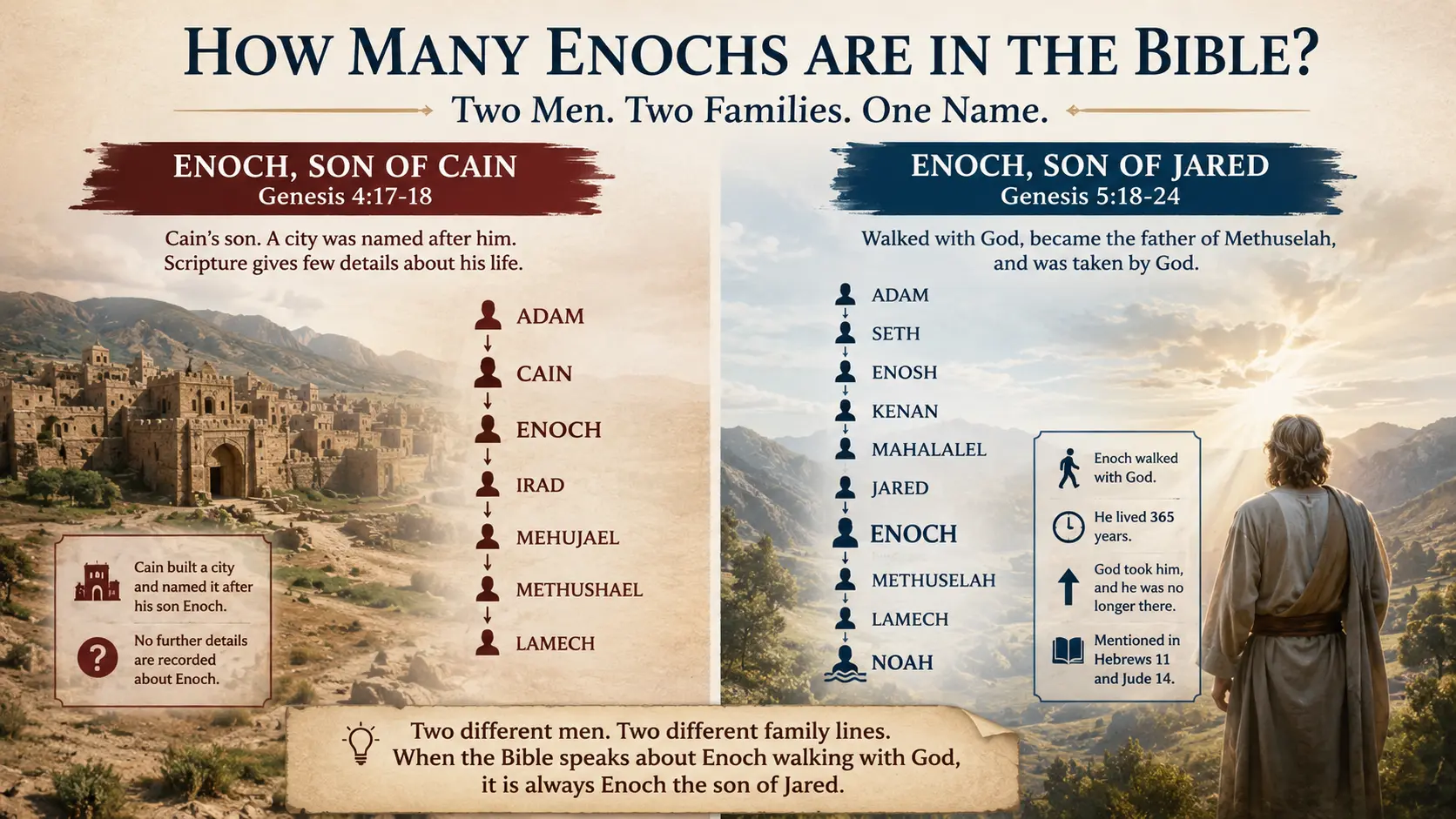

There are two different men commonly called Enoch in the early chapters of Genesis: Enoch the son of Cain and Enoch the son of Jared. They shared the same name but they belonged to different family lines and should not be confused with each other.
There is also a small translation detail behind the question. The Hebrew name translated as Enoch is used for two other men who are usually called Hanoch or Hanok in English Bibles. So readers may encounter different totals depending on whether they are counting the English spelling “Enoch” or every person bearing the same Hebrew name.
For most readers, however, the important distinction is between Cain’s Enoch in Genesis 4 and Jared’s Enoch in Genesis 5.
How Many Enochs Are Mentioned in the Bible?
If you are reading a modern English Bible and looking specifically for the familiar name Enoch, the two main people are:
- Enoch, the son of Cain — Genesis 4:17–18
- Enoch, the son of Jared — Genesis 5:18–24
The second Enoch is the one most people mean when they talk about Enoch in the Bible. He was the father of Methuselah, was described as walking with God, and was later mentioned in Hebrews and Jude.
Cain’s son appears earlier and receives much less attention.
Here is the basic difference:
| Enoch, son of Cain | Enoch, son of Jared |
|---|---|
| Introduced in Genesis 4 | Introduced in Genesis 5 |
| Son of Cain | Son of Jared |
| Descended from Adam through Cain | Descended from Adam through Seth |
| Cain named a city after him | Father of Methuselah |
| Scripture gives few details about his life | Described as walking with God |
| Not the Enoch of Hebrews 11 | Mentioned in Hebrews 11 |
| Not called the seventh from Adam | Called the seventh from Adam in Jude |
The two men lived in the generations before Noah, but Genesis places them in separate genealogies.
Who Was Enoch the Son of Cain?
The first Enoch named in the Bible was Cain’s son.
Genesis 4:17 says that Cain and his wife had a son named Enoch. The same verse says Cain was building a city and named it after his son.
Genesis then traces this family line:
Adam → Cain → Enoch → Irad → Mehujael → Methushael → Lamech
Apart from his place in this genealogy and the city bearing his name, Scripture tells us very little about Enoch himself.
This is important because details commonly associated with Enoch do not belong to Cain’s son. Genesis never says that this Enoch walked with God, fathered Methuselah, lived 365 years, or was taken by God.
Those details belong to Jared’s son in Genesis 5.
The close placement of the two genealogies is probably what causes much of the confusion. Cain’s Enoch appears in Genesis 4, and only a short time later the reader encounters another Enoch in Genesis 5.
But Genesis 5 is not continuing Cain’s family line. It begins a different genealogy.
Who Was Enoch the Son of Jared?
Enoch the son of Jared is the better-known Enoch of the Bible.
Genesis 5 traces his ancestry through Adam’s son Seth:
Adam → Seth → Enosh → Kenan → Mahalalel → Jared → Enoch
Genesis 5:18 identifies Jared as Enoch’s father. Later verses say that Enoch became the father of Methuselah when he was 65 years old. The genealogy then gives Enoch an unusual description.
Genesis says that Enoch walked with God. It records his total lifespan as 365 years and says that he was no longer there because God took him.
This makes his entry noticeably different from the surrounding genealogy, where the lives of the other patriarchs end with the repeated statement that they died.
Hebrews 11:5 later refers to this same Enoch and connects his story with faith and pleasing God. Jude 1:14 also identifies Enoch as “the seventh from Adam,” which matches the genealogy through Seth and Jared.
So whenever a discussion connects Enoch with Methuselah, walking with God, being taken by God, Hebrews 11, or Jude, it is referring to Enoch the son of Jared.
How Can You Tell the Two Enochs Apart?
The easiest way is to look at their fathers and family lines.
Cain’s Enoch belongs to this branch:
Adam → Cain → Enoch
Jared’s Enoch belongs to this branch:
Adam → Seth → Enosh → Kenan → Mahalalel → Jared → Enoch
They therefore cannot be the same person.
Their descendants also help distinguish them.
Cain’s genealogy continues from Enoch to Irad. Jared’s Enoch became the father of Methuselah, whose son Lamech later became the father of Noah.
That produces this sequence:
Enoch → Methuselah → Lamech → Noah
Enoch the son of Jared was therefore Noah’s great-grandfather. This relationship belongs only to Jared’s Enoch. Cain’s son has no place in Noah’s genealogy.
Why Do Genesis 4 and Genesis 5 Both Have an Enoch?
Genesis does not explain why the same name appears in both family lines, so it would be speculation to claim that the repetition has a particular hidden meaning. Repeated names are not unusual in the Bible.
In fact, the two genealogies contain another obvious example: Lamech.
Cain’s line includes a Lamech in Genesis 4, while the line through Seth eventually includes another Lamech in Genesis 5—the father of Noah.
The repeated names can make the early chapters of Genesis difficult to follow if the reader looks only at individual names rather than the surrounding genealogy.
The chapter division provides a useful clue:
- Genesis 4 traces Cain’s descendants.
- Genesis 5 presents Adam’s genealogy through Seth.
The second Enoch appears only after the genealogy has moved to the line of Seth. That context removes the apparent contradiction. Genesis is not giving two different fathers for one person. It is describing two people who happened to share a name.
Which Enoch Walked With God and Was Taken by God?
Both details belong to Enoch the son of Jared. Genesis 5:22 and Genesis 5:24 describe him as walking with God. The chapter then says God took him.
Hebrews 11:5 makes the identification even clearer by referring to Enoch being taken and connecting him with faith. Cain’s son is never described in this way.
The question of why God took Enoch involves a different search intent and deserves to be considered separately. For distinguishing the two men, it is enough to remember that the extraordinary event of Genesis 5 belongs to Jared’s Enoch.
Which Enoch Is Mentioned in Jude?
Jude is also referring to Enoch the son of Jared.
Jude 1:14 calls him “the seventh from Adam.”
Counting the Genesis 5 genealogy inclusively gives:
- Adam
- Seth
- Enosh
- Kenan
- Mahalalel
- Jared
- Enoch
This description makes it impossible to confuse him with Cain’s son.
Jude then associates this Enoch with a prophecy concerning divine judgment. The details of Enoch’s prophecy in the Bible are a separate subject, but Jude’s genealogical description helps establish which Enoch it means.
What About Hanoch or Hanok in Other Bible Passages?
There is one additional detail worth knowing if you search the name in a concordance or compare several Bible translations.
The Hebrew personal name behind Enoch also belongs to two other men in the Old Testament. Modern English translations often spell their names Hanoch or Hanok rather than Enoch. One was a son of Midian, mentioned in Genesis 25:4 and 1 Chronicles 1:33.
Another was a son of Reuben, mentioned in passages including Genesis 46:9. This is why a very technical answer to “How many Enochs are in the Bible?” can differ from the ordinary answer.
- If you are counting the people normally written as Enoch in the opening chapters of an English Bible, there are two.
- If you are studying the underlying Hebrew name and including Hanoch/Hanok, that name is associated with four different men.
This translation detail does not change the main distinction most Bible readers need to make: Cain’s Enoch and Jared’s Enoch were two separate people.
