
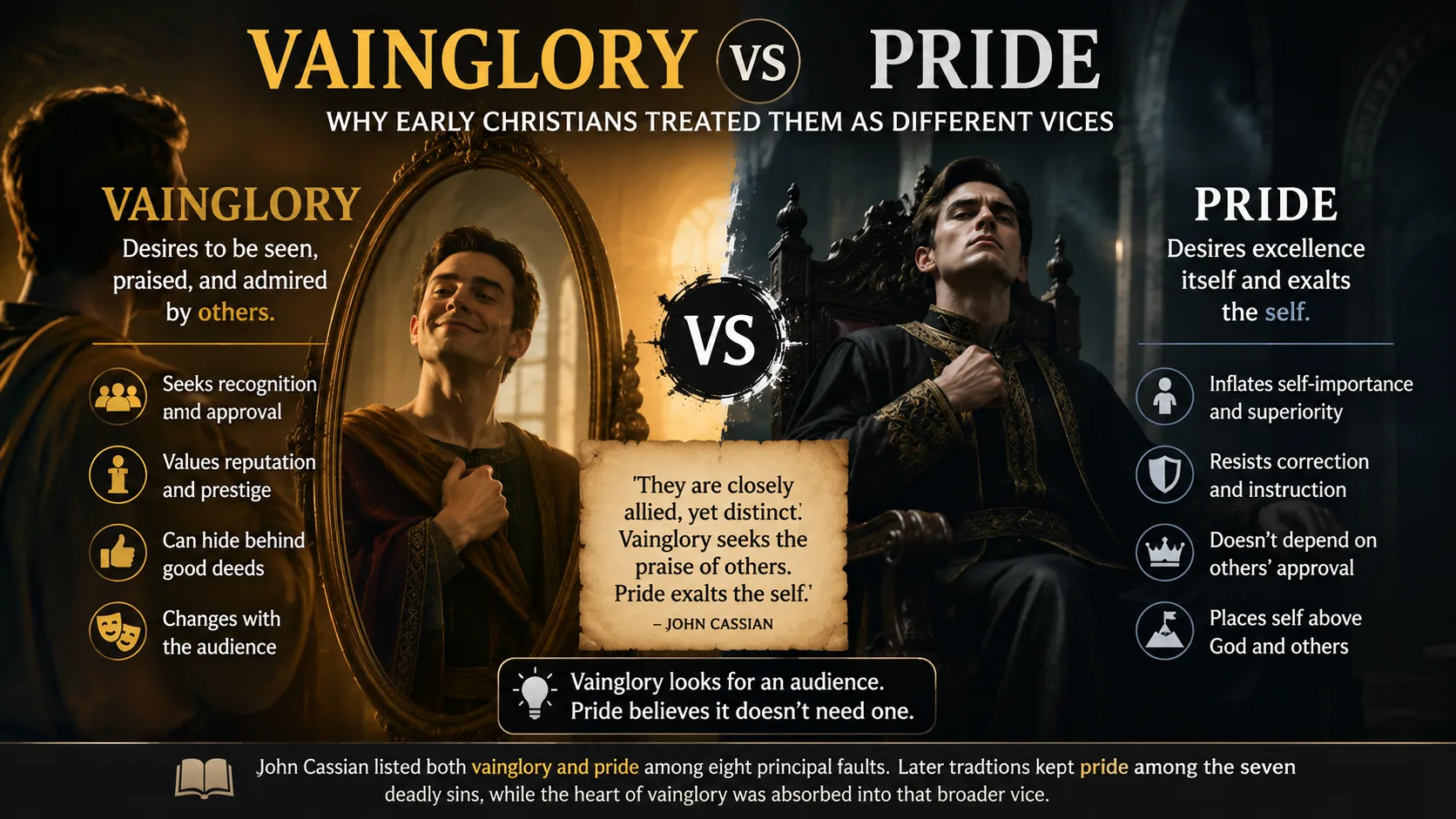

Vainglory and pride are closely related, but they were not always treated as the same vice. In the influential eight-vices tradition preserved by John Cassian, vainglory and pride appear separately: vainglory is seventh and pride eighth.
The distinction is subtle but meaningful. Vainglory is especially concerned with having one’s excellence known, admired or praised, while pride concerns an excessive claim to excellence itself.
A person can therefore want to appear wise, holy, generous, or impressive to others without yet expressing every form of pride. Pride reaches deeper into how a person understands his own importance, superiority, independence and need for correction.
That helps explain why an older Christian list could contain both—even though the familiar seven deadly sins today normally name pride but not vainglory.
What Is the Difference Between Vainglory and Pride?
Thomas Aquinas later gives one of the clearest explanations of the distinction.
He says pride and vainglory are not identical. Pride desires excellence in an excessive or disordered way; vainglory is concerned with the outward manifestation of excellence.
In simpler language, pride can say:
“I am greater than I ought to think myself.”
Vainglory is more concerned with:
“I want my greatness, goodness or achievement to be recognized.”
These are not completely separate psychological worlds. A desire for admiration can grow from pride and receiving admiration can reinforce pride.
But the object of each vice is different enough that earlier Christian writers found it useful to distinguish them.
Cassian makes that relationship especially clear. In his Conference 5, he says vainglory and pride are “closely allied,” yet still treats them as two principal faults rather than one.
That is the key to understanding the old classification: closely related did not mean identical.
What Did Vainglory Mean to John Cassian?
The English word vainglory sounds old-fashioned, but the human tendency Cassian describes is easy to recognize.
His Institutes names kenodoxia—vain or empty glory—as the seventh of eight principal faults, immediately before pride.
In Conference 5, Cassian says vainglory can take different forms. He distinguishes between being puffed up over visible or worldly things and seeking vain praise for spiritual things. The second form is particularly important.
For Cassian, a person did not have to boast about wealth, appearance, rank or possessions to fall into vainglory. Religious achievement itself could become material for self-display.
A monk might become concerned with being regarded as:
- unusually disciplined;
- spiritually mature;
- knowledgeable;
- devoted to prayer;
- capable of severe fasting;
- worthy of respect.
The underlying problem was not that discipline, prayer or spiritual growth were bad. The problem arose when being known for those things became spiritually important in its own right.
That makes vainglory more complicated than ordinary boasting. Someone does not necessarily need to say, “Look how wonderful I am.”
A person can quietly begin to value the reputation of being good almost as much as goodness itself.
Why Could Vainglory Attach Itself to Good Deeds?
This is one of the most perceptive parts of Cassian’s analysis.
Some temptations are obvious because they pull a person directly toward something he already recognizes as wrong. Vainglory can work through something good.
A person may genuinely help someone and also begin enjoying the reputation of being generous. He may genuinely study Scripture while becoming increasingly attached to being regarded as knowledgeable. He may practice self-discipline and slowly start measuring his spiritual progress by the admiration it attracts.
The outward action does not necessarily become bad. The motive becomes mixed.
This concern has an obvious parallel in Jesus’ teaching in Matthew 6. Jesus warns against practicing righteousness “to be seen” by others and applies the warning to giving, prayer, and fasting.
The problem in that passage is not giving, praying, or fasting. It is turning good actions toward the reward of human recognition.
Cassian’s technical classification came centuries later, so Matthew 6 should not be described as a biblical list of the vice of vainglory. But it helps show why early Christian spiritual writers were interested in the difference between doing good and wanting to be known for doing good.
Does Vainglory Simply Mean Wanting Praise?
Not every desire for recognition is vainglory. That distinction is necessary because otherwise the concept becomes so broad that ordinary human appreciation starts looking sinful.
Aquinas explicitly argues that glory itself is not automatically wrong. For him, vain glory is the problem.
He explains that glory can become vain when someone seeks recognition for something that does not truly deserve it, relies on unstable human judgment, or pursues personal glory without ordering it toward an appropriate good.
So enjoying a sincere compliment is not automatically vainglory. Neither is wanting a good reputation in every circumstance.
A teacher may reasonably want students to trust his competence. Someone falsely accused may reasonably want his reputation restored. A Christian leader’s public character can legitimately matter to the community.
The deeper problem begins when recognition itself becomes disordered.
A useful test is not merely:
“Do I enjoy being appreciated?”
It is:
“How much does being appreciated control what I do and how I see myself?”
- Would the good action still seem worthwhile if nobody knew about it?
- Does correction feel unbearable because it threatens an identity built around appearing wise or good?
- Does being overlooked produce resentment disproportionate to what actually happened?
- Would appearing virtuous become more important than discovering whether one truly needs to change?
Those questions come much closer to the older idea of vainglory.
How Is Pride Deeper Than Vainglory?
Pride does not depend on public recognition in quite the same way.
Cassian’s separate treatment of pride describes problems such as resisting instruction, becoming unwilling to submit to guidance, and developing an inflated confidence in one’s own judgment.
Aquinas later describes pride more generally as an inordinate desire for one’s own excellence. That is why pride can remain even when there is no applause. Consider two people.
One wants everyone around him to recognize how knowledgeable he is. He repeatedly finds ways to display what he knows and feels disappointed when someone else receives the recognition. That illustrates vainglory particularly well.
Another person does not care much about public praise, but he has become convinced that other people have little to teach him. He rejects correction because he assumes his judgment is superior. That illustrates pride more directly.
Real people are rarely this tidy, of course. The two tendencies frequently overlap. The examples simply show why early Christian thinkers could see value in naming them separately.
Vainglory centers especially on one’s excellence becoming manifest and recognized. Pride concerns one’s relationship to excellence itself.
Why Did Cassian Put Vainglory Before Pride?
Cassian did not merely place the two next to each other by accident.
In Conference 5, he says that vainglory and pride are closely connected and describes the growth of vainglory as providing an opening toward pride. He even says that to drive out pride, vainglory must first be restrained.
His reasoning becomes especially interesting because he treats these two faults differently from several of the others.
Cassian observes that vainglory and pride can become especially dangerous after a person has achieved something spiritually admirable.
Success itself can provide new material for temptation. A person overcomes one weakness and begins admiring himself for having overcome it.
He becomes disciplined and then becomes attached to being known as disciplined. He develops a reputation for humility and starts enjoying the reputation.
The danger is almost paradoxical: spiritual progress can become something the ego claims as evidence of its own greatness.
This helps explain why Cassian placed vainglory immediately before pride.
In his framework, the desire for empty glory can prepare the way for a deeper distortion of how a person understands himself.
Is Vainglory Just Another Word for Vanity?
Not quite. Modern use of vanity often suggests excessive concern with physical appearance. Vainglory is much broader.
A person can seek glory from:
- intelligence;
- religious knowledge;
- professional achievement;
- moral reputation;
- generosity;
- leadership;
- social status;
- sacrifice;
- spirituality.
Physical appearance can become part of it, but appearance in the cosmetic sense is not the defining issue.
The deeper concern is the desire for one’s supposed excellence to be known and esteemed.
That is why spiritual vainglory interested Cassian so much. A person could leave behind wealth, social status, and ordinary public ambition and still discover a new way to seek distinction inside religious life.
Changing the thing one wants to be admired for does not necessarily remove the desire to be admired.
Why Isn’t Vainglory One of the Seven Deadly Sins Today?
This requires more care than saying simply that “vainglory became pride.” Historically, different enumerations treated the relationship differently.
Cassian listed both vainglory and pride among eight principal faults. Gregory the Great later treated pride as having a broader ruling position while retaining vainglory among seven principal vices.
Aquinas explicitly acknowledges that there were different ways of counting them. He notes that some enumerations counted pride among the capital vices and therefore did not list vainglory separately, while Gregory treated pride as the queen of the vices and counted vainglory among the seven beneath it.
The familiar list used today follows the first-looking arrangement more closely in this respect: it contains pride and does not give vainglory a separate place.
The current Catholic Catechism lists the capital sins as pride, avarice, envy, wrath, lust, gluttony, and sloth or acedia.
That does not mean the older concept of vainglory ceased to exist in Christian moral thought. It means the way closely related vices were counted changed.
This distinction also prevents a historical oversimplification. There was no clear single moment when church authorities announced that “vainglory has now been renamed pride.” The classifications developed over time.
For the broader story of how the earlier eight-vices tradition eventually relates to the familiar seven, see Who Created the Seven Deadly Sins? From Eight to Seven.
Does the Old Distinction Still Make Sense Today?
The vocabulary is ancient, but the distinction remains recognizable.
Modern life provides countless opportunities to turn personal identity into something performed before other people. Yet vainglory should not simply be reduced to social media, likes, or public self-promotion. It can be much quieter.
Someone can become attached to being known as the reasonable person in the family, the most faithful member of a church, the smartest person in a discussion, the generous friend, or the person who never needs help.
That is where the distinction from pride remains useful. The desire for a reputation may reveal vainglory.
The deeper belief that the reputation proves one’s superiority may reveal pride. Sometimes the two reinforce each other. Sometimes one is more visible than the other.
Early Christian writers did not separate them because they believed every human motive could be placed neatly in one box. They separated them because the distinction helped expose two ways self-exaltation can operate: through the glory one wants from others and through the excessive excellence one claims for oneself.
Why the Difference Between Vainglory and Pride Matters
Vainglory and pride are related enough that it is easy to understand why later lists no longer always name them separately.
But treating them as identical can cause us to miss what writers such as Cassian were trying to observe.
Vainglory can turn even genuine accomplishment into a search for reputation. It can make praise disproportionately important and tempt someone to manage the appearance of goodness.
Pride reaches further into the person’s judgment of himself—his excellence, superiority, independence, and willingness to be corrected. Cassian therefore had reason to list both.
His distinction also reveals why the old Christian analysis of vice was interested in more than obvious misconduct. A person’s spiritual difficulty might appear not only when he fails, but also in what he begins to think about himself after succeeding.
That is why vainglory could stand beside pride rather than merely serving as an outdated name for it.
For the modern seven themselves and their broader biblical meaning, see the main guide to the seven deadly sins and what the Bible says.
