
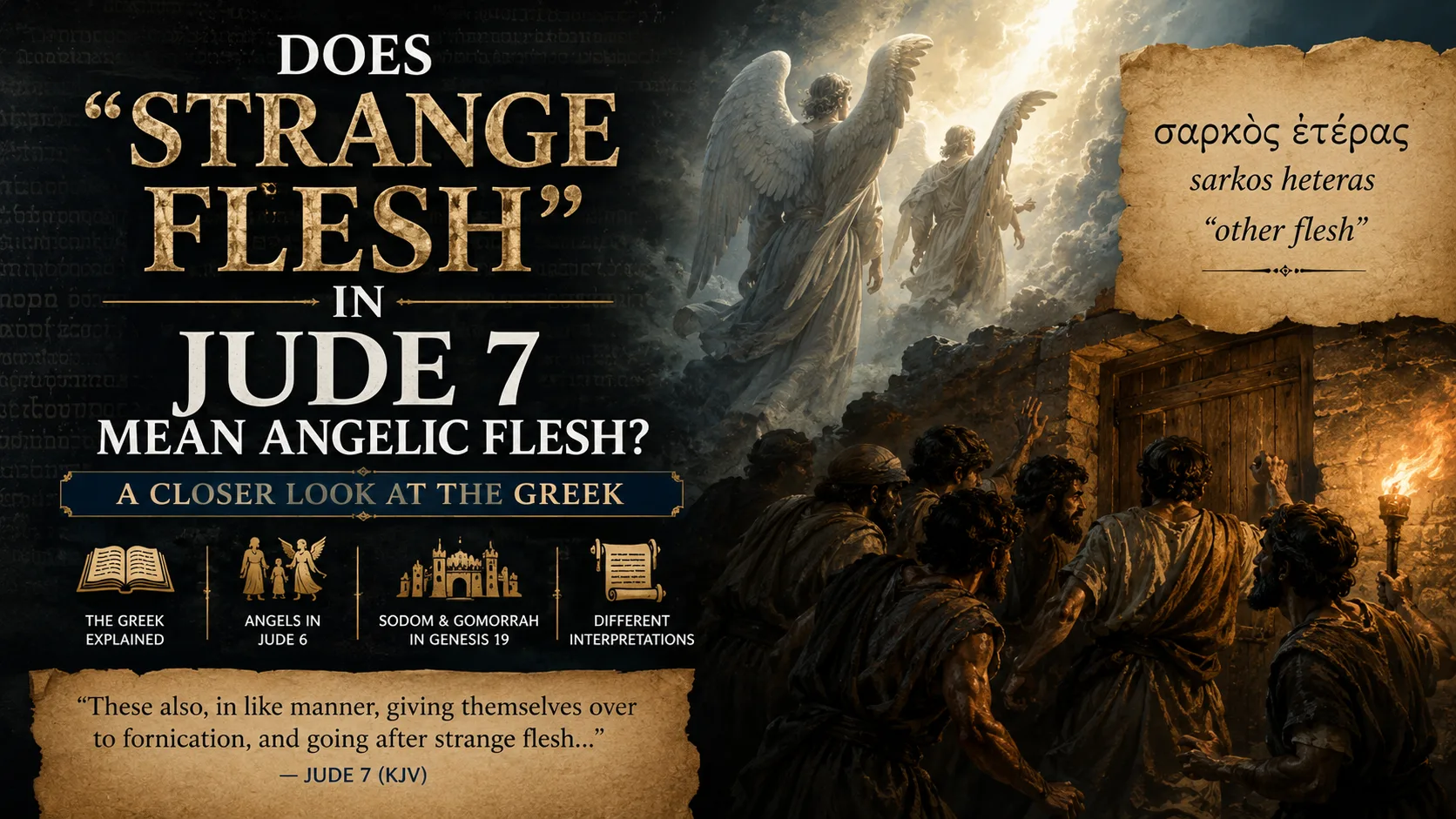

Jude 7 contains a phrase that sounds unusually mysterious in the King James Version: “going after strange flesh.”
The Greek is sarkos heteras (σαρκὸς ἑτέρας), which can be rendered more literally as “other flesh” or “different flesh.” The ESV interprets the expression as “unnatural desire,” the NIV uses the broader word “perversion,” while the NASB retains “strange flesh” with a note that the Greek can mean “different” or “other” flesh.
Jude is clearly describing sexual wrongdoing: the same verse says that Sodom, Gomorrah, and the surrounding cities gave themselves over to sexual immorality. For the broader biblical vocabulary behind sexual immorality, see PsalmWisdom’s Biblical Meaning of Fornication.
But Jude adds something more specific. The cities did not simply pursue “flesh.” They pursued other flesh.
The difficulty is deciding what kind of difference Jude has in mind.
The Greek Actually Says “Other Flesh”
The key adjective is heteros, meaning another, other, or different. It does not by itself tell us whether the difference is sexual, moral, biological, or something else. Context has to supply that information.
That is important because some English translations already interpret the phrase for the reader.
“Unnatural desire,” for example, communicates a possible meaning of the Greek, but it does not reproduce its wording. Jude actually uses the noun sarx, “flesh,” together with heteros, “other” or “different.”
The NET Bible’s translators openly acknowledge the difficulty. Their note lists several possible ways of understanding the phrase, including flesh of a different kind and sexual desire directed toward what would not normally be pursued. The note does not treat any one of those explanations as self-evident from the two Greek words alone.
So a responsible reading has to go beyond the phrase itself.
The most important clue appears immediately before it.
Jude Has Just Been Talking About Angels
Jude 6 describes angels who did not remain within their proper position but left their own dwelling. They are kept for judgment because of that rebellion.
Jude then turns directly to Sodom, Gomorrah, and the neighboring cities.
The relationship between the two examples is significant because Jude 7 contains the expression often translated “in like manner,” “in a similar way,” or something comparable.
Some translations make the connection especially explicit. The NET says that the cities acted in a way similar to “these angels,” and the NASB likewise supplies “these angels.” The word angels is not repeated in the Greek text of verse 7; it is supplied because the demonstrative pronoun most naturally points back to the angels of verse 6.
That does not mean the grammar alone settles the interpretation.
It does mean that Jude intentionally places two unusual examples side by side:
angels who abandon their proper sphere and cities that pursue “other flesh.”
That sequence is one reason interpreters have asked whether the two examples involve a similar kind of boundary crossing.
Genesis 19 Identifies the Visitors as Angels
The angelic interpretation becomes more interesting when Jude’s wording is compared with the story he is invoking.
Genesis 19 does not leave the visitors’ identity uncertain for the reader. Its opening sentence says that two angels came to Sodom.
Later, the men of the city surround Lot’s house and demand access to those visitors. From the perspective of the Genesis narrator, the people of Sodom are therefore pursuing beings who are actually angels.
That creates a possible explanation for Jude’s phrase “other flesh.”
If the visitors belong to a different order of beings, Jude could be describing the true identity of the flesh being pursued: humans attempting sexual access to angelic visitors.
There is, however, an important limitation.
Genesis does not clearly say that the men outside Lot’s house knew the visitors were angels. They call them men, and the visitors appear within the narrative in human form.
It would therefore go beyond the text to say that the inhabitants of Sodom knowingly decided to pursue angels.
The distinction is subtle but important.
Genesis tells the reader that the visitors are angels. It does not clearly tell us that the attackers knew this.
Jude could still use their true identity when interpreting the event, but that would be Jude’s theological perspective on the episode rather than the attackers’ conscious intention.
Does Jude 6 Echo the Angel Story Behind Genesis 6?
The connection becomes more plausible if Jude 6 itself draws on an ancient interpretation of Genesis 6:1–4.
Genesis describes the “sons of God” taking women and producing unusual offspring. In later Jewish literature, especially the tradition preserved in 1 Enoch, this passage developed into the story of rebellious heavenly beings often called the Watchers. They leave the heavenly sphere, take human women, and violate the boundary between the heavenly and human worlds.
That interpretation was influential in Second Temple Judaism, and scholarship on Jude has long recognized his familiarity with Enochic material. Jude later quotes material corresponding to 1 Enoch directly in verses 14–15, while academic studies have also examined the connection between Jude 6 and traditions about the rebellious angels of Genesis 6.
If Jude 6 is drawing on that tradition, the sequence becomes striking:
Jude 6: heavenly beings leave their appointed sphere in a story associated with human women.
Jude 7: human cities pursue “other flesh” in a story whose visitors are angels.
This has led some interpreters to see a deliberate reversal.
- In the first example, heavenly beings cross toward humanity.
- In the second, humans attempt to cross toward beings who are heavenly.
That reading gives sarkos heteras—“other flesh”—a concrete contextual meaning without requiring the Greek phrase by itself to carry the entire argument.
Still, it remains an interpretation. Jude never explicitly writes, “The strange flesh was angelic flesh.”
Why “Other Flesh” Is Also Read as Unnatural Sexual Desire
There is another major way of reading the phrase.
Genesis 19 describes male inhabitants of Sodom demanding sexual access to visitors they understand as men. On that basis, many Christian interpreters have understood Jude’s “other flesh” as sexual desire outside the male-female pattern they regard as natural.
This is reflected in translations such as the ESV’s “unnatural desire.”
This interpretation cannot simply be dismissed. Jude explicitly introduces the episode with language of sexual immorality and the sexual character of Genesis 19 is unmistakable.
The difficulty is whether this interpretation fully explains the word heteros and the close placement of Jude 7 beside the rebellious angels of verse 6.
The NET translators note exactly this problem. They acknowledge the same-sex interpretation but also ask whether “different flesh” might suggest a more fundamental difference of kind. At the same time, they recognize difficulties with making the angelic explanation fit every detail.
This is why English translations diverge so noticeably.
They are not working from completely different Greek texts. They are making different judgments about what “other flesh” means in Jude’s argument.
What Jude 7 Can—and Cannot—Settle
Several conclusions are firmer than others.
Jude explicitly connects Sodom and the neighbouring cities with sexual immorality.
He also says that they pursued sarkos heteras, literally “other” or “different flesh.”
Immediately before this, Jude describes rebellious angels, and several translations understand his “similar manner” language as comparing the cities with those angels. Genesis 19, meanwhile, explicitly identifies the visitors pursued at Sodom as angelic beings.
Together, those details give the angelic-flesh interpretation real contextual support.
But they do not make it certain.
Jude does not explicitly define “other flesh” as angelic flesh, and Genesis does not say that Sodom’s inhabitants recognized the visitors as angels. The traditional reading that connects the expression with improper sexual desire also draws on genuine features of the Genesis story.
The strongest conclusion is therefore narrower than either extreme.
“Strange flesh” in Jude 7 literally represents “other” or “different flesh.” The connection with the rebellious angels of Jude 6 makes an angelic or different-order interpretation plausible, but the phrase remains disputed and should not be presented as though the Greek settles the question by itself.
Nor should this one phrase be forced to explain every biblical statement about Sodom. PsalmWisdom examines that larger question separately in The Real Sin of Sodom and Gomorrah in Genesis 19.
Jude 7 gives us something more specific: an unusual Greek expression whose meaning becomes clearer when it is read beside Jude’s angels, Genesis 19’s visitors and the ancient tradition surrounding rebellious heavenly beings.
