
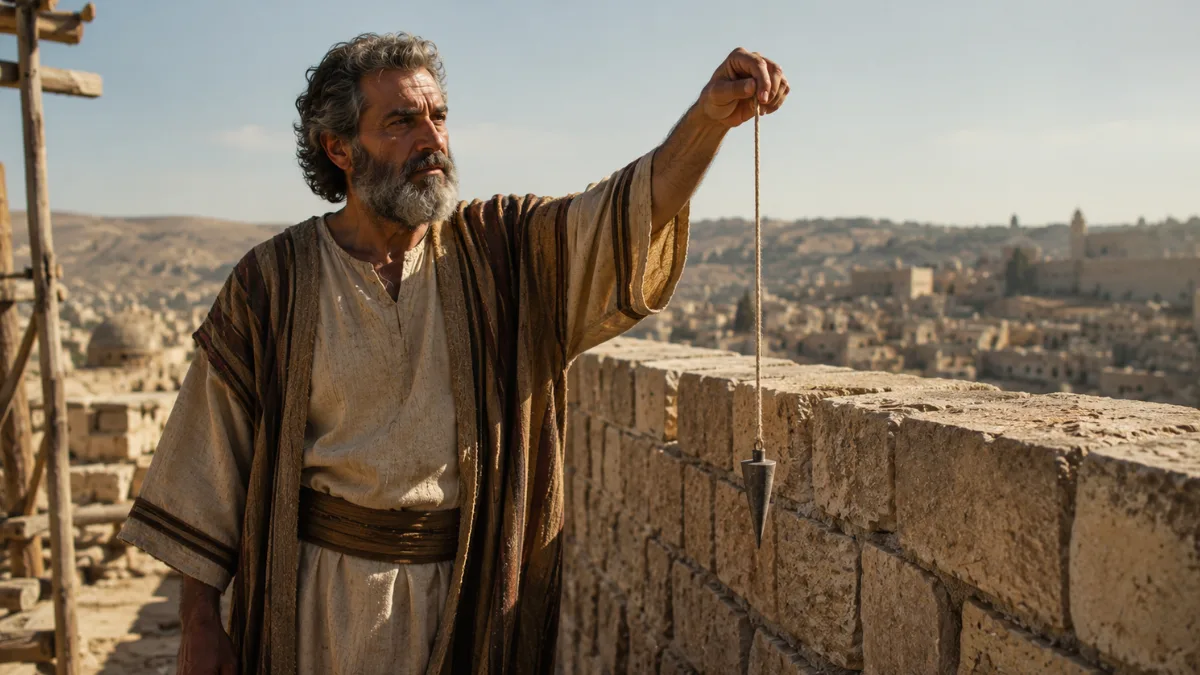

Most English Bibles describe the object in Amos 7:7–9 as a plumb line, a weighted cord that builders used to test whether a wall stood upright. In the traditional interpretation, the image shows God measuring Israel against His righteous standard and exposing how far the nation had moved from justice, faithful worship and covenant obedience.
The rare Hebrew word in this passage has caused some debate. It may refer to a plumb line, tin or another metal object. Even so, the main message remains clear: God examined Israel, found persistent rebellion and announced that He would no longer delay judgment.
The vision does not simply encourage people to improve their behaviour. It confronts a nation that had ignored repeated warnings while continuing to appear prosperous and religious.
What Was a Plumb Line?
A plumb line consisted of a cord with a weight attached to one end. Gravity pulled the weight downward, giving builders a straight vertical reference.
A builder could hold the cord beside a wall, post or structure to see whether it stood upright. A wall might look stable from a distance, yet the plumb line could reveal that it leaned dangerously.
The tool did not make the wall crooked. It exposed a problem that already existed.
That idea explains why the traditional interpretation fits Amos 7 so well. Israel looked secure, wealthy and religious, but God’s examination revealed serious moral and spiritual misalignment.
People often measure themselves by appearances, intentions, traditions or comparisons with others. God measures according to His own character and commands.
Also Read: 7 Important Facts About the Amalekites in the Bible
Does the Hebrew Word Definitely Mean “Plumb Line”?
The Hebrew word translated “plumb line” in Amos 7 appears only in this passage, which makes its exact meaning difficult to prove.
Most familiar English translations use “plumb line.” Other interpreters connect the word with tin, lead or another metal. Some suggest that Amos saw a metal object in God’s hand rather than a builder’s cord.
Readers should therefore avoid claiming more certainty than the language allows.
However, the translation debate does not erase the central message. God stands beside a wall, places the object among His people and announces that He will no longer pass over their rebellion.
Whether Amos saw a weighted builder’s tool or another metal symbol, the vision communicates divine examination and approaching judgment.
The plumb-line interpretation remains useful because the imagery of a wall, measurement and alignment fits the context naturally. Christians can use that interpretation while acknowledging that the exact physical object remains debated.
What Happens in Amos 7:7–9?
The plumb-line vision appears after two earlier visions.
First, Amos sees locusts destroying the crops of Israel. He pleads with God to forgive the nation and God relents.
Next, Amos sees a consuming fire that threatens to devour the land. Again, he intercedes and God relents.
Then Amos sees the Lord standing beside a wall with the object commonly translated as a plumb line in His hand.
God asks Amos what he sees. After Amos answers, God declares that He will place the plumb line among His people Israel and will no longer spare them.
He then announces judgment against the high places, sanctuaries and royal house.
This vision changes the pattern of the chapter. Amos does not intercede again.
The text does not directly explain his silence but the structure suggests that the third vision announces a settled judgment. God had already shown patience. Israel had continued in rebellion and the time for postponement had ended.
Also Read: What Is Grace in the Bible? Meaning and Examples
What Did the Plumb Line Reveal About Israel?
Amos did not condemn Israel for one isolated failure. He exposed a broad pattern of injustice, empty religion, dishonesty and false confidence.
Israel Exploited Poor People
The wealthy lived comfortably while many vulnerable people suffered.
Powerful people took advantage of debtors, seized land and treated human lives as less important than profit. Merchants looked for ways to increase their earnings even when their actions harmed struggling families.
Amos shows that God does not separate worship from the treatment of people.
Israel could not claim faithfulness while building prosperity on exploitation.
Israel Corrupted Justice
The courts no longer protected the weak.
Influential people shaped decisions for their own benefit, while poor citizens struggled to receive fair treatment. Bribery and self-interest weakened the legal system.
God had called Israel to practice justice but the nation had allowed power and wealth to determine outcomes.
A society may continue functioning outwardly while injustice slowly weakens its foundations. The vision exposes that kind of hidden instability.
Israel Practiced Empty Religion
Israel continued to hold festivals, offer sacrifices, sing worship songs and gather at religious centres.
Yet the people separated worship from obedience.
They honoured God with ceremonies while ignoring His commands in daily life. Their public religion could not hide oppression, dishonesty and self-indulgence.
Amos made clear that God did not want religious activity without righteousness. He wanted justice to shape the nation continuously.
Israel Trusted Prosperity and Security
Israel enjoyed a period of national strength during the ministry of Amos.
People saw wealth, military stability, and successful commerce and assumed that nothing serious could happen to them. They treated material success as proof that God approved of their conduct.
The vision challenged that assumption.
Prosperity did not cancel injustice. Religious activity did not remove guilt. Political strength did not protect a nation that had moved away from God’s covenant.
Also Read: Why God Rejected Saul as King in 1 Samuel
What Does “I Will Spare Them No Longer” Mean?
God’s statement means that He would no longer continue postponing judgment.
The earlier visions had already shown His willingness to respond to Amos’s intercession. God had not acted impulsively or without mercy.
However, patience did not make rebellion harmless.
Israel had received warnings, prophetic correction and opportunities to repent. Instead of changing, the people continued to trust their wealth, worship practices, and national strength.
God’s mercy had given them time. They used that time to deepen the same patterns He had condemned.
The statement therefore marks a turning point. Judgment would now move forward.
Why Did Amos Stop Interceding?
Amos prayed after the visions of locusts and fire, but he remained silent after the third vision.
The passage does not tell readers exactly why.
One reasonable interpretation is that the plumb-line vision revealed a settled decision. The earlier visions showed disasters that Amos asked God to stop. The third focused on God’s direct examination of the nation.
Another possibility is that Amos understood that Israel’s condition had reached a point where further delay would not produce repentance.
Readers should treat these explanations as interpretations rather than explicit statements from the text.
What remains certain is that the third vision carries greater finality. God announces that He will no longer pass over Israel’s rebellion, and Amos offers no further plea.
How Was the Vision Fulfilled?
Amos ministered during a period of strength in the northern kingdom of Israel, especially during the reign of Jeroboam II.
The nation appeared stable, but its security did not last.
Decades later, Assyria conquered the northern kingdom. Samaria fell in 722–721 BC, and Israel lost the political strength that its leaders had trusted.
The fall did not happen because one generation made a small mistake. The prophets had warned repeatedly about idolatry, injustice, corrupt leadership, and covenant rebellion.
The plumb-line vision warned that outward success could not protect a nation whose foundations had become morally crooked.
Is the Plumb Line the Word of God?
Many Christian teachers compare the Bible to a plumb line because Scripture provides an objective standard for belief and conduct.
That application can help believers, but Amos 7 does not directly identify the plumb line with the completed Bible.
In its original context, the image represents God’s examination of Israel according to His righteous covenant standard.
Christians may connect the image with Scripture because God’s Word reveals His will, corrects error, and exposes self-deception. However, they should preserve the original meaning before moving to a modern application.
The point is not merely that people should read the Bible more often. The point is that God’s truth challenges the ways individuals and communities justify injustice, empty worship, and rebellion.
Where Else Does the Bible Use Measuring Imagery?
The Bible sometimes uses lines, levels, and building tools to communicate judgment or restoration.
| Passage | Meaning of the image |
|---|---|
| Isaiah 28:17 | Justice and righteousness expose false security |
| 2 Kings 21:13 | Measurement announces judgment against Jerusalem |
| Isaiah 34:11 | Measuring imagery accompanies desolation |
| Zechariah 4:10 | A plumb line appears during the rebuilding of the temple |
These passages show that measuring imagery can carry different meanings.
In one setting, God measures in order to expose and judge. In another, He measures in connection with rebuilding and restoration.
The context determines the meaning.
In Amos 7, the context clearly emphasizes judgment.
What Does the Plumb-Line Vision Teach Christians?
Christians do not live under the same national covenant as ancient Israel. Amos does not give believers permission to pronounce destruction on modern nations or political opponents.
The vision still reveals enduring truths about God and faithful living.
God Examines More Than Outward Religion
Religious activity does not replace obedience.
Church attendance, worship music, public prayer and biblical language can coexist with pride, dishonesty, exploitation, and indifference.
Israel’s ceremonies did not protect it from God’s examination.
Christians should therefore ask whether their faith shapes how they treat family members, employees, neighbours, strangers, and vulnerable people.
God’s Patience Should Lead to Repentance
Delayed consequences do not prove that God approves of harmful behaviour.
Israel mistook patience for permanent protection. The people continued in rebellion because judgment did not come immediately.
God’s patience gives people time to turn back to Him. It should produce humility, not presumption.
Worship and Justice Belong Together
Amos refuses to separate devotion to God from concern for people.
Faithful worship should lead to honesty, fairness, mercy, and compassion. A person cannot claim to honour God while deliberately exploiting others.
The plumb-line vision calls believers to examine both private devotion and public conduct.
Frequently Asked Questions
Why did Amos stop interceding after the plumb-line vision?
The text does not directly explain Amos’s silence. The vision appears to announce a settled judgment after God had already relented following Amos’s prayers during the previous visions of locusts and fire.
Does the plumb line represent the Bible?
Amos 7 does not directly identify the plumb line with Scripture. Christians sometimes compare the Bible to a plumb line because God’s Word provides an objective standard that exposes error and guides faithful living.
Does the Hebrew word definitely mean plumb line?
Not necessarily. The rare Hebrew term appears only in Amos 7:7–8, and some interpreters connect it with tin or another metal. The exact object remains debated, but the vision clearly communicates divine examination and judgment.
