
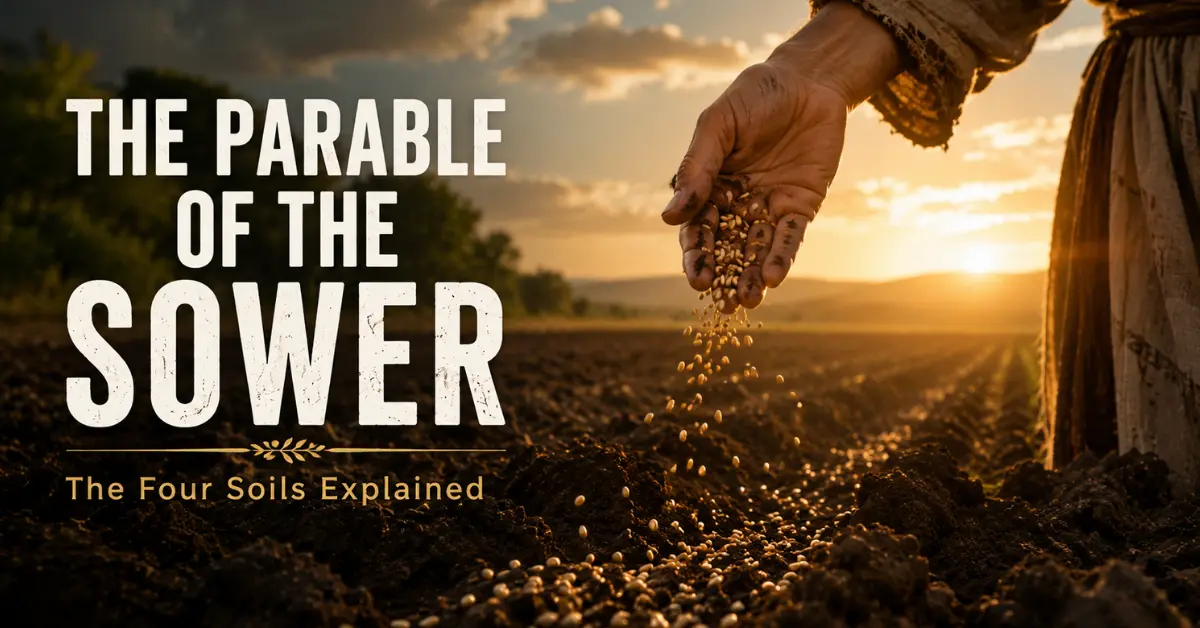

The parable of the sower explains how people respond differently when they hear the Word of God. Jesus describes one sower scattering the same seed across four kinds of ground but only the good soil produces a lasting harvest.
The seed represents God’s Word, while the soils represent different conditions of the human heart. Some people reject the message immediately. Others receive it with enthusiasm but abandon it when following Christ becomes difficult. Some allow worry, wealth, pleasure and competing desires to choke spiritual growth. Others hear, understand, retain and obey the Word until it produces fruit.
Jesus told this parable in Matthew 13:1–23, Mark 4:1–20, and Luke 8:4–15. Each Gospel adds details that help explain its meaning.
Where Is the Parable of the Sower Found?
Matthew records the parable after Jesus faced growing opposition from religious leaders. A large crowd gathered beside the Sea of Galilee, so Jesus sat in a boat and taught the people standing on the shore.
He said:
“Behold, a sower went forth to sow.” — Matthew 13:3
As the sower scattered seed, some fell beside the path, some fell on rocky ground, some fell among thorns, and some fell on good soil.
Birds ate the seed that landed on the path. The seed on rocky ground grew quickly but withered because it had no deep root. The seed among thorns grew but became choked. The seed on good soil produced a harvest of thirty, sixty, or one hundred times what the sower planted.
Jesus later explained the meaning privately to His disciples.
Matthew emphasizes understanding the message of the kingdom. Mark stresses receiving the Word and enduring opposition. Luke highlights keeping the Word in an honest and good heart and producing fruit with patience.
Also Read: Slavery in the Bible Explained in Context
What Is the Main Meaning of the Parable?
The parable teaches that hearing God’s Word does not always produce the same result.
The sower scatters the same seed across every kind of ground. The message does not change. The difference lies in the condition of the ground that receives it.
A person can hear biblical truth without accepting it. Another person may receive it emotionally but lack the depth needed to remain faithful. Someone else may show spiritual growth for a time but allow worldly pressures and desires to take control.
The good soil represents the person who receives the Word sincerely and allows it to shape life over time.
Jesus therefore directs attention beyond the act of hearing. He asks what happens after the message reaches the heart.
Who Is the Sower?
Jesus does not directly identify the sower in His explanation, although the image first points to Christ proclaiming the message of God’s kingdom.
The sower can also represent anyone who faithfully shares God’s Word. Pastors, teachers, parents, missionaries, and ordinary Christians sow the seed when they communicate biblical truth.
The parable places more attention on the hearers than on the sower’s identity or technique. The sower spreads the seed widely, even where the ground appears unlikely to produce anything.
This broad scattering reflects the generous proclamation of the gospel. The message reaches people with different attitudes, experiences, desires, and levels of spiritual openness.
The sower cannot force the seed to grow. He can communicate the message faithfully, but the condition of the heart affects how the listener responds.
Also Read: Exalt a Horn in the Bible: Meaning and Symbolism Explained
What Does the Seed Represent?
Jesus clearly identifies the seed:
“Now the parable is this: The seed is the word of God.” — Luke 8:11
Matthew calls it “the word of the kingdom,” while Mark calls it simply “the word.”
The seed represents the message about God’s kingdom, repentance, faith, salvation, and Jesus Christ. It also includes biblical truth that calls people to trust God and live under His authority.
A seed may appear small, but it contains the potential for life and growth. In the same way, God’s Word can begin quietly in a person’s heart and gradually reshape beliefs, priorities, habits, relationships, and character.
The power does not come from the messenger alone. God works through His Word. However, people can resist, neglect, or crowd out what they hear.
What Does the Wayside Soil Mean?
The first seed falls beside the path, where repeated traffic has hardened the ground. The seed remains on the surface, and birds quickly consume it.
Jesus explains:
“When any one heareth the word of the kingdom, and understandeth it not, then cometh the wicked one, and catcheth away that which was sown in his heart.” — Matthew 13:19
Mark identifies the enemy as Satan, while Luke calls him the devil.
The wayside soil represents a hardened or unreceptive heart. The person hears the message, but it never penetrates deeply enough to produce faith.
Pride, unbelief, spiritual indifference, resentment, attachment to sin, or repeated resistance can harden a person’s response. Some people dismiss the message before considering it seriously. Others hear familiar biblical words so often that they stop paying attention to their meaning.
The evil one also seeks to prevent the Word from producing faith. Jesus therefore presents rejection as more than an intellectual disagreement. Spiritual opposition also works against the message.
This soil warns that exposure to biblical teaching does not guarantee spiritual understanding. A person can hear sermons, read Scripture, or attend church while maintaining a closed heart.
What Does the Rocky Ground Mean?
The second seed falls on rocky ground. This likely describes a thin layer of soil covering solid rock rather than ground containing a few loose stones.
The seed germinates quickly, but the plant cannot develop deep roots. When the sun rises, it withers.
Jesus explains that this person hears the Word and immediately receives it with joy. However, the Word has no lasting root. When trouble or persecution comes because of the message, the person falls away.
The rocky ground represents a shallow spiritual response.
The person may feel emotionally moved, make strong claims of commitment, or show rapid outward change. However, the message never develops into deep conviction and perseverance.
The problem does not lie in joy itself. Scripture often connects genuine faith with joy. The problem appears when someone receives the promise of faith without accepting the cost of following Christ.
Jesus warned that discipleship could involve rejection, pressure, sacrifice, and persecution. A faith built mainly on emotional excitement may collapse when obedience becomes difficult.
Deep roots grow as people understand Scripture, depend on Christ, practise obedience, receive correction, and continue believing when circumstances or feelings change.
What Does the Thorny Ground Mean?
The third seed falls among thorns. The seed begins to grow, but the thorns grow alongside it and eventually choke the plant.
Jesus identifies the thorns as the cares of this world, the deceitfulness of riches, desires for other things, and the pleasures of life.
Unlike the wayside soil, this person does not reject the Word immediately. Unlike the rocky soil, this person may continue for some time. The problem develops through competition.
God’s Word becomes one concern among many rather than the truth that governs life.
Anxiety can dominate the heart through fear about money, security, family, health, work, or the future. Wealth can deceive people into believing that possessions provide lasting safety or significance. Pleasure and ambition can gradually absorb the attention and affection that belong to God.
Jesus does not teach that work, money, family responsibilities, or ordinary enjoyment are inherently sinful. The problem begins when these things become controlling loyalties.
Thorns rarely destroy a plant in one dramatic moment. They slowly compete for space, light, water, and nutrients.
Spiritual fruit can decline in the same way. A person may not openly reject Christianity but may become increasingly distracted, compromised, and unfruitful.
Also Read: Moses at Mount Sinai: The Covenant and the Giving of the Law
What Does the Good Soil Mean?
The final seed falls on good ground and produces a harvest.
Matthew says the good soil represents the person who hears and understands the Word. Mark says the person hears, receives, and bears fruit. Luke describes someone who keeps the Word in an honest and good heart and produces fruit with patience.
Together, these descriptions show that genuine spiritual reception involves more than hearing or feeling inspired.
The good soil represents someone who:
- Hears the Word attentively
- Understands its message
- Receives it sincerely
- Holds onto it through difficulty
- Allows it to shape conduct
- Produces lasting spiritual fruit
The good soil does not represent a naturally perfect person. Every human heart needs God’s grace and transforming work.
It represents a receptive, teachable, and persevering response. The person does not merely admire the message but allows it to take root.
Luke’s emphasis on patience also matters. Spiritual growth often develops gradually through struggle, correction, repentance, endurance, and repeated obedience.
What Does the Fruit Represent?
Jesus does not give one narrow definition of fruit in the parable. The wider teaching of Scripture helps explain it.
Spiritual fruit can include repentance, obedience, love, faithfulness, generosity, humility, perseverance, godly character, and participation in God’s work.
Fruit shows that the Word has moved beyond information and begun changing the person.
Someone can possess biblical knowledge without producing biblical fruit. A person may understand Christian language, defend doctrine, or participate in church activity while remaining proud, dishonest, unloving, or controlled by sin.
James expresses a similar principle when he tells believers to become doers of the Word rather than hearers only.
Fruit does not earn salvation. It reveals that the message has taken root and that God continues working in the believer’s life.
Genuine fruit also does not require immediate perfection. Christians still struggle, fail, repent, and grow. The good soil describes a lasting direction of faith and obedience.
What Do Thirtyfold, Sixtyfold and a Hundredfold Mean?
Jesus says that the good soil produces different levels of harvest. Some seed yields thirtyfold, some sixtyfold, and some a hundredfold.
These figures describe an abundant return compared with the amount originally planted.
The variation also shows that fruitful believers do not always produce identical visible results. God gives people different abilities, opportunities, responsibilities, and areas of influence.
One person may serve through teaching, another through generosity, another through raising children faithfully, and another through quiet acts of compassion.
The main contrast does not lie between thirtyfold and a hundredfold. It lies between fruitfulness and unfruitfulness.
Jesus does not teach believers to measure their worth by comparing their harvest with someone else’s. He teaches that a receptive heart will produce real spiritual results.
Why Did Jesus Teach This Message as a Parable?
After Jesus told the story, the disciples asked why He spoke to the crowds in parables.
Jesus explained that the mysteries of the kingdom had been given to the disciples, while others heard without truly understanding. He connected this response to Isaiah’s description of people whose hearts had become dull.
Parables both reveal and conceal.
They reveal truth to people who listen humbly, seek understanding, and remain willing to respond. They conceal truth from those who hear casually or resist what Jesus teaches.
The disciples understood more because they came to Jesus and asked for an explanation. Many people in the crowd heard the same story but did not pursue its meaning.
The parable’s form therefore reflects its message. Just as the seed receives different responses from the soils, Jesus’ teaching receives different responses from its hearers.
How Should Christians Apply the Parable?
The parable should not become only a method for classifying other people. It calls every listener to examine how they receive God’s Word.
A person may resist biblical teaching in one area while accepting it in another. Worry or ambition may begin choking spiritual growth after years of faithfulness. Pressure may expose convictions that never developed deep roots.
Christians should approach Scripture with humility, seek to understand what it says, and remain willing to obey when the message challenges personal desires.
They should also guard against the spiritual conditions represented by the first three soils.
A hardened heart needs repentance and openness to truth. Shallow roots need deeper understanding, obedience, prayer, and endurance. Thorny ground requires the removal of competing loyalties that consume attention and weaken faith.
Those who share the gospel should also continue sowing faithfully. Not every listener will respond in the same way, and the messenger cannot force spiritual growth. God works through His Word, often in ways that do not become visible immediately.
The parable ultimately asks whether the Word remains on the surface, disappears under pressure, becomes crowded by other priorities, or takes root and produces a fruitful life.
