
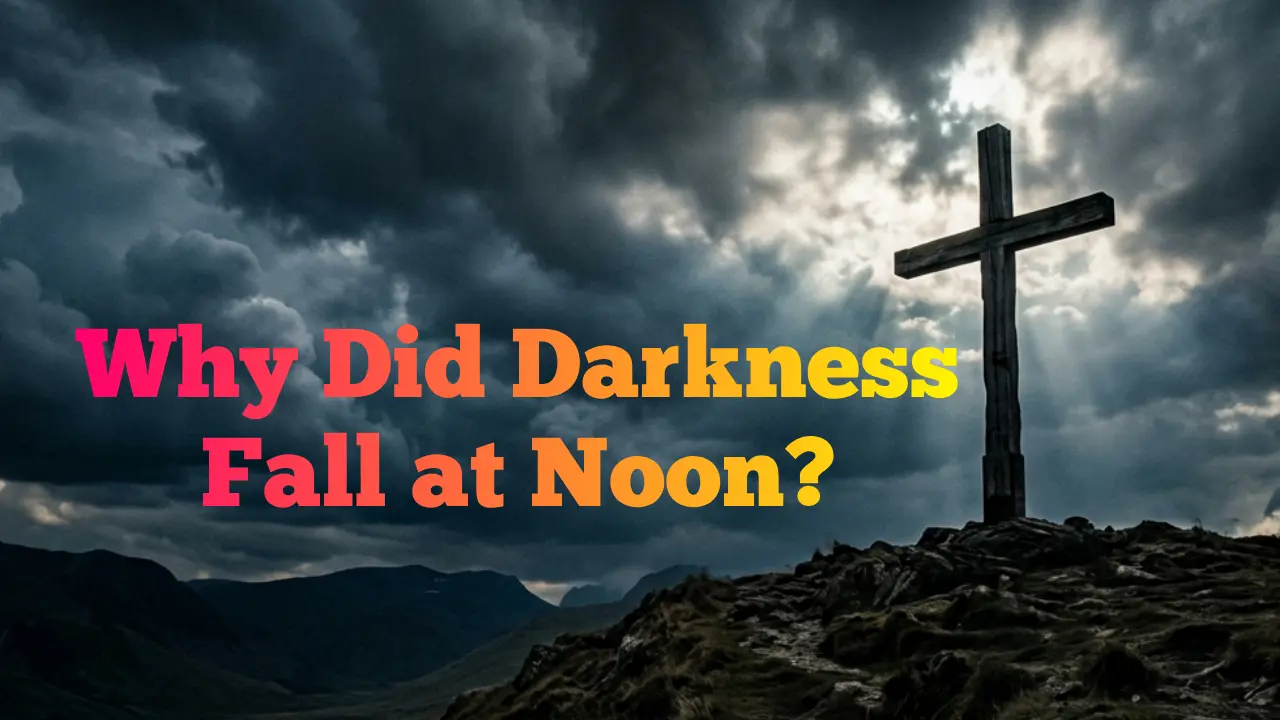

This was not a small detail or a passing moment in the crucifixion story. It happened right at the centre of Jesus’ suffering, when everything was already intense and difficult to understand.
Many people assume it was just a natural event or a symbolic touch. But the Bible presents it as something far more serious—something that points to judgment, sorrow and a deeper spiritual reality unfolding at the cross.
The scene at Calvary was already heavy with pain. Jesus hung on the cross, mocked, beaten and rejected. Yet something happened that went beyond human cruelty. From noon until three in the afternoon, darkness covered the land as recorded in Matthew 27:45, Mark 15:33 and Luke 23:44–45.
Not an Eclipse
The Bible clearly records the darkness, but it does not explain how it happened physically. This silence is important. It keeps the focus on meaning rather than mechanism.
Why an eclipse does not fit
Passover took place during a full moon. A solar eclipse requires a new moon. This means the darkness could not have been a normal eclipse. The timing itself rules that out.
The deeper point
This was an act of God. The darkness was not random or accidental. Creation itself became part of the message. In that moment, God used the natural world to draw attention to the weight of what was taking place on the cross.
Judgment Fell on Christ
In Scripture, darkness often appears when judgment is near. It is not just about the absence of light. It signals something serious and holy.
Earlier shadows
In Exodus 10:21–23, darkness covered Egypt during one of the final plagues. It was a sign of God’s judgment. In Amos 8:9, God speaks of the sun going down at noon as a warning of coming judgment.
At Calvary
The same pattern appears at the cross. Jesus was not suffering for His own sin. He stood in the place of sinners. The judgment that belonged to humanity was being placed on Him. The darkness marked that moment. It showed that something holy and fearful was taking place.
Sin Was Placed on Jesus
Jesus lived without sin, yet He carried the burden of human guilt. As 2 Corinthians 5:21 teaches, He bore our sin so that we could receive righteousness through Him.
What was taking place
On the cross, Jesus carried what did not belong to Him. Every wrong, every failure, every act of rebellion was placed upon Him. This was not symbolic. It was real and costly.
Why the darkness matters
The darkness reflects the weight of that moment. It shows that sin is not light or harmless. It carries a cost. The cross reveals that cost fully. Redemption required sacrifice, suffering and surrender.
Creation Mourned Its Maker
The New Testament teaches that all things were made through Jesus, as seen in John 1:3 and Colossians 1:16. The One on the cross was not only a teacher or prophet. He was the Creator.
Who suffered there
The One who formed the world was now rejected by it. The One who gave life was facing death. This truth adds depth to the moment.
A sorrow beyond words
As darkness covered the land, it was as if creation itself responded. The world that He made stood still in silence. The darkness reflects a kind of sorrow that words cannot fully explain. It was not ordinary. It was a moment that touched heaven and earth.
The Cry in the Darkness
During this time of darkness, Jesus cried out, “My God, My God, why have You forsaken Me?” (Matthew 27:46), echoing Psalm 22:1.
The depth of His suffering
This cry shows the intensity of what He endured. Jesus entered into deep anguish. He experienced suffering in a way that goes beyond physical pain.
The weight of that hour
The darkest part of the day surrounded the deepest moment of the cross. This was the point where the burden of sin was fully felt. Yet even in this cry, Scripture was being fulfilled. God’s plan was still moving forward.
The Veil Was Torn
Luke 23:44–45 connects the darkness with another powerful event. The curtain of the temple was torn in two.
What the veil showed
The veil separated people from the most holy place. It represented distance between God and humanity. Only a high priest could pass through, and only at a specific time.
What changed through Christ
When Jesus died, the veil was torn. Access to God was opened. The barrier was removed, not by human effort, but by Christ’s sacrifice.
From judgment to access
The darkness marked judgment, while the torn veil revealed mercy. Together, they show a transition. Through the cross, what was once closed is now open.
Learn More: The Three Hours of Darkness
If you want to go deeper into this moment, you can explore a focused study on the full three hours of darkness during the crucifixion. This event carries layers of meaning that connect judgment, prophecy and redemption in a powerful way.
Read more here: The Three Hours of Darkness During the Crucifixion—Why It Changed Everything
This additional study will help you understand not just why the darkness happened, but what those three hours reveal about the heart of the cross and the work of Christ.
What This Means for Us
This moment is not only history. It speaks directly to every person.
The cross confronts us
The darkness shows that sin is serious. It is not something to ignore or minimize. It brings judgment and separation.
The right response
At the same time, the cross shows grace. Jesus took what we could not carry. The right response is not fear alone but humility and trust. The darkness invites us to see the truth and to turn toward the light that Christ offers.
From Darkness to Light
The darkness at noon was not without purpose. It revealed judgment, exposed sin, reflected sorrow and pointed to redemption. It marked one of the most significant moments in history.
Yet the darkness did not remain. It gave way to the victory of the cross and the promise of new life. Through Jesus, the Light has come into the world and no darkness can overcome the salvation He has secured.
Frequently Asked Questions
Was the darkness caused by a solar eclipse?
No, it could not have been a solar eclipse. Passover happened during a full moon, while a solar eclipse requires a new moon. This means the darkness was not natural but a supernatural act.
How long did the darkness last?
The Gospels record that the darkness lasted for about three hours from noon until three in the afternoon (Matthew 27:45; Mark 15:33; Luke 23:44–45).
What does darkness symbolize in the Bible?
Darkness often represents judgment, sorrow and the presence of something serious or holy. In the case of the crucifixion, it points to God’s judgment on sin being placed on Jesus.
Did this event fullfill any prophecy?
Yes, it connects with passages like Amos 8:9, where God speaks of the sun going down at noon. It also aligns with the broader pattern of prophetic signs pointing to the Messiah.
What happened spiritually during those three hours?
During that time, Jesus bore the weight of human sin. He suffered deeply, both physically and spiritually as He carried what humanity deserved.

1 thought on “Why Darkness Fell at Noon During Jesus’ Crucifixion”