
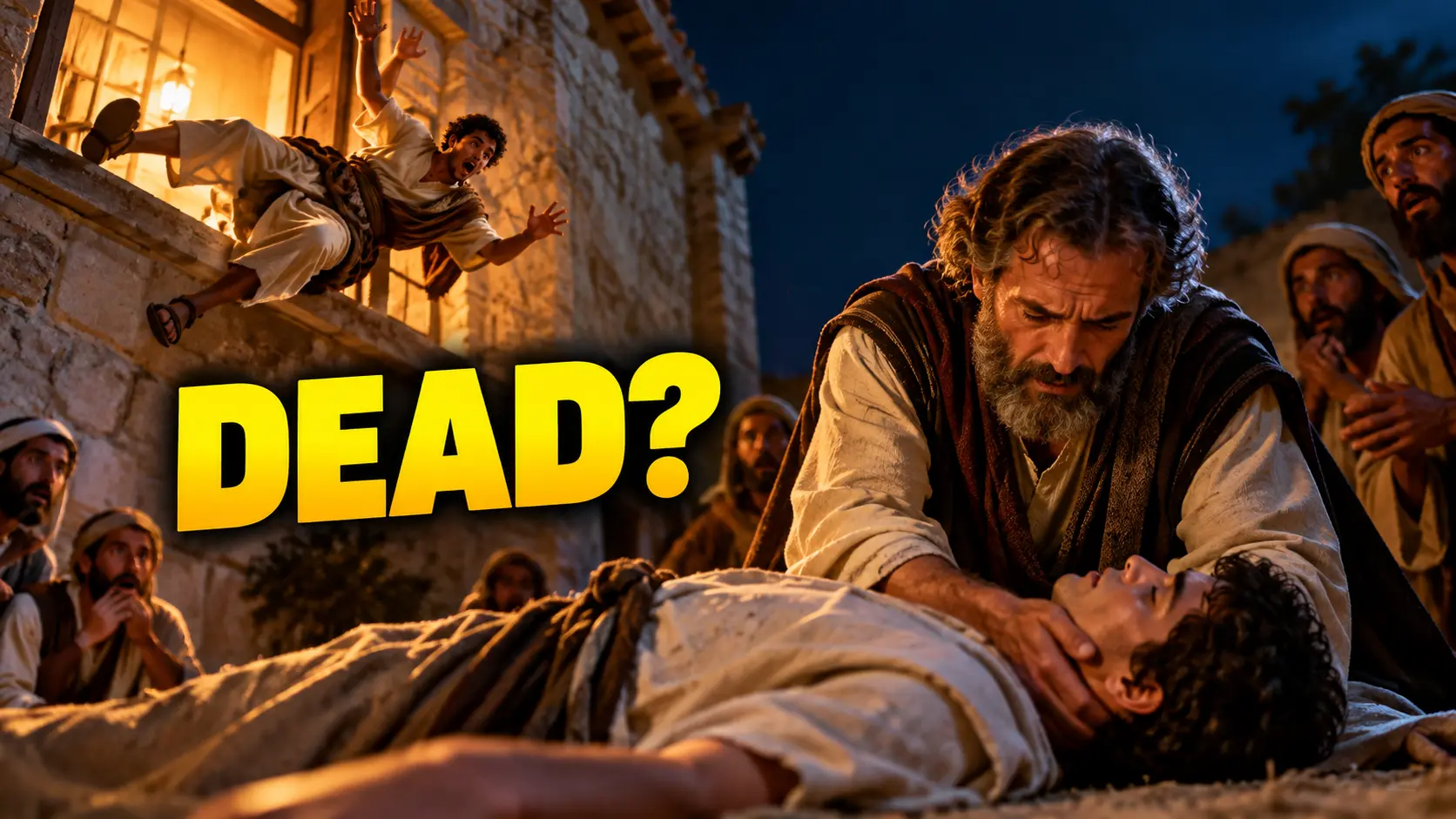

Eutychus was a young man who fell from a third-story window while the Apostle Paul was speaking to believers in Troas. According to Acts 20:7–12, he fell into a deep sleep, plunged from the window and was picked up dead. Paul went downstairs, embraced him and reassured the gathering that his life was in him.
The incident ended with Eutychus being brought away alive, bringing considerable comfort to those who had witnessed his fall. However, the wording of the passage raises an important question about what actually happened between his apparent death and Paul’s declaration that he was alive.
How Eutychus Fell From the Third-Story Window
The incident occurred during Paul’s visit to Troas, where he and his companions had remained for seven days. On the first day of the week, the believers gathered to break bread and Paul spoke to them because he intended to depart the following day.
According to Acts 20:7, Paul continued speaking until midnight. His approaching departure helps explain why the gathering lasted so long, as the believers had an opportunity to hear him before he continued his journey.
The meeting took place in an upstairs room where many lamps were burning. Among those listening was Eutychus, a young man seated in a window on the third story of the building.
As Paul’s speech continued, Eutychus became increasingly overcome by sleep. Acts 20:9 describes him falling into a deep sleep before losing his position at the window and plunging to the ground below.
The King James Version records:
“And there sat in a window a certain young man named Eutychus, being fallen into a deep sleep: and as Paul was long preaching, he sunk down with sleep and fell down from the third loft, and was taken up dead.” — Acts 20:9, KJV
Luke’s description establishes that Eutychus was not merely resting or momentarily distracted. He had fallen into a sufficiently deep sleep that he could no longer maintain his position at the window, resulting in a fall from a considerable height.
The passage does not explain why Eutychus chose to sit there or what made him unusually sleepy. Although the late hour and prolonged gathering provide relevant circumstances, suggestions that he had worked throughout the day or was struggling with the room’s temperature go beyond what Scripture records.
Neither does Luke portray the accident as punishment for falling asleep during religious teaching. His attention remains on the circumstances of the fall and the young man’s condition afterward.
The final words of verse 9 are particularly important because they describe Eutychus as having been picked up dead. That statement establishes the seriousness of the incident and provides the context for Paul’s extraordinary response.
What Paul Did When Eutychus Was Picked Up Dead
After Eutychus fell, Paul went downstairs to where the young man had landed. Acts 20:10 describes Paul bending over him, embracing him and addressing those who had gathered around the scene.
Paul declared:
“Trouble not yourselves; for his life is in him.” — Acts 20:10, KJV
His response combined physical contact with an assurance that the young man’s life was present. Rather than describing an extended prayer or a spoken command to rise, Luke concentrates on Paul’s actions and the reassurance he gave to those concerned about Eutychus.
The physical gesture resembles earlier biblical accounts in which Elijah and Elisha approached children who had died. In 1 Kings 17:21–22 and 2 Kings 4:32–35, the prophets’ physical contact forms part of the events surrounding the children’s restoration to life.
Nevertheless, Acts does not explicitly say that Paul intended to imitate either prophet. The comparison helps readers recognize a biblical parallel without supplying details that Luke himself does not provide.
Was Eutychus Actually Dead or Merely Unconscious?
The question arises because Acts 20:9 describes Eutychus as dead, while the following verse records Paul saying that his life was in him. Some interpreters understand Paul’s reassurance as evidence that Eutychus survived the fall and had only appeared lifeless to those who reached him.
Under this interpretation, the people may have mistaken a severely unconscious young man for someone who had died. Paul’s statement would then represent his recognition that Eutychus was still alive rather than an announcement following his restoration from death.
However, this explanation encounters a significant difficulty in Luke’s wording. Acts 20:9 does not merely report that the witnesses thought Eutychus was dead; the narrative states that he “was taken up dead.”
The distinction is important because Luke presents the young man’s death as part of the narrated event. Nothing in the immediate passage explicitly identifies the witnesses’ assessment as mistaken.
The traditional Christian interpretation therefore understands Eutychus as having genuinely died from the fall and subsequently been restored to life through Paul’s intervention. This reading follows the sequence of Luke’s account without treating the description of death as an error.
Paul’s declaration in verse 10 does not necessarily contradict that understanding. His statement that life was in Eutychus describes the young man’s condition when Paul reassured the gathering, whereas verse 9 describes his condition immediately after the fall.
The passage does not specify the precise moment when Eutychus recovered. It does not explain whether life returned during Paul’s embrace or immediately before his declaration, and those details cannot be established from the surviving account.
A further indication of the intended outcome appears in Acts 20:12, which reports that the believers brought the young man away alive. Luke’s emphasis on his living condition at the end of the account reinforces the contrast with the condition described after his fall.
For these reasons, the most natural reading is that Eutychus died and was restored to life, although the passage does not explain the physical process or exact moment of his restoration. The interpretation that he was merely unconscious remains possible only by treating the earlier description of death as a mistaken assessment, something Luke does not expressly indicate.
What Happened After Eutychus Was Restored to Life?
Paul’s actions were followed by an unexpected continuation of the gathering. Instead of ending the meeting after the accident, he returned to the upstairs room and resumed his time with the believers.
Acts 20:11 explains that Paul broke bread, ate and continued speaking until daybreak. The account does not describe the congregation’s conversations following his reassurance but it makes clear that Paul’s departure proceeded after the overnight gathering.
The reference to breaking bread is also significant because the believers had originally assembled for that purpose. The interrupted gathering continued, allowing the events of the evening to reach their intended conclusion before Paul departed.
Luke then returns to Eutychus in the final verse:
“And they brought the young man alive and were not a little comforted.” — Acts 20:12, KJV
The expression “were not a little comforted” emphasizes the considerable relief experienced by the believers. Their reaction followed an incident in which a young member of the gathering had fallen from a dangerous height and been described as dead.
Interestingly, the passage does not record Eutychus speaking after his restoration. Luke provides no account of his first words, how he felt or whether he remembered anything about the fall.
Neither does Scripture describe his subsequent activities or explain what became of him in later years. The closing statement establishes that he was alive and that those present were deeply comforted, without expanding the narrative into a biography of his later life.
The account’s ending also reveals where Luke places his emphasis. Rather than describing the contents of Paul’s lengthy speech, he concludes with the congregation’s response to the young man’s restoration.
This makes Acts 20:7–12 more than an account of someone falling asleep during a sermon. Its central event is the restoration of a young man whose fatal fall had interrupted an important gathering and its final detail is the relief experienced by those who saw him alive before Paul’s departure.
