
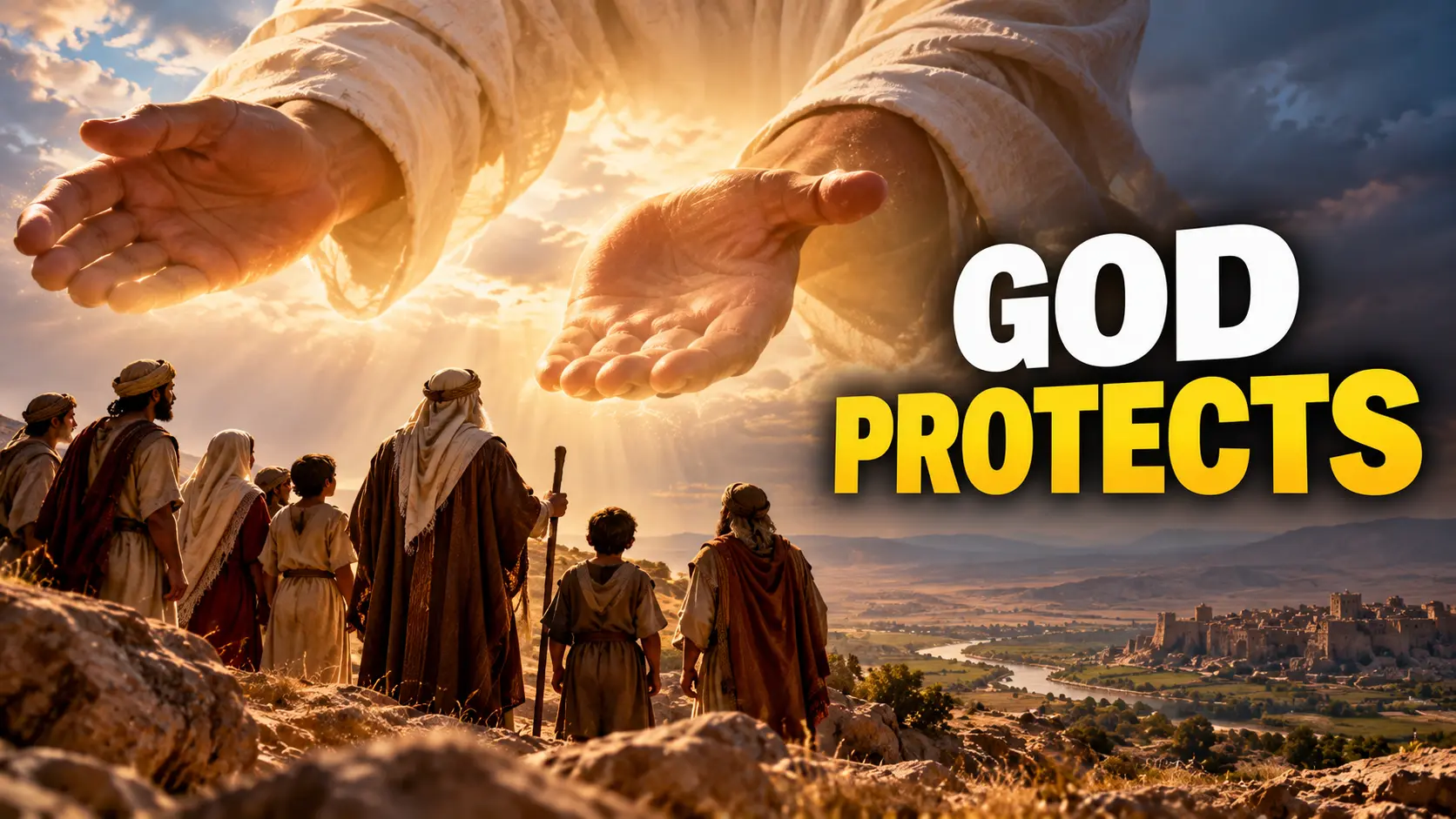

Deuteronomy 33:27 describes God as an eternal refuge whose everlasting arms sustain His people. Moses spoke these words in his final blessing over Israel, assuring the nation that God’s protection would remain dependable even as its leadership and circumstances changed.
The verse combines three important declarations: God provides a secure dwelling place, His everlasting arms offer enduring support and His power drives enemies away. Understanding these statements within Moses’ final blessing reveals what the promise originally meant and how Christians can understand its message today.
Deuteronomy 33:27 Meaning in Its Original Context
The King James Version reads:
“The eternal God is thy refuge and underneath are the everlasting arms: and he shall thrust out the enemy from before thee; and shall say, Destroy them.” — Deuteronomy 33:27, KJV
Moses delivered this blessing near the end of his life, shortly before the Israelites entered the land promised to their ancestors. After decades of wilderness journeys, the nation was preparing for a future that would unfold without Moses as its leader.
Deuteronomy 33 contains individual blessings for Israel’s tribes, followed by declarations about God’s relationship with the nation. Verse 27 belongs to this concluding section, where Moses emphasizes the divine protection upon which Israel’s security depended.
The surrounding verses help establish the meaning. Deuteronomy 33:26 describes God coming through the heavens to help His people, while verses 28–29 portray Israel dwelling securely and receiving deliverance through divine strength.
Within this setting, Moses was not offering an isolated promise about personal comfort. He was assuring Israel that its security rested upon the God who had sustained the nation throughout its history and would remain its source of help after Moses’ departure.
The timing gives the blessing particular significance. Moses’ leadership was approaching its conclusion, but the God he described was not limited by the lifespan or authority of any human leader.
What Does “The Eternal God Is Thy Refuge” Mean?
The opening statement identifies God as Israel’s refuge, presenting Him as the source of security upon which the nation could depend. Unlike a temporary shelter that protects someone only while its walls remain standing, the refuge Moses describes rests upon God’s enduring existence.
The Hebrew word me’onah, translated as “refuge” in the King James Version, carries the meaning of a dwelling place or habitation. This explains why several English translations describe God as Israel’s dwelling place rather than using the word refuge.
Both renderings communicate closely related ideas, although they emphasize different aspects of the image. Refuge highlights protection from danger, while dwelling place suggests a secure habitation in which someone can remain.
The Hebrew expression Elohei qedem also deserves attention. While the KJV translates it as “the eternal God,” other translations use “the God of old,” reflecting the Hebrew word qedem, which refers to ancient time or what existed long ago.
This difference does not create two opposing descriptions of God. The expression identifies Him as the God who existed before Israel’s present circumstances, directing attention toward His enduring identity rather than a new or temporary source of protection.
For Israel, these words recalled the contrast between changing human circumstances and the God who had remained throughout the nation’s history. The generation preparing to enter Canaan faced different challenges from those encountered by its ancestors, yet Moses identified the same God as its refuge.
The statement therefore establishes the foundation for everything that follows. Israel’s security did not originate in Moses’ leadership, military strength or possession of the promised land but in the God upon whom the nation had been called to depend.
What Does “Underneath Are the Everlasting Arms” Mean?
The phrase “underneath are the everlasting arms” portrays God’s sustaining power through the image of arms supporting someone from below. It expresses the strength upon which Israel could rely when facing circumstances beyond its own ability to control.
The Hebrew word zero’ot means arms, while olam conveys an extended or enduring duration. Together, the words form the expression commonly translated as “everlasting arms,” presenting God’s power as enduring rather than temporary.
In biblical language, the arm frequently represents the ability to accomplish something through strength. Deuteronomy itself uses similar imagery when describing God’s deliverance of Israel from Egypt through His mighty hand and outstretched arm.
The expression in Deuteronomy 33:27 develops this familiar understanding of divine power but its position within the sentence adds another dimension. Moses describes the arms as being underneath, creating an image of support rather than merely strength displayed against an opponent.
Someone supported from beneath depends upon what carries their weight. Applied to God’s relationship with Israel, the imagery communicates that the nation’s security rested upon divine strength rather than upon its own capacity to remain secure.
The arms are also described as everlasting. Their reliability does not diminish with age or disappear when human circumstances change, which makes the image especially appropriate in a blessing delivered near the end of Moses’ life.
The wording creates a deliberate relationship between the verse’s first two declarations. God is the refuge in whom Israel finds security and His everlasting arms represent the strength sustaining that security.
Neither expression requires a literal interpretation of God’s physical form. Moses uses familiar human images to communicate divine protection, making an otherwise invisible reality understandable through the experience of dwelling securely and receiving support.
The phrase also does not specify that God’s people will never experience suffering or physical danger. Its immediate purpose is to describe the dependable power of the God who sustained Israel, not to establish an unconditional promise that every individual would escape hardship.
Why Does Deuteronomy 33:27 Mention Destroying Enemies?
The final portion of Deuteronomy 33:27 introduces a statement often omitted when people quote the promise of everlasting arms:
“And he shall thrust out the enemy from before thee; and shall say, Destroy them.”
These words connect God’s sustaining strength with His action against Israel’s enemies. The historical setting is important because Moses spoke to a nation preparing to enter Canaan, where it would encounter opposition from peoples already occupying the land.
Earlier passages in Deuteronomy had described God’s role in Israel’s conquest and the removal of opposing nations. The final statement in verse 27 belongs to that same historical framework rather than presenting an unrestricted command concerning every enemy a believer might encounter.
Who Is Giving the Command to Destroy?
The sentence identifies God as the one who drives out the enemy and then issues the command. The Hebrew concludes with hashmed, an imperative meaning “destroy,” which explains why English translations commonly render the statement as “Destroy!” or “Destroy them!”
The distinction between the two actions matters. God drives the enemy away from Israel, while the command introduces the action that follows His intervention.
The original wording does not explicitly identify the recipient of the command within this short clause. However, the surrounding conquest instructions make Israel the natural recipient within the historical setting.
This also explains why the command should not be interpreted independently of the passage’s original audience. Moses was speaking about Israel’s national future, not instructing Christians to destroy people they regard as personal, religious or spiritual opponents.
How the Final Statement Connects With the Everlasting Arms
The reference to enemies completes the picture of divine protection established earlier in the verse. God is not merely described as a dwelling place where Israel can find security; He is also portrayed as possessing the power to act against threats confronting the nation.
The movement from refuge to everlasting arms and finally to the expulsion of enemies gives the blessing a coherent direction. Moses first identifies the source of Israel’s security, then describes the enduring strength supporting that security, and finally speaks of divine action against opposition.
The final statement therefore belongs to the same assurance rather than introducing an unrelated subject. For Israel preparing to enter Canaan, God’s sustaining presence and His power against enemies formed two connected aspects of the blessing.
What Does Deuteronomy 33:27 Mean for Christians Today?
Christians can understand Deuteronomy 33:27 as a declaration of God’s enduring character while recognizing that Moses originally addressed Israel. The descriptions of God as a refuge and the source of everlasting strength remain meaningful but the specific promise concerning Israel’s enemies belongs to its historical and covenantal setting.
Other biblical passages develop similar images of divine protection. Psalm 46:1 identifies God as a refuge and strength in times of trouble, while Psalm 90:1 describes Him as a dwelling place throughout generations. These passages help explain why Christians have long understood the language of Deuteronomy 33:27 as an expression of confidence in God’s continuing care.
The everlasting arms can therefore encourage believers who face uncertainty, weakness, or changing circumstances. The image directs their confidence toward God’s enduring strength without requiring them to assume that every difficulty will disappear or that every personal desire will receive a favourable outcome.
For Christians, the significance of Deuteronomy 33:27 lies in understanding the source of the protection Moses described. The promise begins with who God is before it describes what He does: the God of old is Israel’s refuge, His everlasting arms sustain His people and His power is sufficient to act on their behalf.
