
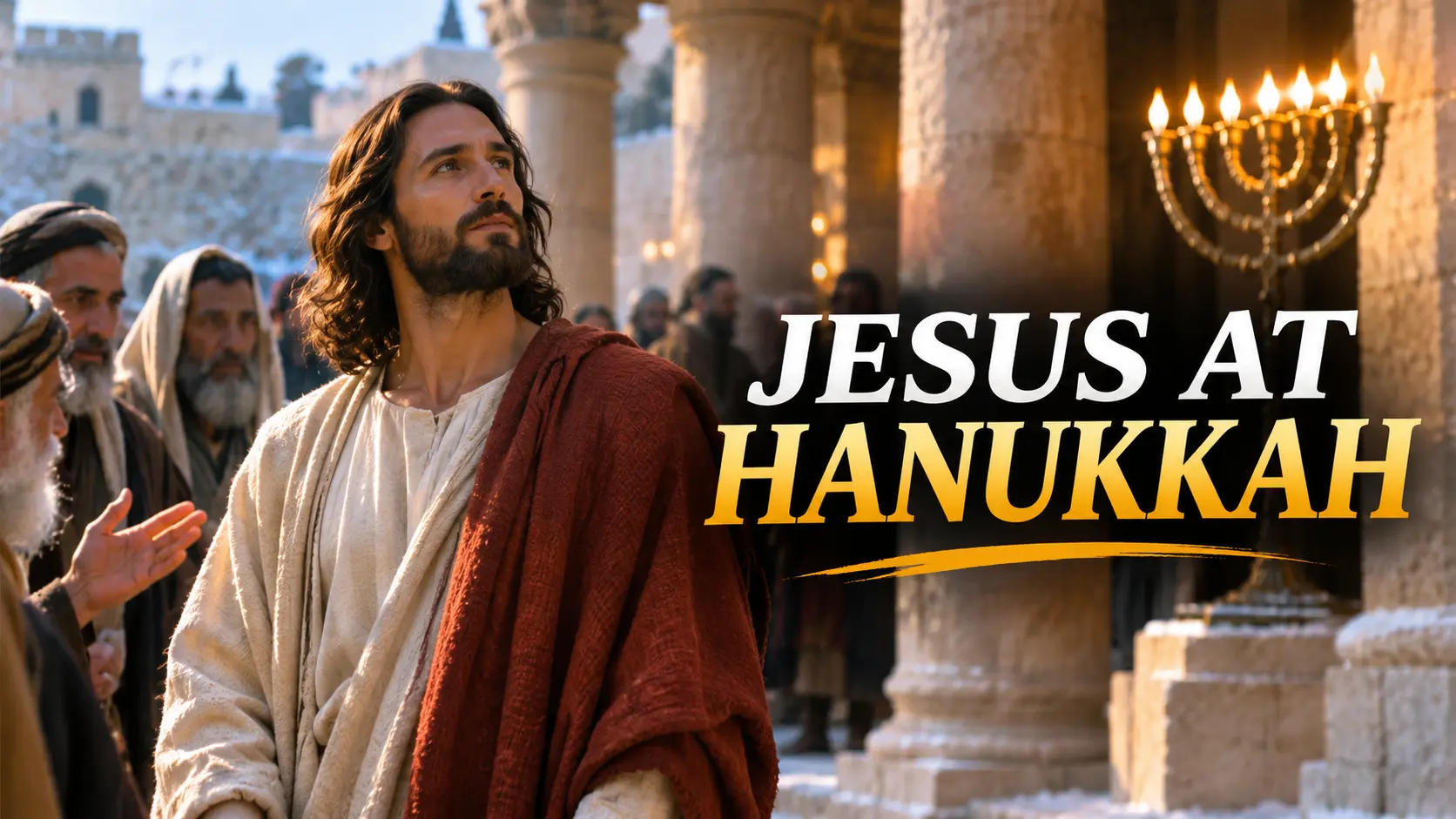

Jesus was present in Jerusalem during Hanukkah, as John 10:22–23 records Him walking through the Temple complex during the Feast of Dedication. However, Scripture does not tell us whether He travelled specifically to celebrate the festival or participated in its religious ceremonies.
During this Jewish festival commemorating the restoration of Temple worship, Jesus spoke about His identity, His relationship with the Father and the eternal life He gives to His followers. Understanding the history of Hanukkah helps us appreciate the setting in which these words were spoken.
Where Hanukkah Appears in the Bible
The King James Version refers to Hanukkah by its translated meaning rather than its Hebrew name. Hanukkah means dedication, which explains why the Gospel of John identifies the occasion as the Feast of the Dedication.
“And it was at Jerusalem the feast of the dedication, and it was winter. And Jesus walked in the temple in Solomon’s porch.” — John 10:22–23 (KJV)
These verses introduce an encounter that continues through John 10:39, followed by Jesus’ departure beyond the Jordan River. The complete account in John 10:22–42 reveals what happened during and immediately after this encounter.
What Scripture Actually Confirms
Being present during a religious festival is not necessarily the same as participating in its ceremonies. The distinction matters when examining what the Bible tells us about Jesus and Hanukkah.
| Question | Biblical evidence |
|---|---|
| Was Jesus in Jerusalem during Hanukkah? | Yes, according to John 10:22–23. |
| Was Jesus in the Temple complex? | Yes, He walked in Solomon’s porch. |
| Did Jesus teach during Hanukkah? | His conversation is recorded in John 10:24–39. |
| Did He travel specifically to celebrate it? | His reason for being there is not stated. |
| Did He light Hanukkah lamps? | Scripture does not record this. |
| Did He oppose the festival? | No such opposition is recorded. |
| Did He command Christians to celebrate it? | No such command is recorded. |
The absence of recorded ceremonies proves neither that Jesus observed them nor that He avoided them. His presence is established, but the extent of His personal festival observance remains unknown.
The Historical Origin of Hanukkah
Hanukkah commemorates the purification and rededication of the Second Temple in Jerusalem in approximately 164 BC. The restoration followed religious persecution under the Seleucid ruler Antiochus IV Epiphanes, during whose reign Jewish religious practices were suppressed and the sanctuary was desecrated.
Judas Maccabeus and his followers recovered the sanctuary, replaced the desecrated altar and restored Temple worship. According to 1 Maccabees 4:36–59, the dedication of the restored altar began on the twenty-fifth day of Kislev and was celebrated for eight days.
Judas, his brothers and the assembly of Israel established the occasion as an annual celebration. Hanukkah therefore originated during the Second Temple period rather than among the festivals instituted through Moses.
First and Second Maccabees belong to the Catholic biblical canon and are included in many Orthodox Bibles, while most Protestant traditions classify them as Apocrypha. Both books were also included in the Apocrypha section of the original 1611 King James Bible and they remain valuable historical sources for understanding the festival.
Why Hanukkah Lasts Eight Days
Many people associate the eight days of Hanukkah with the Jewish tradition of a miraculous supply of oil. However, the ancient historical accounts also connect the length of the celebration with the restoration of the Temple and another established Jewish festival.
According to 2 Maccabees 10:1–8, the people celebrated the purification of the sanctuary for eight days in a manner resembling the Feast of Tabernacles. The account remembers how persecution had previously forced them to spend that festival in mountains and caves.
The rededication celebration included branches, palms and songs of thanksgiving, recalling elements of Sukkot. Understanding the biblical meaning of the Feast of Tabernacles helps explain this historical relationship between two distinct Jewish festivals.
Four Ancient Accounts
The surviving records of Hanukkah come from different historical periods. Their approximate composition dates help us distinguish what was documented before Jesus’ lifetime from traditions preserved in later written sources.
| Historical source | Approximate period | Principal account |
|---|---|---|
| 1 Maccabees 4:36–59 | Around 100 BC | Altar dedication and an annual eight-day celebration. |
| 2 Maccabees 10:1–8 | Probably late second century BC | Temple purification and a celebration resembling Sukkot. |
| Josephus, Jewish Antiquities 12.316–325 | AD 93–94 | Restoration of worship and the Festival of Lights. |
| Babylonian Talmud, Shabbat 21b | Compiled centuries after Jesus | The traditional miracle of oil lasting eight days. |
The composition dates of the Maccabean books are scholarly estimates rather than precisely established historical dates. The introductions to First Maccabees and Second Maccabees provide further information about their origins.
Writing near the end of the first century AD, the Jewish historian Josephus identifies Hanukkah as the Festival of Lights in his account of the Temple’s rededication. He suggests that its name reflects the unexpected recovery of the freedom to worship.
These records preserve different aspects of Hanukkah’s history and religious significance. The earlier accounts of altar dedication and the later recorded tradition of the miraculous oil need not be understood as mutually exclusive explanations of the celebration.
Jesus in Solomon’s Porch
Solomon’s porch, also known as Solomon’s Portico, was a covered colonnade within the Jerusalem Temple complex. John’s reference to winter establishes the seasonal setting, although he does not explain whether the weather influenced Jesus’ choice of location.
The same portico appears in Acts 3:11 and Acts 5:12 as a public gathering place associated with the apostles’ ministry. During Hanukkah, it provided the setting for a conversation concerning Jesus’ identity as the Messiah.
What Jesus Taught During Hanukkah
Although John introduces Hanukkah in only two verses, he gives considerable attention to the conversation that follows. The discussion concerns Jesus’ works, His relationship with the Father and the response of those who hear Him.
His Identity as the Messiah
In John 10:24, those questioning Jesus asked Him to tell them plainly whether He was the Christ. Jesus responded by directing their attention toward the works He performed in His Father’s name, explaining that these works testified concerning Him.
Hanukkah remembered the restoration of Jewish worship following foreign oppression, which provides an interesting historical setting for a question about the Messiah. Nevertheless, John does not establish that those questioning Jesus were specifically expecting another military deliverer like Judas Maccabeus.
The Promise of Eternal Life
In John 10:27–29, Jesus describes His sheep as those who hear His voice and follow Him. He promises them eternal life and declares that no one can take them out of His hand or the Father’s hand.
Christian traditions differ over the wider implications of these verses concerning perseverance and salvation. The immediate passage nevertheless offers a profound assurance of Christ’s care for His followers without promising freedom from earthly suffering.
His Unity With the Father
The conversation reaches a decisive moment when Jesus makes one of His most significant statements concerning His relationship with God. His words in John 10:30 explain why the encounter became contentious.
“I and my Father are one.” — John 10:30 (KJV)
In John 10:33, His opponents accuse Him of blasphemy because they understand Him as making Himself God. Jesus responds by appealing to Scripture, including Psalm 82:6, before directing their attention again toward His works and divine mission.
Two Different Responses
John 10:39 records that Jesus escaped when His opponents attempted to seize Him, after which He went beyond the Jordan River. There, people remembered the testimony of John the Baptist and many believed in Jesus.
These contrasting responses reflect the wider purpose of John’s Gospel, expressed in John 20:31. The Gospel directs readers toward belief in Jesus as the Christ and Son of God, through whom they may receive life.
Dedication and Sanctification
Perhaps the most meaningful connection between Hanukkah and Jesus’ teaching appears in John 10:36. During a festival remembering the dedication of the restored altar, Jesus speaks of His own consecration by the Father.
“Say ye of him, whom the Father hath sanctified, and sent into the world, Thou blasphemest; because I said, I am the Son of God?” — John 10:36 (KJV)
The Greek interlinear text of John 10 reveals two different expressions in these passages. John 10:22 uses enkainia (ἐγκαίνια), referring to dedication, while John 10:36 uses hēgiasen (ἡγίασεν), meaning sanctified or consecrated.
The expressions do not share the same Greek root, but they have a possible thematic relationship. Hanukkah commemorates the dedication of the restored sanctuary, while Jesus describes Himself as set apart and sent by the Father.
Biblical scholar Warren Carter discusses this interpretive connection in his 2011 study of festivals in the Gospel of John. He identifies the relationship between the dedicated altar and Jesus as God’s sanctified One as an established interpretation among biblical commentators.
I find this distinction useful because it keeps our interpretation grounded in the words of the passage. John does not explicitly identify Jesus as the rededicated altar, so the connection should be understood as theological interpretation rather than a direct biblical assertion.
Did Jesus Light Hanukkah Lamps?
Lighting Hanukkah lamps remains a central feature of Jewish observance today. The traditional account of oil miraculously lasting eight days appears in the Babylonian Talmud, in Shabbat 21b, reproduced in Sefaria’s collection of Hanukkah texts.
According to this rabbinic tradition, a small quantity of ritually pure oil sufficient for one day lasted for eight days. The account helps explain the religious significance of lighting Hanukkah lamps in Jewish homes.
First Maccabees 4:49–50 and Second Maccabees 10:3 describe lamps being lit within the restored sanctuary, but neither narrates this particular oil miracle. These references to sanctuary worship should not be confused with evidence of individual participation in commemorative Hanukkah lamp-lighting ceremonies.
The ancient seven-branched Temple menorah also differs from the nine-branched Hanukkah lampstand, commonly called a hanukkiah. The National Library of Israel’s explanation of Hanukkah describes the religious tradition of kindling lights across the eight nights, together with the additional servant light known as the shamash.
The later compilation of the Talmud does not establish when its oral traditions first arose. We can not determine from John whether Jesus participated in such customs and we should avoid projecting every modern form of Hanukkah observance into His lifetime.
Did Jesus Call Himself the Light During Hanukkah?
Christians sometimes connect Hanukkah, the Festival of Lights, with Jesus’ declaration in John 8:12 that He is the Light of the World. Although this connection can carry theological meaning, the historical setting of His declaration is not entirely settled.
The conventional reading associates John 8:12 with the preceding Feast of Tabernacles narrative, while Hanukkah is first explicitly identified in John 10:22. An alternative scholarly interpretation, however, proposes that the Hanukkah setting begins earlier in the Gospel.
In the published abstract of his 2008 study, Hanukkah in the Narrative Chronology of the Fourth Gospel, John C. Poirier argues that the festival setting extends through John 10, John 9 and most of John 8. This is an alternative scholarly proposal, rather than a date explicitly established by the biblical narrative.
Christians may reflect on the relationship between Jesus and the symbolism of light without claiming certainty about when He made this declaration. Hanukkah also retains its own historical and religious meaning within Judaism, independently of Christian interpretations.
Should Christians Celebrate Hanukkah?
John 10 does not establish the observance of Hanukkah as a requirement for Christians. Its presence within the Gospel instead helps readers understand the Jewish religious world in which Jesus lived and taught.
Romans 14:5–6 addresses differences among believers concerning the observance of particular days. Although Paul is not specifically discussing Hanukkah, some Christians apply its principles of conscience and mutual respect when considering religious celebrations.
Christian traditions differ over the observance of festivals not expressly commanded in Scripture. Some Christians commemorate Hanukkah because of its historical significance, while others study its connection with the Bible without adopting its religious customs.
Hanukkah should not be reduced to a Jewish version of Christmas or treated as a festival whose meaning depends entirely upon Christian theology. It remains a living Jewish celebration with its own history, prayers, traditions and religious significance.
When Is Hanukkah 2026?
Hanukkah begins on the twenty-fifth day of Kislev and continues for eight days. Its Gregorian calendar dates vary because the celebration follows the Hebrew lunisolar calendar.
According to the Hebcal Jewish holiday calendar, Hanukkah 2026 begins at sundown on Friday, December 4, and ends at nightfall on Saturday, December 12. Although John identifies winter as the season of Jesus’ encounter, he does not provide its exact calendar date or year.
What the Encounter Reveals
The historical background of Hanukkah enriches our understanding of the setting in which Jesus spoke, but His words remain the central concern of John’s narrative. At a festival remembering the restoration of worship, Jesus invited His listeners to examine His works and recognize His relationship with the Father.
My prayer is that God gives us discernment to distinguish biblical truth from historical assumptions and humility to understand the religious traditions of others fairly. May the words Jesus spoke in Solomon’s porch encourage us to hear His voice, follow Him and appreciate more deeply the eternal life He promises.
