
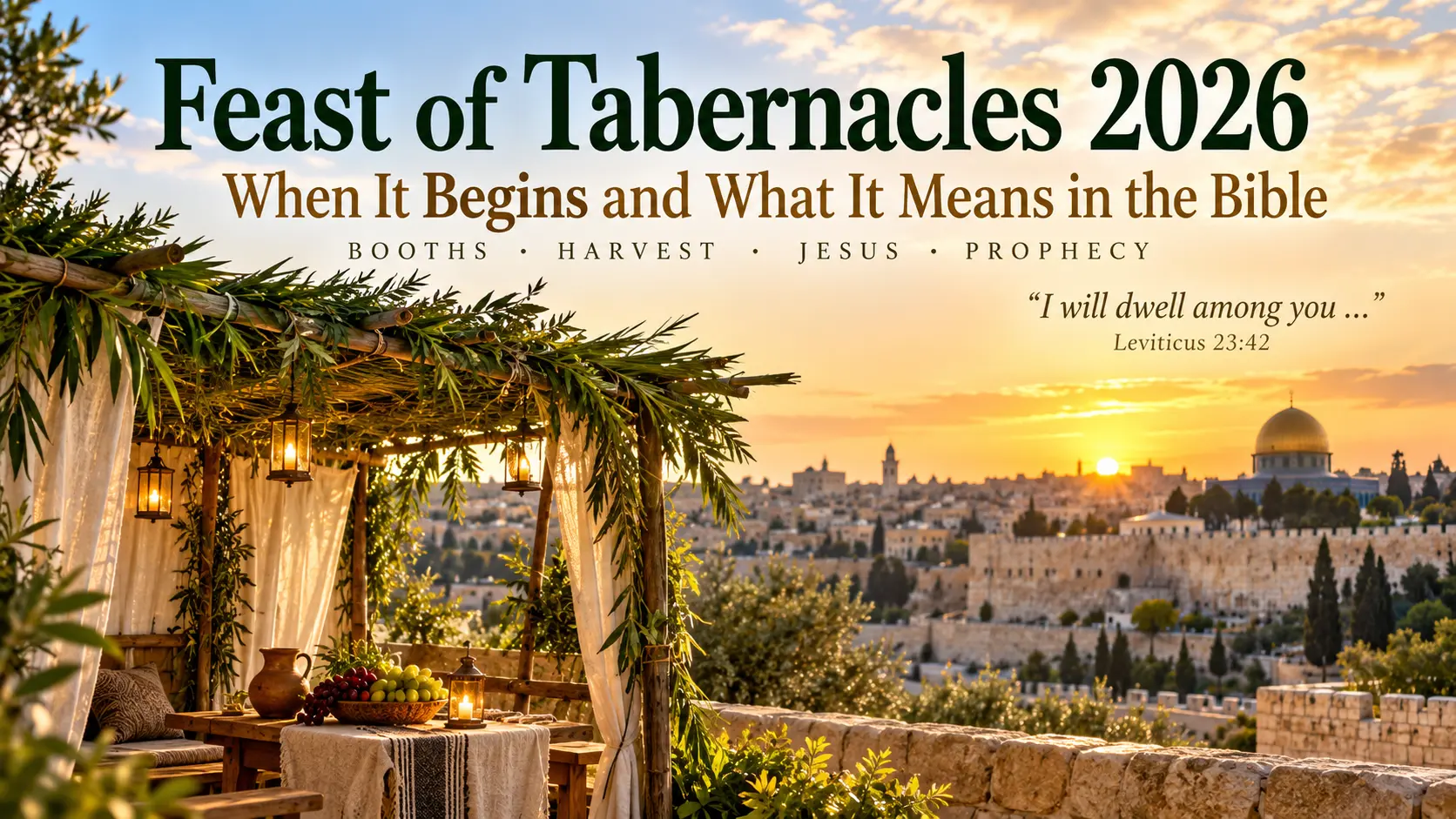

The Feast of Tabernacles brought a dramatic change of atmosphere to Israel’s seventh month. Temporary shelters made from branches became part of daily life, pilgrims gathered for worship, families celebrated together and a season that had recently included the solemn Day of Atonement moved toward one of the most joyful festivals on the biblical calendar.
Only five days separated the Day of Atonement from the beginning of Tabernacles. The contrast was striking: after a day centred on atonement, self-denial and cleansing came a seven-day festival centred on remembrance, harvest, worship, provision and rejoicing.
For readers following the biblical calendar today, the Feast of Tabernacles 2026 offers an opportunity to understand not only the dates of Sukkot but also why Israelites lived in booths, why harvest and rejoicing were central to the festival, how later Temple traditions illuminate the Gospel of John and why Zechariah 14 gives the feast a remarkable prophetic dimension.
The sacred seventh month begins with the Feast of Trumpets 2026, a biblical observance marked by trumpet blasts, sacred rest and assembly before the calendar moves toward the Day of Atonement and Tabernacles.
Feast of Tabernacles 2026 at a Glance
- Feast Begins: Sundown on Friday, September 25, 2026
- First Full Day: Saturday, September 26, 2026
- Feast Ends: Nightfall on Friday, October 2, 2026
- Hebrew Calendar Window: 15–21 Tishrei 5787
- Length: Seven days
- Core Biblical Text: Leviticus 23:33–44
- Also Called: Sukkot, Feast of Booths, Feast of Ingathering
Sukkot itself covers 15–21 Tishrei. The sacred assembly known as Shemini Atzeret follows immediately on 22 Tishrei, beginning at sundown on October 2, 2026.
Only five days earlier came Yom Kippur 2026, the Day of Atonement, a solemn observance centred on atonement, cleansing, self-denial and Israel’s annual priestly rites.
Ⅲ. What Is the Feast of Tabernacles? History & Agriculture
The Feast of Tabernacles was one of Israel’s three major pilgrimage festivals. It lasted seven days and required the Israelites to remember a defining part of their national story: the period after the Exodus when they depended on God during their wilderness journey.
Leviticus 23 explains that Israelites were to live in booths so future generations would know that God had Israel dwell in temporary shelters after bringing them out of Egypt. The festival therefore turned national memory into a physical experience. Families who normally lived in permanent homes spent the festival in temporary shelters and remembered the dependence of their ancestors.
Tabernacles was also closely connected with agriculture. Deuteronomy 16 places the festival after produce had been gathered from the threshing floor and winepress and repeatedly commands the people to rejoice.
This gave Sukkot two closely connected dimensions. Israel remembered God’s provision during the wilderness years while also celebrating His provision through the harvest of the land.
This seventh-month setting also appears in the historical background of Nehemiah 8, where the returned exiles gathered in Jerusalem to hear the Law during the same sacred season that included the Feast of Trumpets, Day of Atonement, and Feast of Booths.
Architecture of Vulnerability: Why Live in Booths?
God commanded the Israelites to live in temporary shelters, or sukkot, for seven days. Leviticus gives the central purpose clearly: future generations were to remember what God had done for Israel after the Exodus.
The Torah does not provide all the detailed construction rules familiar from later Jewish observance. Those requirements developed more fully within Jewish law and tradition.
The roof of a traditional sukkah is known as sechach. It is made from suitable natural vegetation that has been detached from the ground, such as branches or other plant material. Jewish tradition developed additional rules governing how the covering should be arranged, with some traditions regarding a view of the sky or stars through the roof as desirable.
Beyond its historical purpose, the temporary shelter naturally became a powerful image of dependence. Spending time in a structure far less permanent than an ordinary house can remind worshipers that wealth, walls, and possessions cannot provide ultimate security.
That is a meaningful spiritual application of the sukkah, while the explicit biblical reason remains remembrance of Israel’s experience after the Exodus.
Four Species: Biblical Mandate vs. Tradition
Leviticus 23:40 instructs Israel to take beautiful fruit, palm branches, leafy boughs and willows and rejoice before the Lord for seven days.
Jewish tradition eventually identified the familiar Four Species associated with Sukkot:
- Etrog: citron
- Lulav: date-palm frond
- Hadas: myrtle
- Aravah: willow
In traditional observance, the palm, myrtle and willow are brought together while the etrog is held separately.
The practice of moving or waving the Four Species in different directions belongs to later Jewish ritual tradition rather than an explicit command in Leviticus. One traditional interpretation connects these movements with acknowledging God’s sovereignty in every direction—around the worshiper, above, and below.
The distinction is important: Leviticus provides the biblical foundation, while later Jewish tradition developed the detailed ritual practice.
Hidden Temple Ceremonies: Jesus and the Feast
Later rabbinic sources preserve traditions about Sukkot celebrations at the Second Temple that provide an important historical background for reading the Gospel of John.
The Water Libation Ceremony — John 7
The Mishnah describes a Sukkot water-libation ceremony in which water was drawn from the Pool of Siloam in a golden vessel, carried into the Temple amid trumpet blasts, and poured into a basin at the altar.
John records Jesus attending the Feast of Tabernacles. Then, on the last and greatest day of the festival, Jesus stood and publicly invited the thirsty to come to Him and drink. John immediately explains that Jesus was speaking about the Spirit who would be received by those who believed in Him.
The Gospel does not say that Jesus spoke at the exact instant the Temple water was being poured. That detail should not be invented.
Yet against the historical background of Sukkot’s well-attested water traditions, Jesus’ language about thirst, drinking, and living water carries an especially striking resonance. The festival imagery of physical water and divine provision becomes a powerful setting for Jesus’ promise concerning spiritual life and the Spirit.
The Illumination Ceremony — John 8
The Mishnah also describes a spectacular nighttime celebration in the Court of the Women. Golden candelabra stood there, priests supplied them with oil, and the account remembers their light as so brilliant that Jerusalem’s courtyards were illuminated.
The celebration also included dancing, torches, music and songs.
John 8:12 records Jesus declaring:
“I am the light of the world.”
The Gospel does not say that Jesus was standing directly beneath the Temple candelabra when He spoke, nor does it provide their height.
The safest connection is contextual. John 8 follows the Gospel’s Feast of Tabernacles narrative and many Christian interpreters have understood the brilliant festival illumination as a meaningful backdrop to Jesus’ declaration.
Seen in that setting, His claim to be the Light of the World gains an additional layer of significance without requiring details that Scripture itself does not provide.
Zechariah 14 and the End Times
Zechariah 14 gives the Feast of Tabernacles an extraordinary prophetic dimension.
The passage describes survivors from the nations that had attacked Jerusalem going up year after year to worship the King, the Lord Almighty and to celebrate the Feast of Tabernacles.
Zechariah then describes a consequence for peoples who refuse to go up: they will receive no rain. Egypt is specifically addressed in the prophecy as well.
The imagery is especially striking in relation to Sukkot because the feast already carries themes of harvest, agricultural provision, water, rejoicing and dependence upon God. Christians differ over how this prophecy should be interpreted.
Many premillennial Christians understand Zechariah 14 as describing a literal future period in which nations will travel to Jerusalem and observe the Feast of Tabernacles during Christ’s earthly kingdom.
Other Christian traditions interpret the passage more symbolically or eschatologically, seeing the nations gathering at Jerusalem as a prophetic picture of universal worship and God’s ultimate kingship.
Zechariah itself does not use the phrase “Millennial Kingdom,” so the article should distinguish the biblical prophecy from later systems used to interpret it.
What remains unmistakable in the passage is its extraordinary final picture: nations once opposed to Jerusalem are shown coming to worship the Lord as King.
Do Christians Need to Observe Tabernacles Today?
Most Catholic and Protestant Christian traditions do not teach that Christians are required to observe Sukkot as an Old Covenant festival obligation.
The feast nevertheless provides imagery that Christians often connect with the larger biblical theme of God dwelling with humanity.
John 1:14 says that the Word became flesh and dwelt among us. The Greek verb used there carries the idea of dwelling or pitching a tent, which has led many Christian readers to notice a natural connection with tabernacle imagery.
Revelation 21:3 brings the theme to its final biblical climax with the announcement that God’s dwelling is with humanity.
Neither passage explicitly states that it is explaining the fulfillment of Sukkot, so that connection should be presented as theological interpretation rather than as the direct claim of the text.
Some Messianic Jewish believers and some Torah-observant Christian communities continue to celebrate Sukkot by building booths and gathering for meals, worship, prayer, Scripture study and fellowship.
Their reasons and theological understandings vary considerably. Some view the feast primarily as biblical remembrance and celebration, while others place greater emphasis on continuing the biblical festival calendar.
Christians can therefore value the biblical meaning of Tabernacles while reaching different conclusions about whether the festival itself should be observed today.
What Is Shemini Atzeret? The Eighth Day
Leviticus 23 describes an eighth-day sacred assembly immediately following the seven-day Feast of Tabernacles.
Sukkot runs from 15–21 Tishrei.
Shemini Atzeret falls on 22 Tishrei, directly after those seven days.
In 2026, Shemini Atzeret begins at sundown on Friday, October 2 and ends at nightfall on Saturday, October 3.
Jewish tradition treats Shemini Atzeret as a festival in its own right even though it immediately follows Sukkot. Unlike Sukkot, its observance does not depend on the sukkah or the Four Species.
Later Jewish teaching has developed beautiful interpretations of the additional day, including the image of God asking His people to remain with Him a little longer after the larger festival has ended.
That intimate interpretation comes from later Jewish tradition. The biblical text itself presents the eighth day more simply as a sacred concluding assembly.
The Chronological Fall Feasts
| Festival | Biblical Timing | 2026 Dates | Core Biblical Theme |
|---|---|---|---|
| Feast of Trumpets | 1 Tishrei | Sept. 11 sundown–Sept. 12 nightfall | Trumpet blasts, sacred rest and assembly |
| Day of Atonement | 10 Tishrei | Sept. 20 sundown–Sept. 21 nightfall | Atonement, cleansing, self-denial and solemn rest |
| Feast of Tabernacles | 15–21 Tishrei | Sept. 25 sundown–Oct. 2 nightfall | Booths, remembrance, harvest, provision and rejoicing |
| Shemini Atzeret | 22 Tishrei | Oct. 2 sundown–Oct. 3 nightfall | Concluding sacred assembly |
