

Catholicism is part of historic Christianity, but it has distinct beliefs, practices, authority structures and traditions that differ from many Protestant and evangelical churches. The main differences usually involve the role of the Pope, church tradition, sacraments, Mary and the saints, confession, salvation language and how Scripture is interpreted.
When people compare Catholicism and Christianity, they often really mean Catholicism compared with Protestant Christianity. A fair comparison should recognize that Catholics confess Jesus Christ, use the Bible, practice baptism and communion and belong to a long Christian tradition, while also explaining where their teachings differ from other Christian groups.
1. Understand the Roots of Christianity
The Birth of the Christian Faith
Christianity began in the first century A.D., rooted in the life, death and resurrection of Jesus Christ. His earliest followers — a small group within Judaism — believed He was the promised Messiah. They spread His message across the Roman Empire, emphasizing love, forgiveness and faith in God’s grace.
As Christianity spread, cultural and regional influences shaped different interpretations and traditions. These variations eventually blossomed into the many denominations that make up the Christian world today.
How Catholicism Emerged as the First Organized Church
The Catholic Church traces its origins directly to the apostles, especially Peter, whom Catholics believe Jesus appointed as the leader of His followers. According to tradition, the line of popes continues this apostolic leadership, forming an unbroken chain from the first century to today.
For over a thousand years, Catholicism was essentially the form of Christianity. It wasn’t until the Protestant Reformation of the 16th century that significant divisions emerged, leading to new denominations such as Lutheranism, Anglicanism and later, Evangelicalism.
2. Defining the Core Differences
Scripture and Authority: Who Interprets God’s Word?
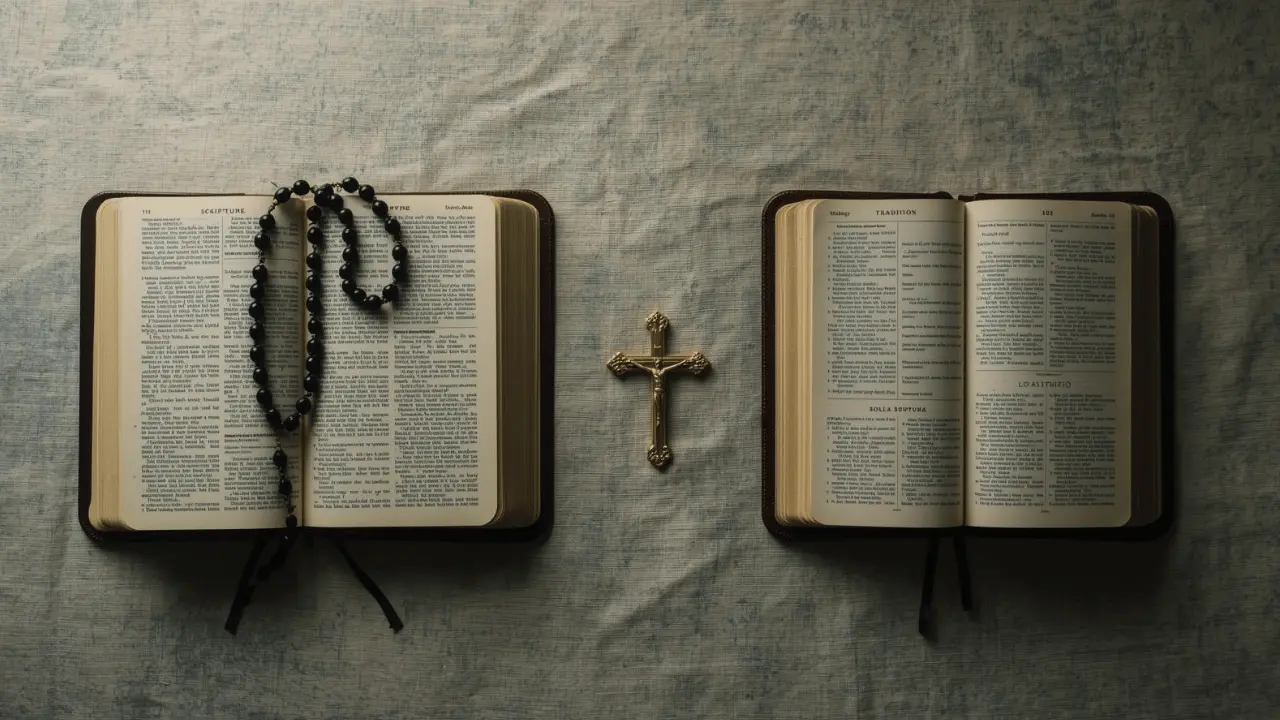
Both Catholics and other Christians hold the Bible as sacred and divinely inspired. The main difference lies in how its message is interpreted.
- Catholics rely on both Scripture and Sacred Tradition. Church councils, teachings, and the papacy play a role in interpreting Scripture within a unified framework.
- Protestant Christians follow the principle of sola scriptura — “Scripture alone.” They believe the Bible is the sole, sufficient guide for faith and practice, independent of additional Church traditions.
This key distinction explains much of the theological diversity within Christianity today.
Salvation and Grace: Faith vs. Works
Another fundamental difference lies in the understanding of salvation — how a person is saved and reconciled with God.
- Catholic teaching holds that faith and good works are inseparable. Grace is freely given by God, but living a life of charity, repentance, and obedience reflects genuine faith.
- Protestant theology, rooted in Martin Luther’s teachings, emphasizes faith alone (sola fide). Good works naturally flow from faith but are not a requirement for salvation.
Despite these differences, both traditions share a vital truth: salvation comes through Jesus Christ alone.
3. Rituals, Sacraments and Worship
The Central Role of the Sacraments
Catholicism is deeply sacramental, recognizing seven sacraments — Baptism, Confirmation, Eucharist, Penance (Confession), Anointing of the Sick, Holy Orders, and Matrimony. These are considered tangible channels of God’s grace.
Most Protestant denominations recognize only two sacraments — Baptism and Communion — and view them as symbolic acts of faith rather than literal means of grace.
How Worship Differs Across Traditions
Catholic worship centres on the Mass, a structured liturgy culminating in the Eucharist, which Catholics believe is the real presence of Christ in the bread and wine. The ceremony’s formality and symbolism reflect centuries of sacred tradition.
In contrast, Protestant services often emphasize preaching, prayer, and music. Depending on the denomination, worship can range from traditional liturgies (as in Anglican or Lutheran churches) to modern, spontaneous gatherings (as in Evangelical or Pentecostal communities).
4. The Role of Mary and the Saints
Veneration vs. Worship
One of the most recognizable distinctions between Catholicism and other Christian branches is the veneration of Mary and the saints. Catholics honour Mary as the mother of Jesus and look to the saints as role models who can intercede in prayer. This is not considered worship — worship is reserved for God alone — but rather a sign of reverence for holy lives.
Many non-Catholic Christians view this practice cautiously, choosing instead to pray directly to God through Jesus Christ as the sole mediator.
Icons, Statues and Symbolism
Catholic churches often include statues, icons, and candles that help believers reflect on the mysteries of faith. These symbols serve as reminders of spiritual truths and sacred history. Protestant churches, especially those in the Reformed tradition, tend to favour simplicity, focusing more on Scripture and preaching than on imagery or ritual.
5. Leadership and Structure
The Pope and the Magisterium
Catholics recognize the Pope as the earthly head of the Church and the successor of Saint Peter. Together with bishops and cardinals, he forms the Magisterium, the body that defines and preserves Church doctrine.
Protestant Christians generally reject centralized authority. Leadership structures vary widely, with most denominations governed locally by pastors, elders, or congregational boards.
Unity and Diversity in the Body of Christ
While Catholicism emphasizes unity under a single Church and teaching authority, Protestantism embraces a diversity of interpretation and expression. This flexibility has given rise to thousands of Christian denominations around the world, each offering its own unique cultural and theological identity.
6. Modern Perspectives: Bridging Faith and Dialogue
Ecumenism and Shared Values
In recent decades, Christians have made meaningful progress toward ecumenism — efforts to build understanding and unity across denominations. Catholics and Protestants increasingly work together in humanitarian missions, education, and interfaith dialogue, focusing on shared faith rather than differences.
Examples include joint Bible translations, global prayer initiatives, and charitable projects — all driven by the shared mission of serving others and spreading God’s love.
A Shared Faith in Christ
At the core of both Catholic and Protestant traditions is a steadfast belief in Jesus Christ as Lord and Savior. Despite differing doctrines and practices, this faith unites more than two billion Christians worldwide. Whether through praying the rosary or singing contemporary worship songs, the heart of Christianity remains the same — a personal relationship with a loving, living God.
| Topic | Catholic Christianity | Many Protestant Christians |
|---|---|---|
| Identity | A major historic branch of Christianity | A broad group of non-Catholic Christian traditions |
| Authority | Scripture, sacred tradition, Church teaching authority, Pope and bishops | Scripture as final authority, with tradition valued differently |
| Church leadership | Pope, bishops, priests, deacons | Pastors, elders, ministers; structure varies |
| Sacraments | Seven sacraments | Usually two ordinances/sacraments, depending on tradition |
| Eucharist/Communion | Real Presence in a sacramental sense | Views vary: memorial, spiritual presence, or other views |
| Mary and saints | Honored; intercession commonly practiced | Usually respected historically but not invoked in prayer |
| Confession | Sacrament of reconciliation with a priest | Confession directly to God; accountability varies |
| Worship style | Liturgical Mass and sacramental worship | Varies widely from liturgical to informal |
| Origins | Claims continuity with the ancient apostolic church | Emerged especially through Reformation movements |
Beyond Labels, Toward Understanding
When seen from a broader perspective, the differences between Catholicism and Christianity are not lines of division but threads in a shared spiritual story. Catholicism reflects the ancient, sacramental depth of the faith, while Protestant and other Christian movements embody its diversity and renewal across time and culture.
Ultimately, what binds all believers together is Jesus Christ — the cornerstone of faith, love and redemption. Whether it’s the incense of a cathedral or the music of a modern worship band, the message endures: love God and love others.

3 thoughts on “Catholicism and Christianity Compared Simply”