
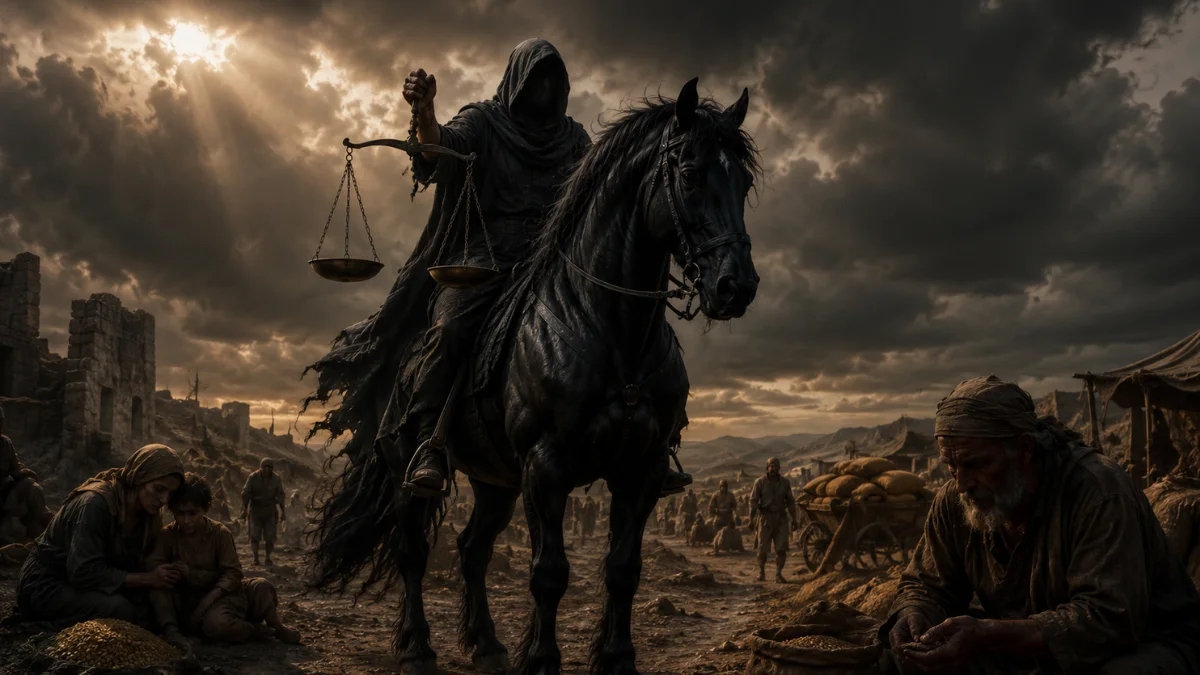

The black horse in Revelation 6 represents famine, food scarcity, extreme prices and the economic suffering that follows widespread conflict. Its rider carries a pair of scales, while a voice announces that a full day’s wage will buy only a small amount of grain.
The vision shows more than a complete absence of food. Grain remains available but ordinary workers can barely afford enough to survive. The black horse therefore reveals how scarcity, inflated prices, hunger and inequality can work together during a time of judgment.
John sees the black horse after the Lamb opens the third seal. The horse follows conquest and war, which helps explain its place in the vision. War damages farms, interrupts trade, displaces workers and makes food harder to obtain. As supplies fall, prices rise and vulnerable people suffer first.
What Happens When the Black Horse Appears?
Revelation 6:5–6 describes the opening of the third seal. John sees a black horse and its rider holds scales in his hand. A voice then announces the prices of wheat and barley before commanding the rider not to harm the oil and wine.
Each part of the scene contributes to its meaning:
- The black colour points toward hunger, mourning and distress.
- The scales show that people must measure and ration food.
- The announced prices reveal severe scarcity.
- The wheat and barley represent basic daily necessities.
- The protected oil and wine show that the crisis has limits.
The passage does not identify the rider by name. Instead, the objects and prices explain his mission. He brings suffering through hunger and economic pressure rather than through direct violence.
The red horse before him removes peace from the earth. The black horse shows what often follows when violence disrupts ordinary life. People may survive the conflict itself but then face hunger, poverty, and unstable markets.
What Does the Black Horse Represent?
The black horse primarily represents famine. However, Revelation presents famine through the language of prices, wages, and measured food.
This means the symbol includes several connected conditions:
- A reduced food supply
- Rapidly increasing grain prices
- Weak purchasing power
- Careful rationing
- Hunger among working families
- Greater suffering among the poor
The rider does not simply remove every piece of food. He creates a condition in which people must spend nearly everything they earn on basic survival.
That distinction matters. A society may still have working markets, active businesses, and available goods while large numbers of people struggle to afford what they need. Revelation shows economic activity continuing, but it no longer provides security for ordinary workers.
The black horse therefore represents famine expressed through severe economic hardship.
Why Does the Rider Carry Scales?
The rider carries scales because people must weigh food carefully during scarcity. In a time of abundance, a family does not need to measure every portion anxiously. During famine, each amount matters because the household cannot easily replace it.
The scales also echo Old Testament descriptions of judgment.
Leviticus 26 describes a situation in which people receive bread by weight but still cannot satisfy their hunger. Ezekiel 4 also describes people weighing their food and eating it with anxiety. Revelation draws on the same picture: people have food, but they must measure every portion because scarcity controls daily life.
The scales may also suggest controlled distribution. Someone determines the amount available and the price people must pay. Ordinary workers cannot freely obtain what they need. They depend on a system shaped by shortage.
The rider’s scales reveal a slow and relentless form of suffering. A sword causes immediate destruction, but famine places pressure on people day after day. Families must decide how much to eat, what they can afford, and who must go without.
What Do the Wheat and Barley Prices Mean?
The voice announces that a measure of wheat will cost one denarius and that three measures of barley will cost the same amount.
A denarius commonly represented approximately one day’s wage for a labourer. This means a person could work all day and spend the entire wage on a limited amount of wheat. That amount might sustain one person for a day, but it would not comfortably feed a household or cover other expenses.
The worker would have little or nothing left for:
- Housing
- Clothing
- Fuel
- Medical needs
- Family responsibilities
- Future emergencies
Barley offered a cheaper alternative. People often viewed it as a less desirable grain than wheat, but the same wage could buy three measures rather than one.
Even that option reveals hardship. A worker might choose lower-cost food to feed more family members, but the household would still live close to hunger.
The announced prices show that grain has not completely disappeared. However, scarcity has pushed the cost of basic food to an extreme level. The economic system continues to function, but it no longer protects people from deprivation.
Does the Black Horse Represent Famine or Inflation?
The black horse represents famine, but the vision clearly includes extreme price inflation.
Revelation connects the two conditions. Food becomes scarce, scarcity raises prices, and rising prices weaken the value of wages. Workers may continue earning money, but that money buys far less than before.
The sequence looks like this:
- Conflict disrupts food production and transportation.
- The available supply decreases.
- Sellers charge much higher prices.
- A full day’s wage buys only a small amount of grain.
- Poor families struggle to meet their daily needs.
Calling the black horse only a symbol of inflation makes the passage too narrow. Modern economies experience inflation for many reasons, and ordinary price increases do not prove that the third seal has opened.
Calling the horse only a symbol of famine may also overlook the deliberate economic details in the text. John does not merely see hungry people. He hears specific prices and sees scales.
The vision joins food scarcity with the loss of purchasing power.
Why Is the Horse Black?
The black color fits the sorrow and suffering connected with famine.
Several Old Testament passages associate darkness or a blackened appearance with grief, hunger, and physical weakness. Lamentations describes people whose appearance darkened as famine consumed their strength.
Black therefore communicates mourning, deprivation, and distress. It prepares the reader to understand the rider’s work before the voice explains the grain prices.
The color does not support unrelated ideas about black horses in dreams, personal omens, hidden messages, or supernatural signs. Revelation provides its own context. The scales, wages, and food prices explain what the horse means.
Readers should allow the biblical passage to define its own symbol rather than attaching modern superstitions to it.
What Does “Do Not Harm the Oil and the Wine” Mean?
The command not to harm the oil and wine has produced several interpretations. Revelation does not directly explain the phrase, so readers should avoid turning one possible interpretation into absolute certainty.
God Places a Limit on the Judgment
The command may show that God restricts the rider’s power. The famine causes serious suffering, but it does not destroy every crop or product.
Revelation repeatedly shows God setting boundaries around judgment. The horsemen do not possess independent or unlimited authority. The Lamb opens the seals, and the riders act within the limits God allows.
Under this interpretation, the oil and wine remind readers that judgment remains controlled even when it feels overwhelming.
Some Crops May Survive the Shortage
Wheat and barley grow differently from olive trees and grapevines. A particular crisis could damage grain production while leaving vineyards and olive groves less affected.
The command may therefore describe a selective shortage rather than the complete destruction of agriculture.
People would still face severe hunger because grain formed a major part of the daily diet. The survival of oil and wine would not remove the suffering caused by unaffordable wheat and barley.
The Phrase May Reveal Economic Inequality
Some readers understand the oil and wine as goods that wealthier people could still obtain while ordinary workers struggled to buy bread.
Oil and wine did not always function as luxury goods in the ancient world, so this explanation cannot settle the question by itself. However, the passage clearly shows unequal suffering. A wealthy household could absorb higher food prices more easily than a laborer who spent an entire day’s wage on grain.
The command may therefore reveal a society in which some products remain available while poorer people lose access to essential food.
The passage may communicate both limitation and inequality. The crisis does not destroy everything, but it still places an unbearable burden on vulnerable families.
How Does the Black Horse Connect With the Other Horsemen?
The black horse appears as the third of four horsemen:
- The white horse brings conquest.
- The red horse removes peace and brings violence.
- The black horse brings famine and economic distress.
- The pale horse brings death.
The order creates a recognizable pattern. Conquest leads to war. War disrupts farms, transportation, employment, and trade. Food becomes scarce and expensive. Hunger, disease, and death follow.
The horsemen therefore work as connected parts of one vision. They show how human violence and divine judgment can affect every level of society.
The black horse occupies an important point in that progression. It reveals that conflict continues harming people long after a battle ends. Families who never carried weapons may still lose access to food, income, and stability.
Revelation 7 later shifts attention toward God’s servants and the sealing of the 144,000. Readers who want to understand that next part of John’s vision can explore the meaning of the 144,000 in Revelation without assuming that every symbolic detail has only one accepted interpretation.
Is the Black Horse a Prediction About Current Food Prices?
Christians should interpret modern events with humility.
Wars, famines, shortages, and rising food prices may remind believers of the pattern Revelation describes. However, every increase in grocery prices does not prove that the black horse has arrived or that the third seal has opened.
History has witnessed many periods of severe famine and economic collapse. Christians from different traditions also interpret the timing of Revelation’s seals differently. Some understand the horsemen as future end-times events. Others see patterns that have appeared repeatedly throughout history. Some connect the vision closely with events surrounding the early Christian world while also recognizing a larger future fulfillment.
The passage does not give readers permission to identify every financial crisis as a specific prophetic fulfillment.
Revelation calls believers to spiritual alertness, endurance, and faithfulness. It does not encourage fear-driven predictions, date setting, or sensational headlines.
A careful interpretation recognizes the warning without claiming knowledge that the passage does not provide.
What Should Christians Learn From the Black Horse?
The black horse teaches that material systems can lose their stability quickly.
People may trust wages, food supplies, governments, businesses, or national strength. Yet war and crisis can weaken all of them. A worker may have employment and money but still struggle to obtain basic necessities.
The vision also directs attention toward the poor. Wealthier families may survive price increases by adjusting their spending. Poor families often have no remaining expenses to cut. Any increase in the price of food immediately threatens their well-being.
Christians should not discuss the black horse only as a future symbol while ignoring people who experience hunger now. The passage should deepen compassion rather than satisfy curiosity alone.
Believers can respond by:
- Helping people who lack food
- Using resources responsibly
- Refusing to exploit scarcity
- Supporting fair treatment of workers
- Praying for communities affected by war
- Trusting God rather than wealth
The passage also warns against indifference. Hunger does not represent an abstract economic issue for the person who cannot feed a family. It creates fear, exhaustion, grief, and vulnerability.
Psalm 10 also confronts the pain of watching powerful people prosper while the poor suffer. Its message can help readers understand why God seems distant when injustice continues without concluding that He has abandoned those who cry to Him.
Should Christians Fear the Black Horse?
Christians should take the warning seriously, but they should not live in panic.
Revelation centers on Jesus Christ, not on the horsemen. The Lamb opens the seals, controls the course of the vision, and ultimately defeats evil. The riders cannot move beyond the authority God allows.
Believers may face suffering, scarcity, or uncertainty. Revelation does not promise that Christians will avoid every hardship. It calls them to remain faithful when earthly security disappears.
Fear becomes spiritually harmful when it produces obsession, careless predictions, or hopelessness. A proper understanding of the black horse should produce sobriety, compassion, and trust.
Christians who feel overwhelmed by uncertain events can practice the biblical ways to trust God during difficult seasons rather than allowing every frightening headline to control their thoughts.
The black horse reminds believers that food, money, and social order can fail. It also reminds them that hardship does not remove God from His throne.
Frequently Asked Questions
Does the Black Horse Symbolize Modern Inflation?
The vision includes extreme price inflation caused by food scarcity. However, ordinary modern inflation does not automatically prove that the third seal has opened.
What Do the Oil and Wine Represent?
The oil and wine may show that God limits the judgment, that some crops survive, or that economic inequality continues during the famine. Revelation does not provide one explicit explanation.
Is the Black Horse Active Today?
Christians disagree about the timing of the seals. Current famines and economic crises reflect the kind of suffering the vision describes, but the Bible does not authorize readers to connect every crisis confidently with the third seal.
