
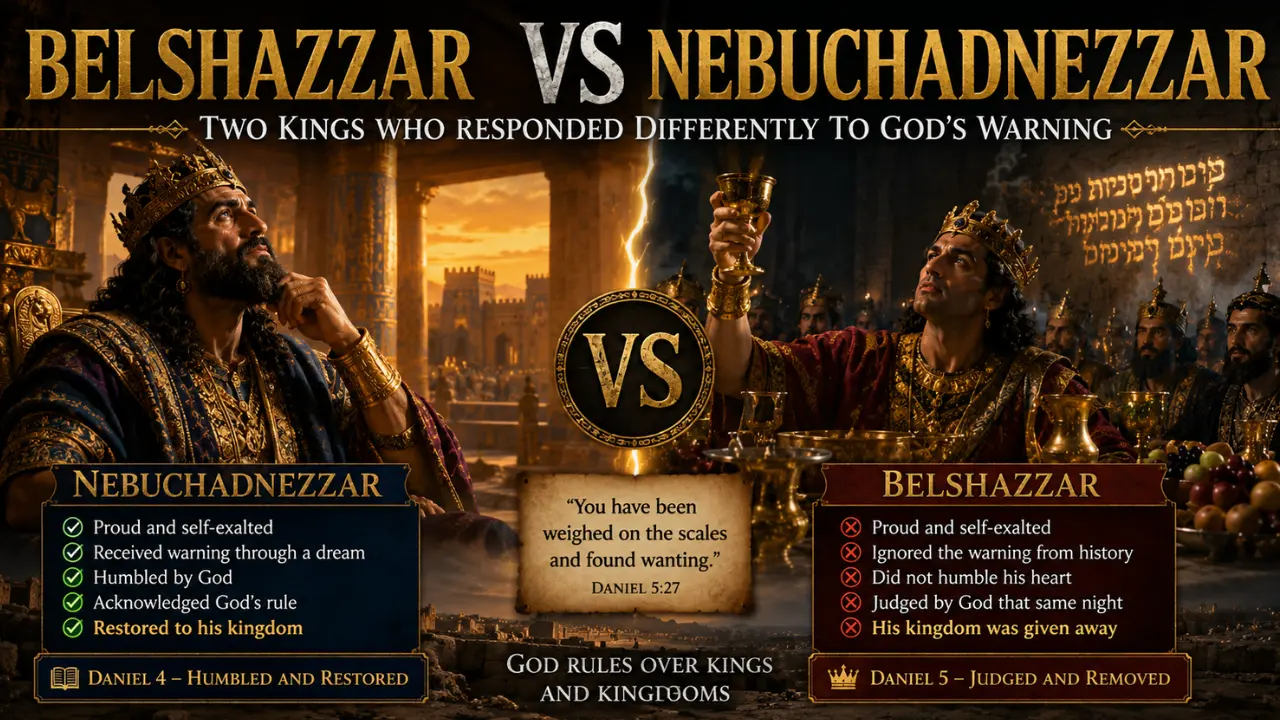

Belshazzar vs Nebuchadnezzar is one of the clearest comparisons in the book of Daniel because Daniel 5 directly says Belshazzar should have learned from Nebuchadnezzar’s humbling. Nebuchadnezzar was proud, warned, humbled, and eventually restored. Belshazzar was proud after knowing that history, but he refused to humble himself and lost the kingdom that same night.
Nebuchadnezzar and Belshazzar were both Babylonian rulers connected to pride, royal power, and divine warning. The main difference is that Nebuchadnezzar was humbled and restored after recognizing God’s rule, while Belshazzar ignored the lesson of Nebuchadnezzar’s life and faced judgment without restoration.
Why Compare Belshazzar and Nebuchadnezzar?
Belshazzar and Nebuchadnezzar should be compared because Daniel himself connects them. When Daniel speaks to Belshazzar in Daniel 5, he refers back to what happened to Nebuchadnezzar. That means the comparison is not forced into the text from outside. It is part of the argument Daniel makes inside the chapter.
Nebuchadnezzar’s story appears earlier in Daniel as the story of a powerful king who exalted himself and had to be humbled. Belshazzar’s story appears later as the story of another Babylonian ruler who had the advantage of that earlier warning but still refused humility.
The two kings are not compared because they were exactly the same. They are compared because their difference reveals the moral weight of Daniel 5. Nebuchadnezzar was proud, but he was brought low and restored. Belshazzar was proud with knowledge of that example, yet he acted as though the lesson did not apply to him.
This is why Daniel’s rebuke of Belshazzar is so strong. Belshazzar was not judged merely because he made a mistake in a moment of celebration. He was judged as a ruler who had ignored a known example of God’s authority over Babylonian kings.
Also Read: 9 Historical Details Behind Belshazzar’s Feast
What Happened to Nebuchadnezzar?
Nebuchadnezzar was the greatest king of Babylon in the book of Daniel. He had power, military success, royal wealth, and imperial confidence. Under his rule, Babylon became a symbol of earthly greatness and royal pride.
Daniel 4 shows Nebuchadnezzar at the height of his self-confidence. He looked at Babylon and saw it as the work of his own power and majesty. His mistake was not that he recognized Babylon as impressive. His mistake was that he treated his power as self-made and forgot that kingship still stood under God’s rule.
Before judgment came, Nebuchadnezzar received a warning. His dream was interpreted by Daniel, and the message was clear. His pride would be brought down unless he turned from his arrogance. This warning gave him time to see the danger of his condition.
Nebuchadnezzar did not escape humbling. He was brought low in a severe and public way. His royal dignity was removed, his condition became beastlike, and the king who had once stood over Babylon was made to learn that human rule is limited before the Most High.
Yet Nebuchadnezzar’s story did not end with removal. After his period of humbling, his reason returned to him. He acknowledged that heaven rules, and his kingdom was restored. His story became a royal testimony that even the proudest ruler could be humbled and brought to recognition of God’s sovereignty.
Nebuchadnezzar was not presented as naturally humble. His humility came through correction. But the important point is that his warning and judgment led to recognition, and that recognition was followed by restoration.
Also Read: What “Mene Mene Tekel Upharsin” Means in the Bible
What Happened to Belshazzar?
Belshazzar appears in Daniel 5 as the ruler hosting a great feast in Babylon. The scene is filled with royal display, wine, nobles, gold and silver vessels, and public confidence. It is not a quiet private meal. It is a royal event that reveals the atmosphere of the court.
The most serious detail is that Belshazzar commanded the vessels from the Jerusalem temple to be brought into the feast. These were sacred objects connected to worship, conquest, and Babylon’s earlier victory over Judah. Using them in a drunken royal celebration was not a small act of poor manners. It was an act of arrogant misuse.
Belshazzar’s feast showed more than luxury. It showed a ruler treating sacred things lightly while exalting the gods of gold, silver, bronze, iron, wood, and stone. The feast became a public display of spiritual arrogance inside a kingdom already standing near its end.
Then came the writing on the wall. Belshazzar was shaken, his confidence collapsed, and Daniel was brought in to interpret the warning. But Daniel did not begin by flattering the king. He began by reminding him of Nebuchadnezzar.
That reminder is the key to the whole comparison. Daniel told Belshazzar that Nebuchadnezzar had been lifted up, humbled, and made to know that God rules over human kingdoms. Then Daniel said that Belshazzar knew all this, yet had not humbled his heart.
This means Belshazzar’s problem was not ignorance. His problem was refusal. He had the example of Nebuchadnezzar before him, but he acted as though royal power made him untouchable.
How Did Nebuchadnezzar Respond to God’s Warning?
Nebuchadnezzar’s response was not immediate perfection. He did not become humble the moment Daniel interpreted the dream. His pride still had to be broken through discipline.
However, after he was humbled, Nebuchadnezzar recognized the authority of God over kings and kingdoms. His response came after judgment, but it still led to restoration. That is important because Daniel presents Nebuchadnezzar’s humbling as corrective, not merely destructive.
Nebuchadnezzar had to learn that royal greatness was not independent. His throne, reason, honor, and kingdom could not stand apart from God’s permission. When his understanding returned, he praised the One who rules over heaven and earth.
His response matters because it shows that warning can become mercy when it leads a ruler to humility. Nebuchadnezzar’s story is severe, but it is not hopeless. He was proud, but his pride was confronted. He was humbled, but not permanently removed. He lost dignity, but he was restored after acknowledging God’s rule.
In Daniel’s larger message, Nebuchadnezzar becomes an example of a king who learned through humiliation what he refused to recognize in prosperity.
How Did Belshazzar Respond Differently?
Belshazzar responded differently because he ignored a lesson that was already available to him. He was not the first Babylonian ruler in Daniel to encounter divine warning. He stood after Nebuchadnezzar’s story, and Daniel made that fact central to the rebuke.
Belshazzar’s response was not humble recognition. He did not pause before the feast to consider the sacred vessels. He did not treat Nebuchadnezzar’s humiliation as a warning. He did not honor the God who held his breath and his ways in His hand.
Daniel’s charge against him was direct: Belshazzar knew what happened to Nebuchadnezzar, but he did not humble himself. That sentence makes Belshazzar more accountable. His failure was not only that he acted proudly. His failure was that he acted proudly after history had already taught him where that road leads.
This is the clearest difference between the two kings. Nebuchadnezzar was humbled through judgment and restored. Belshazzar rejected the lesson of that humbling and was removed.
Belshazzar’s judgment came quickly because the warning was not arriving in a vacuum. It came after a royal example had already been given. Nebuchadnezzar’s life stood behind Daniel’s words like a witness against Belshazzar.
Belshazzar vs Nebuchadnezzar Comparison Table
This comparison is easier to understand when the two kings are placed side by side.
| Comparison Point | Nebuchadnezzar | Belshazzar |
|---|---|---|
| Main Daniel chapter | Daniel 4 | Daniel 5 |
| Main issue | Pride in royal greatness | Pride after ignoring a known warning |
| Type of warning | A dream interpreted by Daniel | Writing on the wall interpreted by Daniel |
| Connection to Babylon | Powerful imperial builder and king | Later royal ruler in Babylon’s final period |
| Response to humbling | Eventually acknowledged God’s rule | Did not humble himself despite knowing the lesson |
| Outcome | Restored after judgment | Judged and removed that night |
| Main contrast | Pride corrected through humbling | Pride judged after refusing known truth |
| Daniel’s emphasis | God rules over kings | Belshazzar should have learned from Nebuchadnezzar |
The table shows why this comparison is not merely about personality. Daniel is comparing two responses to divine authority. Nebuchadnezzar learned through being brought low. Belshazzar refused to learn from a lesson already given to Babylon’s royal house.
Nebuchadnezzar Was Humbled and Restored
Nebuchadnezzar’s restoration is one of the major differences between him and Belshazzar. His pride was judged, but his story continued beyond judgment.
In Daniel 4, Nebuchadnezzar lost the dignity that made him appear untouchable. The king who once stood over Babylon was reduced to a condition that exposed the weakness beneath human glory. His power, intelligence, and honor were not secure in themselves.
But when his reason returned, he did not simply return to normal life as though nothing had happened. He recognized the rule of God. He acknowledged that no earthly power can resist the authority of the One who rules from heaven.
That recognition is what separates his ending from Belshazzar’s. Nebuchadnezzar was not spared from discipline, but discipline produced acknowledgment. His humiliation did not become the final word over his life. Restoration followed recognition.
This does not mean Nebuchadnezzar’s story should be softened into a simple success story. His humbling was serious. His pride had real consequences. But Daniel presents his end as a ruler who learned what pride had hidden from him.
Belshazzar Was Warned and Removed
Belshazzar’s ending is much different. He was warned, but the warning did not lead to restoration in the chapter. The message announced that his kingdom had been numbered, weighed, and given to another power.
The full wording of the wall writing belongs to a separate study, but the comparison here is clear. Belshazzar’s rule had reached its limit. His authority was being judged, and the kingdom was passing away from Babylonian control.
The judgment was immediate. That same night, Belshazzar was killed, and Babylon’s kingdom passed into the hands of another empire. Daniel 5 does not describe a long period of correction for Belshazzar. It describes a final verdict.
This is why his story feels heavier than Nebuchadnezzar’s. Nebuchadnezzar’s warning led through humbling to restoration. Belshazzar’s warning exposed a ruler who had already refused the lesson he should have learned.
Belshazzar’s removal shows that ignored warning can become final judgment. His story stands as the other side of the comparison.
Why Was Belshazzar’s Guilt Greater?
Belshazzar’s guilt was greater because he had knowledge. Daniel did not accuse him of lacking information. Daniel accused him of refusing humility despite knowing what happened to Nebuchadnezzar.
Knowledge increases responsibility. When a person has seen the consequence of pride and still repeats that pride, the issue is no longer simple ignorance. It becomes deliberate disregard.
Belshazzar had the advantage of royal memory. He knew that Nebuchadnezzar, the great king of Babylon, had been humbled. He knew that power did not protect Nebuchadnezzar from God’s authority. He knew that Babylonian greatness could be brought low.
Yet he still exalted himself. He still used sacred vessels in a feast. He still honored lifeless gods while dishonoring the God who held his life and kingdom.
That is why Daniel’s rebuke is so direct. Belshazzar did not merely fail to understand history. He failed to submit to what history had already shown him.
Nebuchadnezzar’s humbling should have become a warning to later rulers. For Belshazzar, it became evidence against him.
Was Nebuchadnezzar Better Than Belshazzar?
Nebuchadnezzar should not be treated as a perfect or naturally righteous king. Daniel does not present him that way. He was proud, self-exalting, and in need of severe correction.
The difference is not that Nebuchadnezzar had no pride while Belshazzar had pride. Both kings were proud. Both stood in positions of power. Both had to face the reality that God rules over human kingdoms.
The difference is in what happened after warning and humbling.
Nebuchadnezzar was brought low and eventually acknowledged God’s sovereignty. Belshazzar already knew that example, yet did not humble himself. Nebuchadnezzar learned through discipline. Belshazzar refused the lesson of someone else’s discipline.
This makes the comparison more serious than a simple “good king versus bad king” contrast. Daniel is showing that pride can be corrected when a person is humbled, but pride becomes more dangerous when it refuses a warning already made clear.
Why Daniel 5 Mentions Nebuchadnezzar
Daniel 5 mentions Nebuchadnezzar because his story explains why Belshazzar was accountable. Daniel does not bring up Nebuchadnezzar as an unrelated historical detail. He brings him up to show that Belshazzar had no excuse.
Nebuchadnezzar’s experience had already revealed that the Most High rules over the kingdoms of men. This was not hidden knowledge. It had happened inside Babylon’s own royal story.
When Belshazzar ignored that lesson, he was not merely repeating an old mistake. He was rejecting a known warning. Daniel’s reference to Nebuchadnezzar turns Belshazzar’s feast into more than a scene of royal arrogance. It becomes a scene of remembered truth being ignored.
That is why Daniel’s words carry such force. He is not only interpreting a sign. He is explaining why the judgment is deserved.
Belshazzar had inherited more than royal privilege. He had inherited a warning.
What This Comparison Shows in the Book of Daniel
The comparison between Belshazzar and Nebuchadnezzar shows one of Daniel’s major themes: God rules over kings, kingdoms, and empires. Babylon may appear powerful, but its rulers are still accountable to God.
Nebuchadnezzar’s story shows that God can humble even the greatest king and restore him when he recognizes divine authority. Belshazzar’s story shows that God can judge a ruler who refuses to learn from a warning already given.
Together, the two kings create a strong contrast inside Daniel.
- Nebuchadnezzar shows pride interrupted by humbling.
- Belshazzar shows pride hardened by ignored knowledge.
- Nebuchadnezzar shows judgment that becomes correction.
- Belshazzar shows judgment that becomes removal.
- Nebuchadnezzar shows a king who eventually looks upward.
- Belshazzar shows a ruler who continues exalting himself until the verdict arrives.
This contrast helps readers understand Daniel 5 more clearly. The chapter is not only about a feast or mysterious writing. It is about a ruler who stood after a warning and still refused humility.

1 thought on “7 Differences Between Belshazzar and Nebuchadnezzar”