
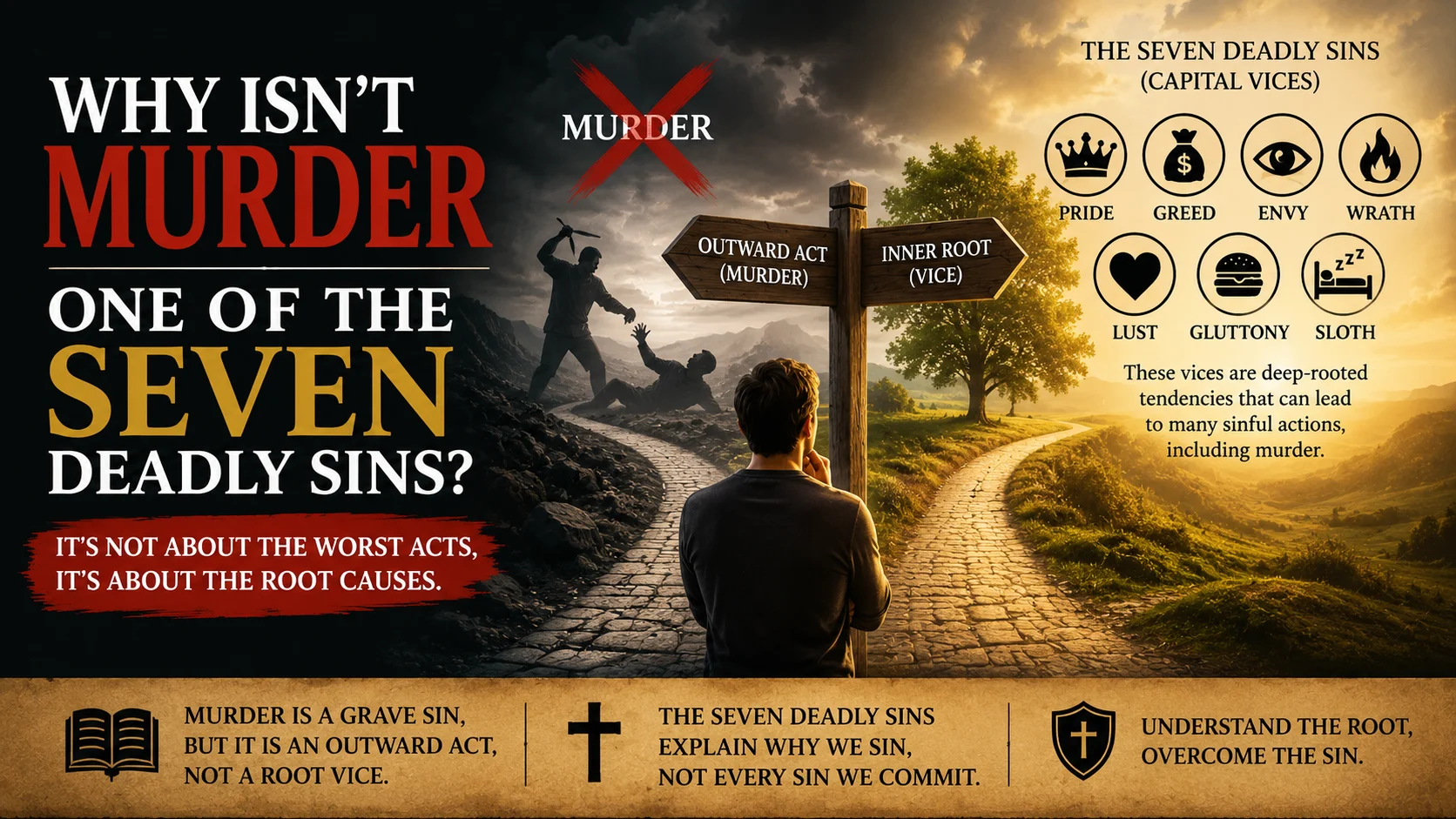

Murder is not one of the seven deadly sins because the traditional list was never meant to identify the seven worst acts a person can commit. The seven are called capital sins or capital vices because they are understood as especially powerful sources of other sins. Murder, by contrast, is a particular kind of wrongful act that can arise from different motives and is judged separately for its moral gravity.
This is why a list containing pride, greed, envy, wrath, lust, gluttony and sloth can leave out something as serious as murder without suggesting that murder matters less.
The confusion comes largely from the word “deadly.”
Aren’t the Seven Deadly Sins Supposed to Be the Worst Sins?
No. That is probably the most common misunderstanding of the list.
If “seven deadly sins” meant “the seven most serious sins in Christianity,” murder would be an obvious omission. The same question could be asked about adultery, theft, idolatry or false witness, all of which receive direct attention in Scripture.
But the older Christian tradition commonly speaks of the seven capital sins or capital vices.
“Capital” comes from the Latin caput, meaning “head.” The idea is that these vices can stand at the head of other sins because they generate or encourage further wrongdoing.
The Catechism of the Catholic Church explains the point directly in paragraph 1866: they are called capital because they “engender other sins, other vices.”
So the list is not primarily asking:
Which seven sinful acts are worse than everything else?
It is asking something closer to:
Which recurring disordered desires and tendencies commonly become sources of further sin?
Those are very different questions.
Then What Is the Difference Between a Capital Vice and Murder?
The distinction needs a little care because Christian writers have traditionally used both “capital sins” and “capital vices.”
Strictly speaking, a vice is a settled bad disposition or habit, while a sin can refer to a wrongful act. In ordinary Christian teaching, however, the familiar seven are often called sins even though they describe broad patterns such as pride, envy, greed and wrath rather than one narrowly defined outward action.
Murder is more specific. It refers to the wrongful intentional taking of another human life.
Wrath, greed or envy can influence many different choices. They do not describe one single act.
A person driven by greed might deceive, exploit, steal, withhold what is owed or commit some other wrong for material gain. Someone dominated by wrath might nurture hatred, seek excessive revenge, injure another person or commit some other act of violence.
The vice describes a deeper moral tendency. The resulting act depends on what the person actually chooses to do.
That is one reason murder does not need to appear as an eighth deadly sin. It belongs to a different kind of moral classification.
Does That Mean Murder Is Less Serious Than Gluttony or Sloth?
Absolutely not. Murder’s absence from the seven deadly sins says nothing about it being less serious than the sins that appear on the list.
Christian moral theology distinguishes between what generates other sins and how grave a particular sinful act is.
Those are separate questions.
The distinction becomes clearer in Catholic moral teaching:
| Term | What it is asking |
|---|---|
| Capital sin or vice | Is this a leading vice that can generate other sins? |
| Grave matter | Is the act itself seriously contrary to the moral law? |
| Mortal sin | Was grave matter committed with full knowledge and deliberate consent? |
Murder can therefore be gravely wrong without appearing among the seven capital sins.
In fact, the Catechism specifically teaches that sins differ in gravity and gives a very direct comparison: murder is graver than theft. It also describes direct and intentional killing as gravely sinful.
So it would be a serious mistake to look at the seven deadly sins as a ranking and conclude:
“Gluttony is on the list and murder is not, therefore gluttony must be worse than murder.”
That is simply not what the list means.
Why Is Wrath on the List Instead of Murder?
Wrath helps show the logic especially clearly. Wrath is broader than murder.
An unhealthy desire for retaliation can express itself through cruelty, hatred, humiliation, revenge, violence, damaged relationships and many other forms of wrongdoing. In an extreme situation it may also contribute to killing, but murder is not the inevitable result of wrath, nor does every murder necessarily arise from wrath.
Thomas Aquinas explains anger’s place among the capital vices by arguing that many forms of wrongdoing can arise from it, particularly because of the desire for revenge and anger’s ability to disturb rational judgment.
That is why wrath fits the purpose of the capital-vices framework better than murder does. The framework is looking upstream.
It asks what kinds of desires and dispositions repeatedly feed sinful choices, rather than simply collecting the most serious outcomes at the end of the process. This also prevents an overly simple equation such as:
wrath = murder
The relationship is not that mechanical.
Someone can struggle seriously with wrath without killing anyone, and murder can occur for motives other than anger, including financial gain, jealousy, fear, power or a combination of motives.
The Story of Cain Shows Why Christians Look Beneath the Act
Genesis 4 offers a useful example without requiring us to force the later seven-deadly-sins framework back into the story.
Cain eventually murders his brother Abel. Yet the biblical narrative does not begin with the killing itself.
After God regards Abel and his offering favourably, Cain becomes angry. God addresses what is happening before the murder and warns him that sin is “crouching at the door” and that he must rule over it.
Cain later kills Abel.
Genesis does not call Cain’s anger one of the “seven deadly sins”; that classification developed much later. But the story illustrates a principle that became important in Christian reflection on vice: serious outward wrongdoing can have an inner history.
There may be desires, resentments, habits and choices developing before the final act.
That is why a moral tradition interested in the roots of sinful behaviour would pay attention to things such as wrath and envy rather than limiting itself to a catalogue of completed crimes.
Readers interested specifically in Cain’s motives can explore the separate question of why Cain killed Abel.
Why Aren’t Theft and Adultery Among the Seven Deadly Sins Either?
Murder is not an isolated omission. The seven deadly sins also do not separately list:
- theft
- adultery
- false witness
- idolatry
- assault
- fraud
Yet nobody familiar with biblical teaching would conclude that these things are acceptable simply because they are absent from the seven.
That observation is another clue that the capital sins were never intended to be a complete list of Christian wrongdoing.
Christian tradition classifies sin in several ways. A sin can be discussed according to the commandment it violates, its object, the virtue it opposes, whether it harms God, neighbour or oneself, whether it occurs in thought, word, deed or omission, and how grave it is.
The capital-vices framework is only one of those approaches. Its usefulness lies in identifying recurring sources of temptation and wrongdoing.
This is also why the full meaning of the seven deadly sins should not be confused with a list of the only sins Christianity takes seriously.
Is Murder a Mortal Sin Even Though It Is Not One of the Seven?
Within Catholic theology, this requires another important distinction.
“Capital sin” and “mortal sin” do not mean the same thing.
A capital sin is called capital because of its relationship to other sins.
For a particular sin to be mortal, Catholic teaching says three conditions must be present together:
- the object involves grave matter;
- the person has full knowledge of its grave character;
- the person gives deliberate consent.
Intentional murder concerns grave matter. But Catholic theology also distinguishes the gravity of an act from the person’s full culpability, which is why it is better not to declare automatically that every individual person who commits an objectively grave act has necessarily committed a mortal sin in the fullest subjective sense.
That depends on the conditions involved. What can be said confidently is that murder does not need to belong to the seven capital sins in order to be gravely sinful.
The two classifications are answering different questions.
Is Murder Actually Mentioned in Biblical Lists of Serious Sin?
Yes, and this further shows why its absence from the seven deadly sins should not be misunderstood.
Jesus says in Matthew 15:19:
“For out of the heart come evil thoughts, murder, adultery, sexual immorality, theft, false witness, slander.”
That passage is especially relevant because it contains both sides of the distinction we are discussing.
It names concrete evils such as murder and theft, but it also places them in relation to what comes “out of the heart.”
The later capital-vices tradition is not simply a restatement of Matthew 15, and the seven deadly sins are not a hidden biblical list waiting to be extracted from that verse. Still, Christianity’s longstanding concern with both the heart and the outward act helps explain why later moral thinkers became interested in recurring vices that could generate further sins.
The Bible can condemn murder directly while Christian moral theology separately asks what passions, desires and habits lead human beings toward sinful actions. There is no contradiction between the two.
