

Deuteronomy 23:17 looks very different depending on which English Bible is opened.
The King James Version reads:
“There shall be no whore of the daughters of Israel, nor a sodomite of the sons of Israel.”
Many modern translations use expressions such as “cult prostitute,” “temple prostitute,” “shrine prostitute,” or “sacred male prostitute” instead. The NRSV Updated Edition goes further and speaks of serving at an “illicit shrine.”
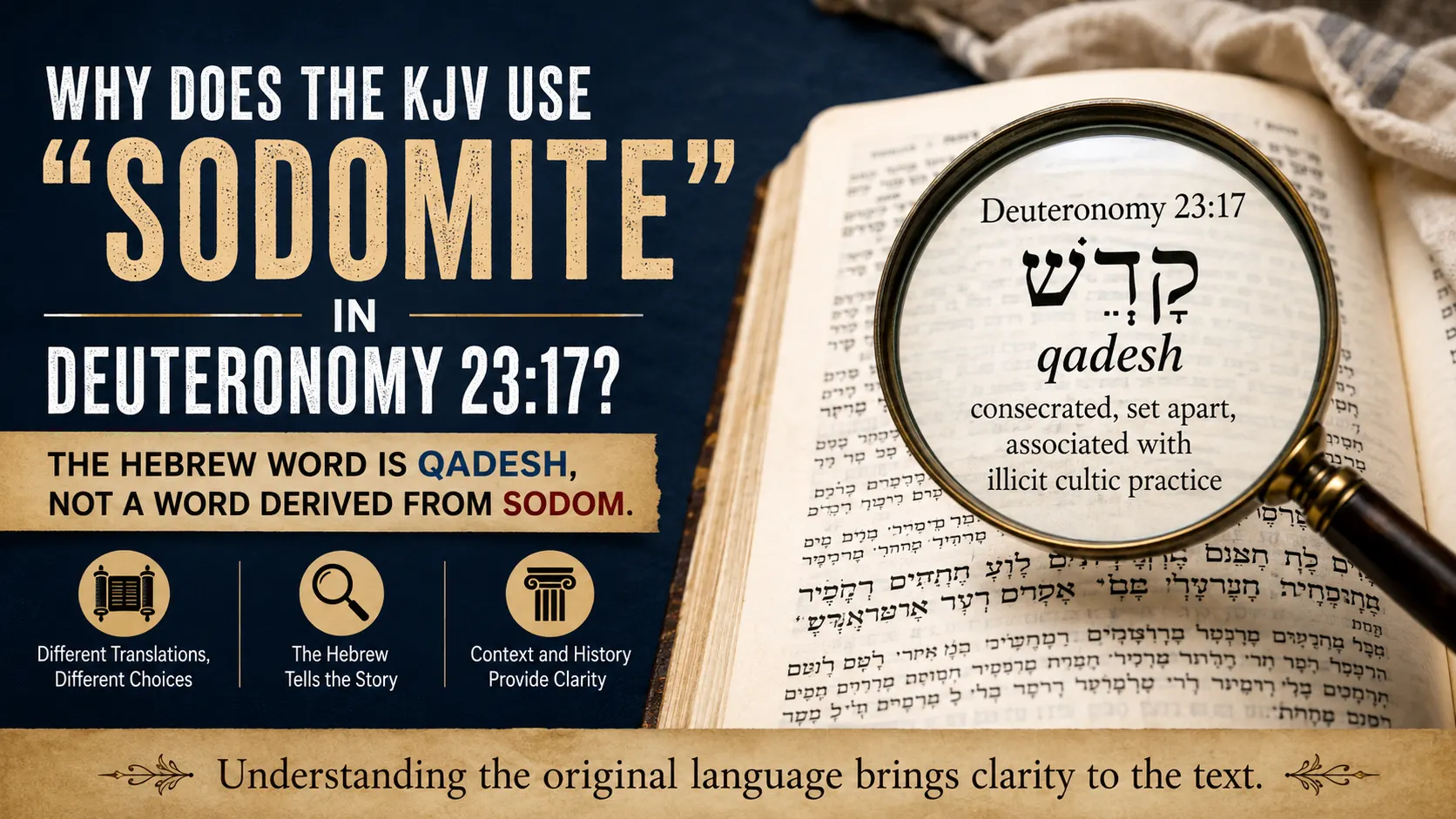
This is not because modern translations have removed the Hebrew word for “sodomite.” The Hebrew text does not contain a word derived from Sodom at this point.
The word behind the KJV’s “sodomite” is qadesh (קָדֵשׁ).
Differences like this are not unusual when translators have to decide how an ancient Hebrew term should be represented in English. A different kind of translation problem can be seen in why Psalm 145:13 is longer in some Bible translations, where manuscript evidence rather than vocabulary creates the variation.
The Hebrew Text Pairs Qadesh With Qedeshah
Deuteronomy 23:17 contains a closely related pair of Hebrew nouns.
The woman is called a qedeshah (קְדֵשָׁה), while the man is called a qadesh (קָדֵשׁ). The two terms belong to the Hebrew word family associated with holiness, consecration, or being set apart.
The structure of the Hebrew verse is therefore much more symmetrical than the traditional KJV wording makes it appear.
| Person mentioned | Hebrew term | KJV | Common modern renderings |
|---|---|---|---|
| Daughter of Israel | qedeshah | “whore” | cult/shrine/sacred prostitute |
| Son of Israel | qadesh | “sodomite” | male cult/shrine/sacred prostitute |
Traditional Hebrew lexicons have interpreted qadesh as a male temple or cult prostitute. Brown-Driver-Briggs, for example, lists the masculine noun as “temple-prostitute,” while older Strong’s material describes a male devotee connected with idolatrous prostitution.
The same basic difficulty appears with other ancient Hebrew terms whose exact modern equivalent is debated. For example, Isaiah 28:25–27 is translated as black cumin, caraway, dill, or “fitches” depending on the English Bible. In both cases, seeing different English words does not mean translators are working from completely different Hebrew passages.
But it does not yet explain why the KJV chose the very different word “sodomite.”
English Bibles Before the KJV Did Not Have to Use “Sodomite”
One revealing detail is that sodomite was not the standard English wording inherited by the King James translators.
William Tyndale’s translation reads:
“nor whorekeper of the sonnes of Israel”
The Coverdale Bible and Bishops’ Bible used similar language. The Geneva Bible, one of the major English Bibles circulating before the KJV, likewise translated Deuteronomy 23:17 with “whore keeper” rather than “sodomite.”
So the history is not:
Hebrew qadesh → always translated “sodomite” → modern Bibles changed it.
English translators were already handling the word differently before the KJV appeared in 1611.
The KJV translators made a particular interpretive choice.
That choice also tells us something important about how English usage and biblical interpretation had developed by their time. A term derived from Sodom had already acquired a broader sexual meaning in Christian Europe, allowing sodomite to function as a label rather than simply as the geographical description “person from Sodom.”
The English word was therefore carrying interpretive baggage that is not contained in the Hebrew spelling of qadesh itself.
The Same Hebrew Word Appears Six Times
Looking beyond Deuteronomy makes the translation problem clearer.
The masculine Hebrew noun qadesh occurs six times in the Hebrew Bible: Deuteronomy 23:17, 1 Kings 14:24, 1 Kings 15:12, 1 Kings 22:46, 2 Kings 23:7, and Job 36:14.
The Kings passages place these people in contexts involving prohibited worship and religious reform.
In 1 Kings 14:24, the writer describes qedeshim in Judah while condemning practices associated with the surrounding nations.
In 1 Kings 15:12, Asa removes them from the land while also removing idols.
In 1 Kings 22:46, Jehoshaphat removes those who remained.
The most concrete setting appears in 2 Kings 23:7, where Josiah destroys the houses or quarters of the qedeshim associated with the house of the LORD.
That last passage is particularly important. Whatever precise activity the word described, the biblical text clearly places these people within a prohibited cultic or religious setting.
This is one reason modern translators frequently prefer terms such as cult prostitute, shrine prostitute, or some other expression emphasizing illicit religious practice rather than simply reproducing the English word sodomite.
Even the KJV Does Not Translate Qadesh the Same Way Every Time
There is another detail that is easy to miss.
The KJV uses “sodomite” or “sodomites” for qadesh in Deuteronomy and the Kings passages.
But when the same Hebrew noun occurs in Job 36:14, the KJV translates it as:
“the unclean”
The underlying Hebrew word is still qadesh.
That alone shows why it is risky to treat the English word sodomite as though it were a direct lexical equivalent of the Hebrew noun.
Even the translators responsible for the KJV did not apply that English label mechanically every time qadesh appeared.
Translation involves context and interpretation.
“Cult Prostitute” Is Also an Interpretation
Replacing “sodomite” with “cult prostitute” solves one problem, but it can create another if the modern rendering is presented as completely certain.
Older lexicons strongly associate qadesh and its feminine counterpart qedeshah with prostitution. That remains the basis for translations such as “male cult prostitute” and “sacred male prostitute.”
Modern scholarship, however, has questioned whether the Hebrew terminology itself proves the existence of the kind of institutional “sacred prostitution” often reconstructed in older biblical scholarship.
Phyllis A. Bird devoted an extensive study to the feminine term qedeshah. She argues that its basic sense is closer to a “consecrated woman” and challenges the automatic identification of every qedeshah with a sacred prostitute. Her study compares the biblical evidence with related terms from Mesopotamian and Ugaritic texts and proposes a broader role for women functioning as religious specialists.
That does not prove that prostitution is absent from every passage.
It does mean that “cult prostitute” is an interpretation of the person’s function rather than the simple dictionary meaning of the Hebrew root.
This distinction is especially useful in Deuteronomy 23:17 because verse 18 immediately discusses the earnings of a prostitute and the “price of a dog.” The proximity of those verses has understandably influenced interpretation, but scholars still debate exactly how the people in verse 17 relate to the practices condemned in verse 18.
A careful translation discussion therefore has to preserve two facts at once:
Traditional interpretation strongly connects qadesh with prohibited cultic prostitution.
The Hebrew term itself comes from vocabulary associated with consecration and does not literally contain the name Sodom.
The KJV’s “Sodomite” Is an Interpretive English Label
This leaves a fairly clear conclusion.
When the KJV says “sodomite” in Deuteronomy 23:17, readers are seeing an English interpretive label placed over the Hebrew noun qadesh.
They are not seeing the Hebrew equivalent of “a man from Sodom.”
They are also not seeing a Hebrew word linguistically derived from Sodom.
Earlier English translators had already rendered the term differently, and modern translators have generally moved toward language that reflects its apparent cultic setting. Even those modern expressions remain subject to scholarly debate over the exact function of a qadesh.
This is also why Deuteronomy 23:17 should not be used as though its English wording independently settles questions about the events of Genesis 19. Those events require examination in their own narrative and biblical context, which is addressed separately in our study of the sin of Sodom and Gomorrah.
For Deuteronomy 23:17 itself, the textual point is narrower: the KJV’s “sodomite” represents one historical English interpretation of qadesh, not the literal Hebrew name for the person described in the verse.
The KJV’s use of sodomite can also tempt readers to make Deuteronomy 23:17 settle questions that actually belong to another passage. The events involving Sodom need to be examined from Genesis itself; PsalmWisdom covers that separately in its study of the sin of Sodom and Gomorrah in Genesis 19.
