
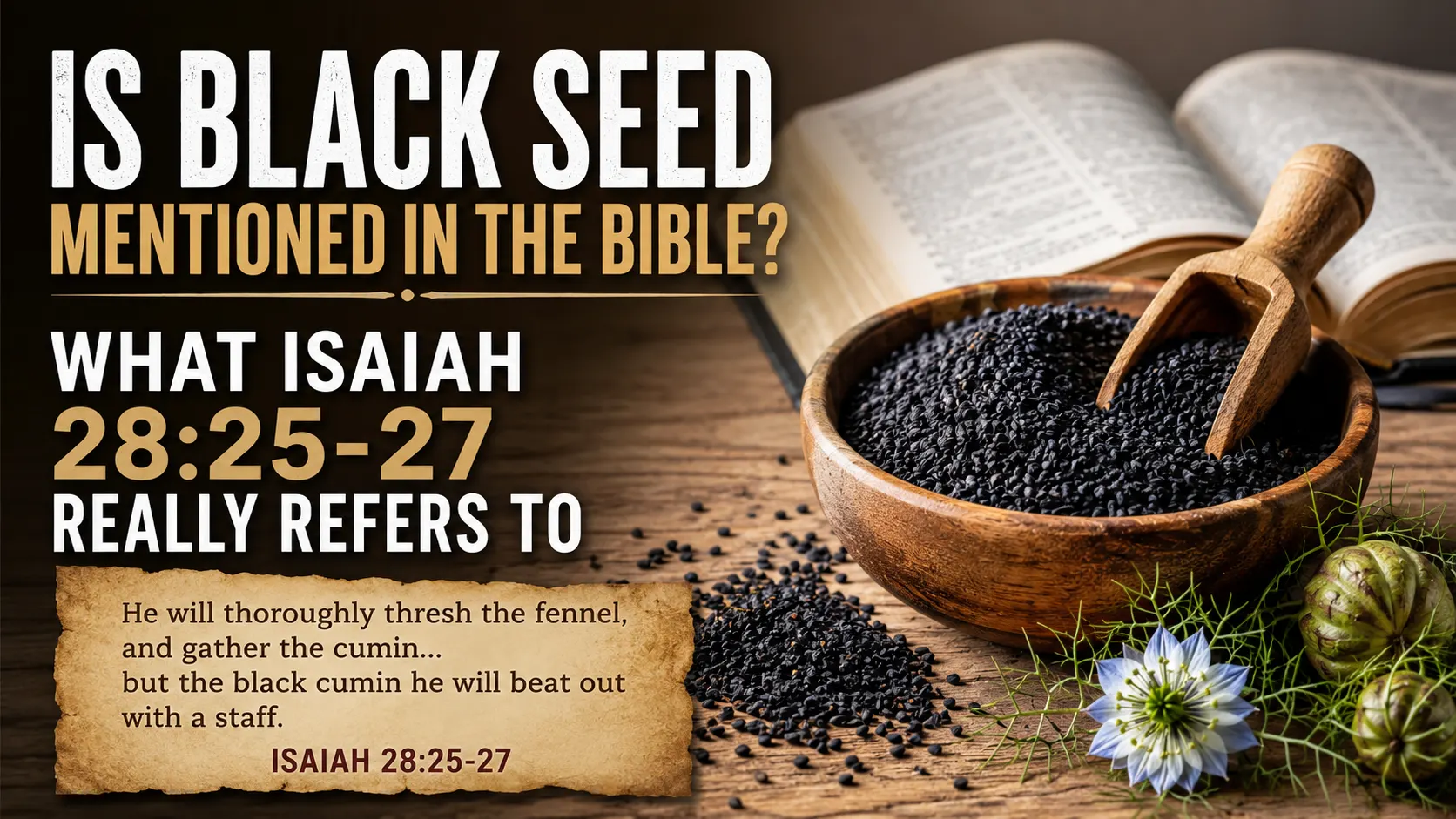

Black seed is probably mentioned in the Bible, although many readers will never see the exact words “black seed” in their English translation. Isaiah 28:25 and 28:27 use the Hebrew word qetsach (קֶצַח), which major Hebrew lexicons identify with black cumin or Nigella sativa, the plant commonly known today as black seed or kalonji. The uncertainty comes mainly from translation, because English Bibles do not all give qetsach the same plant name.
Some translations call it black cumin, while others use caraway, dill or the older English word fitches. That means a reader can search an English Bible for “black seed,” find nothing, and reasonably assume the plant is absent even though the Hebrew text contains a word that has long been associated with Nigella sativa. Understanding that translation issue is the key to answering the question accurately.
Where Is Black Seed Mentioned in the Bible?
The relevant passage is Isaiah 28:23–29, where the prophet describes a farmer preparing his field, sowing different crops, and later threshing them according to their characteristics. Wheat, barley, cumin and qetsach all appear in the illustration. In verse 25, qetsach is one of the crops scattered after the soil has been prepared and verse 27 explains that its seeds are beaten out with a staff rather than treated with the same heavy threshing methods used for tougher grain.
The Hebrew word qetsach appears three times in this short section of Isaiah. Brown–Driver–Briggs identifies it as black cumin and connects it specifically with Nigella sativa. This is why discussions about black seed in the Bible usually focus on Isaiah 28 rather than searching elsewhere in Scripture for the modern English phrase.
Isaiah’s purpose, however, is not to give readers a botanical lesson. The plant appears naturally within an agricultural example that would have been familiar to the original audience. Its significance in the passage comes from the way a skilled farmer handles different crops appropriately, not from any special property assigned to the seed itself.
Why Do Bible Translations Use Different Names for Qetsach?
The variation becomes obvious when Isaiah 28:27 is compared across English translations.
| Bible translation | Rendering of qetsach |
|---|---|
| New Living Translation | Black cumin |
| Christian Standard Bible | Black cumin |
| New King James Version | Black cummin |
| New International Version | Caraway |
| New English Translation | Caraway seed |
| English Standard Version | Dill |
| New American Standard Bible | Dill |
| King James Version | Fitches |
These translations are working from the same Hebrew word. The difference lies in how translators identify an ancient plant and which modern English term they believe will be most understandable to readers.
Plant names can be especially difficult because biblical writers were speaking to people who already knew the crops around them. They did not need to describe each plant in scientific terms, and modern translators therefore have to rely on the Hebrew vocabulary, ancient translations, agricultural details, and historical usage when deciding how to render a word such as qetsach.
This is why the absence of the phrase “black seed” in one translation does not settle the question. A Bible that says dill or caraway may still be translating the same Hebrew plant that another version calls black cumin.
Why Is Qetsach Connected With Nigella Sativa?
The connection between qetsach and Nigella sativa does not rest on a single modern Bible translation. Major Hebrew lexical sources identify the word with black cumin and older translation traditions also help show how the plant was understood in earlier periods.
The Greek Septuagint renders qetsach with the word melanthion, while the Latin Vulgate uses gith. Those ancient renderings do not by themselves settle the modern botanical identification but they provide useful historical evidence alongside the Hebrew lexicons and the farming context of Isaiah 28.
The description of the crop also makes sense for a small-seeded plant. Isaiah explains that it was not threshed in the same manner as heavier grain but handled more carefully. That agricultural detail fits the broader identification of qetsach with a delicate seed crop such as Nigella sativa.
It is still better to avoid absolute language. English translations continue to differ over the best plant name, so the most careful conclusion is that qetsach is widely and traditionally identified with Nigella sativa, rather than claiming that every translator or botanist agrees without qualification.
Why Does Isaiah Mention Qetsach?
Isaiah 28 uses farming to illustrate wisdom and judgment. The farmer in the passage understands that agriculture does not work by applying one method to every stage or every crop. He prepares the soil, plants different seeds appropriately and later uses the right threshing method for each harvest.
The reference to qetsach fits this illustration because its seeds required a gentler treatment than heavier grain. Isaiah is showing that good judgment involves recognizing differences and responding to them properly. The farmer’s skill is not presented as random instinct; verse 26 connects his knowledge with instruction from God and the passage closes by praising the wisdom of the Lord.
Seen in that context, black cumin is important because it helps make Isaiah’s agricultural illustration concrete. The passage does not ask readers to focus on the seed as a sacred object. It uses an ordinary crop to show how wisdom works through careful, appropriate action.
What Does Isaiah 28 Actually Tell Us About Black Seed?
The passage gives a fairly narrow picture. It tells us that qetsach was a known crop, that it was sown in cultivated fields, and that its seeds were handled differently from tougher grain during threshing. Hebrew lexical tradition strongly connects that word with black cumin or Nigella sativa.
Isaiah does not prescribe the seed as medicine, discuss black seed oil or attach supernatural power to it. Those subjects may come up in other historical, religious or scientific discussions, but they should not be read into Isaiah 28 when the passage itself is concerned with farming and wisdom.
Keeping that boundary clear helps avoid a common problem in modern religious discussions, where claims from several different sources are sometimes blended together and then attributed to the Bible. Isaiah gives enough information to support the identification of the plant but not the wider claims that are often attached to black seed today.
So, Is Black Seed Mentioned in the Bible?
The most balanced answer is that it probably is. Isaiah 28:25–27 contains the Hebrew word qetsach, which major Hebrew lexicons identify with black cumin or Nigella sativa. The main reason this is not obvious in every Bible is that English translations use several different names for the plant, including black cumin, caraway, dill and fitches.
The larger passage is not about the medicinal or mystical qualities of the seed. Isaiah includes qetsach as part of a farming illustration in which different crops require different treatment and that practical wisdom becomes part of a wider reflection on the wisdom of God.
For readers who use a translation that says dill, caraway, or fitches, the important detail is the Hebrew word behind the English rendering. Once qetsach is examined, the connection with the plant commonly known today as black seed becomes much easier to understand.
Readers interested in the broader Christian reflections connected with the plant can also explore our guide to the spiritual benefits of black seed.

1 thought on “Is Black Seed Mentioned in the Bible? Isaiah 28:25-27 Explained”