
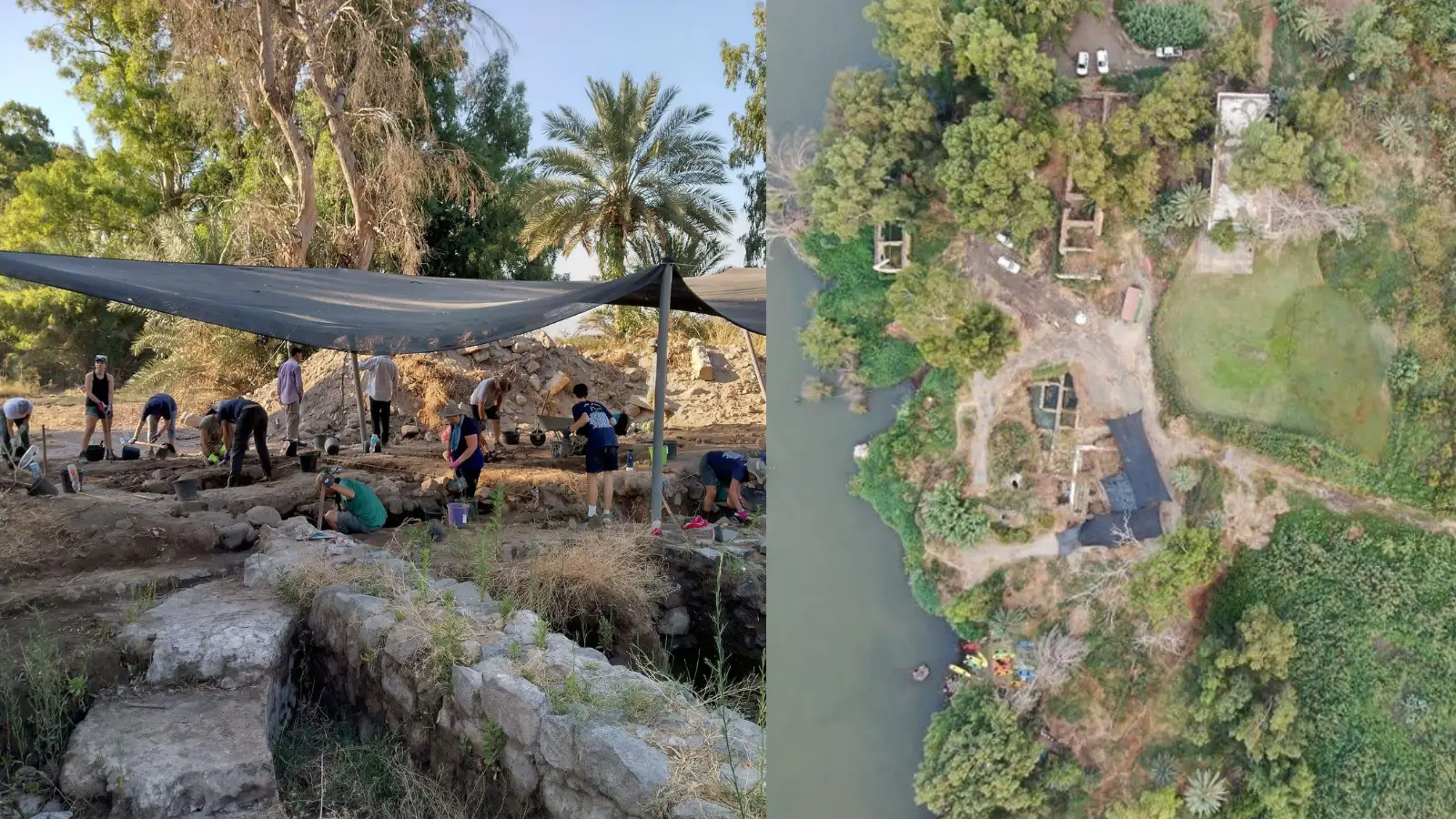

More than 150 coins, three intact lamps associated with the first-century Jewish world and scores of fishing weights have emerged from an archaeological site beside the Sea of Galilee. None of these objects carries the name “Bethsaida,” but together they are strengthening one of the most intriguing cases in New Testament archaeology.
The site is El-Araj, near the northern shore of the Sea of Galilee. Archaeologists working there believe it is the best candidate for biblical Bethsaida, the hometown of Peter, Andrew and Philip mentioned in John 1:44. The 2026 excavation season added important Roman-period evidence to a case that has been developing for a decade.
The identification is not universally settled. Another site, et-Tell, has long been proposed as Bethsaida and still has scholarly defenders. What makes the latest El-Araj discoveries interesting is therefore not that archaeologists suddenly “proved” the location of Bethsaida. It is that several different kinds of evidence are beginning to fit the same historical picture.
What Did Archaeologists Find at El-Araj in 2026?
The tenth excavation season at El-Araj pushed several areas of the site down into Roman-period levels, the period most important for investigating the Bethsaida described in the New Testament.
According to the excavation team’s 2026 season report, researchers recovered more than 150 coins across the site. They also found three intact Herodian-style lamps, fragments of chalk stone vessels, numerous fishing weights, Roman walls, grinding equipment, an unusually well-preserved taboon or oven, worked glass and part of a Doric architectural capital.
The excavation team considers the lamps particularly useful because this style was produced during the period before the destruction of Jerusalem in AD 70. Chalk stone vessels also matter because such objects are strongly associated with Jewish communities during the late Second Temple period.
The fishing weights add another layer of evidence. Researchers have now recovered many of them from different parts of El-Araj, suggesting that fishing was not incidental to the settlement but remained an important part of its economy.
That matters when the site being investigated is a candidate for Bethsaida, a settlement beside the Sea of Galilee remembered in the Gospels as the hometown of men closely connected with fishing.
How Strong Is the New Evidence for Bethsaida?
No single artifact discovered in 2026 identifies El-Araj as Bethsaida. Archaeologists instead compare several kinds of evidence at once: location, date, settlement size, economy, religious identity and later historical memory.
This is where the latest discoveries become more useful when viewed together.
| Evidence from El-Araj | What it suggests | Why it matters for Bethsaida | What it does not prove |
|---|---|---|---|
| Herodian-style lamps | Occupation connected with the early Roman period | Bethsaida must have existed during the New Testament period | The lamps are not unique to Bethsaida |
| Chalk stone vessels | A Jewish population lived at the site | Fits the Jewish setting expected for Gospel-era Bethsaida | Stone vessels cannot identify the settlement by name |
| Fishing weights | Fishing formed part of the local economy | Fits a lakeside town associated with fishermen | They cannot be linked personally to Peter or Andrew |
| Roman walls and buildings | A substantial Roman-period settlement existed | Fits Bethsaida’s development during the Roman era | Other Galilean settlements also had Roman structures |
| Fine glass and architectural decoration | Parts of the settlement had access to costly or refined material culture | Helps reconstruct the social world of first-century Galilee | It does not tell us how wealthy every resident was |
| Later Byzantine church and Peter inscription | Christians centuries later strongly associated the location with Peter | Preserves an important tradition connecting the site with an apostle from Bethsaida | It does not prove the church stood over Peter’s actual house |
The strength of El-Araj therefore lies less in one spectacular discovery than in the way separate pieces of evidence begin to reinforce each other.
This is similar to the problem faced when considering the archaeology of Sodom and Gomorrah. Archaeology usually works through cumulative evidence rather than a single artifact that settles every question. A site becomes a stronger candidate when geography, chronology and material remains increasingly fit what historical sources lead researchers to expect.
Why Does El-Araj Fit the Bethsaida of the Gospels?
John 1:44 gives Bethsaida unusual importance by identifying it as the hometown of Philip, Andrew and Peter.
Peter and Andrew are also associated with fishing in the Gospel accounts, which makes the evidence for a fishing economy at El-Araj especially interesting. This does not mean one can point to a lead weight and imagine Peter once holding it. The connection is broader and more useful than that.
The archaeological evidence shows that people at this settlement really did live within the fishing economy of the Sea of Galilee.
That helps restore something easily lost when biblical places become nothing more than names printed on maps. Fishing in Galilee involved nets, weights, boats, repair work, local markets and families whose livelihoods depended on the lake. If El-Araj is Bethsaida, this was the kind of working environment from which some of Jesus’ earliest disciples emerged.
Bethsaida itself also appears during Jesus’ ministry.
In Mark 8:22–26, Jesus encounters a blind man at Bethsaida and leads him outside the village before healing him. Luke 9:10 connects the region of Bethsaida with the events surrounding the feeding of the large crowd. Matthew 11:21 and Luke 10:13 preserve Jesus’ severe warning to Bethsaida, placing it alongside Chorazin as a town that had witnessed remarkable works but had not responded as expected.
These references require a real settlement operating during the early first century. That is why reaching secure Roman-period occupation at El-Araj is so important to the archaeological argument.
Lipscomb University’s Lanier Center for Archaeology, which joined the El-Araj project in 2026, describes the site as containing Roman, Byzantine and later remains and says the accumulated evidence strongly favors its identification with Bethsaida-Julias. At the same time, the center still describes investigation of the site’s ancient identity as one of the project’s central research questions.
That combination of growing confidence and continued investigation is a better reflection of the evidence than simply announcing that Bethsaida has been “found.”
The Fishing Weights May Be the Most Human Part of the Discovery
Coins and monumental architecture often dominate archaeological headlines, but the fishing equipment at El-Araj may help Bible readers understand the site more naturally.
Peter and Andrew are remembered not as rulers or wealthy patrons but as working fishermen before becoming disciples of Jesus. The Gospel world around the Sea of Galilee was shaped partly by people who made their living from the water.
Finding repeated evidence of fishing activity at a possible hometown of these men does not prove an individual Gospel event. It does, however, show that the occupation described in the biblical setting belongs naturally within the economic life of the site.
This distinction matters.
Archaeology is most useful when it helps reconstruct the world surrounding a text without pretending it can recover every person or event mentioned in that text. The same principle applies when examining the archaeology behind the biblical city of Gath: discovering the city and its material culture can illuminate the environment of a biblical story without identifying every individual who appears in it.
At El-Araj, the fishing weights make Bethsaida feel less like an abstract biblical location and more like a community where ordinary people repaired equipment, prepared food, traded goods and worked beside the lake.
Was Bethsaida More Developed Than a Simple Fishing Village?
The discoveries also complicate an overly simple picture of first-century Galilee.
A town connected with fishermen is easily imagined as an isolated collection of poor houses. El-Araj has produced evidence of something more varied. Excavators have reported decorative architectural features, glassware and remains of substantial structures alongside the ordinary equipment of working life.
R. Steven Notley, academic director of the excavation, has argued that such evidence challenges descriptions of Galilean communities as uniformly impoverished and culturally isolated.
That interpretation should not be pushed too far. Fine glass or a decorated building does not mean every family living at El-Araj was prosperous. Ancient towns, like modern ones, contained differences in status and wealth.
What the evidence does suggest is a community connected to a wider economy while still retaining fishing as an important occupation.
That makes the social setting more interesting. Peter and Andrew could have come from fishing families without necessarily growing up in a place cut off from trade, architecture or the broader Roman world.
Archaeology therefore adds texture to the Gospel setting rather than replacing it.
Why the Church of the Apostles Strengthens the El-Araj Case
One of the most unusual arguments for El-Araj comes from a period centuries after Jesus.
Archaeologists uncovered a large Byzantine basilica at the site that has become known as the Church of the Apostles. In 2022, researchers announced a mosaic inscription inside the church that refers to Peter using a title associated with him in Byzantine Christianity.
The discovery is significant because an eighth-century pilgrim named Willibald described visiting Bethsaida and seeing a church associated with the home of Peter and Andrew.
This does not establish that archaeologists have found Peter’s actual house. A church built centuries later reflects Christian memory and tradition, not direct first-century identification.
Yet the evidence still matters.
Researchers have a Roman-period settlement associated with fishing, located beside the Sea of Galilee, followed centuries later by a substantial Christian church whose community explicitly honored Peter. That sequence gives El-Araj a kind of historical continuity that is difficult to dismiss.
The church is therefore not proof by itself. It becomes significant because it fits the larger pattern already emerging from the site.
Why Some Archaeologists Still Prefer Et-Tell
El-Araj is not the only candidate for biblical Bethsaida.
Excavations at et-Tell, around two kilometers away, began decades before the El-Araj project. Archaeologists working there uncovered major ancient remains as well as Roman-period houses and fishing equipment, and supporters of the site have argued that it fits the historical Bethsaida-Julias.
The disagreement remains serious enough that the American Society of Overseas Research hosted a dedicated scholarly session on the competing identifications. Representatives of both excavation projects presented arguments for their respective sites.
This debate explains why the 2026 discoveries should be described as strengthening the El-Araj case rather than finally settling it.
Researchers looking for Bethsaida generally want several conditions to fit. The settlement should have existed during the early first century, have a relationship with the Sea of Galilee and fishing, show the development expected of Bethsaida-Julias and continue into later Roman times. Both location and changes in the ancient shoreline also have to be considered.
El-Araj has become increasingly persuasive because several of those lines of evidence now converge there. Et-Tell, however, cannot simply be erased from the discussion because a new excavation season produced exciting discoveries.
A credible archaeological conclusion has to account for both.
Does El-Araj Prove the Gospel Stories Happened?
Even if future excavations lead to broad agreement that El-Araj is Bethsaida, archaeology would still have limits.
It could establish that the settlement existed during the correct period. It could reveal a Jewish population, fishing activity, buildings, trade and later Christian memory associated with Peter. It might eventually produce even stronger evidence identifying the ancient town.
What it can not do is excavate a miracle.
The healing of the blind man in Mark 8 cannot be demonstrated by pottery or coins. Neither can archaeology establish that Jesus miraculously fed a crowd in the region described by Luke.
Those claims belong to the Gospel testimony rather than the material record.
This does not make the archaeological work insignificant for Christians. Its value is different. The excavations help reconstruct the physical world in which the Gospel narratives are set.
Bethsaida was not invented as a vague spiritual landscape. The New Testament places Peter, Andrew and Philip within a particular community beside the Sea of Galilee. It remembers fishermen, villages, roads and towns whose geography mattered to the movement of Jesus and His disciples.
The 2026 discoveries at El-Araj bring one possible part of that world into sharper focus.
