
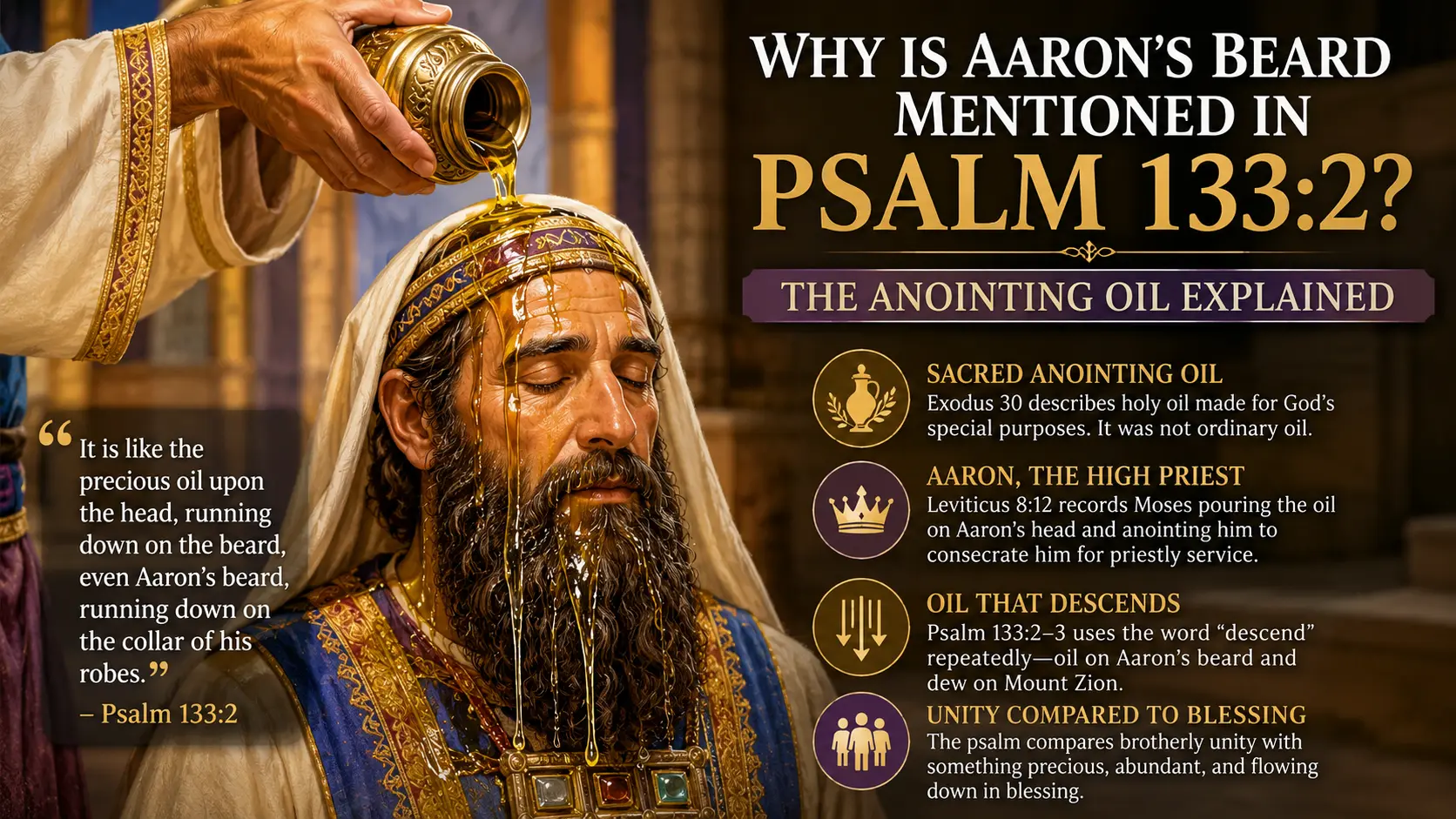

Psalm 133:2 contains one of the Bible’s more unusual images:
“It is like the precious oil upon the head, running down on the beard, the beard of Aaron…”
Why does David mention Aaron’s beard at all?
The reference is not an incidental detail about Aaron’s appearance. Psalm 133 is recalling the consecration of Israel’s high priest, when sacred anointing oil was poured on Aaron’s head. The oil flowing from his head onto his beard and priestly clothing gives the psalm a concrete image of something precious being poured out abundantly and moving downward.
Understanding the verse therefore requires looking at Aaron’s anointing in Exodus and Leviticus, the special status of the oil and the repeated Hebrew language of “descending” in Psalm 133.
What Does Psalm 133:2 Mean in Simple Terms?
Psalm 133:2 compares the goodness of Israel dwelling together in unity with the sacred oil used to consecrate Aaron as high priest.
The comparison is based on a real priestly practice described elsewhere in the Old Testament. Exodus 29:7 instructs Moses to pour anointing oil on Aaron’s head, and Leviticus 8:12 records Moses doing so when Aaron was consecrated.
Psalm 133 develops that scene visually. The oil is pictured flowing from Aaron’s head onto his beard and down toward the opening or edge of his priestly garment.
The verse therefore assumes that its readers recognize Aaron not merely as an individual Israelite but as Israel’s first high priest.
What Was the “Precious Oil” on Aaron’s Head?
The oil in Psalm 133:2 was not ordinary household olive oil.
Exodus 30:22–33 describes a sacred anointing oil made according to a specific formula involving olive oil and aromatic ingredients. It was used to consecrate the tabernacle, its furnishings, Aaron, and his sons for holy service.
The text also placed restrictions on its use. It was not to be reproduced casually or used as an ordinary perfume.
That background explains why Psalm 133 calls it “precious” or “good” oil. The image carries associations of fragrance and abundance, but its priestly setting also brings in the idea of consecration.
Older and modern commentators commonly identify the oil of Psalm 133:2 with this sacred priestly anointing oil rather than with ordinary cosmetic oil.
This matters because the psalmist did not choose a random pleasant substance as his comparison. He chose something associated with worship and with a person being set apart for service before God.
Why Does Psalm 133 Mention Aaron Specifically?
Aaron was Israel’s first high priest.
Leviticus 8 describes the formal consecration of Aaron and his sons, but Aaron receives a particularly distinctive action in verse 12: Moses pours the anointing oil on Aaron’s head and anoints him.
The distinction is worth noticing. Aaron’s sons were also consecrated, but the Old Testament specifically depicts oil being poured on the high priest’s head. Later priestly legislation similarly speaks of the high priest as the one upon whose head the anointing oil had been poured.
Psalm 133 therefore does not simply say that unity is like pleasant oil. By naming Aaron, the psalm deliberately places the comparison in Israel’s priestly world.
Aaron represented a consecrated office connected with Israel’s worship before God.
This gives the image considerably more biblical depth than the explanation that “oil feels refreshing.”
Why Does the Oil Run Down Aaron’s Beard?
The beard shows how generously the oil was poured.
Psalm 133 does not picture Moses applying a tiny ceremonial drop to Aaron’s forehead. The poetic image presents enough oil to move from the head, through the beard, and toward the priestly garment.
That abundance helps explain why the beard is mentioned.
The beard also creates a visible path between Aaron’s head and clothing. The reader can follow the movement of the oil through the verse.
The Hebrew emphasizes that movement. A form of the verb yarad, “to go down” or “descend,” occurs repeatedly in verses 2 and 3. In verse 2 the oil descends onto Aaron’s beard and continues downward toward his garment. In verse 3 the same verbal idea is used for the dew descending.
Several commentators regard this repeated downward movement as structurally important to the psalm.
The beard, then, is not an eccentric decorative detail. It allows the poet to describe the sacred oil visibly spreading downward from the place where it was poured.
Did Anointing Oil Really Run Down Aaron’s Beard?
Leviticus 8:12 states that Moses poured oil on Aaron’s head, but it does not separately record that the oil reached his beard.
Psalm 133 supplies that poetic visualization.
There is no difficulty in imagining this happening when oil is poured rather than merely dabbed onto the head. Commentaries on the verse have long pointed out that a generous pouring could naturally run from the head onto the face and beard.
It is important, however, to distinguish the two biblical texts accurately.
Leviticus records the pouring. Psalm 133 describes the oil descending over Aaron’s beard.
Psalm 133 is therefore not giving a second historical account of Aaron’s consecration. It is using that familiar priestly scene as poetic imagery.
Did the Oil Reach the “Skirts” or the “Collar” of Aaron’s Robe?
Bible translations differ at the end of Psalm 133:2.
The King James Version says that the oil went down to “the skirts of his garments.”
Many modern translations instead use wording such as “the collar of his robes,” “the edge of his garments,” or simply “his robes.”
The Hebrew wording is difficult enough that interpreters have debated the precise part of the garment intended.
One important Hebrew term can refer to an opening or “mouth,” and similar language appears in the Old Testament’s description of the opening at the top of a priestly robe. For this reason, a number of commentators understand Psalm 133:2 as referring to the collar or neckline rather than claiming that oil necessarily ran all the way to the bottom hem.
The main meaning of the comparison does not depend on deciding exactly how far down the garment the oil traveled.
What is clear in the Hebrew poem is its downward movement from Aaron’s head to his beard and toward his priestly clothing.
Why Was Aaron Anointed With Oil?
Aaron was anointed because he was being consecrated for priestly service.
Leviticus 8:12 says that Moses poured the anointing oil on Aaron and anointed him to consecrate him.
Consecration means being set apart for a holy purpose.
Aaron was not being given oil simply as a sign of personal comfort or prosperity. His anointing belonged to his appointment as high priest and to the worship system God established for Israel.
This background places an important limit on interpretations of Psalm 133.
The oil should not be treated merely as a generic biblical symbol into which any desired spiritual meaning can be inserted. Psalm 133 chooses a specific sacred oil, a specific priest, and a specific biblical institution.
The first task of interpretation is therefore to understand that historical and textual setting.
Does the Oil in Psalm 133 Represent the Holy Spirit?
Christian teaching often connects anointing with the Holy Spirit, and there are New Testament passages where the language of anointing develops important spiritual associations.
However, Psalm 133:2 itself does not say that Aaron’s oil represents the Holy Spirit.
That distinction should be preserved.
The immediate Old Testament background is Aaron’s priestly consecration. Exodus 30 describes the sacred oil, while Leviticus 8 describes its use in setting Aaron apart as high priest.
A Christian interpreter may later draw theological connections between anointing and the work of the Spirit, but that is a broader canonical interpretation rather than the explicit identification made by Psalm 133.
Saying simply, “The oil is the Holy Spirit,” therefore skips over the meaning the image already possessed in Israel’s worship.
The stronger interpretation begins with consecration, priesthood, sacredness, abundance, and the movement of the oil before considering later Christian applications.
Why Does David Compare Unity With Aaron’s Anointing?
Psalm 133 begins by declaring how good and pleasant it is for brothers to dwell together.
Verse 2 then supplies the first comparison.
The psalm does not provide a sentence explaining every element of the analogy, so interpreters should be cautious about assigning a separate symbolic meaning to Aaron’s head, beard, oil, and clothing.
What the verse clearly presents is something precious, sacred, abundant, and descending.
Aaron’s anointing also belonged to the corporate worship of Israel. The high priest did not hold an isolated private office; his consecration was connected with his ministry on behalf of the covenant community.
Some commentators have gone further and connected Aaron’s priestly clothing with his representation of Israel, including the names of the tribes carried in his priestly garments. That is a possible broader theological connection, but Psalm 133 itself does not explicitly explain the metaphor in those terms.
It is therefore safer to let the central image carry the argument: the harmony praised in verse 1 is compared with an abundant and sacred act of priestly consecration.
Why Is the Word “Descending” Important in Psalm 133?
The repeated downward movement is one of the strongest literary details in the psalm.
The Hebrew of Psalm 133:2 describes the oil descending upon the beard and then descending toward Aaron’s garment.
Verse 3 repeats the same verbal idea when describing the dew of Hermon.
English translations do not always make the repetition equally obvious because they may use “running down,” “flowing down,” or “falling” in different places. In Hebrew, the repetition is much easier to notice.
- This repetition connects the two images without requiring them to mean exactly the same thing.
- The first image belongs to priestly consecration.
- The second belongs to the natural imagery of dew.
Both, however, describe something beneficial moving downward.
That literary pattern is more firmly grounded in the wording of Psalm 133 than interpretations that assign a different hidden symbol to every physical detail.
Is Aaron’s Beard the Main Symbol in Psalm 133:2?
No. The beard is part of the description, not the independent subject of the verse.
Searching for a special spiritual meaning of “Aaron’s beard” can therefore lead the interpretation away from the psalm.
The text does not say that the beard represents wisdom, maturity, masculinity, Israel, or any other concept sometimes attached to beards elsewhere.
Its function in Psalm 133 is straightforward.
Aaron has been anointed on the head, and the precious oil descends onto his beard and toward his priestly garment.
That visible movement gives the comparison its richness.
The safest interpretation is one that does not invent symbolism where the text provides none.
How Is Aaron’s Oil Different From the Dew of Hermon?
Psalm 133 uses two separate images.
- Verse 2 draws on Aaron’s sacred anointing.
- Verse 3 turns to the dew of Hermon.
They belong to the same poem and are connected by the repeated language of descending, but each deserves to be understood in its own setting.
The oil image brings priestly consecration and sacred abundance into view. The dew image introduces a different geographical and natural comparison.
Readers who want the second image explained in detail can read the separate study of the dew of Hermon meaning in Psalm 133.
Keeping the two questions distinct is useful because Psalm 133 compresses a surprising amount of imagery into only three verses.
