
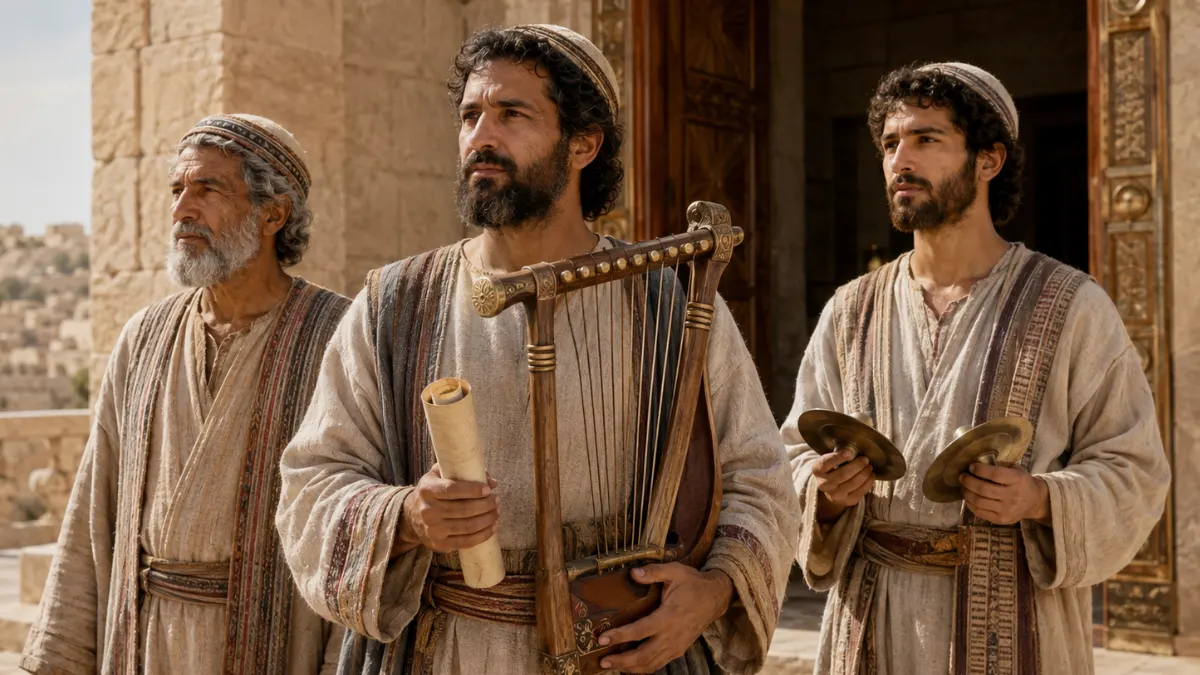

Who were the sons of Korah in the Psalms? They were later descendants of Korah who became a recognized Levitical family associated with sanctuary service, sacred music and several psalms. Numbers 26:11 confirms that Korah’s sons did not die, but Scripture never states the precise reason they were spared. Since the account does not name them among the active rebels, the safest conclusion is that they were not included in their father’s judgment.
The Bible does not say whether they separated themselves from Korah, were somewhere else or were too young to participate. Those explanations remain possible, but none is stated as fact. What Scripture does reveal is that Korah’s family line continued for generations and eventually became closely connected with Israel’s worship.
Who Were the Sons of Korah in the Psalms?
The sons of Korah in the Psalms were members of a Levitical family descended from Korah, the man who challenged Moses and Aaron in the wilderness. Korah was a son of Izhar, a grandson of Kohath and a great-grandson of Levi. He therefore belonged to the tribe set apart for service connected with the tabernacle.
Exodus 6:24 names Korah’s immediate sons as Assir, Elkanah and Abiasaph, adding that these names represented the families of the Korahites. These immediate sons were not the same people who later served during the time of David or whose family designation appears in the Psalm titles. Many generations separated the wilderness rebellion from Israel’s organized worship in Jerusalem.
Biblical genealogies often use the word “sons” for later descendants, not only immediate male children. The expression “sons of Korah” in the Psalms is therefore best understood as a family, clan or worship association descended from Korah. The Society of Biblical Literature’s Bible Odyssey describes the Korahites as one of the major guilds of temple singers, which agrees with the worship roles assigned to them in Chronicles.
What Did Korah Do in the Wilderness?
Korah’s rebellion appears in Numbers 16. Although he was already a Levite with sacred responsibilities, he joined Dathan and Abiram in challenging the authority of Moses and Aaron. The rebellion involved 250 recognized community leaders who accused Moses and Aaron of elevating themselves above the congregation.
This was not simply a disagreement about leadership style. Moses’ response indicates that Korah wanted access to a priestly role that God had assigned exclusively to Aaron and his descendants. The Kohathites carried sacred objects after the priests had covered them, but they could not perform the priestly duties reserved for Aaron’s family.
Korah therefore used his existing Levitical position to demand an authority that did not belong to him. Moses announced that God would demonstrate whom He had appointed. The ground opened beneath the company associated with the rebellion, while fire consumed the 250 men who presented incense.
The event became a lasting warning in Israel about rejecting God’s appointed order and approaching sacred service on human terms.
Why Did Korah’s Sons Survive the Rebellion?
Numbers 26 reviews the earlier rebellion and includes an important clarification: “The sons of Korah, however, did not die.” Some translations express the same idea by saying that Korah’s family line did not die out.
The statement confirms their survival, but it does not explain exactly how it happened. Numbers 16 does not describe Korah’s sons joining his accusation, standing with the 250 leaders or presenting incense. Before the judgment, Moses also instructed the congregation to move away from the dwellings associated with Korah, Dathan and Abiram.
These details support the cautious inference that Korah’s sons were not included among the people who persisted in the revolt. They do not prove that the sons publicly rejected their father, repented at the last moment or deliberately walked away from his tent. The passage never narrates such a scene.
The suggestion that they were too young to participate is also possible but Scripture does not give their ages. Presenting any one of these explanations as certain would add information to the account.
The biblical conclusion is narrower but clear: Korah died under judgment, while his sons did not. The later genealogies and the continuing presence of the Korahites confirm that his family remained within the tribe of Levi.
How Did the Korahites Become Temple Servants and Singers?
The surviving family continued within the Kohathite branch of Levi. First Chronicles 6 records the ancestry of a musician named Heman through the prophet Samuel and a succession of ancestors reaching back to Korah. This genealogy establishes Samuel and this Heman within the Korahite line.
Heman served alongside other important musicians, but their family lines should not be merged. Chronicles traces Asaph through Gershon and Ethan through Merari, two other branches of Levi. Heman is the musician specifically connected with Korah’s family in the genealogy of 1 Chronicles 6.
The Korahites later received several recognized responsibilities in Israel’s worship. First Chronicles 9:19 identifies Shallum and his Korahite relatives as gatekeepers responsible for guarding the entrances to the sanctuary. First Chronicles 26 also includes Korahites among the organized divisions of gatekeepers.
Gatekeeping was a trusted Levitical office connected with protecting the sanctuary and maintaining proper order around its entrances. It was not a minor or meaningless assignment.
Music also became a prominent part of Korahite service. First Chronicles 6 places Heman among the musicians appointed for worship. Second Chronicles 20:19 later describes Kohathites and Korahites standing to praise God with powerful voices.
The Bible does not suggest that every Korahite performed every role. It presents an extended family whose members served in different capacities, particularly as gatekeepers, singers and musicians. The appearance of their name in the Psalm titles belongs within this wider history of organized worship.
Which Psalms Are Associated With the Sons of Korah?
Eleven psalms are traditionally associated with the sons of Korah:
- Psalm 42
- Psalms 44–49
- Psalms 84–85
- Psalms 87–88
These psalms do not repeat one subject or follow one emotional pattern. Psalm 42 expresses intense longing for God while the worshipper is separated from the sanctuary. Psalm 46 declares that God remains a refuge when the world appears unstable. Psalm 49 examines wealth, mortality and the limits of human power.
Psalm 84 celebrates the beauty of God’s dwelling place, while Psalm 88 preserves a prayer that ends without visible relief. Other Korahite psalms include communal lament, royal celebration, praise connected with Zion and declarations of confidence in God.
This variety means that the Korahite collection should not be reduced to a single testimony about the family’s history. The psalms address different circumstances and serve different purposes within worship.
Readers can explore one of the collection’s best-known prayers through Psalm 42 and its language of spiritual longing. The Korahite association also provides valuable background for understanding the desire to reach God’s house in the Valley of Baca in Psalm 84.
Psalm 43 requires a separate clarification. It has no title in the Hebrew Psalter but it shares a repeated refrain, vocabulary and structure with Psalm 42. These connections have led many interpreters to believe that Psalms 42 and 43 originally formed one composition.
Psalm 43 may therefore belong with the Korahite material in a literary sense. However, it is not included among the eleven psalms carrying an explicit Korahite designation.
Did the Sons of Korah Write All Eleven Psalms?
It is reasonable to call these works the Korahite psalms but claiming that one identifiable group personally composed all eleven goes beyond what the headings establish.
The Hebrew wording used in Psalm titles can express ideas such as “of,” “for” or “belonging to” a person or group. A Korahite heading may indicate authorship, performance, collection, dedication or a combination of these functions. Ancient Psalm headings do not always operate like modern author bylines.
Psalm 88 makes this uncertainty particularly important. Its title associates the psalm with the sons of Korah while also naming Heman the Ezrahite. Some interpreters identify this Heman with the Korahite musician recorded in 1 Chronicles 6. However, that identification is not certain. Another Heman appears in a Judahite genealogy in 1 Chronicles 2:6, and scholars differ over the meaning and family significance of the title “Ezrahite.”
The safest conclusion is that Psalm 88 belongs to the Korahite collection and that its heading also preserves an association with Heman the Ezrahite. The precise relationship between those designations remains debated.
More broadly, members of the Korahite family may have composed some psalms, preserved others and performed them during worship. Scripture does not reveal the individual poet behind every psalm in the collection.
Does Their Story Prove That Korah’s Family Was Redeemed?
The later history of the Korahites shows that Korah’s rebellion did not determine the permanent identity of every descendant who carried his name. His family continued within Levi, and later Korahites received trusted responsibilities in Israel’s worship. Their family designation eventually appeared above prayers and songs preserved in Scripture.
However, the Bible never says that the Korahite psalmists composed their songs while deliberately reflecting on their rebellious ancestor. It does not present their psalms as a coded account of family restoration.
Some readers connect the earthquakes in Psalm 46, the longing for the sanctuary in Psalm 84 or the humility found throughout the Korahite collection with Korah’s earlier rebellion. These connections may be meaningful reflections, but the psalms themselves do not explicitly make them.
The historical contrast remains significant without adding unrecorded motives. Korah used his Levitical position to challenge the boundaries of his calling. Later members of his family served within recognized roles as gatekeepers, singers and musicians. Their history demonstrates that one ancestor’s rebellion did not erase the family or prevent later generations from serving God.
