
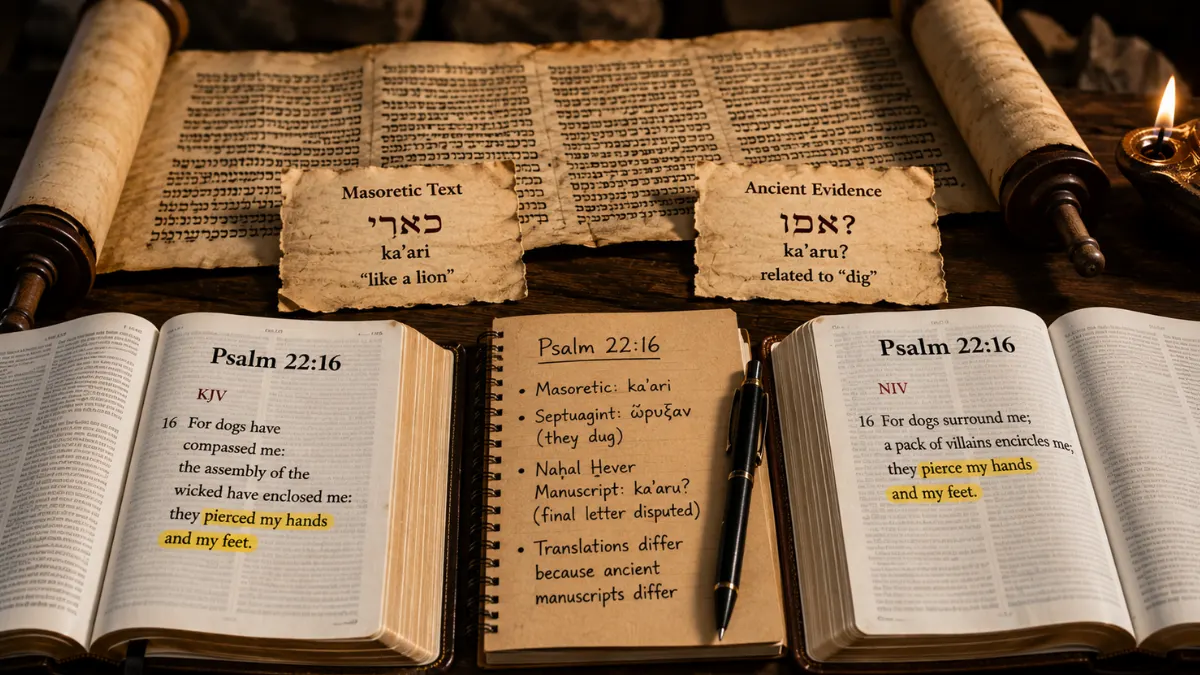

Why does Psalm 22:16 say “they pierced my hands and my feet” in some Bibles but “like a lion” in others? The difference comes from an ancient textual problem in the Hebrew wording. Most manuscripts of the Masoretic Text read ka’ari, meaning “like a lion,” while other ancient evidence points toward an alternative reading reflected in the Greek Septuagint and possibly in a Hebrew manuscript from Naḥal Ḥever.
Neither wording was invented by a modern Bible translator. The disagreement is ancient and the surviving evidence does not allow the original form to be reconstructed with complete certainty.
Readers may also find this line numbered Psalm 22:17 in Hebrew and Jewish editions because the verse numbering differs. It is the same disputed line usually numbered Psalm 22:16 in English Christian Bibles.
Why does the Masoretic Text say “like a lion”?
The traditional Masoretic Hebrew text contains the word כָּאֲרִי (ka’ari), which naturally means “like a lion.”
The difficulty appears when that phrase is read with the words that follow.
A very literal representation is roughly:
“Dogs surround me; a company of evildoers encircles me; like a lion, my hands and my feet.”
The phrase lacks an explicit verb describing what the lion is doing to the speaker’s hands and feet.
That awkwardness has led translators and textual critics to ask whether the surviving Masoretic wording preserves the original text exactly or whether the sentence should be understood as an intentionally compressed image.
The lion imagery itself is not out of place in Psalm 22. Lions already appear elsewhere in the psalm as images of threatening enemies.
For that reason, the Masoretic reading should not be dismissed simply because its syntax is difficult.
Some translations that retain the lion reading supply an implied action in English so that the sentence makes sense. The key point is that the Hebrew word ka’ari itself means “like a lion”; the uncertainty concerns how that phrase fits the complete sentence.
Where does “they pierced my hands and feet” come from?
The familiar “pierced” reading is much older than modern Bible translations.
The ancient Greek Septuagint uses the verb ὤρυξαν (ōryxan), which means essentially “they dug.”
The Greek therefore reflects a sentence with an actual verb rather than the Masoretic phrase “like a lion.”
That difference is significant.
English translations that use “pierced” understand the Greek and related textual evidence as describing an action done to the hands and feet. But “pierced” is not the simple dictionary meaning of the Greek verb. It is an interpretive English rendering of an ancient verbal tradition.
This distinction matters because the textual question is sometimes oversimplified.
The issue is not:
Hebrew says “lion,” while Greek literally says “pierced.”
A more accurate description is:
The Masoretic Hebrew has “like a lion,” while the Greek Septuagint reflects a verbal reading meaning “they dug.”
The English “pierced” comes from interpreting that verbal tradition in the context of hands and feet.
The KJV already translated the passage as “they pierced my hands and my feet” centuries before the discovery of the Judean Desert manuscripts. The reading therefore did not originate with modern translators or with the discovery of the Dead Sea Scrolls.
What does the Naḥal Ḥever manuscript add to the evidence?
A Hebrew Psalms manuscript discovered at Naḥal Ḥever in the Judean Desert preserves the disputed portion of Psalm 22.
At the crucial word, the final letter has often been read as waw, producing a form commonly transcribed כארו (ka’aru), rather than the Masoretic כארי (ka’ari).
That reading would be important because it would prevent the word from being read straightforwardly as “like a lion.”
However, the manuscript should not be described too confidently.
The identification of the final letter has been disputed, and some scholars have argued that what appears to be a waw could instead be an elongated yod.
Even if the form is read ka’aru, another problem remains:
כארו is not simply the normal Hebrew word meaning “they pierced.”
Scholars have often connected the form with כרו (karu), from a Hebrew root meaning “dig,” which would resemble the verbal reading found in the Septuagint.
But doing that requires explaining the unusual spelling, including the extra aleph.
The Naḥal Ḥever manuscript therefore provides important ancient Hebrew evidence that may support an alternative to the dominant Masoretic reading, but it does not give us an uncontested Hebrew word that can simply be translated “they pierced.”
That is a crucial distinction.
The manuscript strengthens the case that the textual history of Psalm 22:16 was already complex in antiquity. It does not by itself settle which wording was original.
Why do Bible translations make different choices?
Bible translators must weigh several pieces of evidence that do not point in exactly the same direction.
The Masoretic Text supports “like a lion.”
That reading has strong Hebrew manuscript support and fits the surrounding animal imagery, but the resulting syntax is unusually difficult.
The Septuagint preserves a verbal reading meaning “they dug.”
The Naḥal Ḥever manuscript may preserve a Hebrew form different from the Masoretic reading, although both the final letter and the precise interpretation of that form remain disputed.
Translators therefore have to decide whether to follow the dominant Masoretic wording or adopt a reconstructed verbal reading.
This is why reputable Bible versions can differ so sharply at the same verse.
Some print “they pierced my hands and my feet.”
Others retain “like a lion.”
Some place an alternative reading in a footnote.
These differences do not automatically mean one translation is careless or theologically motivated. They reflect different judgments about a genuine textual problem.
Is “pierced” or “like a lion” more likely to be original?
There is no universally accepted answer.
The Masoretic “like a lion” reading has several strengths.
It is preserved by the dominant Hebrew manuscript tradition and lion imagery fits the wider language of Psalm 22.
Its main weakness is the awkward syntax around “my hands and my feet.”
The alternative reading also has significant strengths.
The Septuagint shows that an ancient textual tradition understood the phrase verbally rather than as “like a lion.” The Naḥal Ḥever manuscript may provide ancient Hebrew support for a different consonantal form.
But the alternative has difficulties too.
The Septuagint says “they dug,” not literally “they pierced.” The Naḥal Ḥever spelling is unusual, and even the identification of its final letter has been debated.
That means neither side should be overstated.
It is too strong to say that the Hebrew unquestionably reads “like a lion” and that “pierced” is merely a later Christian invention.
It is equally too strong to say that the Judean Desert manuscripts conclusively prove the original Hebrew plainly meant “they pierced.”
The most careful conclusion is this:
Psalm 22:16 preserves an ancient textual difficulty. The dominant Masoretic tradition reads ka’ari, “like a lion,” while ancient evidence—especially the Greek Septuagint and possibly the Naḥal Ḥever Hebrew spelling—points toward an alternative verbal reading. The English word “pierced” represents one interpretation of that alternative tradition rather than an uncontested literal Hebrew reading.
That is why different Bible translations can legitimately print very different wording at Psalm 22:16 while working from serious ancient textual evidence.
