
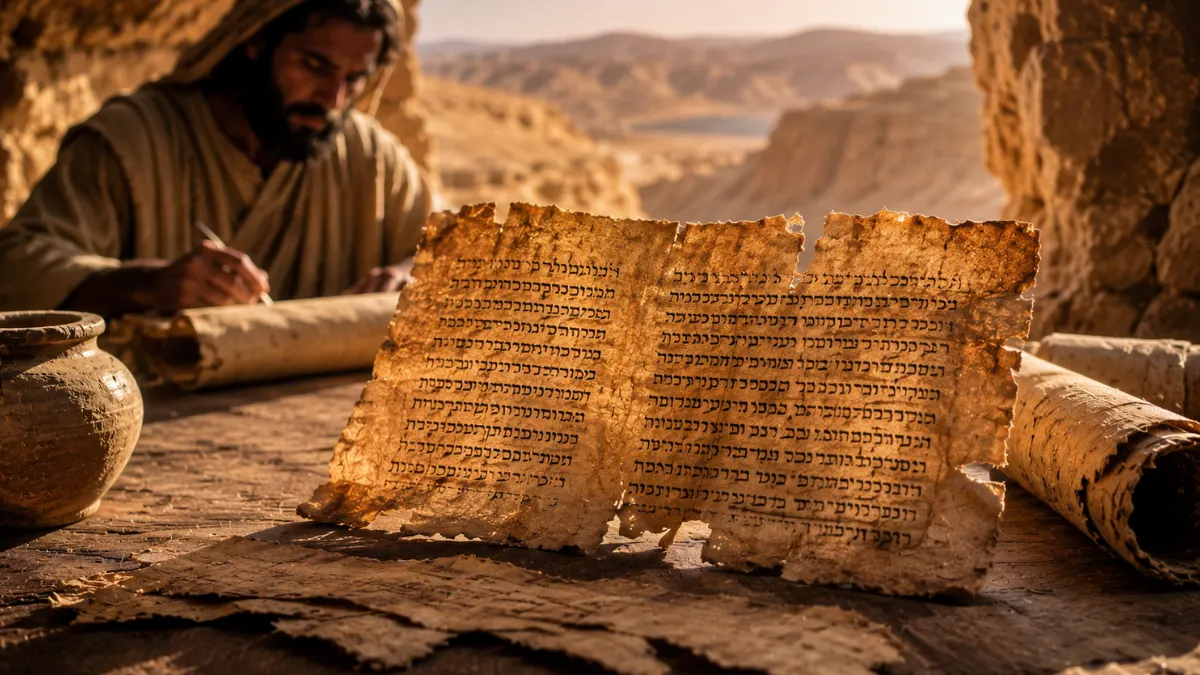

What is Psalm 151? Psalm 151 is an ancient psalm attributed to David that appears after Psalm 150 in the Greek Septuagint tradition and in Eastern Orthodox Bibles, but it is absent from the traditional Hebrew Psalter followed by Judaism and most Protestant Bibles.
Psalm 151 describes David as Jesse’s youngest son, a shepherd and musician whom God chose before his brothers, and it ends by connecting him with the defeat of the Philistine. Related Hebrew compositions discovered among the Dead Sea Scrolls show that the material behind Psalm 151 existed in Hebrew, although the Hebrew forms are not identical to the familiar Greek Psalm 151.
That manuscript discovery makes Psalm 151 historically important, but it does not by itself determine whether every Jewish or Christian tradition should include the psalm in its biblical canon.
What Is Psalm 151 About?
Psalm 151 presents David speaking about his early life in the first person.
He remembers being the youngest among his brothers and caring for his father’s sheep. He also describes his connection with music before turning to the moment when God chose him despite the more impressive appearance of his older brothers.
The basic movement resembles the events of 1 Samuel 16. Jesse’s sons pass before Samuel, but the expected candidates are not chosen. David, who had been tending the sheep, is eventually brought in and anointed.
The final part of the familiar Greek Psalm 151 shifts toward the confrontation with the Philistine associated with the David and Goliath account in 1 Samuel 17.
The psalm therefore compresses major elements of David’s early story into a short poetic reflection: he begins as the overlooked youngest son, is chosen by God, and becomes the young man who defeats Israel’s enemy.
Readers interested in the biblical narrative behind that final episode can explore PsalmWisdom’s separate study of why David faced Goliath.
Psalm 151 does something different from 1 Samuel, however. Instead of narrating the events from the outside, it places them into a poem spoken in David’s voice.
Why Do Most Bibles Stop at Psalm 150?
Most Bibles stop at Psalm 150 because the traditional Hebrew collection of Psalms contains 150 psalms.
That Hebrew Psalter became the standard collection used in Judaism. Most Protestant Old Testaments likewise follow the Hebrew textual tradition for the Book of Psalms, so they also end with Psalm 150.
Psalm 151 survives in another important ancient textual tradition: the Greek Septuagint, often abbreviated LXX.
The Septuagint was an ancient Greek translation and collection of Jewish Scriptures used widely in the ancient world and by early Christians. In this tradition, Psalm 151 appears after the normal 150 psalms.
An especially revealing detail appears in the Greek heading of Psalm 151. The psalm is associated with David and his confrontation with Goliath, but the heading also describes it as being outside the number.
That wording suggests awareness that the numbered Psalter consisted of 150 psalms even within the tradition that preserved this additional composition.
Psalm 151 should therefore not be described simply as a psalm that someone later “removed” from every Bible.
A more accurate explanation is that different ancient textual and canonical traditions preserved the Psalter differently. The Hebrew tradition maintained the collection of 150 psalms, while the Greek tradition also transmitted Psalm 151 after that collection.
Which Bibles Include Psalm 151?
Whether Psalm 151 appears in a Bible depends on the religious tradition and edition.
The Jewish Hebrew Bible contains a Psalter of 150 psalms. Psalm 151 is not part of the traditional Jewish canonical Psalter.
Most Protestant Bibles also contain 150 psalms because their Old Testament Psalter follows the traditional Hebrew collection.
The Roman Catholic canonical Psalter likewise contains 150 psalms. Psalm 151 is not part of the Catholic canonical Book of Psalms.
The situation differs in Eastern Orthodox Christianity, where the Septuagint has played a particularly important role in the Old Testament tradition. Psalm 151 is included in Orthodox Christian editions of Scripture. The Orthodox Church in America specifically notes the additional Psalm 151 found in the Greek tradition and its inclusion in Orthodox Bibles.
This also explains why calling Psalm 151 simply “Apocrypha” can create confusion.
In some Bible editions outside the Orthodox tradition, Psalm 151 may be presented among additional or apocryphal writings. From an Eastern Orthodox perspective, however, describing it merely as a noncanonical apocryphal text would not accurately represent its status.
The safest wording is therefore tradition-specific:
Psalm 151 is outside the traditional Jewish and Protestant Psalter, is not part of the Roman Catholic canonical Psalter, and is included in Eastern Orthodox biblical tradition.
What Did the Dead Sea Scrolls Reveal About Psalm 151?
For centuries, Psalm 151 was known primarily through ancient translations such as the Greek Septuagint.
The discovery of the Dead Sea Scrolls added an important piece of evidence.
Hebrew material closely related to Psalm 151 appears in the Great Psalms Scroll, a manuscript discovered in Qumran Cave 11 and commonly identified as 11Q5 or 11QPsᵃ. The manuscript itself is documented in the Israel Antiquities Authority’s Dead Sea Scrolls Digital Library.
This discovery showed that material behind Psalm 151 circulated in Hebrew.
That matters because Psalm 151 could no longer reasonably be treated as a composition created entirely from nothing by a later Greek translator. There was a Hebrew textual history behind it.
However, the Qumran discovery also revealed something more complicated.
The Hebrew material does not simply reproduce the familiar seven-verse Greek Psalm 151 word for word.
Instead, scholars distinguish two related Hebrew compositions and commonly refer to them as Psalm 151A and Psalm 151B.
These are modern scholarly labels used to distinguish the compositions. They should not be misunderstood as though ordinary ancient Bibles were divided into officially numbered chapters called “Psalm 151A” and “Psalm 151B.”
The labels simply help scholars discuss the relationship between the surviving Hebrew material and the Greek Psalm 151.
Are Psalm 151A and Psalm 151B the Same as Greek Psalm 151?
Not exactly.
The Hebrew composition known as Psalm 151A survives much more fully. It presents David as Jesse’s youngest son and includes themes involving his shepherding, musical ability, divine selection, and anointing.
Psalm 151B is much more fragmentary. Its surviving material concerns David’s confrontation with the Philistine.
The familiar Greek Psalm 151 brings material associated with these themes together into one shorter composition.
The Bible Odyssey study of Psalm 151 and the Dead Sea Scrolls explains that the Greek text represents an edited form related to the two Hebrew compositions rather than a direct word-for-word copy of one surviving Hebrew psalm.
This distinction prevents an important misunderstanding.
It would be inaccurate to say:
“The Dead Sea Scrolls contained exactly the same Psalm 151 that appears in an Orthodox Bible today.”
What the evidence supports is more careful:
The Dead Sea Scrolls preserve Hebrew compositions closely related to the material found in Greek Psalm 151, while the Greek form combines and reshapes that material.
This makes Psalm 151 particularly valuable for understanding how ancient psalm traditions could develop and circulate in more than one textual form.
Did the Dead Sea Scrolls Prove Psalm 151 Should Be in Every Bible?
No.
The discovery of Hebrew Psalm 151 material answers an important historical question, but it does not automatically answer a canonical one.
The Great Psalms Scroll shows that Psalm 151-related material existed and circulated in Hebrew within ancient Judaism.
That is significant manuscript evidence.
However, the Dead Sea Scrolls contain a wide variety of writings. Finding an ancient Jewish religious composition among them does not automatically mean that every later Jewish or Christian community must consider that composition canonical Scripture.
This distinction is essential:
Ancient manuscript evidence tells us that a text existed and was transmitted. Canonical status asks whether a particular religious tradition receives that text as Scripture.
Those are not identical questions.
The discovery of Psalm 151 material in Hebrew therefore does not prove that someone improperly removed the psalm from Protestant or Jewish Bibles. Neither does it overturn the Orthodox tradition that receives Psalm 151 within Scripture.
Instead, it helps explain why the history of Psalm 151 is more complex than a simple choice between “real psalm” and “fake psalm.”
The Hebrew evidence establishes an ancient textual history. Different religious traditions still make different canonical judgments about that material.
Did David Write Psalm 151?
Psalm 151 is anciently attributed to David and written from David’s perspective.
Its subject matter also comes directly from traditions about David’s early life: his position as Jesse’s youngest son, his work as a shepherd, his divine selection and his confrontation with the Philistine.
That establishes a strong ancient Davidic association.
It does not prove that the historical David personally wrote every word of either the surviving Hebrew compositions or the Greek form of Psalm 151.
The manuscripts preserve traditions and attributions, but they cannot by themselves demonstrate the identity of the original composer.
The careful conclusion is therefore:
Psalm 151 is an ancient psalm attributed to David and centered on David’s early life, but its exact historical authorship cannot be established with certainty from the surviving textual evidence.
That distinction allows the ancient attribution to be taken seriously without claiming more than the manuscripts can prove.

2 thoughts on “What Is Psalm 151? Why It Is Missing From Most Bibles”