
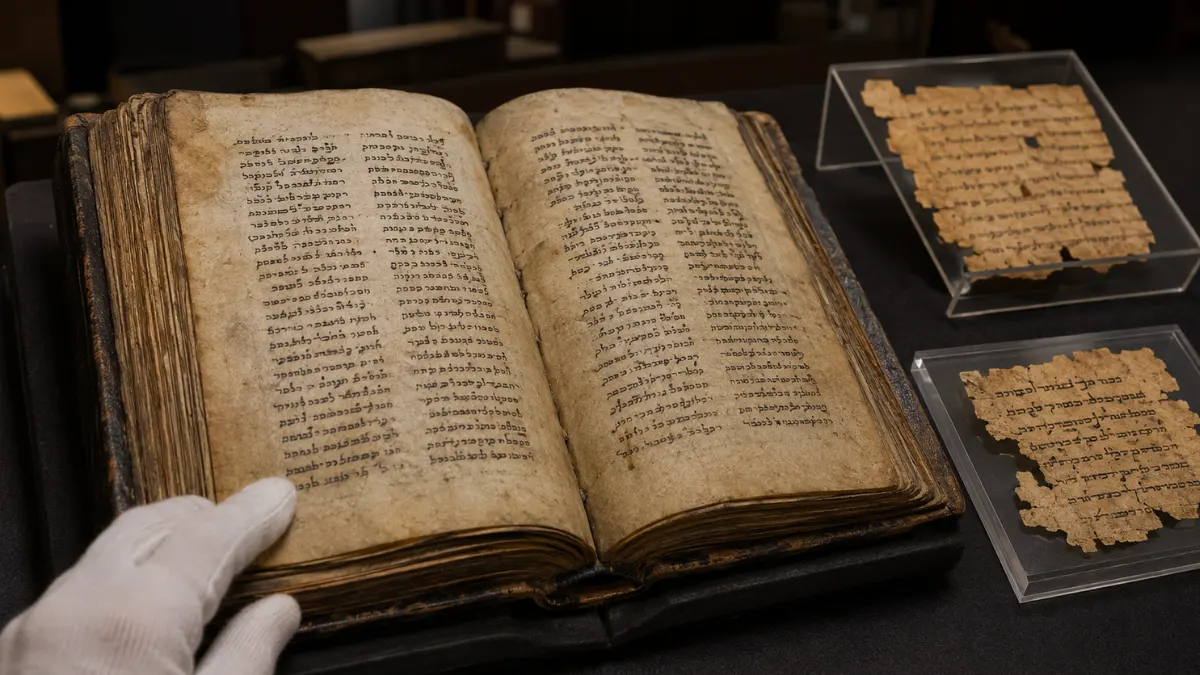

Psalms 152–155 are four ancient compositions preserved in certain Syriac manuscripts, while Psalms 154 and 155 also survive in Hebrew among the Dead Sea Scrolls. Most Bibles do not include them because Jewish Bibles and most Christian Bibles, including Protestant and Roman Catholic editions, follow a 150-psalm collection that did not receive these four works as part of the canonical Book of Psalms.
These texts are sometimes grouped with Psalm 151 and called the “Five Syriac Psalms” or the “Five Apocryphal Psalms of David.” That convenient label can obscure an important fact: Psalms 152–155 do not all have the same manuscript history, and their survival does not show that four chapters were simply removed from an earlier universal version of the Bible.
What Are Psalms 152–155?
Psalms 152–155 are conventional names given to four ancient religious poems transmitted with additional psalms in certain Syriac sources. They use the language, themes and figures associated with biblical psalms, including David, deliverance, repentance, public praise and trust in God.
The numbers can make them sound like an uninterrupted continuation of the Book of Psalms. However, several manuscripts connected with Elijah of al-Anbar’s Book of Exercise arrange the five additional compositions in the order now identified as Psalms 151, 154, 155, 152 and 153. The familiar numerical labels help readers compare the works across different witnesses; they do not prove that every ancient Psalter continued sequentially through Psalm 155.
They are often discussed with Psalm 151, which has its own distinct history in the Septuagint and the Dead Sea Scrolls. Psalm 151 appears in the Greek Psalter and in Eastern Orthodox Bibles, whereas Psalms 152–155 are primarily associated with Syriac witnesses. Treating all five as though they travelled through history together would therefore be misleading.
Where Were Psalms 152–155 Preserved?
All four compositions survive in Syriac sources, but only Psalms 154 and 155 have surviving Hebrew witnesses from Qumran. Psalms 152 and 153 have not been found among the Dead Sea Scrolls and survive only in Syriac.
One important Syriac witness is a medieval manuscript catalogued as Mosul, Library of the Chaldean Patriarchate 1113 and identified by scholars as 12t4. Other witnesses preserve the poems with copies of Elijah of al-Anbar’s Book of Exercise. The Syriaca.org bibliographic record identifies the Mosul witness and the principal scholarly edition of this tradition.
The Hebrew evidence comes from Qumran. Psalm 154 appears in the Great Psalms Scroll, 11QPsᵃ or 11Q5, from Cave 11 and in 4Q448 from Cave 4. Psalm 155 appears in the Great Psalms Scroll. This difference matters because the popular claim that all of Psalms 152–155 were found among the Dead Sea Scrolls is too broad.
| Psalm | Main subject | Surviving evidence | Important distinction |
|---|---|---|---|
| Psalm 152 | David asks for rescue from a lion and a wolf threatening the flock | Syriac manuscripts, including witness 12t4 | No Hebrew copy has been found among the Dead Sea Scrolls |
| Psalm 153 | David thanks God for deliverance from the wild animals | Syriac manuscripts, including witness 12t4 | It forms a natural companion to Psalm 152 |
| Psalm 154 | The community is called to praise God and honor divine wisdom | Syriac witnesses, 11QPsᵃ and 4Q448 | It circulated in Hebrew before its later Syriac transmission |
| Psalm 155 | A prayer combining confession, petition, confidence and thanksgiving | Syriac witnesses and 11QPsᵃ | Its surviving Hebrew form has features of an incomplete alphabetic acrostic |
These witnesses establish that all four poems survived in Syriac and that Psalms 154 and 155 also circulated in Hebrew. They do not show that every Syriac Bible contained the poems or treated them as part of the same canonical collection as the familiar 150 psalms.
What Does Each of These Psalms Say?
Although the four compositions share the literary world of biblical psalmody, they do not tell one continuous story. Psalms 152 and 153 form the clearest pair, while Psalms 154 and 155 address different settings and concerns.
Psalm 152: David’s Prayer During an Attack
Psalm 152 presents David facing danger from a lion and a wolf that threaten his father’s flock. He calls on God to save him from death and prevent the wild animals from overcoming him.
The setting expands a detail from David’s speech before fighting Goliath. In 1 Samuel 17:34–37, David tells Saul that he protected his father’s sheep from a lion and a bear. Psalm 152 turns a similar danger into a first-person prayer, allowing the reader to hear what David might have prayed during the struggle.
Its heading connects the poem to David, but a heading is not the same as proof of authorship. The surviving manuscript evidence shows how the poem was remembered and framed within the Syriac tradition; it cannot demonstrate that the historical David composed its exact words.
Psalm 153: Thanksgiving After Deliverance
Psalm 153 follows naturally from Psalm 152. Instead of pleading for rescue, David thanks God for saving him from the lion and the wolf.
The movement from danger to thanksgiving resembles the pattern found in many biblical psalms. A sufferer cries out, God provides deliverance, and the rescued person responds with praise. This relationship has led readers to treat Psalms 152 and 153 as a deliberate pair: the first presents the crisis, and the second presents the response after survival.
Like Psalm 152, Psalm 153 survives only in Syriac. Scholars have debated whether the two poems were translated from lost Hebrew originals or composed in Syriac using biblical language. The surviving evidence does not allow readers to speak as though Hebrew copies have already been discovered.
Psalm 154: Praise, Community and Wisdom
Psalm 154 moves away from David’s conflict with wild animals. It calls the faithful to gather, praise God publicly and make divine strength known. It also gives wisdom a prominent role and connects genuine praise with an upright community.
Unlike Psalms 152 and 153, Psalm 154 has substantial Hebrew manuscript support. It appears in the Great Psalms Scroll, normally designated 11QPsᵃ or 11Q5, and part of it also appears in manuscript 4Q448. Its presence in more than one Qumran manuscript shows that the composition circulated in Hebrew during the Second Temple period.
That evidence also helps scholars evaluate the Syriac text. The Hebrew and Syriac forms correspond closely enough to show that the Syriac version of Psalm 154 ultimately rests on a Hebrew source, even though differences developed during transmission.
Psalm 155: A Plea for Forgiveness and Rescue
Psalm 155 combines several familiar forms of prayer. The speaker asks God to hear, confesses human sinfulness, seeks instruction, requests protection and expresses confidence that God will respond.
The psalm resembles biblical prayers such as Psalms 22 and 51 without merely copying either one. Its Hebrew text survives in the Great Psalms Scroll, while a more complete form is preserved in Syriac. The Hebrew composition also appears to have been structured as an alphabetic acrostic, although the surviving pattern is incomplete.
An Oxford Academic study of noncanonical psalms in the Dead Sea Scrolls identifies Psalms 154 and 155 in 11QPsᵃ and explains their relationship to the Syriac witnesses. This evidence makes both poems valuable for studying how Jewish religious writings could cross languages and continue circulating in later Christian communities.
Why Do Most Bibles Not Include Psalms 152–155?
Most Bibles do not include Psalms 152–155 because the standard Jewish Psalter contains 150 psalms, and the principal biblical traditions followed by most Christians did not receive these four compositions as part of their canonical Book of Psalms.
The traditional Hebrew collection that became authoritative in Judaism ends with Psalm 150. Protestant Old Testaments generally follow this Hebrew collection. Roman Catholic Bibles also have a canonical Psalter of 150 psalms, even though the numbering of individual psalms can differ between Hebrew- and Greek-based systems.
The Greek Septuagint preserves Psalm 151 after the numbered collection, but it does not continue with Psalms 152–155. Eastern Orthodox Bible editions therefore include Psalm 151 without extending the Psalter through these four additional Syriac psalms.
Their presence in certain Syriac manuscripts shows that Christian scribes preserved and valued them. This history reflects differences among collections and transmission traditions, not evidence of one universal 155-psalm Bible that was later shortened. A text can be ancient, religiously meaningful and carefully copied without becoming part of every community’s scriptural canon.
Did the Dead Sea Scrolls Prove That These Psalms Belong in the Bible?
The Dead Sea Scrolls confirm that Psalms 154 and 155 existed in Hebrew and circulated among ancient Jewish writings. They do not prove that every Jewish or Christian community regarded those compositions as canonical Scripture.
The Qumran discoveries include biblical books, commentaries, community rules, prayers, hymns and many other religious works. A surviving manuscript establishes that a composition existed and circulated by the time it was copied, but physical preservation alone cannot reveal every way a community used the text or settle its canonical status.
The Great Psalms Scroll is especially important because its arrangement differs from the later standard Hebrew Psalter and contains compositions not found in most Bibles. It offers evidence that psalm collections could remain fluid in some ancient settings, but it does not reveal a fixed 155-psalm Bible that was later shortened everywhere else.
Were Psalms 152–155 Lost or Removed?
Calling Psalms 152–155 “lost psalms” is understandable because most modern readers have never encountered them. In a strict historical sense, however, they were not completely lost. Syriac scribes preserved all four, and Hebrew copies of Psalms 154 and 155 survived among the Dead Sea Scrolls.
“Removed from the Bible” is even less accurate because it assumes that every early Bible once contained the same 155-psalm collection. The manuscript record instead shows several lines of transmission. The standard Hebrew Psalter ended at 150, the Septuagint tradition preserved Psalm 151 after that collection, and particular Syriac sources preserved a wider group of five additional compositions.
Psalms 152–155 therefore matter not because they expose a secret deletion, but because they reveal a more complex history of psalm literature. Psalms 152 and 153 survive only in Syriac, while Psalms 154 and 155 connect the Syriac tradition with Hebrew manuscripts from Qumran. Their antiquity deserves serious attention, but it should not be confused with universal canonical acceptance.
