
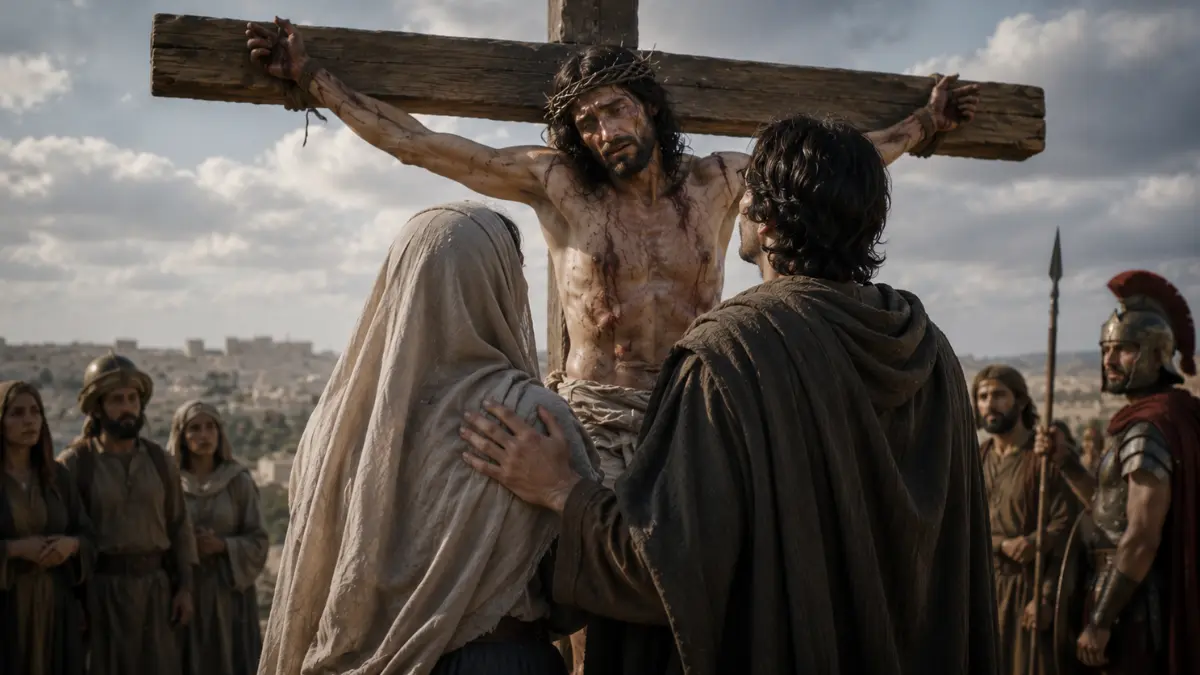

When Jesus said, “Woman, behold your son,” He established a new family relationship between His mother and the beloved disciple. He directed the disciple to receive Mary as his mother and the disciple responded by taking her into his home and care.
The most direct meaning is practical: Jesus provided for Mary before His death. Many Christians also see the scene as reflecting the spiritual family formed among Christ’s followers. Catholic and Protestant traditions differ over whether the passage establishes Mary as the spiritual mother of all Christians, so the direct meaning should remain the starting point.
What Happened in John 19:25–27?
Several women stood near the cross, including Jesus’ mother, Mary Magdalene and Mary the wife of Clopas. The disciple whom Jesus loved also stood nearby.
When Jesus saw His mother and the beloved disciple, He said:
“Woman, behold your son.”
He then said to the disciple:
“Behold your mother.”
Some modern translations use “here is your son” and “here is your mother.” The meaning remains the same: Jesus directed Mary and the beloved disciple to receive one another in a new family relationship.
John adds that from that hour, the disciple took Mary into his own home. This response shows that Jesus’ words created a genuine and continuing responsibility.
The scene occurred during the same final hours in which Jesus prayed, “Father, forgive them.” Even while suffering, He remained attentive to the needs of someone standing near Him.
What Does “Woman, Behold Your Son” Mean?
Jesus was telling Mary to regard the beloved disciple as a son. He then told the disciple to receive Mary as his mother.
The words did not mean that the disciple literally replaced Jesus in every sense or that Mary ceased to be Jesus’ mother. They established a new relationship of care and responsibility after His death.
John confirms the practical result by saying that the disciple took Mary into his own. The statement therefore meant more than offering temporary comfort at the cross.
Jesus gave the beloved disciple a clear responsibility, and the disciple accepted it. Mary would now be received within his household and personal care.
The passage shows that Jesus remained concerned with practical human needs while completing His saving mission. His suffering did not make Him indifferent to the responsibility before Him.
Why Did Jesus Call Mary “Woman”?
Modern readers may hear the word “woman” as distant or disrespectful. In the original setting, however, it was a polite form of address and did not communicate contempt.
Jesus used the same form of address when speaking to Mary at the wedding in Cana. He also used it respectfully when speaking to other women in the Gospels.
However, it was unusual for a son to address his mother in this formal way. In John 19:26, the wording may help mark the new relationship Jesus was establishing between Mary and the beloved disciple.
The action that followed makes His respect clear. Jesus did not dismiss Mary or speak harshly to her. He arranged for her care.
Readers should therefore allow the historical meaning of the term and the surrounding action to guide their interpretation. “Woman” was formal, but it was not insulting.
Who Was the Disciple Jesus Loved?
John’s Gospel identifies the man only as “the disciple whom Jesus loved.” Christian tradition commonly identifies him as the apostle John, although the verse itself does not name him.
The beloved disciple appears at several important moments in the Gospel. He was near Jesus during the Last Supper, stood close to the cross, reached the empty tomb and later recognized the risen Jesus by the Sea of Galilee.
Some scholars have proposed other identities, but the traditional identification with John remains widespread.
Whatever position readers take on his identity, his role in this scene is clear. Jesus entrusted Mary to him, and he accepted that responsibility.
The passage focuses less on his name than on his response. He received Jesus’ instruction and acted on it from that hour.
Why Did Jesus Entrust Mary to the Beloved Disciple?
John does not explain why Jesus selected the beloved disciple. The passage establishes only that the disciple stood nearby, received Jesus’ instruction and took Mary into his care.
His response demonstrates faithful obedience, but the text does not reveal every reason Jesus chose him.
Christians have often understood Jesus’ action as an example of honouring His mother through practical provision. John does not explicitly connect the scene with the commandment to honour one’s parents, but the application is reasonable.
Jesus did not merely express concern. He acted by placing Mary within a relationship where care could continue after His death.
The beloved disciple also provides an example of responsive discipleship. He did not delay or treat Jesus’ words as symbolic only. He accepted the responsibility immediately.
Why Did Jesus Not Entrust Mary to His Brothers?
John does not explain why Jesus entrusted Mary to the beloved disciple instead of one of His brothers.
Earlier in the Gospel, John says that Jesus’ brothers did not believe in Him. Acts later includes them among the believers after the resurrection.
The passage does not say where they were during the crucifixion, whether Joseph was still alive or what family arrangements existed. It also does not say that Jesus’ brothers abandoned Mary or refused to care for her.
Readers should therefore avoid building a certain explanation from details the text does not provide.
The safest conclusion is that Jesus chose the disciple who stood nearby, and that disciple accepted Mary into his care. The reason for choosing him rather than another relative remains unstated.
What Does “He Took Her Into His Own” Mean?
John says that the disciple took Mary “into his own.” Many English translations supply the word “home” because the Greek expression indicates that he received her into what belonged to him.
The phrase can refer to his household, personal possessions or wider sphere of care. In this context, it clearly describes a real and continuing response to Jesus’ instruction.
The wording shows that the disciple accepted Mary into his personal care. John does not provide further details about where they lived, how long the arrangement lasted or how it related to her other relatives.
The verse therefore should not be expanded into a detailed biography of Mary’s later life.
Its central point is sufficient: the disciple acted on Jesus’ words and assumed responsibility for her.
Does the Scene Reflect the Spiritual Family of Believers?
The passage directly establishes a relationship between Mary and the beloved disciple. Many Christians also understand the scene as reflecting the wider family created among Christ’s followers.
Jesus had taught that those who do the will of God belong to a family shaped by faith and obedience. The early church later demonstrated this kind of care by supporting vulnerable believers and treating one another as brothers and sisters.
John 19:26–27 fits that broader pattern. Mary and the beloved disciple were not natural mother and son, yet Jesus joined them in a genuine family relationship.
This application should not replace the practical meaning. Jesus was not merely presenting a symbol. He established an actual arrangement for Mary’s care.
The scene therefore shows how spiritual relationships can carry practical obligations. Christian family language should lead to real concern, hospitality and responsibility rather than remaining only a religious expression.
Does the Passage Make Mary the Spiritual Mother of All Christians?
Catholic teaching interprets the beloved disciple as representing Christ’s disciples more broadly and sees Jesus’ words as revealing Mary’s spiritual motherhood toward the Church.
From this perspective, the scene carries an ecclesial meaning beyond the immediate care arrangement. Mary is understood as receiving a spiritual relationship with Christ’s followers while remaining entirely dependent on Christ and His saving work.
Many Protestant interpreters understand the passage primarily as Jesus arranging practical care for His mother. They may also see the scene as illustrating the new family created among believers without concluding that Jesus formally made Mary the spiritual mother of every Christian.
The direct text unquestionably establishes a relationship between Mary and the beloved disciple. It does not explicitly say that the disciple represents every future believer or that Mary is being given a formal title over the whole Church.
However, John’s Gospel sometimes presents individual events with broader symbolic importance. For that reason, Christians interpret the passage differently according to their wider theological tradition.
The article should not use John 19:26–27 alone to prove every later Marian doctrine. It also should not claim that the scene has no meaning beyond practical caregiving.
The safest conclusion is that Jesus established a real relationship between Mary and the beloved disciple. Whether that relationship formally reveals Mary’s motherhood toward all Christians depends on the broader interpretive tradition.
What John 19:26–27 Teaches Believers
The passage teaches that love notices practical needs. Jesus did not offer Mary only emotional words. He established a relationship in which care would continue.
It also shows that spiritual relationships can involve real responsibility. The beloved disciple received an instruction and responded through action.
Christians should not use the passage to dismiss natural family obligations. Scripture continues to value responsibility toward parents, children and relatives. Instead, the scene shows that the family of faith can provide meaningful care when circumstances require it.
John 19:26–27 also reveals the character of Jesus. During the same final sequence in which He said, “I thirst,” He remained attentive to Mary’s future. Before declaring, “It is finished,” He acted with compassion and responsibility.
His suffering did not erase His concern for others. The passage calls believers to turn concern into faithful action.
