
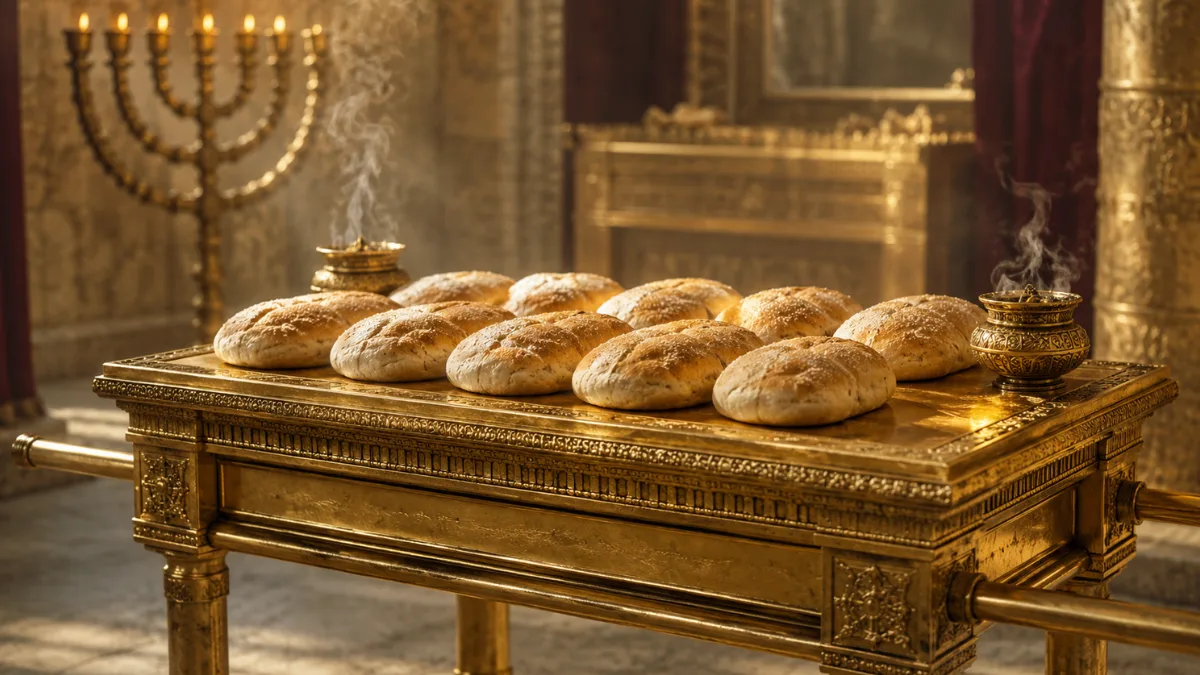

The table of showbread held twelve loaves because they represented the twelve tribes of Israel before God. Together, the loaves showed that the entire covenant nation belonged in God’s presence and depended on His provision.
Leviticus 24:5–9 gives the clearest instructions for this sacred bread. The priests baked twelve loaves from fine flour, arranged them in two rows on the golden table, placed frankincense beside them and replaced them every Sabbath.
The passage does not directly assign a tribal name to each loaf. However, the number twelve consistently represents Israel’s twelve tribes throughout Scripture. This makes tribal representation the clearest and most natural explanation for the twelve loaves.
What Was the Table of Showbread?
The table of showbread stood inside the Holy Place of the Tabernacle. God instructed Moses to make it from acacia wood and cover it with pure gold.
Exodus 25:30 records God’s command:
“Put the bread of the Presence on this table to be before me at all times.”
The priests placed the table near the golden lampstand and the altar of incense. A curtain separated the Holy Place from the Most Holy Place, where the Ark of the Covenant stood.
Only the priests could enter this part of the sanctuary. Ordinary Israelites could not walk inside and view the bread. The priests maintained it as part of Israel’s continuing worship before God.
Different Bible translations use several names for the bread:
- Bread of the Presence
- Showbread
- Shewbread
- Consecrated bread
These names describe the same sacred loaves. “Bread of the Presence” emphasizes that the bread remained continually before God.
Also Read: “Promotion Cometh” Meaning in Psalm 75 KJV
Why Did God Require Twelve Loaves?
God did not leave the number of loaves to the priests. He specifically required twelve.
This number matched the structure of Israel as a covenant nation. Jacob, whom God renamed Israel, had twelve sons. Their descendants formed the tribes that made up the nation.
The twelve loaves therefore represented Israel as a complete people.
The bread did not represent only the priests serving inside the sanctuary. It pointed to all the tribes, including families who lived far from the Tabernacle. Through this sacred arrangement, the whole nation stood symbolically before God.
The loaves communicated several important truths:
- God remembered every tribe.
- All Israel belonged to one covenant.
- The nation depended on God for life and provision.
- God desired to dwell among His people.
- No tribe stood outside His covenant concern.
The tribes had different territories, histories and responsibilities, but the twelve loaves appeared together on one table. The arrangement reflected unity without removing each tribe’s distinct identity.
Did Each Loaf Represent One Particular Tribe?
The Bible does not say that the priests labelled each loaf with a tribe’s name. It also does not explain which loaf represented Reuben, Judah, Benjamin or another tribe.
We should therefore avoid building detailed claims that Scripture does not support.
Still, the connection between twelve loaves and twelve tribes remains strong. God repeatedly used the number twelve when representing the whole nation of Israel.
The high priest’s clothing provides a clear example.
God commanded the high priest to wear a breastpiece containing twelve precious stones. Each stone carried the name of one of Israel’s tribes. When the high priest entered the sanctuary, he carried their names over his heart before God.
He also wore two stones on his shoulders engraved with the names of the tribes.
These priestly garments showed that the high priest represented the entire nation in God’s presence. The twelve loaves expressed a similar truth. They kept Israel symbolically present before the Lord.
The Bible does not state that the bread and the breastpiece carried exactly the same meaning, but both used the number twelve in connection with Israel’s covenant identity.
Also Read: Why God Rejected Cain’s Offering in Genesis 4
Why Were the Loaves Called the Bread of the Presence?
The Hebrew expression behind “Bread of the Presence” carries the idea of bread placed before God’s face or presence.
The loaves remained continually before the Lord. The priests replaced them every Sabbath so that the table never remained empty.
This did not mean that God physically ate the bread. The God of Israel did not depend on human beings for food. He created the earth, the grain, the rain and every person who prepared the loaves.
Instead, the bread represented Israel’s continuing relationship with Him.
The nation lived before God. He saw His people, provided for them, corrected them and remained faithful to His covenant. The bread served as a visible sanctuary sign of that relationship.
Its continual presence also showed that Israel did not belong to God only during festivals or national crises. The covenant shaped their daily and weekly life.
What Did the Bread Say About God’s Provision?
Bread formed a central part of daily life in ancient Israel. Families depended on grain for nourishment, and a failed harvest could threaten an entire community.
The loaves therefore naturally carried the idea of provision.
God had already shown His ability to feed Israel when He gave them manna in the wilderness. After bringing them into the promised land, He provided soil, rain, seasons and harvests.
The showbread reminded Israel that their survival did not come from human effort alone. Farmers planted and harvested, but God remained the ultimate source of life.
The bread on the table did not feed God. It reminded Israel that God fed them.
This distinction separated Israel’s worship from religions that treated food offerings as meals required by their gods. The Lord lacked nothing, while His people depended on Him for everything.
The twelve loaves represented the people who received His provision. Each tribe lived because God sustained the nation.
Why Did the Priests Arrange the Loaves in Two Rows?
Leviticus 24:6 instructed the priests to arrange the twelve loaves in two rows, with six loaves in each row.
The Bible gives this arrangement clearly but does not explain a separate symbolic meaning for the two rows.
Some interpreters connect the rows with tribal divisions, the two tablets of the law or other biblical themes. Scripture does not directly support those explanations.
The safest interpretation focuses on the purpose stated in the passage. The priests presented twelve loaves in an orderly arrangement on the pure gold table.
The two rows displayed care, completeness and obedience. The priests could not arrange the bread according to personal preference. They followed the pattern God had given them.
This detail reflects a wider truth about Tabernacle worship. God established the form of worship, and the priests carried it out faithfully. Sincerity did not give them permission to change His instructions.
Why Was Frankincense Placed Beside the Loaves?
The priests placed pure frankincense with each row of bread. Leviticus describes it as a memorial portion offered to the Lord by fire.
The bread later became food for the priests, but they burned the frankincense as an offering.
Frankincense often accompanied offerings in Israel’s worship. Its fragrant aroma marked the bread as part of a sacred ceremony rather than ordinary food storage.
The combination of bread and frankincense brought together two themes:
- God provided for His people.
- His people owed Him worship and honour.
Israel received its daily bread from God, but the nation also belonged to Him. Provision called for gratitude, trust and obedience.
The bread represented the covenant people, while the frankincense formed part of the offering presented before God.
Also Read: Scarlet Thread Meaning in the Bible Explained
Why Did the Priests Replace the Bread Every Sabbath?
The priests placed fresh loaves on the table every Sabbath. They removed the previous bread and immediately replaced it, preserving the command that bread should remain continually before the Lord.
The weekly replacement connected the showbread with Israel’s regular rhythm of worship.
Every Sabbath, the priests renewed the arrangement. They did not prepare the bread once and treat the command as permanently completed. They returned to the task week after week.
The practice showed consistency and faithfulness.
Fresh loaves replaced the old ones, but the number remained twelve. Israel continued to stand represented before God. His provision continued, and the covenant relationship remained in view.
The weekly act also prevented the bread from becoming a forgotten object inside the sanctuary. The priests actively maintained it as part of their service.
Who Ate the Bread After the Priests Removed It?
The priests did not throw away the old bread when they replaced it.
Leviticus 24:9 assigned it to Aaron and his sons. They had to eat it in a holy place because it formed a most holy portion of the offerings.
The bread therefore served a sacred purpose both while it stood on the table and after the priests removed it.
Ordinary Israelites could not eat it as common food. God reserved it for the priesthood.
One unusual exception appears in 1 Samuel 21.
David arrived at Nob while fleeing from King Saul. He asked the priest Ahimelech for food. The priest had no ordinary bread available, so he gave David the consecrated bread that had been removed from before the Lord.
Jesus later referred to this event when religious leaders criticized His disciples for picking grain on the Sabbath.
Jesus did not argue that sacred things had no importance. Instead, He showed that religious interpretation must not ignore mercy, necessity and the purpose of God’s law.
The story of David also confirms that the showbread normally belonged to the priests. His situation stood out because urgent need created an exceptional circumstance.
Did the Twelve Loaves Represent Israel’s Unity?
The twelve tribes did not always live peacefully with one another. Their history included jealousy, rivalry, civil conflict and political division.
Yet the twelve loaves remained together on one table.
No tribe received a private table. No loaf stood apart as more important than the others. The arrangement presented Israel as one covenant people before one God.
The table therefore pictured unity without demanding sameness.
Each tribe had its own name, territory and history. Yet every tribe belonged within the same covenant relationship.
This truth mattered because Israel’s identity involved more than individual faith. God had formed a people. Each person belonged to a family, tribe and nation that shared covenant responsibilities.
The twelve loaves showed that no tribe could define Israel alone. The whole nation stood before God.
Did the Twelve Loaves Point to the Twelve Apostles?
Jesus later chose twelve apostles. Their number clearly carried meaning.
By choosing twelve, Jesus reflected the structure of Israel and signalled the renewal of God’s people around the Messiah.
However, the Bible does not directly say that the twelve loaves predicted the twelve apostles.
We can recognise a broad biblical pattern without forcing a direct prophecy into the showbread.
The number twelve often represents the covenant people of God:
- Twelve tribes shaped Old Testament Israel.
- Twelve apostles held a foundational role in the early Church.
- Revelation also uses the number twelve in descriptions of God’s redeemed people.
These connections show continuity in God’s redemptive plan. Still, the twelve loaves first belonged to Israel’s Tabernacle worship and represented the nation before God.
That original meaning should remain central.
Did the Bread of the Presence Point to Jesus?
Jesus called Himself the Bread of Life in John 6. He promised that those who come to Him will receive lasting spiritual life.
Christians may therefore recognise a larger biblical connection between sacred bread, God’s presence and the life Jesus gives.
The showbread expressed themes that later receive fuller meaning in Christ:
- God dwelling among His people
- divine provision
- covenant fellowship
- priestly service
- life received from God
Jesus does not merely provide physical bread. He gives eternal life and brings believers into fellowship with God.
However, we should not skip the bread’s original Old Testament purpose. The twelve loaves first represented Israel within the worship of the Tabernacle and Temple.
A responsible Christian reading begins there. It then considers how the wider themes of bread, presence and provision find their fullest expression in Christ.
What Do the Twelve Loaves Teach Christians Today?
Christians do not need to reproduce the table of showbread in church worship. God gave the command within Israel’s Tabernacle system.
The practice still teaches several enduring truths.
God Does Not Forget His People
The twelve loaves represented the whole nation. No tribe disappeared from the table.
Believers may feel overlooked by other people, but God knows those who belong to Him. His attention does not depend on social importance, wealth or public recognition.
God Provides What His People Need
Bread represented daily nourishment. Its place in the sanctuary reminded Israel that God remained the source of their life.
Christians should receive daily provision with gratitude rather than treating it as something guaranteed by personal effort alone.
God Calls His People Into Community
The loaves stood together.
Faith includes a personal response to God, but it does not end with isolated spirituality. God forms a people who worship, serve and carry responsibility together.
Worship Requires Faithful Obedience
The priests followed precise instructions concerning the ingredients, number, arrangement, timing and use of the bread.
Their service shows that faithful worship involves more than good intentions. God’s people should honour Him according to the truth He has revealed.
Life With God Centres on His Presence
The bread remained continually before the Lord.
Israel’s greatest privilege did not come from possessing a golden table or performing a weekly ritual. Their privilege came from God choosing to dwell among them.
The same principle remains central to Christian faith. Religious activity has little value when people lose sight of God Himself.
Frequently Asked Questions
Where did the priests place the twelve loaves?
The priests placed the loaves on a gold-covered table inside the Holy Place of the Tabernacle and later the Temple.
Why were the loaves arranged in two rows?
God instructed the priests to arrange the twelve loaves in two rows of six. Scripture does not explain a separate symbolic meaning for the two rows.
Did each loaf have the name of a tribe?
The Bible does not say that the priests labelled the loaves. However, the number twelve strongly connects them with Israel’s twelve tribes.
Was the showbread an offering of food for God?
No. God did not need food. The bread represented Israel before Him and acknowledged that the nation depended on His provision.
Does the showbread symbolize Jesus?
The showbread first represented Israel before God. Christians may also see a broader connection with Jesus, who called Himself the Bread of Life and gives spiritual life to believers.

1 thought on “Meaning of the Twelve Loaves on the Table of Showbread”