
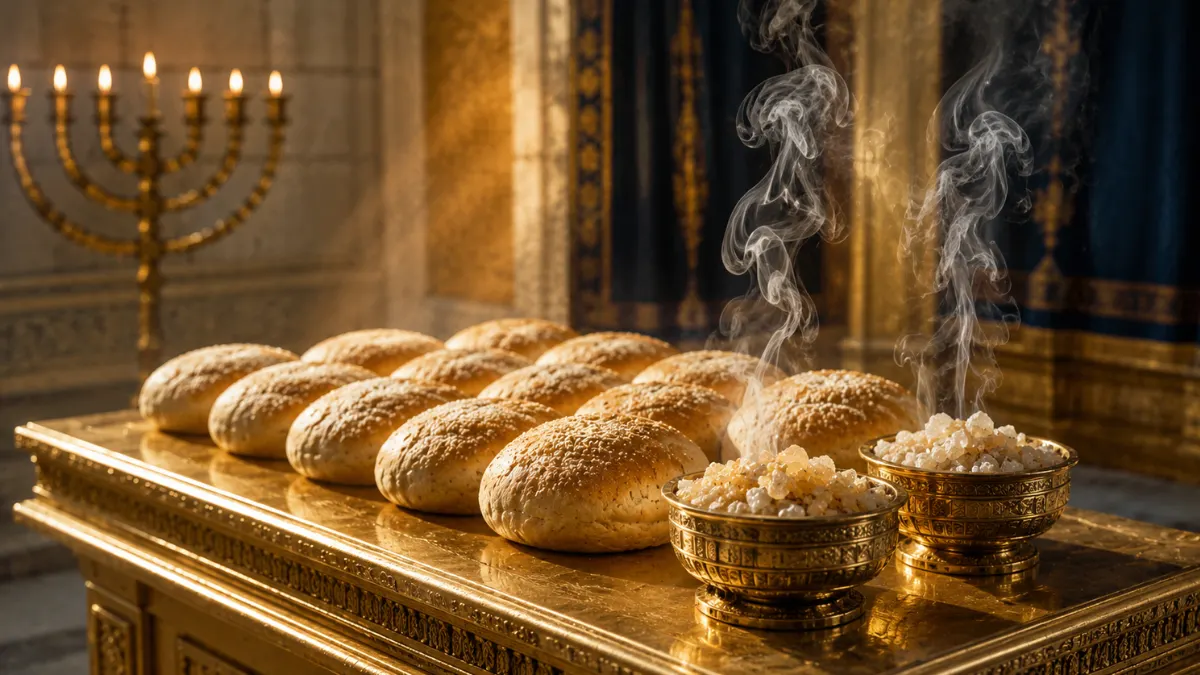

God commanded the priests to place pure frankincense with the Bread of the Presence because it served as the bread’s memorial portion. When the priests replaced the loaves each Sabbath, they burned the frankincense as an offering to the Lord while keeping the bread for the priesthood.
Leviticus 24:7 explains its purpose:
“By each stack put some pure incense as a memorial portion to represent the bread and to be a food offering presented to the Lord.”
The frankincense did not decorate the table, preserve the bread or make the loaves holy. God gave it a specific role within the offering. It represented the sacred bread when the priests presented the offering by fire.
This arrangement allowed the twelve loaves to remain before God throughout the week and later provide food for the priests. At the same time, the burned frankincense formally presented the offering to the Lord.
Where Does the Bible Mention Frankincense With the Bread?
Leviticus 24:5–9 contains the main instructions for the Bread of the Presence.
God commanded the priests to prepare twelve loaves from fine flour and arrange them in two rows of six on the pure gold table. They placed pure frankincense with each row and kept the bread continually before the Lord.
Every Sabbath, the priests removed the old loaves and replaced them with fresh bread. Aaron and his sons then ate the removed bread in a holy place because God had set it apart as a most holy portion.
The weekly service followed an orderly pattern:
- The priests baked twelve loaves.
- They arranged six loaves in each row.
- They placed pure frankincense with the rows.
- The bread remained before God throughout the week.
- The priests replaced it every Sabbath.
- They burned the frankincense as an offering.
- Aaron and his sons ate the removed bread in a holy place.
Each part had a purpose. The bread represented Israel before God, while the frankincense served as its memorial portion in the offering.
The number of loaves also carried a distinct meaning. The twelve loaves represented the complete covenant nation, as explained in Why Were There Twelve Loaves on the Table of Showbread?
What Was Frankincense in the Bible?
Frankincense came from the hardened resin of trees that grew in parts of Arabia and north-eastern Africa. Harvesters made small cuts in the bark and collected the resin after it hardened into pale drops.
When burned, frankincense produced a strong and pleasant fragrance. Its value, purity and distinctive aroma made it suitable for sacred use.
The Bible connects frankincense with several parts of worship:
- Grain offerings
- Sacred incense
- The Bread of the Presence
- Gifts presented in honour
- Fragrant offerings before God
God specifically required pure frankincense beside the bread. The priests could not use damaged, mixed or inferior material.
Purity mattered because the offering belonged to God. Israel’s worship did not depend on whatever materials the priests happened to find. God determined what they should present and how they should use it.
Frankincense itself did not possess magical power. It became sacred within this setting because God appointed it for His service.
What Was a Memorial Portion?
The phrase “memorial portion” explains the frankincense more clearly than any later symbolic theory.
A memorial portion represented a larger offering before God. The priest burned this selected part on the altar, while another part of the offering sometimes remained for priestly use.
Leviticus 2 describes a similar pattern in grain offerings. A worshiper brought fine flour, oil, and frankincense. The priest took part of the flour and oil, together with the frankincense, and burned them on the altar.
The burned portion represented the complete offering.
The Bread of the Presence followed a related principle. The priests did not burn all twelve loaves. God had reserved the bread for Aaron and his sons. Instead, they burned the frankincense that accompanied it.
The frankincense therefore represented the bread in the offering by fire.
“Memorial” did not mean that God might forget Israel unless the priests reminded Him. God does not suffer from human forgetfulness. The memorial portion formally brought the offering before Him according to the worship He had established.
It expressed covenant remembrance, presentation and acceptance rather than supplying God with missing information.
Why Did the Priests Burn the Frankincense Instead of the Bread?
God assigned the removed bread to the priests.
After the loaves remained on the table for a week, Aaron and his sons ate them in a holy place. They could not treat the bread as an ordinary meal because it belonged to the sacred service of the sanctuary.
Burning all twelve loaves would have prevented the priests from receiving the portion God had given them. The use of frankincense preserved both purposes of the arrangement.
The frankincense went into the fire as the memorial portion, while the priests received the bread as holy food.
This arrangement joined worship with provision.
The offering honoured God, and the bread supported the men who served in His sanctuary. God did not ask the priests to choose between presenting an offering and receiving provision. He established an order that accomplished both.
The bread did not become less sacred when the priests ate it. Eating it formed part of the command. They honoured God by receiving it according to His instructions.
Was the Frankincense Placed Directly on the Loaves?
Bible translations describe the placement in slightly different ways. Some state that the priests placed frankincense “on” each row, while others use words such as “by,” “beside,” or “near.”
These differences can create uncertainty about whether the resin physically touched the loaves.
The passage’s main meaning does not depend on that detail. The priests placed frankincense with each row so it could serve as the memorial portion for the bread.
Some historical descriptions suggest that the priests kept the frankincense in small containers positioned beside the rows. This arrangement would have allowed them to remove and burn it without scattering resin across the loaves.
However, Leviticus focuses on the frankincense’s purpose rather than the exact shape of the containers.
The safest conclusion remains simple: the priests placed pure frankincense with the two rows of bread, and they later burned it as the memorial portion of the offering.
Why Did God Choose a Fragrant Offering?
Burning frankincense created a pleasing fragrance. Throughout Scripture, fragrant offerings often communicate worship that God receives favourably.
The aroma did not satisfy a physical need in God. He did not depend on human beings for food, incense, or perfume. Everything Israel offered already came from the world He had created.
Instead, fragrance expressed the acceptability and sacred character of the offering.
The priests did not bring common household bread and place it casually on a table. They prepared the loaves from fine flour, arranged them on a gold-covered table, placed pure frankincense with them, and maintained the display according to God’s command.
The fragrance distinguished the weekly act as worship.
It also engaged the senses of the priests who served inside the sanctuary. They saw the golden table and carefully arranged bread. They smelled the incense when they burned the memorial portion. They handled and ate the holy loaves according to the law.
Every detail reinforced the seriousness of entering God’s service.
Did the Frankincense Represent Prayer?
The Bible sometimes uses incense as a picture of prayer.
Psalm 141 compares prayer rising before God to incense. Revelation also connects incense with the prayers of God’s people.
These passages establish a valid biblical relationship between fragrant incense and prayer. However, Leviticus 24 does not directly say that the frankincense beside the Bread of the Presence represented Israel’s prayers.
The passage identifies it as the bread’s memorial portion and an offering made to the Lord.
Prayer may provide a secondary spiritual connection, but it should not replace the explanation that Scripture gives.
A careful reading separates three things:
- What Leviticus directly states
- What other Bible passages associate with incense
- What later interpreters infer from those connections
The first meaning should control the article. The frankincense represented the sacred bread when the priests presented the memorial portion by fire.
Did Frankincense Make the Bread Holy?
Frankincense did not make the Bread of the Presence holy.
God had already set the bread apart through His command. The priests prepared it for the sacred table, kept it before the Lord, replaced it on the Sabbath, and ate it only in a holy place.
Leviticus describes the bread as a most holy portion.
Its holiness came from God’s appointment, not from any natural power inside the frankincense. The resin did not transform common food through a mysterious process.
The frankincense served one function within an arrangement that God had already made sacred.
This distinction protects readers from treating biblical materials as magical objects. Gold, oil, bread, blood, incense, and other physical elements carried meaning because God assigned them a role in worship.
The materials never controlled God. He gave them their purpose.
What Did the Frankincense Add to the Meaning of the Bread?
The Bread of the Presence expressed Israel’s continuing place before God. The frankincense added the act of formal presentation through offering.
The bread remained on the table, while the frankincense rose in the fire.
Together, they revealed several connected truths.
Israel Depended on God’s Provision
Bread represented daily nourishment. Israel planted grain, harvested crops, ground flour, and baked loaves, but God provided the land, rain, seasons, and life that made every harvest possible.
The sacred bread acknowledged that Israel lived through His provision.
Israel Remained Before God
The priests kept the loaves continually in the Holy Place. The table did not stand empty between Sabbaths.
This continual presence reflected the nation’s covenant relationship with God. He had chosen Israel and dwelt among His people.
Israel Owed God Worship
The arrangement did not communicate only what Israel received. The nation also owed God honour, trust, gratitude, and obedience.
The burned frankincense expressed this side of the relationship. God provided the bread, while Israel presented the appointed memorial portion in worship.
God Provided for the Priesthood
The priests ate the removed loaves. Their sacred service did not remove their need for ordinary food.
God built their provision into the worship system. The same arrangement that honoured Him also supported those who served in the sanctuary.
Did the Frankincense Point to Jesus?
The New Testament does not directly state that the frankincense beside the showbread predicted Jesus.
Christians should therefore avoid assigning a detailed meaning that Scripture never confirms.
Still, the wider themes of the arrangement find fulfilment in Christ.
Jesus called Himself the Bread of Life. He gives lasting spiritual life and brings believers into fellowship with God. The New Testament also describes His self-giving sacrifice as a fragrant offering pleasing to God.
These connections show continuity between the worship of Israel and the work of Christ. They do not erase the original meaning of Leviticus 24.
In its first setting, the frankincense served as the memorial portion for the Bread of the Presence. It represented the bread in the offering by fire.
Christians can recognise how bread, fragrance, sacrifice, provision, and divine presence later come together in Christ, but they should begin with what the passage clearly teaches.
The meaning of sacred bread also develops in the New Testament through Jesus’ final meal with His disciples. The article The Last Supper and Communion Explained examines that separate setting and the meaning Jesus gave to the bread and cup.
What Can Christians Learn From the Frankincense?
Christians do not need to recreate the Table of Showbread or burn frankincense in church. God gave these commands as part of Israel’s Tabernacle worship.
The passage still teaches enduring principles.
God Defines How His People Approach Him
The priests did not invent the ceremony. God specified the bread, number of loaves, arrangement, frankincense, weekly schedule, and proper use of the removed bread.
Faithful worship begins by listening to God rather than designing spirituality around personal preference.
Worship Deserves Care
God required pure frankincense and carefully prepared bread.
The command does not teach that costly materials can purchase God’s favour. It teaches that worship should not become careless, indifferent, or dishonest.
God deserves sincerity, reverence, and obedience.
Gratitude Should Accompany Provision
The bread acknowledged God as the source of Israel’s daily needs. The frankincense expressed an offering presented in response.
Believers should not receive God’s provision without gratitude. Food, work, strength, and opportunity remain gifts that call for thankful living.
Obedience Does Not Require Complete Explanation
God explained the frankincense’s central purpose, but He did not provide a detailed symbolic meaning for every feature.
The priests still followed His command.
Believers will not always understand every part of God’s work immediately. Trust allows them to obey what He has made clear without inventing answers for what He has not revealed.
Frequently Asked Questions
Why was frankincense placed with the Bread of the Presence?
The priests placed frankincense with the bread because it served as the loaves’ memorial portion. They burned it as an offering to God when they replaced the bread.
Did the priests burn the showbread?
No. Aaron and his sons ate the removed loaves in a holy place. The priests burned the frankincense associated with the bread.
What does “memorial portion” mean in Leviticus 24?
A memorial portion represented the larger offering before God. The burned frankincense represented the Bread of the Presence in the fire offering.
Was the frankincense placed directly on the bread?
Translations describe it as placed on, beside, or with the rows. The central point is that it accompanied the bread and served as its memorial portion.
Did frankincense symbolize prayer?
Other Bible passages connect incense with prayer, but Leviticus 24 directly identifies this frankincense as the memorial portion for the bread.
