
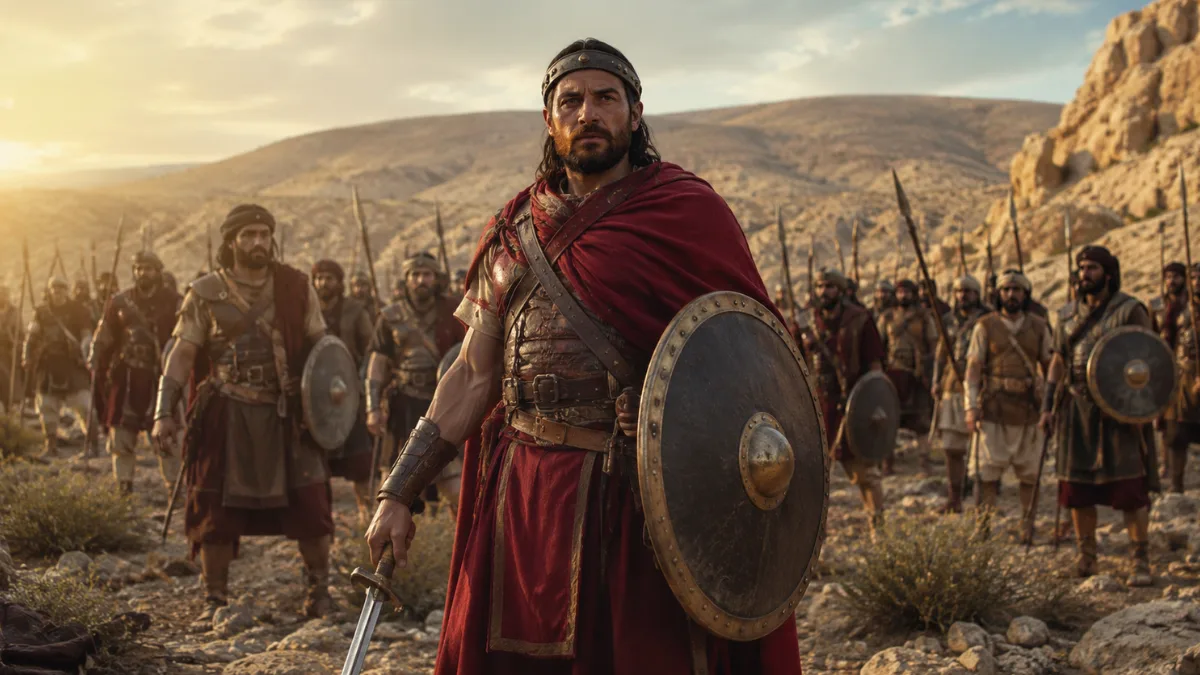

The Amalekites were an ancient people whom the Bible connects with Amalek, a grandson of Esau. They lived around the southern edges of Canaan and repeatedly fought, raided and opposed Israel from the time of Moses through the reigns of Saul and David. Scripture remembers them especially for attacking Israel’s vulnerable stragglers after the exodus.
Their story later became connected with God’s judgment, Saul’s disobedience, David’s rescue of Ziklag and the conflict between Haman and the Jewish people in the Book of Esther.
Who Was Amalek?
Genesis introduces Amalek through Esau’s family line. Amalek was the son of Eliphaz and Timna, which made him Esau’s grandson according to Genesis 36:12.
Esau was Jacob’s brother and God later gave Jacob the name Israel. This genealogy places Amalek within Abraham’s extended family rather than among people completely unrelated to Israel.
The name “Amalek” can refer to Esau’s grandson, the nation associated with him or the territory where that nation lived. The word “Amalekites” refers to the members of that people group.
Their family connection makes the hostility especially tragic. The two peoples emerged from related ancestral branches, yet the biblical narrative presents Amalek as a determined enemy of Israel.
Where Did the Amalekites Live?
The Bible places the Amalekites mainly in the Negev and the wilderness regions south of Canaan. Numbers 13:29 says they lived “in the land of the south,” while other passages connect their movements with areas between southern Canaan, the Sinai region, Edom and the border toward Egypt.
They appear as a mobile desert people rather than a nation centred in one capital. This way of life allowed them to raid settlements, join military alliances, attack fields and retreat into wilderness regions.
Judges 6 describes Amalekites joining Midianite forces that invaded Israel’s land and ruined its crops. These attacks did not always seek permanent control of a city. The raiders often destroyed food, stole livestock and left local communities struggling to survive.
The Bible provides most of what people know about the Amalekites. Historians have not found clear evidence that securely identifies them in surviving records from surrounding ancient nations.
Also Read: What Is Grace in the Bible? Meaning and Examples
When Did the Amalekites First Attack Israel?
The first major conflict appears in Exodus 17:8–16.
Soon after Israel left Egypt, the Amalekites attacked the Israelites at Rephidim. Joshua led Israel’s fighters, while Moses stood on a hill with the staff of God in his hand.
When Moses kept his hands raised, Israel gained ground. When he lowered them, Amalek gained ground. Aaron and Hur eventually supported Moses’ hands until Joshua defeated the attackers.
The scene joins human action with dependence on God. Joshua and Israel’s soldiers had to fight but the raised hands of Moses showed that Israel could not rely on military strength alone.
Deuteronomy 25:17–19 later adds an important detail. It says Amalek attacked Israel while the people felt weary and worn out. The Amalekites struck those who lagged behind the rest of the group.
The passage describes Amalek as acting without the fear of God. Their offense involved more than ordinary warfare. They exploited weakness and attacked vulnerable people during a difficult journey.
Because of this attack, God declared that He would oppose Amalek and eventually remove its memory. That judgment did not happen immediately. Several generations passed before God commanded King Saul to confront them.
How the Conflict Continued Through Israel’s History
The hostility did not end at Rephidim. The Amalekites continued to appear at important moments throughout Israel’s history.
| Biblical event | What the Amalekites did |
|---|---|
| Numbers 14:43–45 | Joined the Canaanites in defeating Israelites who advanced without God’s command |
| Judges 3:12–13 | Allied with Moab and Ammon against Israel |
| Judges 6:3–5 | Joined Midianite raids that destroyed crops and livestock |
| 1 Samuel 15 | Faced Saul’s campaign after God commanded judgment against them |
| 1 Samuel 30 | Burned Ziklag and carried away the families of David and his men |
| 1 Chronicles 4:42–43 | A Simeonite group struck a remaining Amalekite population near Seir |
These passages reveal a repeated pattern of attacks and raids that threatened Israel’s people, food supply and security.
The Amalekites did not appear only once and then disappear. Different Amalekite groups continued to oppose Israel over a long period.
Why Did God Command Saul to Attack the Amalekites?
First Samuel 15 records the most difficult part of the Amalekite story.
Through the prophet Samuel, God commanded King Saul to carry out judgment against Amalek because of what the nation had done to Israel after the exodus. The command called for complete destruction and included people, animals and property.
The passage describes severe judgment and raises serious moral questions, especially because the command includes noncombatants. Faithful interpretation should acknowledge its weight rather than pretending that the passage creates no difficulty.
Within the Bible’s explanation, God issued a specific act of judgment after a long history of violence. Scripture does not present Saul as a private person seeking personal revenge. God gave the command through Samuel to Israel’s appointed king during a unique period of Israel’s covenant history.
The command does not give modern believers a general rule for attacking other nations, religions or ethnic groups.
The chapter also focuses strongly on Saul’s heart. Saul defeated the Amalekites but he spared their king, Agag. He also kept the best animals and valuable possessions.
Saul then tried to present his selective obedience as complete faithfulness. Samuel exposed his deception and declared that obedience mattered more than sacrifice.
Saul followed the parts of God’s command that suited him while rejecting the parts that interfered with his plans. His partial obedience exposed pride, greed and fear of public opinion.
God ultimately rejected Saul’s royal dynasty because Saul repeatedly placed his own judgment above God’s command.
Also Read: Why God Rejected Saul as King in 1 Samuel
What Happened Between David and the Amalekites?
The Amalekites remained active after Saul’s campaign.
First Samuel 30 tells how they raided Ziklag while David and his men were away. They burned the town and carried away its women, children and possessions. David’s own family disappeared with the other captives.
When David and his men returned, they found the city destroyed. The men became overwhelmed with grief and even spoke about stoning David because they blamed him for the disaster.
David responded differently from Saul. Instead of defending himself or making an impulsive decision, he strengthened himself in the Lord and asked God whether he should pursue the raiders.
God directed David to follow them.
David and his men eventually found the Amalekite camp, defeated the raiders, and recovered everyone and everything they had taken. Scripture emphasizes that David rescued every captive. No family member remained missing.
The Ziklag episode reveals the practical cruelty of Amalekite raiding. It also creates a contrast between David and Saul.
Saul followed God selectively and defended his choices. David sought God’s direction during a crisis and acted to rescue the vulnerable people whom the Amalekites had carried away.
Were Haman and the Amalekites Connected?
The Book of Esther repeatedly calls Haman “the Agagite.”
Agag was the name or royal title of the Amalekite king whom Saul spared in 1 Samuel 15. Many Jewish and Christian interpreters therefore understand Haman’s description as a deliberate connection with Amalek.
The connection fits the wider story.
Saul came from the tribe of Benjamin. Mordecai, one of the central Jewish figures in Esther, also belonged to Benjamin. Saul failed during his conflict with Agag, while Mordecai and Esther helped defeat Haman’s attempt to destroy the Jewish population of Persia.
The text does not provide a complete genealogy tracing Haman directly back to King Agag. Some readers understand “Agagite” as a statement of literal ancestry. Others understand it as a literary title connecting Haman with Israel’s ancient enemy.
Either interpretation reinforces the same theme. Haman does not merely oppose Mordecai as an individual. He seeks the destruction of an entire people, continuing the pattern of hostility associated with Amalek.
What Eventually Happened to the Amalekites?
After the time of Saul and David, the Amalekites stopped appearing as a major political or military force.
First Chronicles 4:42–43 reports that men from the tribe of Simeon struck a remaining group of Amalekites in the hill country of Seir. The passage places this event during the period associated with King Hezekiah.
The Bible does not explain precisely how every remaining Amalekite community disappeared. It simply stops presenting the Amalekites as an active nation.
History also offers no reliable way to connect a modern ethnic group with the biblical Amalekites.
For that reason, people should not describe any modern nation, religion, race or political opponent as “Amalek.” Such claims lack a sound historical foundation and can turn an ancient biblical judgment into an excuse for hatred.
The New Testament directs Christians to love their enemies, refuse personal vengeance and recognize that their deepest struggle does not centre on flesh and blood.
Jesus commands His followers to pray for those who persecute them in Matthew 5:44. Romans 12:19–21 tells believers to leave vengeance to God and overcome evil with good. Ephesians 6:12 describes the Christian struggle as a spiritual battle rather than a war against human communities.
What Does the Amalekite Story Teach Christians?
The Amalekite story warns Christians about several forms of evil without asking them to recreate Israel’s ancient wars.
God Notices Cruelty Toward Vulnerable People
Deuteronomy remembers Amalek because the Amalekites struck people who felt weary and fell behind the main group.
They saw weakness and treated it as an opportunity for violence. Their actions reveal the opposite of compassion, justice, and the fear of God.
The passage reminds believers that God notices how people treat those who lack strength, protection, or influence.
Persistent Violence Brings Serious Consequences
The biblical conflict stretched across generations because the Amalekites repeatedly returned to raiding and hostility.
The Bible presents God’s judgment as a response to an established pattern rather than an impulsive reaction to one isolated incident. God did not forget the suffering that Amalek had caused.
Partial Obedience Still Reveals Rebellion
Saul obeyed enough of God’s command to claim success but he kept what benefited him and spared the king who represented his victory.
He tried to cover his self-interest with religious language. Samuel refused to accept that excuse.
Saul’s story warns believers not to call selective obedience faithfulness. People cannot reject the parts of God’s will that challenge their pride and then compensate with religious activity.
Christians Must Not Create Modern Amalekites
The Amalekite story does not authorize Christians to choose a modern enemy and claim that God wants that group destroyed.
Jesus calls His followers to love enemies, pray for persecutors, seek reconciliation and leave final judgment to God.
Christians should therefore approach the Amalekite passages with humility. They can recognize God’s justice while refusing to use those passages as weapons against people today.
Frequently Asked Questions
Why did the Amalekites attack Israel?
The Bible does not explain every political motive behind the conflict. However, Deuteronomy 25 says they attacked Israel after the exodus and targeted weary people who had fallen behind the main group. Their hostility continued through later raids and alliances.
Why did God command Saul to destroy the Amalekites?
First Samuel 15 presents the command as God’s judgment for the Amalekites’ earlier attack on Israel and their continuing violence. The command belonged to a particular moment in Israel’s covenant history and does not authorize Christians to attack modern groups.
Did Saul completely destroy the Amalekites?
No. Saul defeated a major Amalekite population but spared King Agag and kept valuable livestock. Amalekites later attacked Ziklag during David’s lifetime, showing that some groups survived Saul’s campaign.
Was Haman an Amalekite?
Esther calls Haman an Agagite, a title many interpreters connect with Agag, the Amalekite king from Saul’s story. Scripture does not provide a complete genealogy, so the description may indicate ancestry or intentionally associate Haman with Israel’s ancient enemy.

1 thought on “7 Important Facts About the Amalekites in the Bible”