
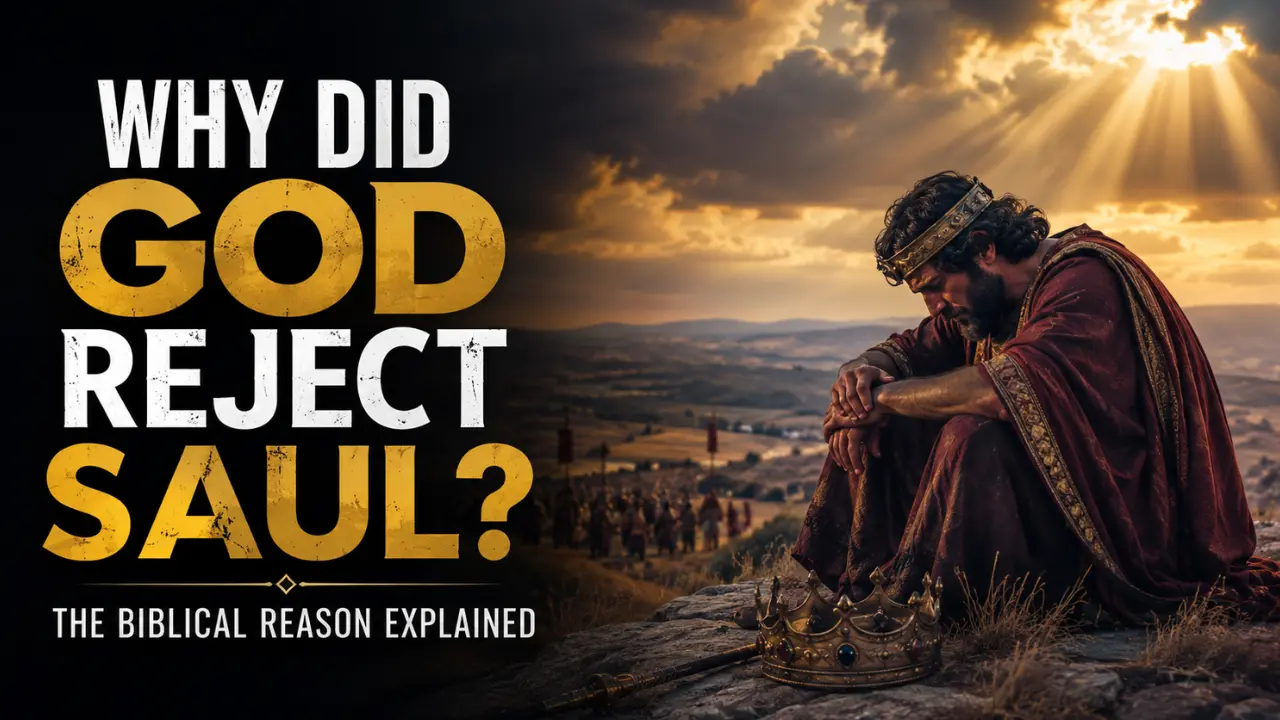

God rejected Saul because Saul repeatedly treated God’s command as something he could adjust, delay, or partially obey when pressure came on him. Saul did not lose the kingdom because he made one small mistake. He lost it because his heart showed a pattern: fear of people, pride, impatience, partial obedience, and refusal to fully repent.
The clearest answer comes from 1 Samuel 13 and 1 Samuel 15.
1. Saul disobeyed God when he offered the sacrifice himself
In 1 Samuel 13, Saul waited for the prophet Samuel before battle. Samuel had told him to wait, but Samuel did not arrive as quickly as Saul expected. The Israelite soldiers started scattering, and Saul panicked.
Instead of waiting for God’s timing, Saul offered the burnt offering himself.
This was serious because Saul was king, not prophet or priest. He stepped outside the role God gave him. His action showed that he cared more about controlling the situation than trusting God’s instruction.
Samuel told Saul:
“You have done foolishly. You have not kept the command of the Lord your God…”
— 1 Samuel 13:13
Then Samuel said Saul’s kingdom would not continue.
The issue was not only the sacrifice. The deeper issue was Saul’s heart. Saul acted from fear, pressure, and impatience instead of obedience.
2. Saul partially obeyed God regarding Amalek
The second major reason appears in 1 Samuel 15.
God commanded Saul to destroy the Amalekites because of their long-standing wickedness and their attack on Israel when Israel came out of Egypt. Saul defeated Amalek, but he did not fully obey God’s command.
He spared Agag, the king of Amalek. He also kept the best sheep, oxen, and valuable things.
When Samuel confronted him, Saul first claimed:
“I have performed the commandment of the Lord.”
— 1 Samuel 15:13
But Samuel immediately exposed the truth:
“What then is this bleating of the sheep in my ears and the lowing of the oxen that I hear?”
— 1 Samuel 15:14
Saul obeyed only the parts of God’s command that suited him. He destroyed what seemed worthless and kept what seemed useful.
That is why Samuel gave one of the most important statements in the whole story:
“To obey is better than sacrifice.”
— 1 Samuel 15:22
God rejected Saul because Saul tried to replace obedience with religious explanation.
3. Saul feared people more than he feared God
Saul later admitted the real reason behind his disobedience:
“I have sinned, for I have transgressed the commandment of the Lord and your words, because I feared the people and obeyed their voice.”
— 1 Samuel 15:24
This sentence reveals Saul’s weakness clearly.
Saul wanted the approval of the people. He wanted to look strong before the army. He wanted to keep support around him. Because of that, he allowed public pressure to overrule God’s command.
A king of Israel had to lead the people under God. Saul allowed the people to lead him away from God.
4. Saul cared more about his image than true repentance
Saul said, “I have sinned,” but his response still focused on public honor.
After Samuel rebuked him, Saul said:
“Honor me now before the elders of my people and before Israel…”
— 1 Samuel 15:30
That statement matters.
Saul wanted Samuel to stand with him publicly so the people would still respect him. He showed sorrow, but his sorrow still centered on reputation. He wanted to repair his image more than he wanted to submit fully to God.
This separates Saul from David later.
David also sinned seriously, but when Nathan confronted David, David did not blame the people or protect his image first. He said, “I have sinned against the Lord” in 2 Samuel 12:13. David’s repentance came from a broken heart. Saul’s confession often came with excuses and self-protection.
5. Saul treated God’s command as negotiable
Saul’s deepest problem was not lack of religion. He still used spiritual language. He still mentioned sacrifice. He still spoke about the Lord.
But he treated God’s word as flexible.
He adjusted God’s command when obedience became uncomfortable. He kept what benefited him. He blamed others when confronted. He used worship language to cover disobedience.
That is why Samuel said:
“Because you have rejected the word of the Lord, he has also rejected you from being king.”
— 1 Samuel 15:23
This verse gives the direct reason.
God rejected Saul from being king because Saul rejected God’s word.
6. God rejected Saul as king, not because God lacked mercy
God’s rejection of Saul does not mean Saul made one mistake and God showed no mercy. Saul received many opportunities. Samuel corrected him. God gave him victories. Saul had time to humble himself.
But Saul’s pattern did not change.
He kept choosing control over trust. He kept choosing appearance over repentance. He kept choosing partial obedience over full obedience.
So God removed the kingdom from Saul’s line and chose David, a man after God’s own heart.
7. The main lesson from Saul’s rejection
Saul’s story teaches that God does not only look at outward success, religious words, or public position. God looks at the heart behind obedience.
Saul had the title of king, but he lacked a surrendered heart.
The main lesson is this:
God rejected Saul because Saul repeatedly rejected God’s authority. He obeyed when obedience fit his plans, but he resisted when obedience required trust, humility, and surrender.
That is why Saul’s fall warns every believer: partial obedience may look religious, but God sees whether the heart truly submits to Him.

1 thought on “Why God Rejected Saul as King in 1 Samuel”